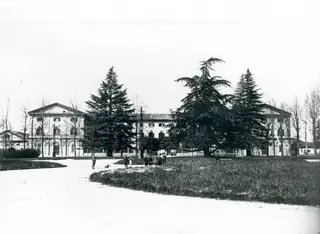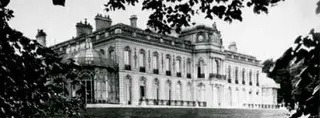
Château de Beauregard, La Celle-Saint-Cloud, 1872
The château de Beauregard in 1872. The house was already ruined by the time the Soviet repatriation mission took over the estate, and it has since disappeared entirely; the camp stood in its park.
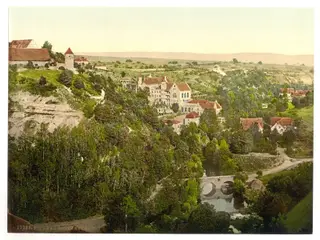
The Wildbad sanatorium at Rothenburg ob der Tauber in a photochrom print of the 1890s. Library of Congress, Photochrom Print Collection, public domain. The buildings later housed UNRRA Team 167.
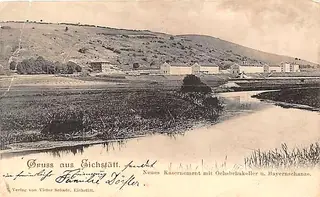
The new Eichstätt barracks on a postcard of 1898, published by Victor Schade, Eichstätt. Work on the complex by the Ochsenkeller began in 1897; it is the barracks later known as the Jägerkaserne. Public domain, via Wikimedia Commons; cropped to the picture side.
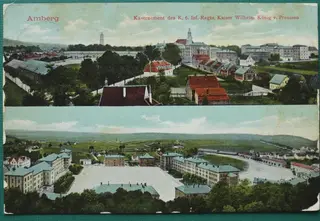
The Kaiser-Wilhelm-Kaserne on a postcard posted from Amberg on 28 November 1909. The lower panorama shows the barrack blocks around the parade square that housed displaced people from 1946.
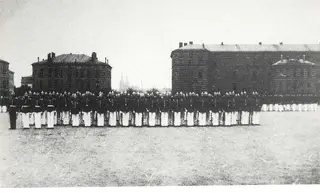
The infantry barracks parade ground in 1910, before the DP period. Bavarian Army Museum, inventory 0287-1998.5, reproduced by the University of Regensburg.
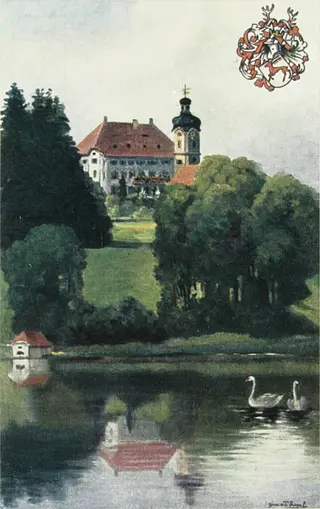
The castle at Haarsee on a picture postcard of 1912. Its rooms, rather than barrack huts, housed the seminary’s lecture hours, its library and its students.
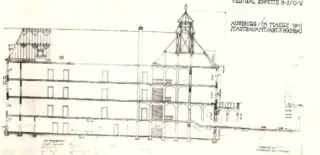
A section through the planned school building, dated March 1913.
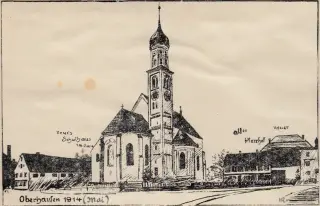
Oberhausen in May 1914: the drawing labels the new school under construction beside the church.
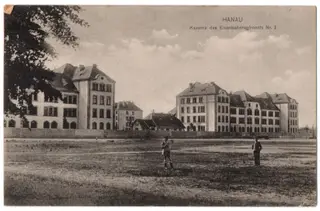
The Hessen-Homburg-Kaserne, the third compound taken into the camp in May 1945, on a field postcard stamped at Hanau on 5 June 1917.
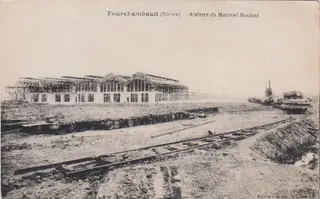
The Matériel Roulant workshops at Fourchambault under construction, about 1917. Postcard reproduced by the Fondation du patrimoine. The image predates the camp.
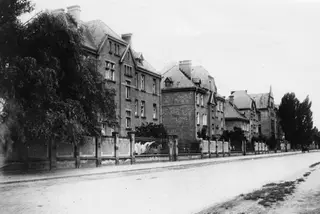
The barrack buildings along today's Willy-Brandt-Allee in the 1920s. Authentic building context from the police historical album, not a DP-period scene.
The Zucchi barracks around 1920, before its use as a displaced-persons camp. Biblioteca Panizzi photographic archive, Ivano Burani collection.