Ziegelmasch
Displacement in Europe
Alfeld and Godenau, Lower Saxony, Germany · 1945–1949
In Alfeld and Godenau, Ukrainian displaced people built a community with elected leaders, schools, worship and a newspaper that recorded the practical work of starting again.
A history in dates
- 3 November 1945The community’s Information Bulletin begins publication at Alfeld.
- February–March 1946The community appears to move to Godenau; its publications begin using the new location.
- 25 January 1947The camp newspaper reports 700 residents.
- 30 January–6 February 1947Residents elect a deputy commandant, an organisational officer and a twelve-member camp administration.
- 1 March 1947Overseas letters are directed through the German postal service instead of the camp’s UNRRA field-post arrangement.
- 1 August 1948The Information Bulletin reaches its final reported issue.
- July 1949A relief-agency return records 238 Ukrainians living at Godenau.
- 1949The camp closes. Residents move on to other camps and, in subsequent years, to new homes overseas.
Sources for this section
- Illia Piavchuk, study of Ziegelmasch camp periodicals, 2024
- Information Sheet, printed issue 5, Godenau, 31 January 1947
- Information Sheet, issue 7, Godenau, 3 February 1947, pp. 1–2
- Information Sheet, issue 8, 7 February 1947
- Information Sheet, issue 15, 27 February 1947
- Ihor Stebelsky, Table 7: Ukrainians in the UNRRA or IRO Camps of the British Zone of Germany
- 25 years serving God and people: jubilee of Fr K. Stangret
- Tetiana Dushenko: obituary
A Ukrainian community in Alfeld and Godenau
Ziegelmasch brought Ukrainian displaced people together in Germany’s British occupation zone after the Second World War. The community is recorded first at Alfeld and then at nearby Godenau. By January 1947, its newspaper described a camp of 700 residents, with a school, elected representatives and services organised around the accommodation blocks.
The move to Godenau appears to have taken place between late February and late March 1946: the camp publications change their place of publication during those weeks. Both names therefore appear in the community’s history. Ziegelmasch is the name used here; the German description ‘Ukrainisches DP-Camp’ means Ukrainian displaced persons camp.
Residents built institutions that served immediate needs and kept Ukrainian cultural life going. A kindergarten and school supported children; vocational courses, workshops and a cooperative supported work; a choir, drama group and library provided opportunities to learn and perform. Two parishes served the community. Its newspaper connected these activities with the everyday decisions of camp government.
How many people lived here?
The camp newspaper reported 700 residents on 25 January 1947. The next day’s election notice identified 566 people old enough to vote. The difference matters: the first figure describes the whole community, while the second concerns eligibility for an election.
A separate survey recorded 650 Ukrainians at Godenau during 1946–1947. By July 1949, a relief-agency table recorded 238. These snapshots show a smaller community near the end of the camp’s life, although their different reporting dates do not provide a continuous record of arrivals and departures.
The community in January 1947
| Date | Number | Measure |
|---|---|---|
| 25 January 1947 | 700 | Camp residents |
| 26 January 1947 | 566 | Residents meeting the voting-age requirement |
Ukrainians recorded at Godenau
| Reporting period | People | Source basis |
|---|---|---|
| 1946–1947 | 650 | Questionnaire returns; no single reporting date |
| July 1949 | 238 | Central Ukrainian Relief Bureau table appended to IRO monthly report |
Choosing the camp’s leaders
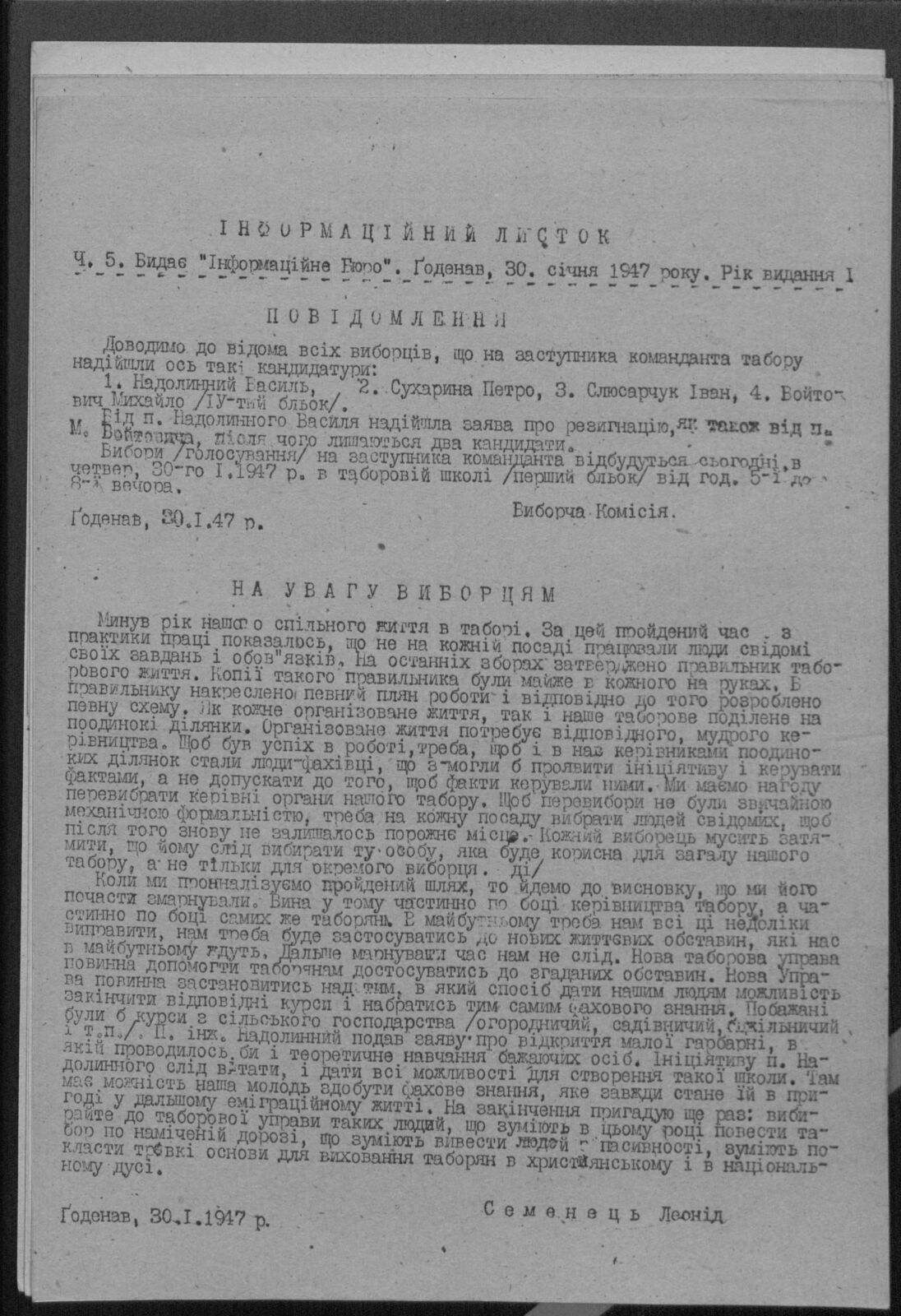
Residents elected representatives to run the camp’s affairs, using the school in Block I as a polling place. The deputy commandant election on 30 January 1947 returned Petro Sukharyna with 234 votes, against 90 for Ivan Sliusarchuk; 12 ballots were invalid. Subsequent votes filled the organisational officer’s post and a twelve-member administration.
The newspaper also carried criticism of the election process. In the issue dated 2 February, a contributor signing as Shumka argued that established officeholders were being favoured and alleged that police were pressing people to vote. The writer contrasted the current procedure with an earlier open show of hands and called for a wider choice of candidates. Alongside this criticism, the election commission announced that Mykhailo Loza was the sole nominee for organisational officer.
Andrii Muzyka answered Shumka in the following issue. He defended the nomination rules and said candidates needed the support of ten residents. He argued that anyone alleging coercion should bring concrete evidence, while acknowledging that forcing people to vote would violate democratic principles. The editors also reversed an earlier decision to stop publishing polemical articles after some residents objected. The newspaper became a forum in which the camp’s rules and its leaders could be challenged and defended.
The election for the twelve-member camp administration took place on 6 February. The following day’s report recorded 317 voters and 40 invalid ballots, mostly because voters had selected more than twelve candidates. It printed results for 29 candidates and named the twelve elected members. The commission also stated that members of the administration could not simultaneously serve on the supervisory commission or the camp court—a rule intended to keep those roles separate.
Deputy commandant election results
Organisational officer election results
Administration election, 6 February 1947
| Measure | Reported number |
|---|---|
| Voters | 317 |
| Candidates listed | 29 |
| Seats filled | 12 |
| Invalid ballots | 40 |
Sources for this section
When too few people voted
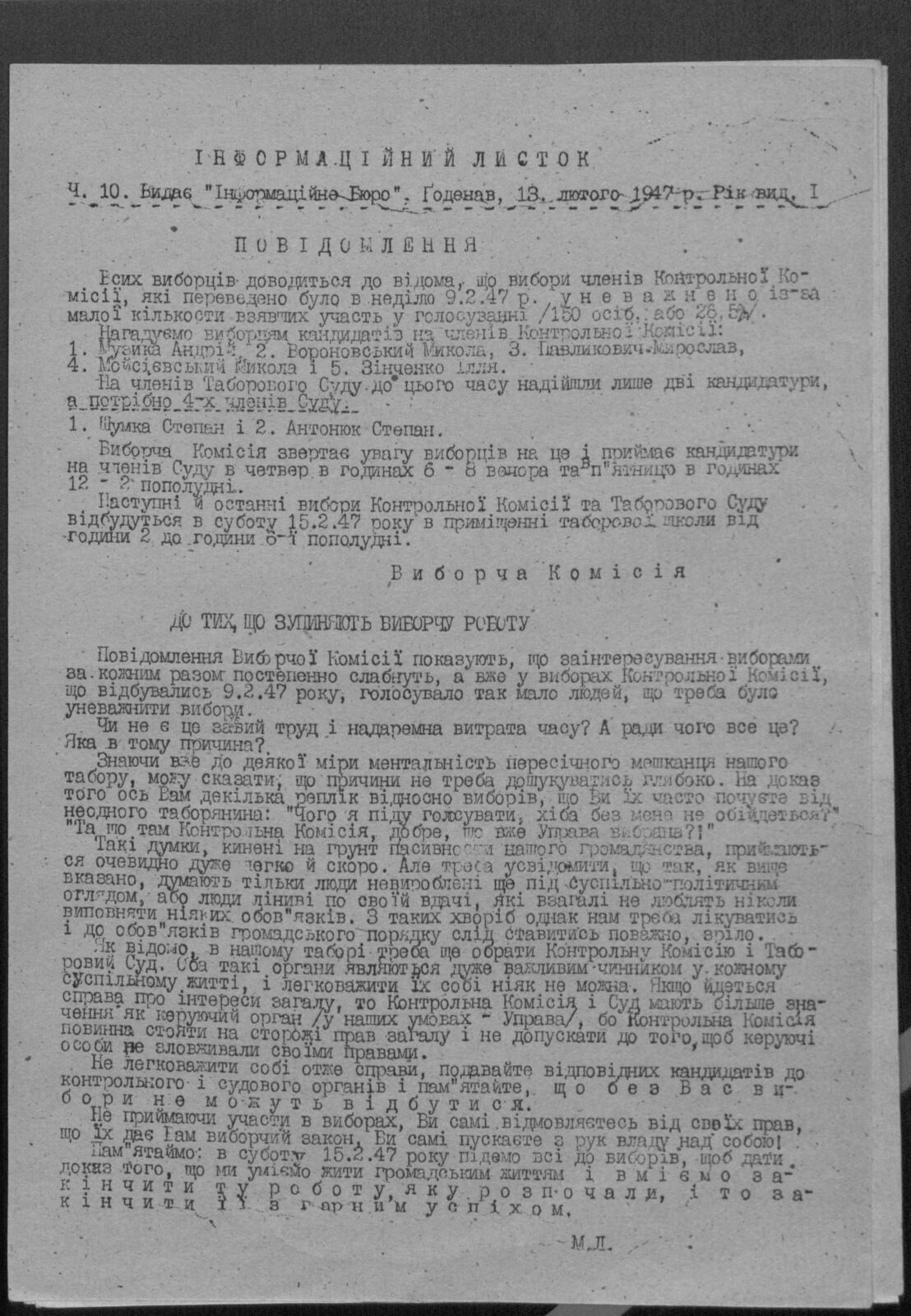
Camp elections also faced low participation. The Information Sheet of 13 February 1947 announced that the control commission election held on 9 February had been invalidated because only 150 people voted. A new election for the commission and camp court was scheduled for 15 February in the camp school, from 2 to 6pm. The accompanying editorial urged residents to take part and argued that oversight bodies should protect their rights.
Control commission election
| Date | Event | Recorded result |
|---|---|---|
| 9 February 1947 | Control commission vote | 150 participants; election invalidated for low participation |
| 13 February 1947 | Bulletin announcement | New vote announced |
| 15 February 1947 | Scheduled commission and court election | Camp school, 2–6pm; result not established by this issue |
Sources for this section
Learning, worship and performance
Education and cultural activity gave the community a life beyond queues, supplies and administration. Children had a kindergarten and school, while adults could attend vocational courses. A library, drama group and choir offered ways to study, rehearse and perform in Ukrainian.
A published history records 28 theatrical performances, 36 concerts, 18 lectures and two folk-art exhibitions. The totals have no stated start and end dates, but they give a sense of the range of organised activity. The school was also a shared civic space: election notices directed residents to vote there.
Performances, talks and exhibitions
| Activity | Recorded total |
|---|---|
| Theatrical performances | 28 |
| Concerts | 36 |
| Lectures | 18 |
| Folk-art exhibitions | 2 |
Preparing for life beyond the camp
The election debate was also about work and the future. Writing on 30 January 1947, Leonid Semenets urged the incoming administration to help residents acquire practical skills. He proposed agricultural courses and supported Vasyl Nadolynnyi’s proposal for a small tannery where people could learn a trade. Semenets connected vocational education with young people’s prospects in a future emigrant life. These were proposals placed before the camp community, rather than a list of courses already operating.
Sources for this section
Clothing and everyday needs
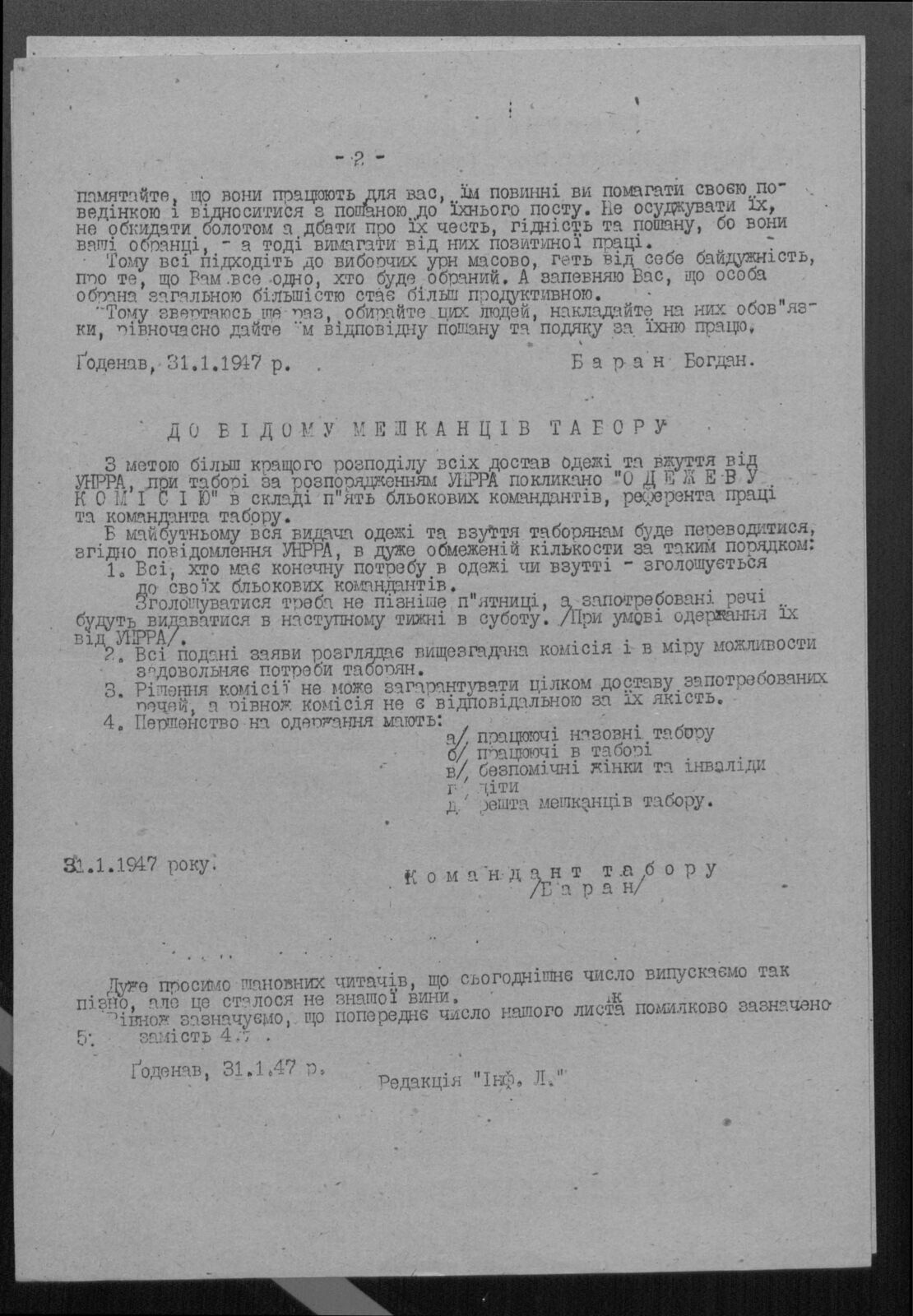
Clothes and shoes were distributed through the camp’s own administration. A notice dated 31 January 1947, signed by commandant Baran, announced a clothing commission comprising the five block commandants, the labour officer and the camp commandant. Residents needing supplies were to apply through their block commandant by Friday. Distribution was planned for Saturday in the following week, provided UNRRA supplies had arrived.
The notice described supplies as very limited and set out who would receive priority. People working outside the camp came first, followed by those working inside it, women needing assistance and disabled residents, children, and then the remaining residents. Applications would be considered according to what was available. This small administrative announcement shows how shortages reached into daily life and how employment affected access to essentials.
Priority for clothing and footwear
| Order | Group named in the notice |
|---|---|
| 1 | People working outside the camp |
| 2 | People working within the camp |
| 3 | Women needing assistance and disabled residents |
| 4 | Children |
| 5 | Remaining residents |
Sources for this section
Finding family overseas
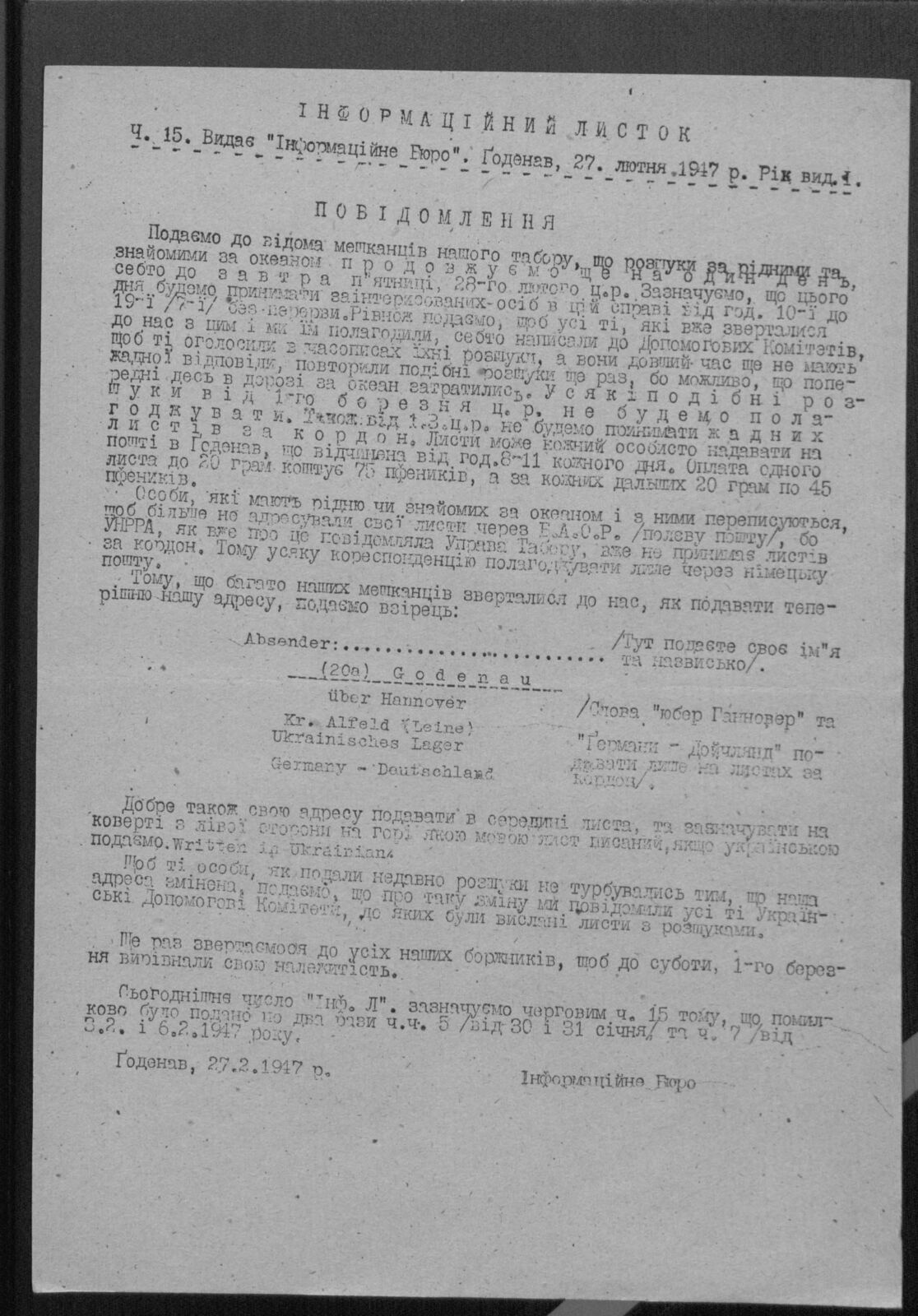
For residents separated from relatives, the Information Bureau offered help finding addresses overseas. A February notice invited enquiries about family and friends in Canada, America, Argentina and elsewhere. By 27 February, the bureau extended its deadline for requests by one day, to 28 February, and urged people whose earlier enquiries had gone unanswered to try again through aid committees.
The same issue announced a change in overseas correspondence. From 1 March the bureau would stop accepting letters for posting abroad, and residents were directed to send them through the German post rather than the UNRRA field-post arrangement. A printed address example identified the community as an “Ukrainisches Lager” in Godenau, Kreis Alfeld (Leine). Finding a relative’s address and knowing how to get a letter delivered were practical parts of rebuilding family contact.
The camp’s publications
The camp produced an Information Bulletin and an Information Sheet. The Bulletin began on 3 November 1945 and its final reported issue appeared on 1 August 1948. The surviving Information Sheets from early 1947 bring readers close to the practical workings of the community: polling hours, candidates, clothing applications, family searches and postal instructions appeared alongside opinion and argument.
The newspaper did more than relay orders. Contributors challenged election arrangements, officeholders answered criticism, and readers persuaded the editors to reopen space for debate. Residents could use the same publication to learn where to obtain shoes, how to find a relative abroad and how their camp should be governed.
Sources for this section
- Illia Piavchuk, study of Ziegelmasch camp periodicals, 2024
- Information Sheet, printed issue 5, Godenau, 31 January 1947
- Information Sheet, issue 5, 31 January 1947, printed page 2
- Information Sheet, issue 15, 27 February 1947
- Information Sheet, issue 6, Godenau, 2 February 1947
- Information Sheet, issue 7, Godenau, 3 February 1947, pp. 1–2
People who helped the community function
Father Kostiantyn Stangret served the Ukrainian community at Godenau after arriving in the British zone in August 1946. A later account of his ministry describes pastoral work among the residents and involvement in camp life beyond church services. His work connects the camp’s religious institutions with an individual who served them.
Tetiana Dushenko worked as the camp administration’s secretary and interpreter. Her knowledge of English helped her carry out these responsibilities. Remembered in a later obituary, her work adds another part of the camp’s daily organisation to the elected posts and committees documented in the newspaper.
Sources for this section
After Godenau
Godenau still had 238 Ukrainian residents in July 1949. Later accounts of Father Stangret and Tetiana Dushenko place the camp’s closure in that year. The community’s newspaper had ended earlier, in August 1948; residents remained at Godenau after its final reported issue.
Leaving Godenau did not always mean travelling directly overseas. Father Stangret moved to the Ukrainian camp at Braunschweig, which he had also served while at Godenau, and emigrated to Canada in 1951. Tetiana Dushenko and her family passed through further camps, including Hamburg, before reaching the United States in 1952 and settling in Buffalo.
Documented onward journeys
| Person or family | After Godenau | Overseas move |
|---|---|---|
| Fr Kostiantyn Stangret | Braunschweig after closure in 1949 | Canada, 1951 |
| Tetiana Dushenko and family | Further camps, including Hamburg | United States, 1952; settled Buffalo |
Sources
- Information Sheet, printed issue 5, Godenau, 31 January 1947
- Information Sheet, printed issue 5, Godenau, 30 January 1947
- Information Sheet, issue 5, 31 January 1947, printed page 2
- Information Sheet, issue 6, Godenau, 2 February 1947
- Information Sheet, issue 7, Godenau, 3 February 1947, pp. 1–2
- Information Sheet, printed issue 11, February 1947, overseas tracing notice
- Information Sheet, issue 15, 27 February 1947
- Information Sheet, issue 8, 7 February 1947
- Illia Piavchuk, study of Ziegelmasch camp periodicals, 2024
PDF pp. 5–6; DOI 10.15804/CPLS.2024305
- Informatsiinyi lystok, Godenau, no.10, 13 February 1947
- Ihor Stebelsky, Table 7: Ukrainians in the UNRRA or IRO Camps of the British Zone of Germany
Ukrainskyi Istoryk / The Ukrainian Historian 3 · 1986
Printed pages 50–52 (PDF pages 52–54), Land Niedersachsen section; the Godenau row read against the column positions. In the 1992 book printing the same table is Table 6, printed pages 44–46.
- 25 years serving God and people: jubilee of Fr K. Stangret
Svoboda, 5 August 1967, no. 140, p. 4
- Tetiana Dushenko: obituary
Our Life, printed November 1982, p. 31 / PDF 33
Last researched 12 September 2026