Lagarde-Kaserne
Displacement in Europe
Aschaffenburg, Bavaria, Germany · Documented Ukrainian camp life, 1945–1947
A Ukrainian community built a school, churches, a cooperative and a lively literary life in Aschaffenburg’s Lagarde barracks. Its own bulletin records the people and places behind that achievement.
Introduction
Lagarde-Kaserne housed a Ukrainian displaced-person community in Aschaffenburg after the Second World War. Residents turned barracks into a place of learning, worship, work and performance. A hall above the kitchen hosted lectures and concerts; pupils staged plays in the theatre; a new cooperative promised practical help with the necessities of everyday life.
La Garde, as residents called it, was one of several displaced-person camps in the city. Pionier, Artillerie, Bois Brûlé and Jäger were separate sites. Lagarde’s own population reports and bulletin reveal a distinct community within this larger network.
Sources for this section
- Informatsiinyi biuleten, Ukrainian Group, Aschaffenburg, nos 23–24, 7 November 1945
- Informatsiinyi biuleten, nos 26–27, 17 November 1945
- Informatsiinyi biuleten, no 30, 1 December 1945
- Informatsiinyi biuleten, Year II no 2(36), 14 January 1946
- Aschaffenburg, DP Camps research collection
- Ihor Stebelsky, Table 8
A history in dates
- August 1945A pastoral account describes Ukrainians from Prague already living at Lagarde.
- 31 October 1945Catholic and Orthodox clergy lead a joint memorial at the flag square.
- 14 November 1945Ulas Samchuk addresses an audience in the hall above the kitchen.
- 24 November 1945Residents establish the Samopomich cooperative.
- 21–23 December 1945La Garde hosts the MUR writers’ congress.
- 7 and 9 January 1946Secondary-school pupils perform Bethlehem Night.
- 19 January 1946An Epiphany procession reaches the sports ground; children perform in the theatre.
- December 1947A PCIRO report records 918 Ukrainian residents.
Sources for this section
- Bernadetta Wojtowicz, Geschichte der Ukrainisch-Katholischen Kirche in Deutschland vom Zweiten Weltkrieg bis 1956, 2000
- Informatsiinyi biuleten, Ukrainian Group, Aschaffenburg, nos 23–24, 7 November 1945
- Informatsiinyi biuleten, nos 26–27, 17 November 1945
- Informatsiinyi biuleten, no 30, 1 December 1945
- Informatsiinyi biuleten, No 34, 29 December 1945
- Informatsiinyi biuleten, Year II no 2(36), 14 January 1946
- Informatsiinyi biuleten, year II no 3 (37), 22 January 1946
- Ihor Stebelsky, Table 8
The barracks and their residents
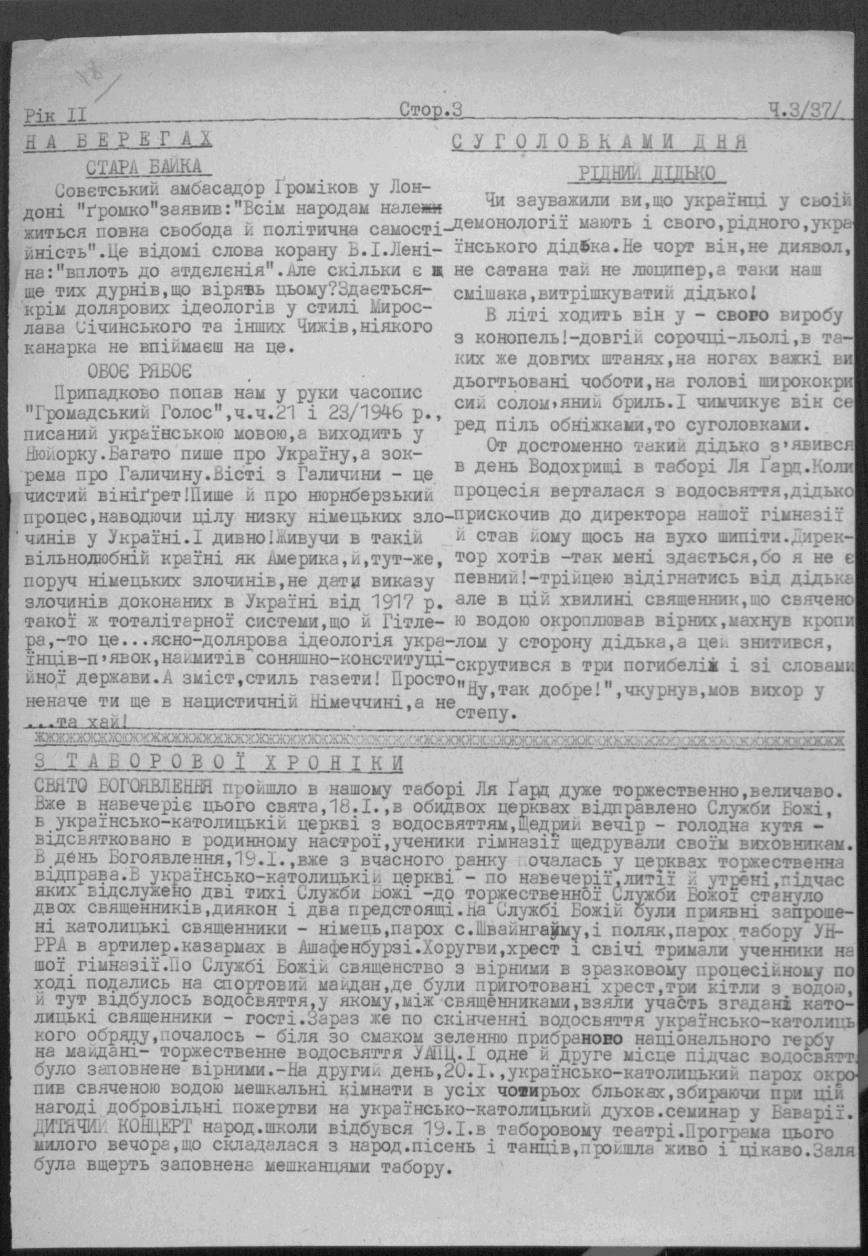
The camp’s January 1946 chronicle describes four residential blocks. It also places activities in two churches, a theatre and a sports ground. Books for Ukrainian studies courses were collected in the basement of block A-2. These spaces supported a community whose daily life extended well beyond its sleeping quarters.
The recorded Ukrainian population fell from 1,398 in August 1946 to 1,081 in May 1947 and 918 in December 1947. A separate questionnaire total of 1,298 belongs to returns collected during 1946–1947, without a precise date. These are Lagarde figures, not totals for all the displaced people living in Aschaffenburg.
Ukrainians recorded at Lagarde
| Reporting period | People | Basis |
|---|---|---|
| August 1946 | 1398 | UNRRA report |
| May 1947 | 1081 | UNRRA report |
| December 1947 | 918 | PCIRO report |
| 1946–1947, precise date unspecified | 1298 | Questionnaire returns |
Two churches and shared celebrations
Pastoral reports quoted by Bernadetta Wojtowicz describe 800 Ukrainians from Prague at Lagarde, approximately half Greek Catholic and half Orthodox. In a separate group arriving in Aschaffenburg in August 1945, Father Veselovsky initially stayed elsewhere before making contact with Lagarde residents. His report describes celebrating Mass outdoors, subsequently sharing the Orthodox chapel, and eventually using a separate Catholic chapel on the third floor of the third barrack. This is his account of the development of worship in the camp.
Bishop Sylvester of the Ukrainian Autocephalous Orthodox Church arrived on 17 November 1945 and celebrated the liturgy the next day. The camp chronicle describes a brief sermon emphasising patience. It also records two performances of a memorial programme on 21 November for the men killed at Bazar in 1921, preceded by services in both camp churches.
The Epiphany celebrations of 18–20 January 1946 brought together church services, pupils and a procession through the camp. The bulletin reports services in both churches on the eve of the feast and pupils of the gymnasium (secondary school) singing festive songs for their educators. On 19 January, pupils carried banners, a cross and candles in a procession to the sports ground for the blessing of water. A children’s concert in the camp theatre that day featured folk songs and dances. The next day, the Ukrainian Catholic priest blessed residents’ rooms in all four blocks and collected voluntary donations for the Ukrainian Catholic seminary in Bavaria.
A January 1946 collection by Lagarde’s priest and choir supported the Ukrainian seminary. An October 1946 report describes a service bringing together more than 3,000 faithful from Lagarde, Pionier and Artillerie in Aschaffenburg. That attendance represents several camps, not Lagarde’s population.
A school, courses and a search for books
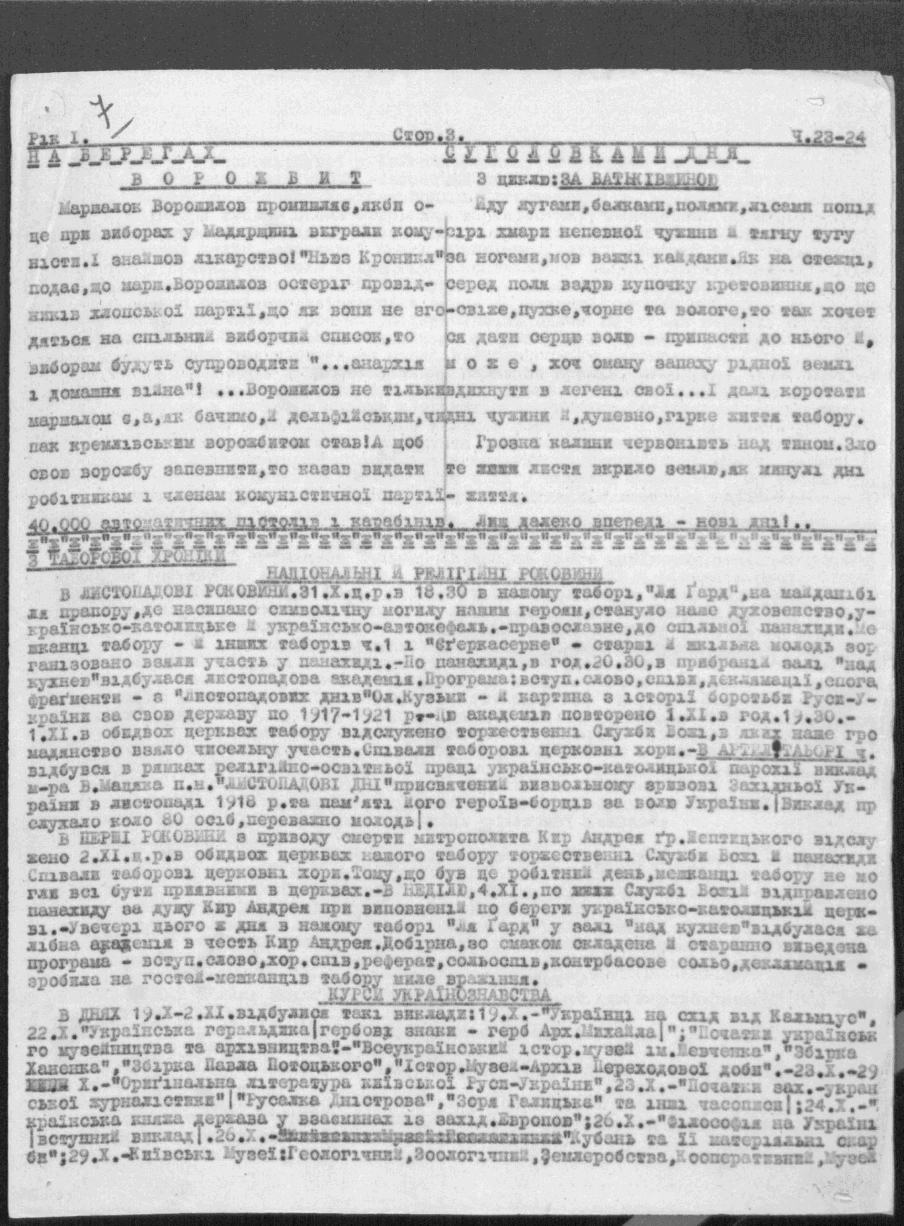
Ukrainian studies courses offered a varied programme in autumn 1945, from museums and historical landmarks to philosophy, the history of law and economic questions. The bulletin records a visit on 30 October by educational representatives, including Professor I. Palyvoda and H. Denysenko from the Ukrainian Technical and Economic Institute in Regensburg. Denysenko proposed putting the courses under his faculty’s patronage and educational direction. At a meeting on 2 November, lecturers and student representatives discussed a practical obstacle: obtaining books and textbooks. They appealed for donations or loans and gave the basement of block A-2 as the place to deliver them. The proposal for institutional patronage is reported as a next step, rather than a completed affiliation.
Gymnasium pupils staged the religious play Bethlehem Night three times on 7 and 9 January 1946, with separate performances for young people and adults. The camp bulletin describes full audiences, including foreign visitors. Together with the earlier appeal for textbooks, the report shows schooling extending beyond classroom lessons into the camp’s public cultural life.
A hall above the kitchen
The camp’s own bulletin places communal life in recognisable spaces: a flag square with a symbolic memorial mound, two churches, a theatre and a hall above the kitchen. On 31 October 1945, Ukrainian Catholic and Orthodox clergy held a joint memorial service at the flag square. Residents of other camps joined the gathering, followed by an evening programme of songs, recitations and recollections in the hall. On 4 November, the same hall hosted a commemorative programme for Metropolitan Andrey Sheptytsky, including choral and solo singing, a talk, recitation and a double-bass solo.
The writer Ulas Samchuk spoke on “Great Literature” in the hall above the kitchen on 14 November 1945. A full audience heard his argument that a creative environment helps produce major writers. The following evening, the visiting Bandera Syndik troupe performed a two-part programme in the same hall.
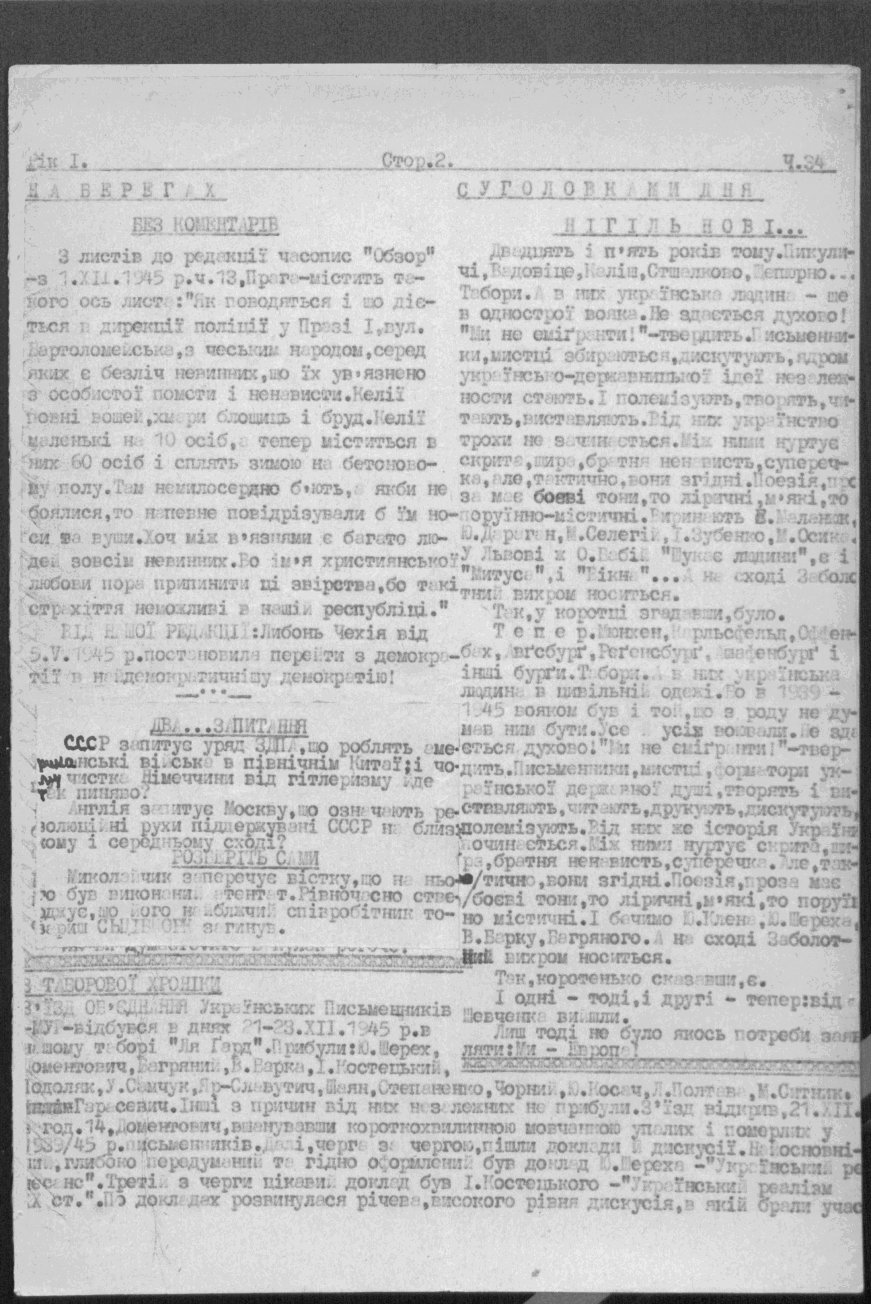
La Garde hosted the MUR (Artistic Ukrainian Movement) writers’ congress on 21–23 December 1945. The opening included remembrance of writers killed during the war. Yu. Sherekh spoke on Ukrainian expressionism and I. Kostetsky on Ukrainian realism. Authors read their work to fellow participants and to residents in the camp theatre, bringing the congress into the community’s public life.
Work, recreation and seasonal celebrations
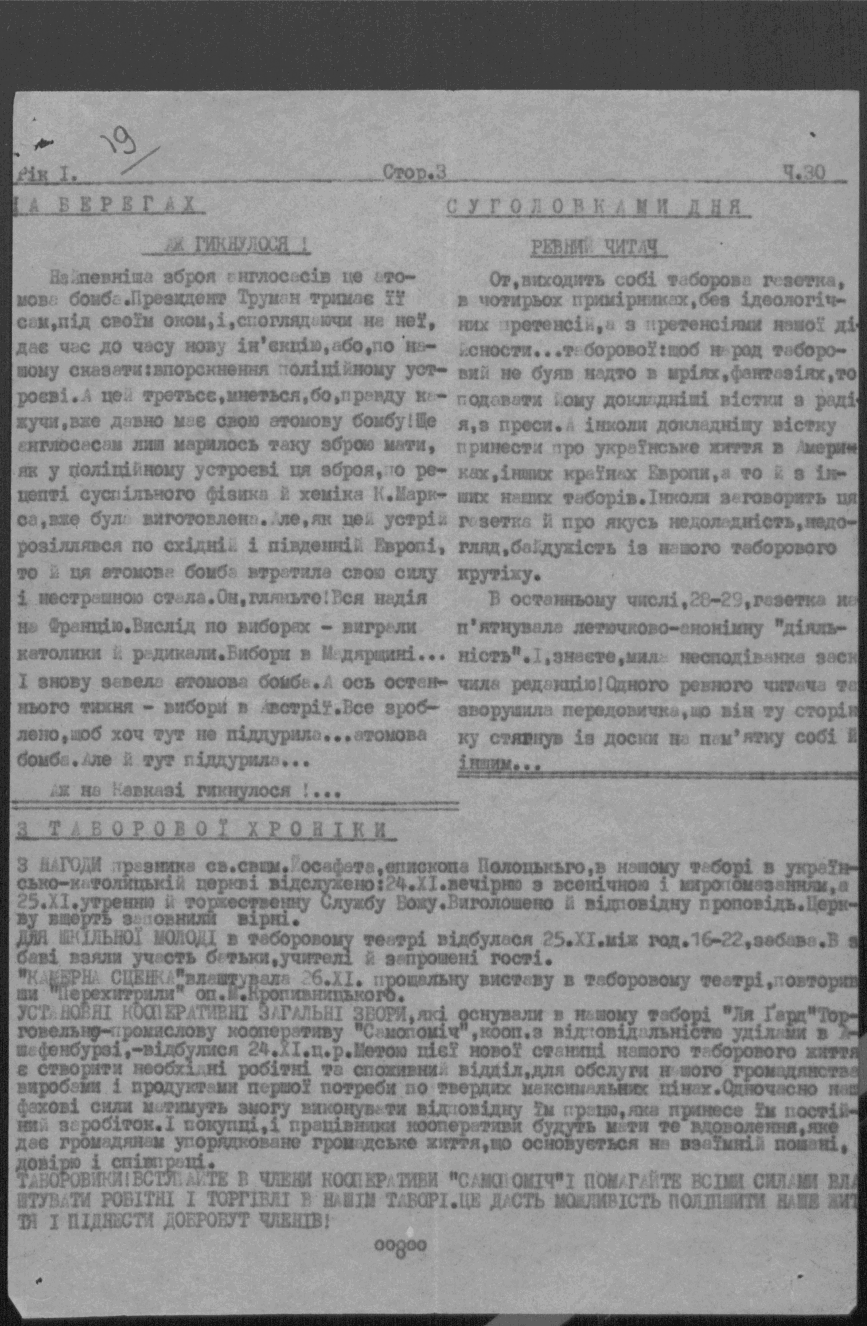
Residents founded the Samopomich trading and industrial cooperative at a general meeting on 24 November 1945. The bulletin explicitly located the organisation in La Garde. Its proposed workshops and consumer departments were intended to provide everyday necessities at moderate prices while giving skilled residents an opportunity to earn money through their trades. These were the cooperative’s stated aims; the announcement does not establish how many workshops subsequently opened.
The November bulletin reports a Ukrainian chess qualifying tournament with 33 players in four groups. Four players from each group were to advance to the final; the others formed a second class. By the time of the report, matches were under way at two boards and attracting spectators. December brought a different kind of gathering. On 18 December, a Saint Nicholas celebration for younger children included songs, dances, recitations and gifts. That evening, Saint Nicholas visited gymnasium pupils in the camp theatre. A further visit to the wider camp community followed on 19 December.
Jarko Sichynsky remembers La Garde
Former resident Jarko Sichynsky remembered La Garde as a cultural centre that drew people from the other camps. Writing in 2012, he recalled its secondary school, concerts and entertainment, and a community that included doctors, professors, artists and priests. He also remembered Plast, the Ukrainian scouting organisation, and SUM, the Ukrainian Youth Association. His recollection complements the bulletin’s contemporary accounts of classrooms and performances.
Sources for this section
Debating the future
A political and social studies circle opened with a talk on the importance of democracy on 3 November 1945; discussion continued three days later. On 12 December, a visiting Vatican delegate addressed a general gathering about displaced Ukrainians and efforts to find new homes overseas. Residents were discussing possible resettlement while continuing to build institutions inside the camp.
Sources for this section
Sources
- Aschaffenburg, DP Camps research collection
DP Camps research collection · 2012 recollection
Jarko Sichynsky’s recollection dated 24 September 2012, directly retrieved and read. Used only for his Lagarde recollections; unrelated contributors and political assertions excluded.
- Ihor Stebelsky, Table 8
Ukrainskyi Istoryk · 1986
Printed pp 53–54 table headings and Aschaffenburg Lagerde row visually checked.
- Bernadetta Wojtowicz, Geschichte der Ukrainisch-Katholischen Kirche in Deutschland vom Zweiten Weltkrieg bis 1956, 2000
Südostdeutsches Kulturwerk · 2000
Printed pp 101, 163, 171, notes 315, 519, 550; PDF 102, 164, 172. Relevant complete pages visually inspected. Quoted archival reports accessed through published book; original letters not inspected.
- Informatsiinyi biuleten, Ukrainian Group, Aschaffenburg, nos 23–24, 7 November 1945
Ukrainian Group, Aschaffenburg; digitised by USHMM / Ukrainian Museum-Archives of Cleveland · 1945–1946
Printed p 3; PDF 9. Issue masthead PDF 7 visually checked. Original camp chronicle visually read; explicitly names our camp La Garde.
- Informatsiinyi biuleten, nos 26–27, 17 November 1945
Ukrainian Group, Aschaffenburg; digitised by USHMM / Ukrainian Museum-Archives of Cleveland · 1945–1946
Printed p 2; PDF 14. Masthead PDF 13. Original page visually checked; camp chronicle and same hall above kitchen as explicitly identified Lagarde reports.
- Informatsiinyi biuleten, no 30, 1 December 1945
Ukrainian Group, Aschaffenburg; digitised by USHMM / Ukrainian Museum-Archives of Cleveland · 1945–1946
Printed p 3; PDF 21. Masthead PDF 19. Original cooperative report visually checked, explicitly names La Garde.
- Informatsiinyi biuleten, year II no 3 (37), 22 January 1946
Ukrainian Group, Aschaffenburg; digitised by USHMM / Ukrainian Museum-Archives of Cleveland · 1945–1946
Printed p 3; PDF 41. Masthead PDF 39. Original camp chronicle visually checked, explicitly names La Garde.
- Informatsiinyi biuleten, nos 28–29, 24 November 1945
Ukrainian Group, Aschaffenburg; digitised by USHMM / Ukrainian Museum-Archives of Cleveland · 1945–1946
Printed p 3/PDF 18; issue masthead PDF 16. Complete original page visually read; substantive camp chronicle checked.
- Informatsiinyi biuleten, no 33, 22 December 1945
Ukrainian Group, Aschaffenburg; digitised by USHMM / Ukrainian Museum-Archives of Cleveland · 1945–1946
Printed p 3/PDF 29; issue masthead PDF 27. Complete original page visually read; literary satire distinguished from camp chronicle.
- Informatsiinyi biuleten, Nos 23–24, 7 November 1945
Ukrainian Group, Aschaffenburg; digitised by USHMM / Ukrainian Museum-Archives of Cleveland · 1945–1946
Printed pp 3–4/PDF 9–10; Ukrainian studies courses, books appeal. Original pages visually inspected with issue masthead.
- Informatsiinyi biuleten, No 25, 10 November 1945
Ukrainian Group, Aschaffenburg; digitised by USHMM / Ukrainian Museum-Archives of Cleveland · 1945–1946
Printed p 2/PDF 12; political/social study circle. Original pages visually inspected with issue masthead.
- Informatsiinyi biuleten, No 32, 15 December 1945
Ukrainian Group, Aschaffenburg; digitised by USHMM / Ukrainian Museum-Archives of Cleveland · 1945–1946
Printed p 2/PDF 26; Vatican delegate visit; satire separate. Original pages visually inspected with issue masthead.
- Informatsiinyi biuleten, No 34, 29 December 1945
Ukrainian Group, Aschaffenburg; digitised by USHMM / Ukrainian Museum-Archives of Cleveland · 1945–1946
Printed pp 2–3/PDF 31–32; congress report explicitly names La Garde. Original pages visually inspected with issue masthead.
- Informatsiinyi biuleten, Year II no 2(36), 14 January 1946
Ukrainian Group, Aschaffenburg; digitised by USHMM / Ukrainian Museum-Archives of Cleveland · 1945–1946
Printed pp 2–3/PDF 37–38; school performance, satire separate. Original pages visually inspected with issue masthead.
Last researched 12 September 2026