Somme-Kaserne
Displacement in Europe
Augsburg, Germany · 1945–1949
A Ukrainian community took shape inside a former barracks: families made homes, children went to school, and residents built a busy sporting and cultural life while preparing for an uncertain future.14
A history in dates
- June–July 1945Polish displaced people live in the barracks before the Ukrainian community arrives.17
- August 1945The camp account records 3,360 Ukrainian arrivals between 12 and 23 August.1
- September 1945Chornohora sports society is formally established.1
- 4 February 1946University courses open at Somme-Kaserne.10
- May 1946First elections for camp self-government, according to the 1948 account.1
- 24 September 1946UNRRA Team 114 grants the camp council the licence under which Ukrainian Thought is published.19
- 27 September 1946The first issue of Ukrainian Thought announces that it continues Nashe Zhyttia under a new title.19
- 28–29 September 1946A jubilee Plast congress at Somme-Kaserne registers 717 scouts from 63 centres at its opening.19
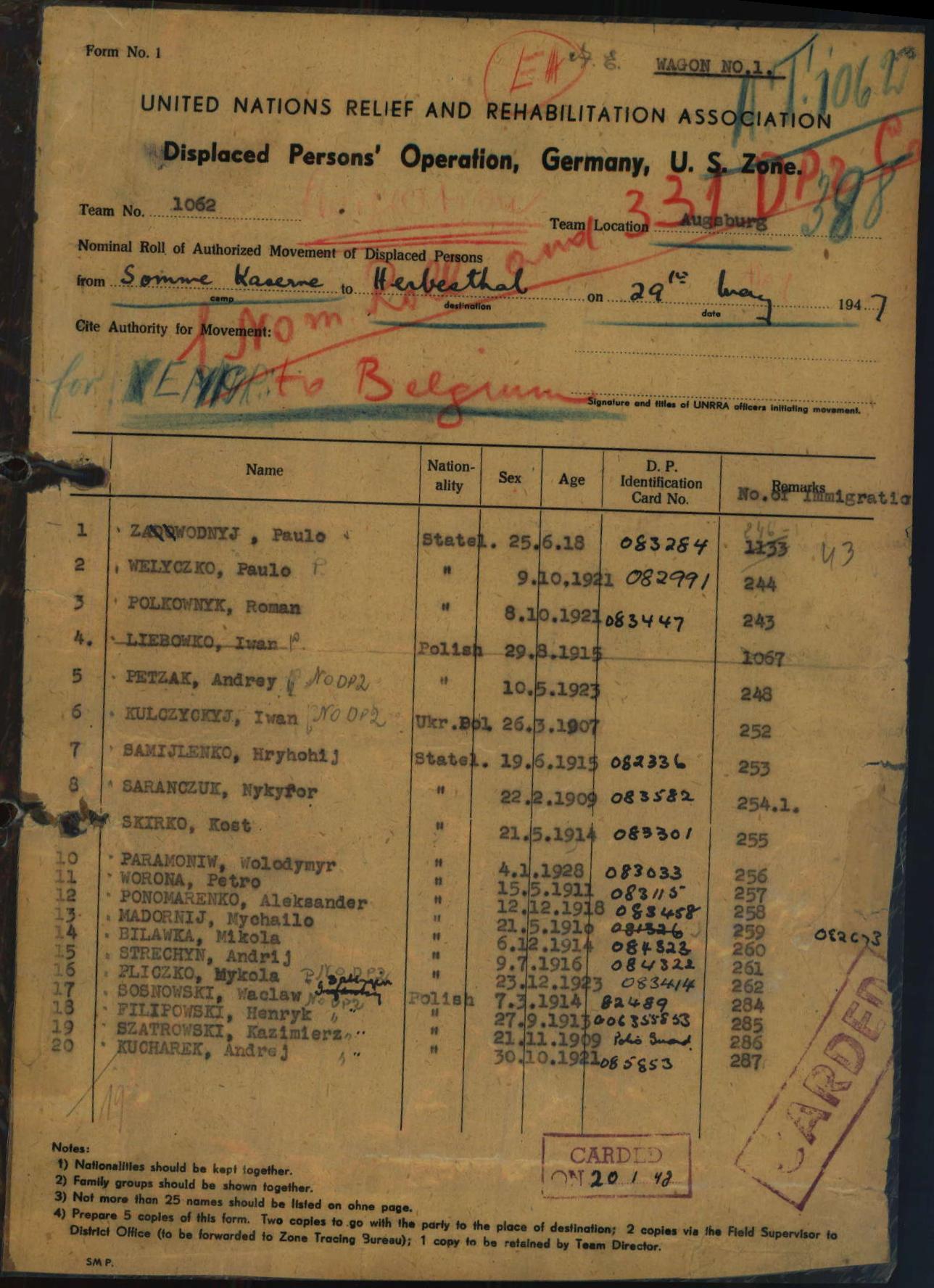
- 29 May 1947A surviving movement roster records a departure to Herbesthal, Belgium.14
- January 1948A dated count records 2,526 residents.1
- June 1949The inventory records the camp’s closure on 1 June.2
- 2025Three former barrack buildings on Sommestraße are demolished.3
A new home in a former barracks
Somme-Kaserne became a Ukrainian displaced persons camp in Augsburg after the Second World War. Families and single adults lived in a former military complex while they tried to establish where they could build their lives. Some had been taken to Germany for forced labour; others had fled west as the Soviet army advanced. Their histories differed, but the camp brought them into a shared Ukrainian-speaking community.4
The residents’ own 1948 account traces the move from an earlier camp at Göggingen to Somme-Kaserne. It records the arrival of 3,360 Ukrainians between 12 and 23 August 1945. It also describes the previous occupants as Polish displaced persons who were transferred out. This contemporary account places the Ukrainian community at Somme-Kaserne several months before the opening date recorded in a later camp inventory.1
Accommodation was badly overcrowded. The same account describes barracks designed for 1,600 soldiers, with residents also housed in attics, cellars and eleven former stables. It reports roughly three square metres of space per person in the main accommodation. Cleaning, organising rooms and making the complex habitable were among the community’s first tasks.1
A separate Polish archival study gives the barracks an earlier post-war chapter. Marian Brudzisz describes approximately 4,300 Polish residents in June 1945, when Fr. Jan Szymaszek became their chaplain. A riding hall was converted into a chapel, with a first Mass on 10 June. His account records transfers to Coburg and to Augsburg’s Infanterie-Kaserne, where a new pastoral centre opened on 27 July. The Ukrainian camp account instead mentions Kulmbach and Poland. Together they establish the preceding Polish community, but they do not yet resolve every transfer destination.117
Sofiia Parfanovych’s later autobiographical account brings the accommodation into view: families divided former stables with improvised partitions, used lofts once filled with hay, and crowded into rooms in the barrack blocks. She describes electric light, horse stalls and German stable notices surviving alongside domestic possessions. Her portrait also follows residents travelling out to work, collecting firewood, attending outdoor worship, and converting a large glazed building into a theatre. The old military spaces became homes through daily labour, with very little privacy.15
Dates, names and camp numbers
The Ukrainian camp is generally described as operating from 1945 to 1949. The August 1945 arrivals are documented in the Chornohora publication; the Arolsen inventory records 24 January 1946 as its opening and 1 June 1949 as its closing date. These should not be compressed into one supposedly exact starting date: the first describes people living there, while the later inventory gives a different administrative date whose basis remains to be established.12
The inventory identifies the camp as AC 94-264, later S 506, and associates it with Team 114 Augsburg. Somme-Kaserne, Somme Kaserne and the Ukrainian Сомме-Касерне refer to this place. Reese Barracks is the name of the larger military complex into which the site was subsequently incorporated, rather than an interchangeable name for every part of the Ukrainian camp.23
Community records sometimes extend beyond the usual 1949 end date. The finding aid for Fr. Petro Stel’makh’s papers describes his service at the camp’s St Nicholas parish as 1948–1951. That later parish chronology does not, by itself, establish continuous operation of the same residential camp through 1951.8
Population figures in their setting
| Date | Figure | What it measures |
|---|---|---|
| June 1945 | About 4,300 | Polish community described in the Polish chaplaincy study. |
| 12–23 August 1945 | 3,360 | Ukrainian arrivals recorded in the resident-written history. |
| October 1945 | 3,634 | Resident count reported by Sebta (2025), citing the published camp history. |
| 31 October 1947 | 2,800 | Accommodation capacity in the camp inventory. |
| 1 November 1947 | 2,643 | Camp questionnaire summary reproduced by Sebta (2025), citing Maruniak and the published questionnaire. |
| 1 January 1948 | 2,526 | Residents counted in the camp publication. |
The people who lived here
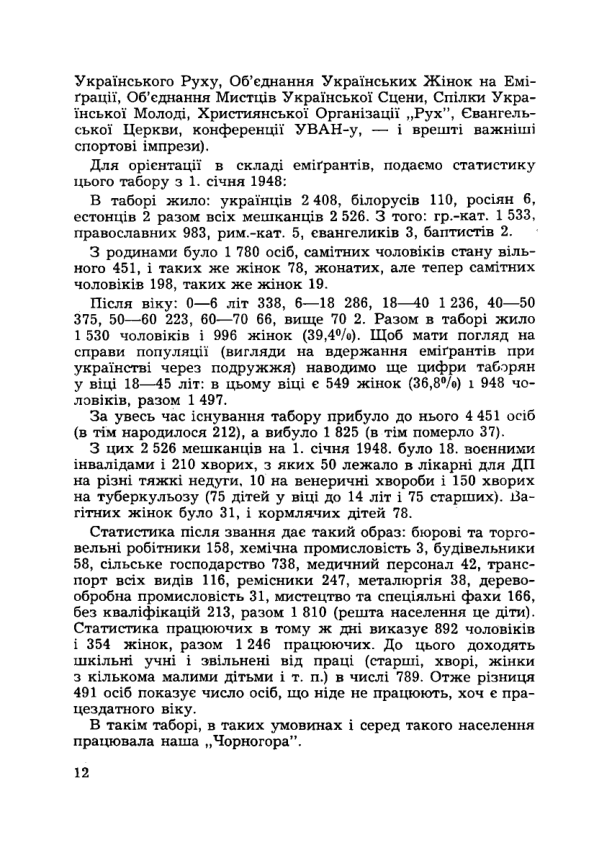
The clearest population snapshot is dated 1 January 1948. The camp’s own publication counted 2,526 residents. Almost half were in its 18–40 age band; the two youngest bands together accounted for 624 people. Families, children and older residents shared the complex with a large population of working-age adults.1
Two earlier snapshots appear in Tetiana Sebta’s 2025 study of Petro Kurinnyi’s photographic archive. Drawing on the published camp history, she reports 3,634 residents in October 1945. She also reproduces a questionnaire summary dated 1 November 1947, with 2,643 residents. Alongside the January 1948 count, these figures show a community whose size changed as residents arrived and left.201
The January 1948 tables transcribe separate classifications in the camp report: nationality, religion, age, sex and family circumstances. A further table brings together Ukrainian population counts from the comparative camp reports published by Ihor Stebelsky.121
The publication’s nationality, religion, age, sex and family-status breakdowns each add to 2,526. The population movements contain an arithmetic inconsistency: 4,451 cumulative arrivals minus 1,825 departures gives 2,626, while the printed resident total is 2,526. The listed occupations sum to 1,810, matching the printed subtotal. The dated breakdowns are reproduced here; the conflicting population totals have not been silently corrected.1
Age of residents
| Category | Residents | Share |
|---|---|---|
| 0–6 | 338 | 13.4% |
| 6–18 | 286 | 11.3% |
| 18–40 | 1,236 | 48.9% |
| 40–50 | 375 | 14.8% |
| 50–60 | 223 | 8.8% |
| 60–70 | 66 | 2.6% |
| Over 70 | 2 | 0.1% |
| Total | 2,526 | 100% |
Recorded nationality
| Category | Residents | Share |
|---|---|---|
| Ukrainian | 2,408 | 95.3% |
| Belarusian | 110 | 4.4% |
| Russian | 6 | 0.2% |
| Estonian | 2 | 0.1% |
| Total | 2,526 | 100% |
Religious affiliation
| Category | Residents | Share |
|---|---|---|
| Greek Catholic | 1,533 | 60.7% |
| Orthodox | 983 | 38.9% |
| Roman Catholic | 5 | 0.2% |
| Evangelical | 3 | 0.1% |
| Baptist | 2 | 0.1% |
| Total | 2,526 | 100% |
Men and women
| Category | Residents | Share |
|---|---|---|
| Men | 1,530 | 60.6% |
| Women | 996 | 39.4% |
| Total | 2,526 | 100% |
Family circumstances
| Category | Residents | Share |
|---|---|---|
| Living with family | 1,780 | 70.5% |
| Unmarried men | 451 | 17.9% |
| Unmarried women | 78 | 3.1% |
| Married men without spouse | 198 | 7.8% |
| Married women without spouse | 19 | 0.8% |
| Total | 2,526 | 100% |
Ukrainian residents in comparative camp reports
| Reporting period | Ukrainians recorded | Basis |
|---|---|---|
| 1946–1947 | 2,643 | Questionnaire returns collected over two years |
| May 1947 | 2,528 | UNRRA report, 31 May 1947 |
| December 1947 | 2,344 | PCIRO report issued 2 January 1948 |
Family life, work and health
Children grew up and families formed while adults waited for decisions about their future. The exhibition Geboren 1946 reconstructs the lives of children born into this community from registration cards, assistance applications and migration records. It brings births, marriages, separation and onward journeys into the camp’s history, rather than treating its residents only as a total on a list.4
Work and illness shaped everyday life. The January 1948 account recorded 1,246 residents as working, while others were pupils, older people, ill or caring for young children. It also reported 150 people with tuberculosis, including 75 children under fourteen. These are figures reported by the contemporary publication; they show how much health and care mattered alongside the camp’s cultural achievements.1
For many residents, returning east was a frightening prospect. The exhibition describes the effect of repatriation policy and the significance of pre-war citizenship in camp paperwork. Labels such as “Polish Ukrainian” need to be read in that historical setting. A nationality field alone cannot tell the whole story of a person’s language, origins or reasons for displacement.4
The report counted 1,780 people living with their families, alongside 529 unmarried people and 217 married people living without their spouses. Separation was therefore part of camp life even for people whose marriages had survived the war. These categories do not reveal whether spouses were missing, living in another camp, already abroad or unable to travel.1
The working population included 892 men and 354 women. The publication grouped 789 other residents together as school pupils or people exempt from work, including older people, those who were ill and women caring for small children. Another 491 were described as of working age but not working. This is a contemporary administrative classification, rather than a modern employment survey: the report does not measure working hours, wages or unpaid care.1
The contemporary health figures record 210 sick residents, including 150 with tuberculosis; 50 people were being treated in a DP hospital. Of the 150 residents reported with tuberculosis, 75 were children under fourteen and 75 were in the older age group. Alongside this burden of illness, the report listed 31 pregnant women and 78 nursing mothers. Relief, nursing, food and childcare were substantial parts of sustaining the community.1
Work and care
| Recorded category | Residents |
|---|---|
| Working men | 892 |
| Working women | 354 |
| All recorded as working | 1,246 |
| Pupils and people exempt from work | 789 |
| Working-age residents not working | 491 |
Running the community
International relief authorities and the residents’ own organisations had different roles. UNRRA—the United Nations Relief and Rehabilitation Administration—and later the International Refugee Organisation oversaw assistance and resettlement. Within that framework, the camp developed an elected administration and its own community institutions.4
The 1948 camp account dates the first elections for self-governing bodies to 12 May 1946. It also records a much harsher event: after military screening results were announced on 24 April 1947, 680 people were excluded from UNRRA assistance. The publication reports the outcome but does not provide the individual case files needed to explain each decision.1
Administration survives in more than official camp lists. The Shevchenko collection includes bylaws, policies, orders, announcements and election material. These are records of a community organising its affairs as well as being administered by international agencies.5
The community was connected to Ukrainian organisations beyond the barracks. The first congress of the Association of Ukrainian Women took place at Somme-Kaserne on 15–16 December 1945. The main council of the Central Representation of Ukrainian Emigration met there on 4–7 March 1949. These gatherings made the camp a meeting place for people and institutions spread across the occupied zones.16
The newspaper also became a focus of disagreement. Ukrainian Thought printed the camp council’s defence of changes to the editorial board, responding to criticism from writers and journalists, peasants’ representatives and Professor V. Shayan. Alongside it, a resolution reported that approximately 1,200 residents attended a meeting on 24 September 1946. It recorded twelve departures in protest, three votes against and one abstention, with the remainder supporting the council’s measures. This is the council’s published account of the dispute.19
The council’s account of the September meeting
| Measure | Reported figure |
|---|---|
| Attendance | Approximately 1,200 |
| Left in protest | 12 |
| Votes against | 3 |
| Abstentions | 1 |
Schools and learning
Education extended from children’s classrooms to adult training. The Ukrainian local-history project describes a school and gymnasium, alongside courses in sewing, electrical work, animal husbandry and household management. It also records university-level courses from 1946.9
University courses opened at Somme-Kaserne on 4 February 1946. The 2025 study by Tetiana Vynarchuk identifies Petro Kurinnyi as their director and records greetings from UNRRA welfare officer Mrs Carpenter. It also credits Nataliia Rudnytska-Chaplenko with organising and leading a camp school, drawing on teacher I. Korol’s published recollection.10
For Roman Korol, who spent part of his childhood here, school was also a family connection: his father served as a school principal. His later return gives the educational history a recognisable setting—a family home in the middle of the three former barrack buildings along Sommestraße.7
The educational programme answered several needs at once. Children needed to recover schooling interrupted by war; adolescents needed secondary education; adults needed practical qualifications for employment and migration. The courses named in local histories ranged from languages to sewing and electrical work. The university-level activity also allowed displaced scholars to teach and students to resume an intellectual life.9
Learning in the camp
| Institution or course | What the sources establish |
|---|---|
| Camp school and gymnasium | Primary and secondary education; Nataliia Rudnytska-Chaplenko is named as a school organiser and leader. |
| University courses | Opened 4 February 1946; directed by Petro Kurinnyi. |
| Sewing and household management | Practical courses for adults. |
| Electrical training | Technical education. |
| Animal husbandry | Agricultural training. |
Sport on the camp field
The camp’s sports ground was a place to gather, compete and represent the community. The Ukrainian sports society Chornohora grew from sporting activity at the earlier Göggingen camp. Its report records a founding meeting on 29 September 1945, when 29 founding members established the society and elected Volodymyr Blavatskyi as its first chairman.1
The beginnings were improvised. The report describes donated shirts, clothing obtained from the welfare store and blue-and-yellow emblems made from available fabric. Organisers developed football, volleyball and chess; the account of the first working year also includes table tennis. Teams travelled to other Ukrainian centres, extending social connections beyond Augsburg.1
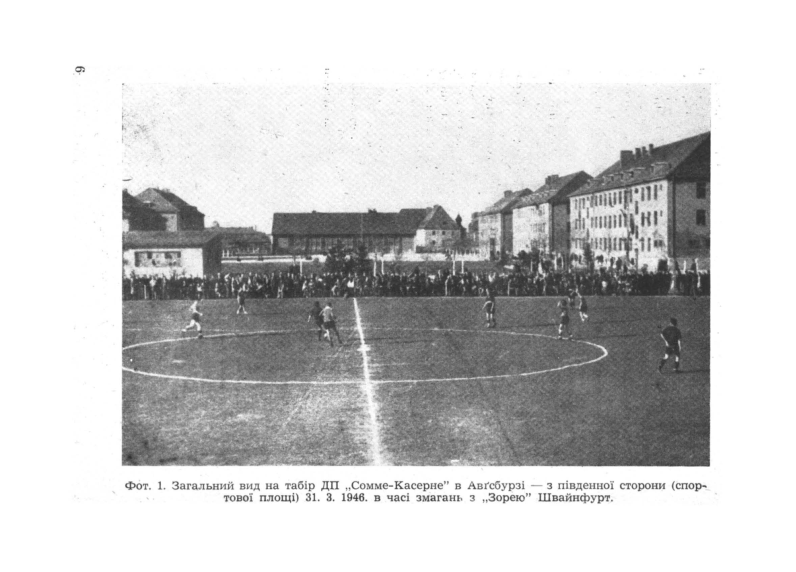
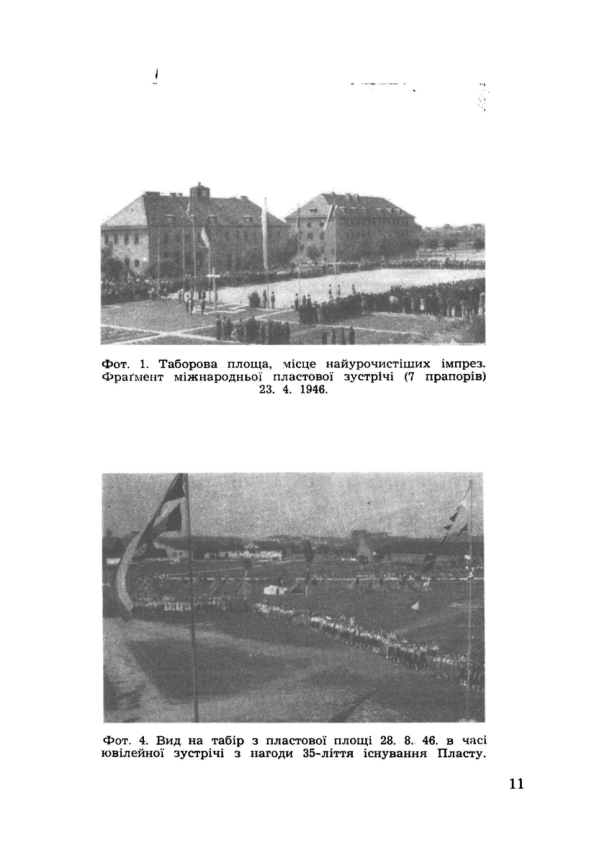
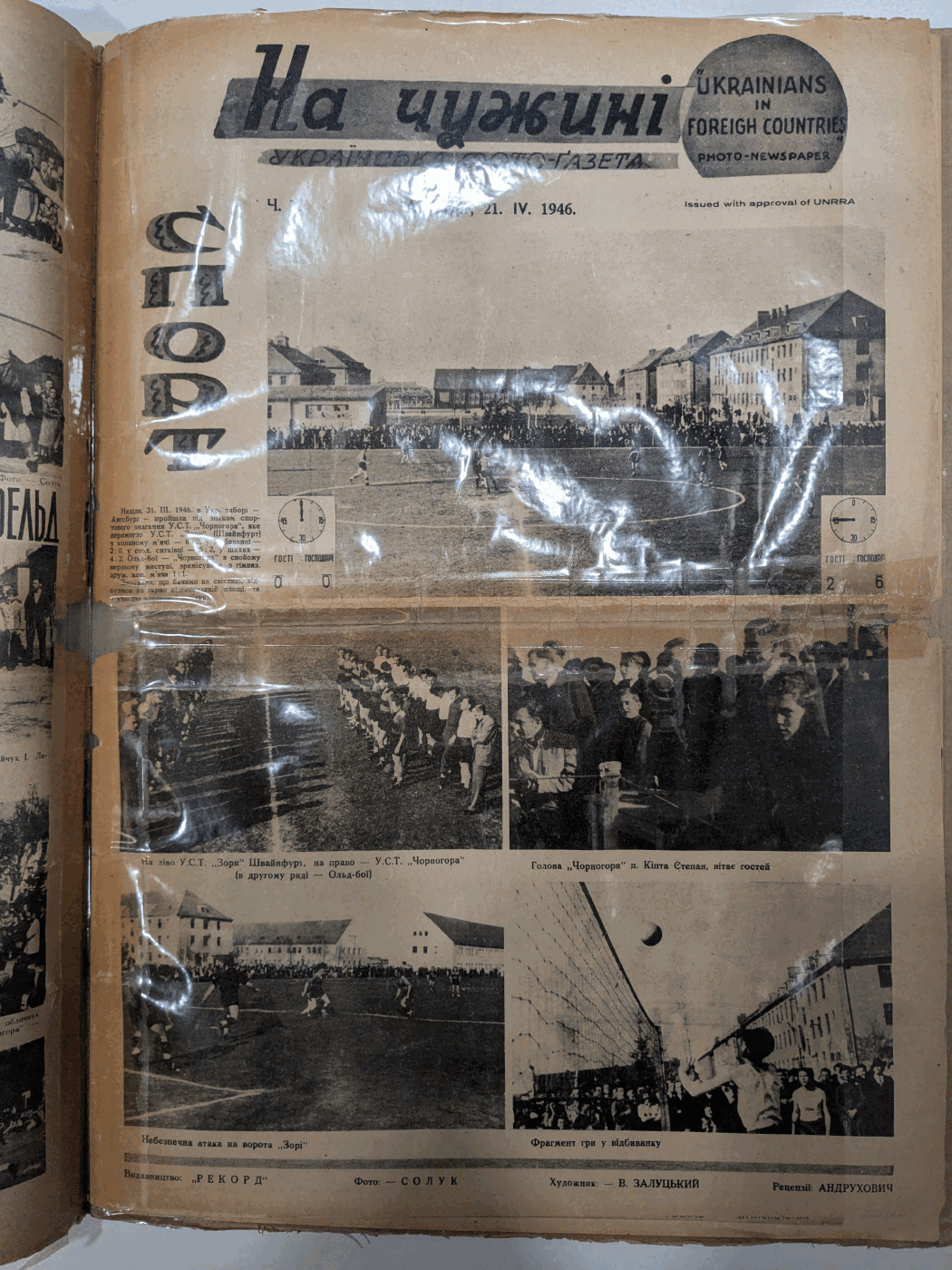
A photograph in the society’s 1948 publication shows the camp from the south, across the sports field, during a match against Zoria of Schweinfurt on 31 March 1946. Other captions record an international Plast gathering on 23 April 1946 and an anniversary gathering on 28 August 1946. Sport, scouting and public celebrations shared the same spaces.1
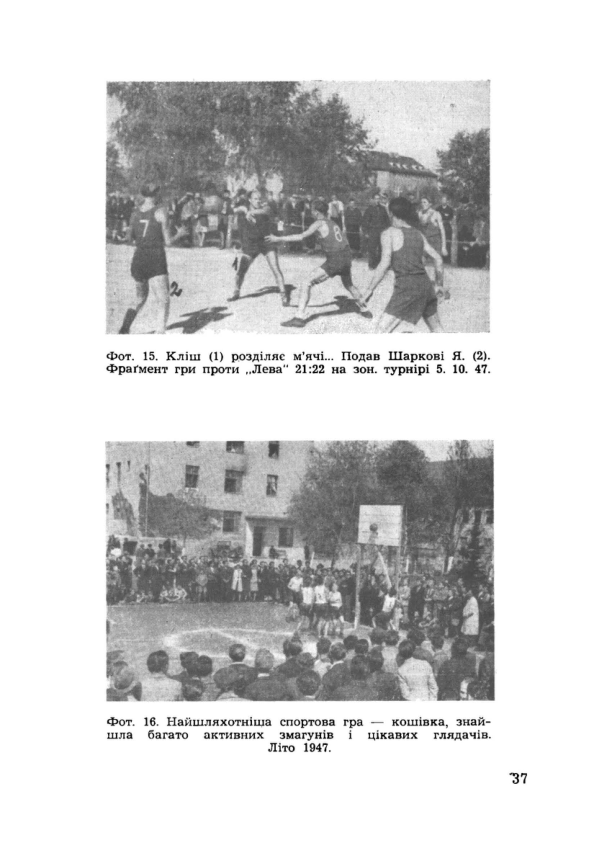
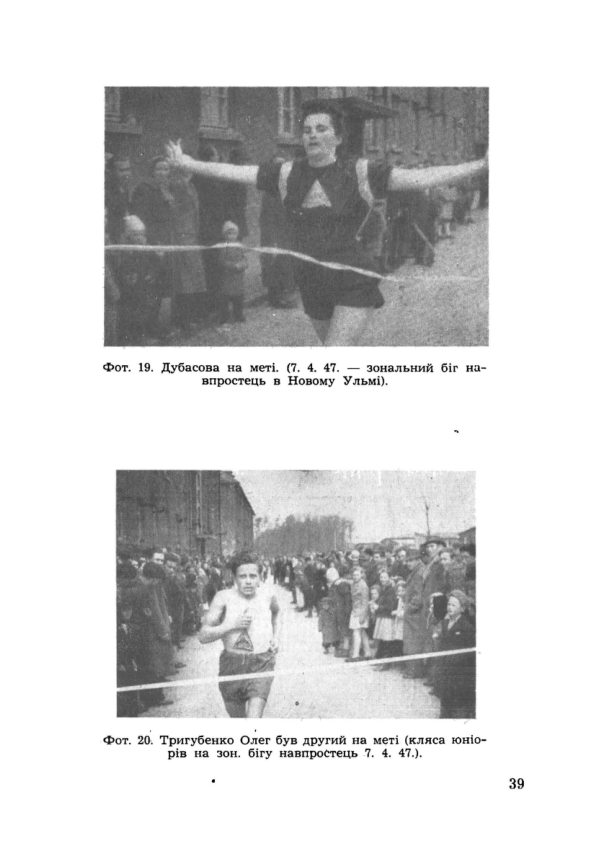
By its third working year, February 1947 to February 1948, Chornohora had developed well beyond football. Its report describes basketball, athletics, volleyball, table tennis, chess, swimming, cycling, skiing and mountain excursions. Women were prominent competitors: Iryna Dubas appears in the photographs crossing the finish line in Neu-Ulm and in the account of awards and reader polls. The publication names athletes, records results and describes both victories and defeats.1
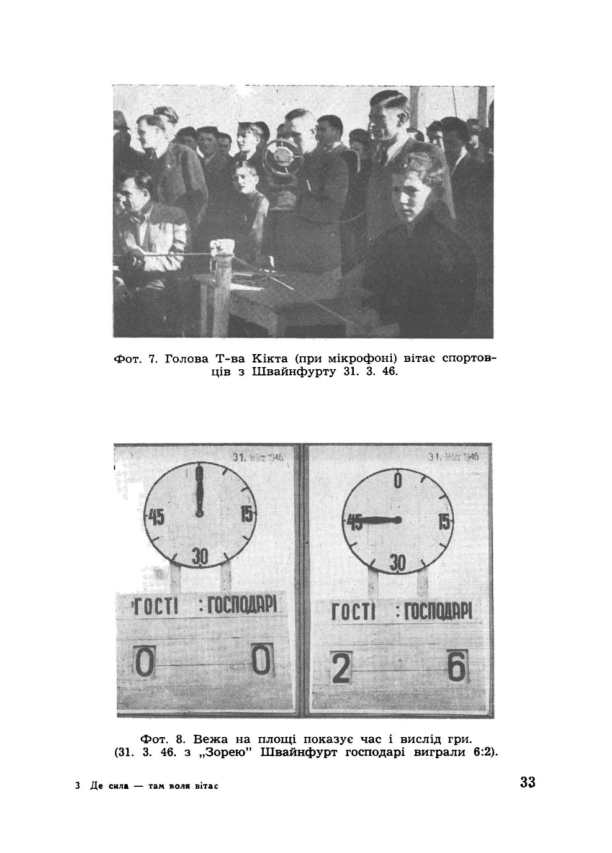
Competition linked Somme-Kaserne with other displaced communities and local clubs. The 31 March 1946 football match against Zoria of Schweinfurt ended 6–2 to Chornohora, recorded both in a caption and on the photographed scoreboard. Basketball brought Latvian players from Hochfeld and Germany’s TV Viktoria into the anniversary programme in February 1948. The club was rooted in one camp but its social world extended far beyond the gates.1
The report’s annual club standings put Chornohora first in 1947, with 6,205 points, ahead of Lev with 4,684. This was the sports organisation’s multi-event ranking, not a football league table. It captures the breadth of the club’s activity. The accompanying athlete lists preserve another form of evidence: names that may otherwise be absent from the better-known administrative collections.1
Theatre and the printed word
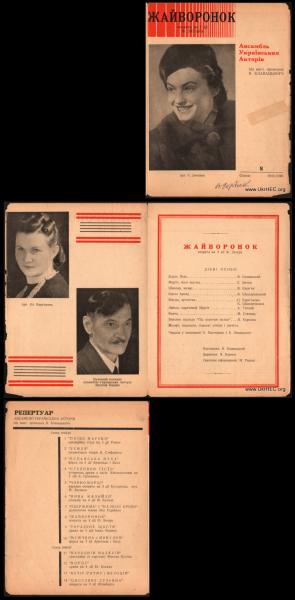
The Ensemble of Ukrainian Actors, founded at Somme-Kaserne by Volodymyr Blavatskyi, staged Ukrainian drama and translated European plays. Its surviving programme for Franz Lehár’s Where the Lark Sings identifies it as the eighth production of the 1945–46 season. The repertoire below records the productions listed as preceding it.6
Nashe zhyttia carried local news and literary debate. Vynarchuk’s 2025 study shows a lively, sometimes argumentative cultural world, distinguishing camp residents from writers living elsewhere in Augsburg. Its account of education, publications and public events draws repeatedly on the newspaper’s 1946 issues.10
Parfanovych’s portrait places the newspaper office and an education section within the camp’s organisational structure. She describes tailors, shoemakers, joiners and metalworkers as well as writers and performers. Culture was part of a working settlement whose residents also repaired possessions, made clothes and provided everyday services.15
On 27 September 1946, readers opened the first issue of Ukrainian Thought to find a notice announcing that their newspaper, previously called Nashe Zhyttia (Our Life), would continue under its new title. International news and political commentary shared the front page with the announcement. The paper connected life inside the camp with arguments and events far beyond Augsburg.19
The paper’s own masthead placed it inside the camp. The imprint of the first issue gives the place of publication as Augsburg, Somme-Kaserne, names the “Ukrainian Thought” publishing house as publisher, and lists an editorial board of V. Yevtymovych, V. Koval and M. Dolnytsky.19
The second issue set out the paper’s legal footing. It stated that Ukrainian Thought was published on the basis of a licence of UNRRA Team 114, granted to the camp council of Somme-Kaserne on 24 September 1946.19
The 1945–46 theatre repertoire
| Production or author | Programme record |
|---|---|
| The Ghost Train · Arnold Ridley | Earlier production |
| Works of Vasyl Stefanyk | Earlier production |
| The Spanish Fly · Arnold and Bach | Earlier production |
| Stepovyi Hist · Borys Hrinchenko | Earlier production |
| Chornomortsi · Iakiv Kukharenko | Earlier production |
| Myna Mazailo · Mykola Kulish | Earlier production |
| Two dramatic poems · Lesia Ukrainka | Earlier production |
| Where the Lark Sings · Franz Lehár | Eighth production |
Churches and shared celebrations
Religion was another part of community life. The contemporary population figures show substantial Greek Catholic and Orthodox communities. Fr. Petro Stel’makh’s archival biography identifies him with the St Nicholas Orthodox parish. Parish council records also survive in the Shevchenko Augsburg collection, although its collection-wide descriptions need to be checked item by item for a precise camp attribution.158
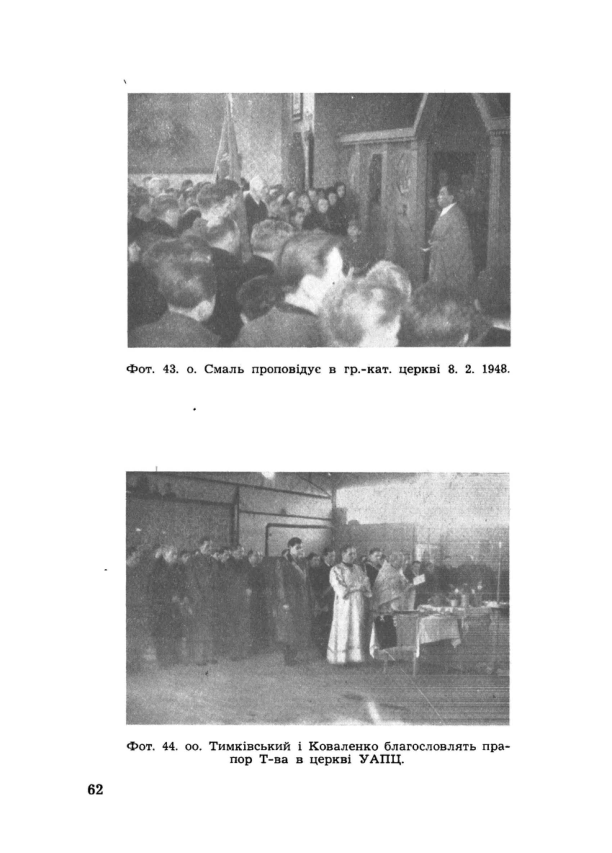
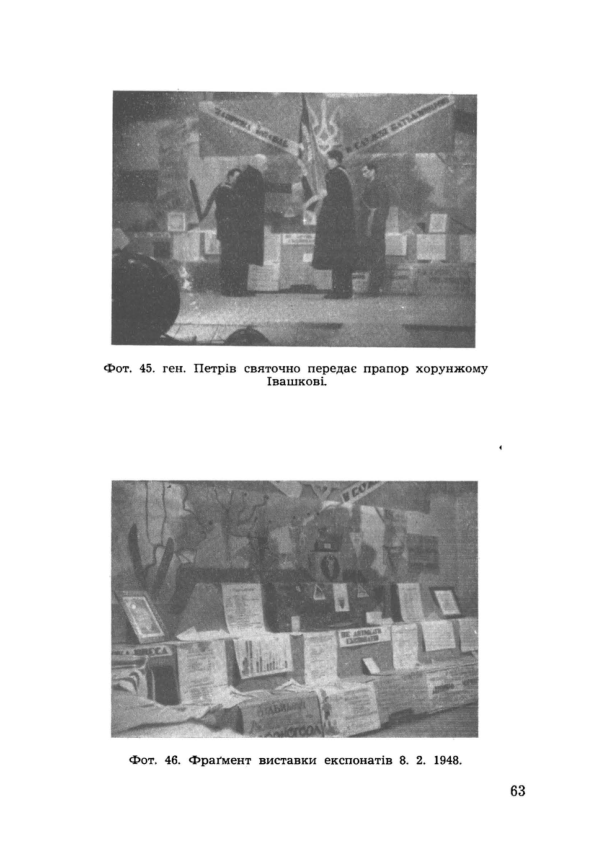
A detailed account of the blessing of Chornohora’s flag on 8 February 1948 shows both churches participating in the same community occasion. Fathers Tymkivskyi and Kovalenko blessed it in the Ukrainian Autocephalous Orthodox church; Fr. Smal celebrated in the camp’s Greek Catholic church. Photographs preserve both interiors and the gathered congregation.1
The celebrations then moved to the theatre, where General Vsevolod Petriv presented the flag to the standard-bearer, Yevhen Ivashko. More than 200 sporting exhibits were arranged on the stage and around the hall: certificates, reports, badges, posters and equipment. The organisers were already collecting a record of the camp’s achievements while its future was uncertain.1
The flag itself was light blue above black, the society’s colours, with its emblem and foundation date. The report describes an intention to entrust it to a Ukrainian museum in Europe or America if emigration scattered the members. Preservation was therefore a deliberate project of the residents, not something begun only by later historians.1
Plast, young people and remembrance
Plast, the Ukrainian scouting movement, used the camp grounds for gatherings and ceremonies. Photographs in the 1948 Chornohora volume identify an international gathering on 23 April 1946 and a celebration of Plast’s thirty-fifth anniversary on 28 August. The parade ground provided room for flags, formations and a large public audience.1
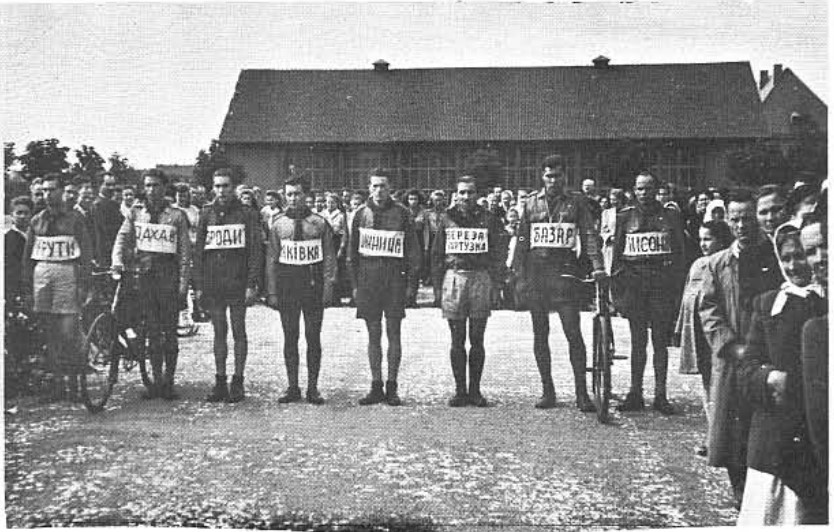
A 2024 history of the Chota Krylatykh scouting unit describes a cycling relay bringing earth from graves at Dachau to a symbolic grave at Somme-Kaserne. It draws on Dmytro Shtohryn’s recollections and the unit’s archive. The riders wore the names of places associated with Ukrainian struggle and suffering over their uniforms. The article reproduces photographs from 1947 and 1948 and links to film identified as the 1947 ceremony.13
The photograph below is captioned 21 May 1948 in that article and credited to the 1964 album marking fifty years of Plast. These ceremonies joined youth activity with remembrance of people who had died. They also created a record that later generations of scouts continued to preserve.13
Ukrainian Thought reported a jubilee Plast congress at Somme-Kaserne on 28 and 29 September 1946. At the official opening on 28 September at three in the afternoon, 717 scouts from 63 centres were registered. The report describes young people arriving the day before and pitching their tents on the large square behind the residential blocks, and representatives of UNRRA taking part in the opening.19
Lives connected with Somme-Kaserne
Roman Korol returned from Canada in August 2015. According to the local society that accompanied him, he recognised his family’s old accommodation and the door of the room where they had lived. By then it was an artist’s studio. His family had emigrated to Canada in 1949; the return brought a childhood home back into view after decades away.7
Olha Kosach-Kryvyniuk, a physician, writer and younger sister of Lesia Ukrainka, reached the camp seriously ill. Tamara Skrypka’s study follows her westward journey through correspondence and memoirs, describing her reunion with her sister Izydora in Augsburg and the crowded accommodation. She died on 11 November 1945. Her story belongs alongside those of children and young adults rebuilding their lives: not everyone lived to leave the camp.11
Blavatskyi’s theatrical work continued after resettlement in Philadelphia. His career connects the performances staged in Augsburg with the Ukrainian cultural institutions that developed overseas. These individual accounts show different outcomes without implying that every camp resident followed the same route.6
Leaving Augsburg
The Chornohora account records the first departures for work in Belgian coal mines in May 1947. By the time its 1948 report appeared, former Somme-Kaserne residents were already in Belgium, England, Canada, the United States, Brazil and Venezuela. These were several distinct migration routes, not one collective departure.1
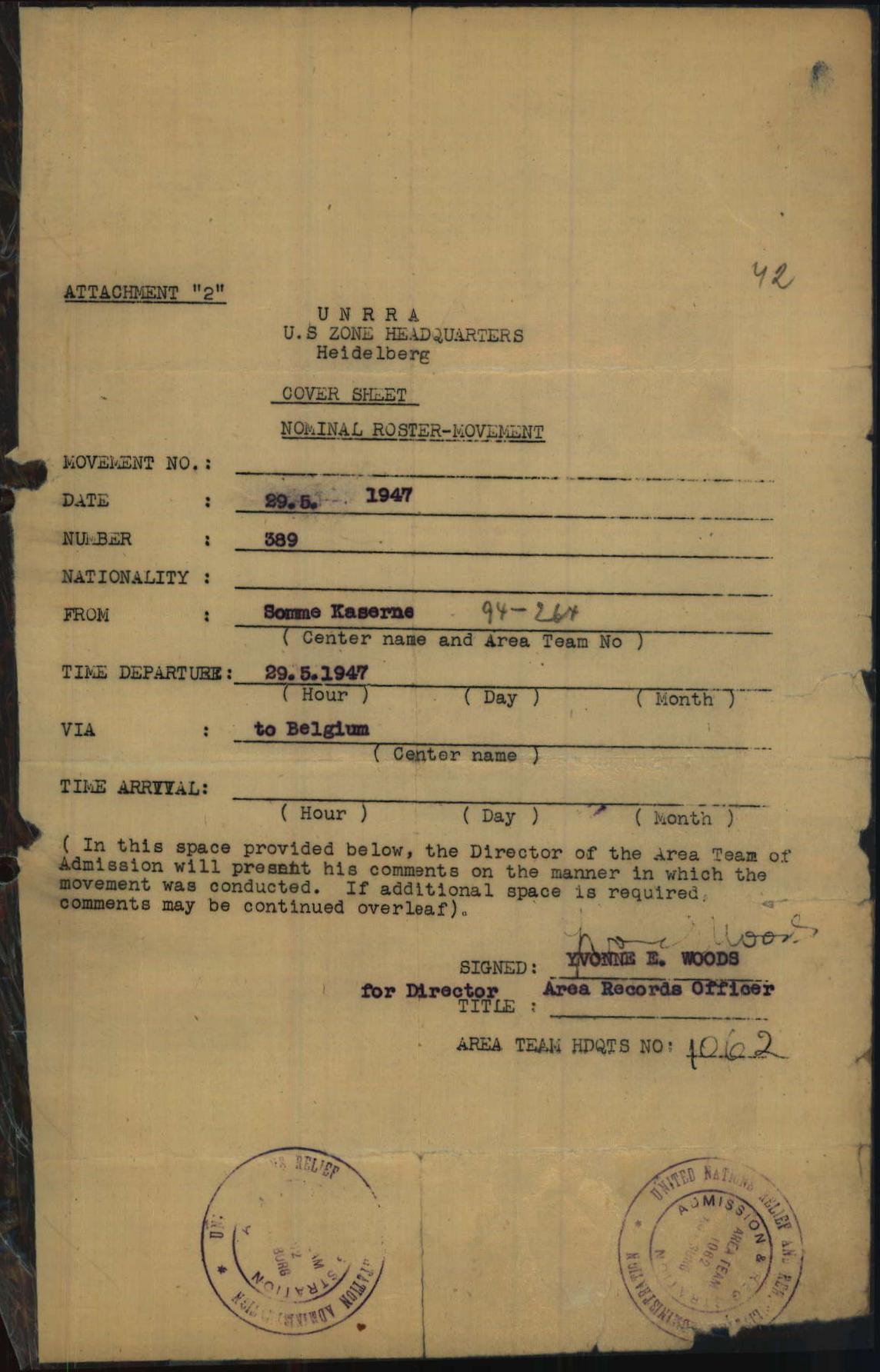
A surviving UNRRA roster makes one of those routes precise. Its cover is dated 29 May 1947 and names Somme-Kaserne and Belgium. The accompanying wagon lists give Herbesthal as the destination. The first sheet bears a later annotation of 331 DPs, while the cover’s NUMBER field reads 389; several individual entries are crossed out. The movement and date are clear, but these sheets alone do not establish a reconciled passenger total.14
The family histories assembled for Geboren 1946 show how journeys could involve transfers to other camps, including Leipheim, before an overseas departure. They also show that migration was not a simple guarantee of reunion or prosperity. Medical assessments, eligibility decisions and family circumstances could change the outcome.4
A camp closing date therefore cannot serve as a departure date for everyone who lived there. The community dispersed over time, and its connections continued through families, churches, cultural organisations and former-resident groups. A 1987 bulletin of former Somme-Kaserne and Leipheim residents survives in the Shevchenko collection.5
The sports report also preserves individual departures: Skorobohatyi left for work in England on 16 January 1948, and Yaroslav Khorostil left for Canada on 23 January. The editor placed those dates beneath an account of their last mountain excursion together. A club history thus records the moment when shared pursuits in Bavaria gave way to lives on different continents.1
The 1949 transfer to Leipheim carried part of Augsburg’s Ukrainian institutional life into another camp. The Encyclopedia of Modern Ukraine records that some organisations continued in Leipheim and Munich. Closure dispersed people and functions rather than ending the community’s history on a single day.16
Documented departures and destinations
| Date | Destination | Evidence |
|---|---|---|
| May 1947 | Belgian coal mines | Chornohora’s account of the first labour transports. |
| 29 May 1947 | Herbesthal, Belgium | UNRRA movement cover and wagon lists. |
| 16 January 1948 | England | Departure of Skorobohatyi for work, recorded in the sports report. |
| 23 January 1948 | Canada | Departure of Yaroslav Khorostil, recorded in the same report. |
| 1949 | Canada | Roman Korol’s family, in the account of his 2015 return. |
| 1949 | Leipheim, Germany | Transfer of the camp community described in the encyclopedia. |
The site today
The former camp lay along Sommestraße in Augsburg’s Kriegshaber district. The former officers’ building is now Kulturhaus Abraxas. Its own building history dates it to 1936 and records the later incorporation of the surrounding barracks into Reese Barracks around 1953. The cultural centre opened in 1995.3
The landscape has changed since Roman Korol’s 2015 visit. The cultural centre’s updated history reports that the former barrack buildings at Sommestraße 38, 40 and 50 were demolished in 2025. Older accounts describing those buildings as still occupied by Kulturpark West no longer describe the present site. Abraxas remains an important link between the location and its layered history.3
Documents and further reading
The 1948 Chornohora volume is especially valuable because it combines a resident-written account with dated statistics, names and photographs. The original-language pages allow the historical narrative to be checked against what the community published about itself.1
The Shevchenko Scientific Society’s Augsburg collection contains documents, photographs and publications, including Na chuzhyni. It covers more than one Augsburg setting; inclusion in the collection does not by itself identify a photograph as Somme-Kaserne.5
Further material is dispersed among repositories. The Stel’makh papers contain church records and correspondence. Philipp Seuferling’s study of refugee-camp media identifies a United Nations Archives file, S-0436-0016-01, containing publications and photographs from the Ukrainian camp. Alongside personal registration and migration records, these collections preserve the camp’s public and private life.812
Recent work continues to widen the picture. Rozhkova and Kuzmenko’s comparative study, published online in January 2026, places memoirs alongside documents to examine housing, family relationships, work, culture and migration. Its reference to the 2020 Augsburg collection leads to Stepan Mechnyk’s account. Experiences from other camps in that study provide context, rather than evidence that the same incidents happened here.18
The United Ukrainian American Relief Committee’s report of 30 June 1948 names Augsburg’s Sommekaserne among the principal camps in the American zone. It provides a contemporary link between the camp and the wider Ukrainian relief network.22
Where the records survive
| Collection | Contents and reference |
|---|---|
| Chornohora, 1948 | Camp history and statistics, pp. 9–12; photographs and sport; participant lists, pp. 72–74; 1948 chronicle, pp. 75–79. |
| UNRRA movement records | Somme-Kaserne–Belgium movement: 81963894–81963896, 29 May 1947. |
| Shevchenko Scientific Society | Augsburg papers: bylaws, elections, parish material, education, photographs, press and former-resident publications. |
| Fr. Petro Stel’makh papers | St Nicholas parish history, church records and correspondence. |
| Vasyl and Liudmyla Serdiuk papers | Theatre programme preserved at the Ukrainian History and Education Center. |
| United Nations Archives | Somme-Caserne publications and photographs cited by Seuferling: S-0436-0016-01. |
Book-length history
Український табір ДП в Авґсбурзі: Спомини. Документи. Світлини
Edited by Volodymyr Serhiychuk, with materials compiled by Dmytro Shtohryn and others. Vyshhorod, 2020. ISBN 978-617-7837-06-9. Memoirs, documents and photographs; a separate, book-length account of the community.
Sources
- Де сила — там воля вітає. Огляд діяльности Українського Спортового Товариства «Чорногора» в Авґсбурзі за роки 1945–1948
Chornohora sports society · 1948
Printed pp. 6, 9–12, 15–17, 32–33, 37, 39, 59–66, 67 and 75–79. Contemporary resident-written history, dated demographic snapshot, sporting results, photographs and departure notes. Original pages inspected; demographic arithmetic checked.
- DP camp inventory, entry 737
Arolsen Archives · 26 October 2023
Administrative identifiers, recorded dates and capacity; not a census.
- Chronik & Geschichte
Kulturhaus Abraxas, City of Augsburg · Accessed 12 September 2026
Building history, Roman Korol interview description and 2025 demolition update.
- Geboren 1946 im ukrainischen DP-Lager in der Somme-Kaserne Augsburg
Reinhold Forster, geschichtsagentur augsburg · Exhibition documentation; accessed 12 September 2026
Camp life, registration records and reconstructed family journeys.
- DP Camps: Augsburg Papers
Shevchenko Scientific Society · Finding aid, 2011
Historical note and container list, pp. 1–3. Collection covers Augsburg beyond this camp.
- Theater amid the ruins of war
Ukrainian History and Education Center · 19 May 2022
Description and images of a 1945–46 theatre programme from the Serdiuk papers.
- Visit from the Past
Amerika in Augsburg e.V. · Account of the August 2015 visit
Roman Korol’s return to his former home; eyewitness reporting of the visit.
- Guide to the papers of Fr. Petro Stel’makh
Michael Andrec, Ukrainian History and Education Center · 24 February 2016
Biographical note and description of church records.
- Табір Соммеказерне (Somme-Kaserne)
Tür an Tür / DIWA 4.0 · Accessed 12 September 2026
Ukrainian-language local history; education and community institutions.
- The Power of Hope and Dreams: Ukrainian Intellectual Renaissance in Postwar Augsburg
Tetiana Vynarchuk, Ukrainian Free University · 2025
Conference proceedings, printed pp. 151–159. Entire article read; specific school history and 4 February 1946 university-course opening on p. 158. Newspaper references retained in the research record.
- Останній рік у житті Ольги Косач-Кривинюк
Tamara Skrypka · Accessed 12 September 2026
Documented biography with letters and memoir references.
- Media and the Refugee Camp: The Historical Making of Space, Time, and Politics in the Modern Refugee Regime
Philipp Seuferling · 2021
Figures 22 and 39, printed pp. 167 and 231; UN Archives reference S-0436-0016-01.
- Велоестафета Чоти Крилатих з нагоди відзначення «Свята Героїв» в Авгсбургу
Andrii Korolyshyn / Istoriia Plastu · 25 April 2024
Account drawing on Dmytro Shtohryn’s recollections and the unit’s archive; historical photographs and a link to 1947 film. Captions distinguish 1947 and 1948 events.
- Nominal roster: Somme-Kaserne to Belgium, 29 May 1947
UNRRA, Area Team 1062; preserved by Arolsen Archives · 29 May 1947
Cover sheet 81963894 and wagon lists 81963895–81963896. Original scans inspected. The cover’s NUMBER field reads 389; the first list bears an annotation of 331 DPs. These are not treated as a verified passenger total.
- На схрещених дорогах [At the crossroads]
Sofiia Parfanovych; Mykola Denysiuk press, Chicago · 1963
Autobiographical literary account. Printed pp. 340–343 checked against the scan; the author describes the barracks community while also living outside it. Distinguishes observation and retrospective narrative from an administrative report.
- Авґсбурґ [Augsburg]
V. S. Lenyk and L. I. Rudnytskyi, Encyclopedia of Modern Ukraine · 2001
Augsburg-wide history; specific dates for congresses at Somme-Kaserne and the 1949 transfer to Leipheim.
- Duszpasterstwo redemptorystów polskich wśród Polonii w Niemczech
Marian Brudzisz, Studia Polonijne, vol. 27 · 2006
Printed pp. 71–72. Archival research on the Polish community before the Ukrainian occupation; cites Fr. Jan Szymaszek’s report of 3 January 1946, Polish Catholic Mission archive, file 227.
- “Further west, from a bright future”: Ukrainians in camps for displaced persons
Liudmyla Rozhkova and Nataliia Kuzmenko, Siverian Chronicle · 2025 issue; published online 6 January 2026
Vol. 5 (2025), pp. 59–66; DOI 10.58407/litopis.250506. Comparative study of memoirs, including a citation to p. 22 of the 2020 Augsburg volume. Used for the wider setting, not to transfer incidents from other camps to Somme-Kaserne.
- Ukrainian Thought, issue 1, 27 September 1946
Ukrainian Museum-Archives of Cleveland / USHMM digitisation · 27 September 1946
Original front page and printed p. 5 checked against scans (PDF pp. 3 and 7). Editorial title-change notice and the camp council’s account of the September press dispute.
- «Архів Петра Курінного»: збірка фотодокументів Інституту рукопису НБУВ. Джерелознавче дослідження
Tetiana Sebta · 2025
Printed p. 34: dated population figures and camp questionnaire, citing the 2020 camp history and Maruniak. ISBN 978-617-14-0419-9; DOI 10.5281/zenodo.15881594. Full PDF acquired; relevant pages checked.
- Table 8: Ukrainians in the UNRRA or IRO Camps of the United States Zone of Germany
Ihor Stebelsky, Ukrainian Historian · 1986
Printed pp. 53–54 (PDF pages 55–56), headings, source footnotes and Augsburg row visually checked. First column covers questionnaire returns collected during 1946–47; other columns are separate UNRRA/PCIRO reports. Original archival reports not inspected.
- Report of the United Ukrainian American Relief Committee, Inc.: History, Accomplishments, Statistics and Plans
United Ukrainian American Relief Committee · 30 June 1948
Printed p. 18 / PDF p. 22: main camps list visually inspected. Contemporary organisational report; selective list, not comprehensive inventory.
- На чужині — Ukrainians in foreign countries, 21 April 1946
Shevchenko Scientific Society · 21 April 1946
Ukrainian photo-newspaper issued with the approval of UNRRA. Archive reference 049_00668_03; the sports page reproduced here is page 4 of the source PDF. Masthead and selected captions transcribed from the scan.
Last researched 12 September 2026