Camp 71, Aldingen
Displacement in Europe
Aldingen (Remseck am Neckar) · Germany · DP camp: April 1946–29 May 1947
A fenced barracks camp on the old Ludwigsburg parade ground held prisoners of war, then interned Nazi functionaries, before becoming a Polish displaced-persons camp in 1946. Its transfer lists record Polish Ukrainians being moved on to separate Ukrainian camps.
Introduction
Camp 71 stood on Aldingen land at the edge of Ludwigsburg, on ground that is now the Grünbühl district. For a little over a year, from spring 1946 to the end of May 1947, it was a displaced-persons camp for former Polish forced labourers, run by an UNRRA team under the American military command in Ludwigsburg. It was one of four DP camps in the Ludwigsburg area at the end of 1946 and the only one outside the town’s barracks.
The camp matters for Ukrainian history in a limited but specific way. The occupancy and transfer reports kept in the Arolsen Archives show that Polish citizens of Ukrainian nationality were moved out of Aldingen to separate Ukrainian DP camps. The reports read so far do not name those camps or give a Ukrainian head count, so the page describes a Polish camp through which some Ukrainians passed rather than a Ukrainian community.
Sources for this section
A history in dates
- 1830The Ludwigsburg garrison begins to lay out its large parade ground on Aldingen land.
- 1935The Alter See barracks camp is built inside the parade ground; from 1940 it holds French prisoners of war.
- May 1945The US Army opens Internment Camp 71 in the former barracks camp for about 2,500 automatic-arrest internees.
- 1946The military government publishes the illustrated camp book Camp 71.
- April 1946Polish displaced persons move in; the Arolsen inventory dates the camp’s records from 1 August 1946.
- 7 December 1946UNRRA counts 905 residents in Aldingen Camp No. 717.
- 29 May 1947The remaining 621 residents are transferred to the Luitpold barracks and the camp closes.
- Summer 1947The barracks are returned to German administration and used for refugees; the Grünbühl settlement follows.
- 1950The Aldingen-Neuheim hostel for remaining DPs is built; Grünbühl becomes part of Ludwigsburg in 1956.
Sources for this section
- Das DP-Camp 71 in Aldingen
- Das Aldinger Camp 71 1945/46 als Internierungslager
- Ludwigsburger Geschichtsblätter 45: the internment camps in and around Ludwigsburg, and Ludwigsburg 1945 to 1948
- DP camp inventory: Aldingen, DP-Camp 71 (Aldinger Kaserne), entry 666
- Displaced Persons (DPs) in Ludwigsburger Kasernen 1945–1951
Parade ground, barracks and prisoners
From 1830 the Ludwigsburg garrison developed its Große Exerzierplatz, the large parade ground, on Aldingen land. In 1935 a barracks camp called Alter See was built inside the parade ground, and from 1940 it held French prisoners of war. The 1991 survey of Ludwigsburg internment camps describes the site as a former Stalag barracks camp.
In May 1945 the American army turned the fenced camp into Internment Camp 71 for people subject to automatic arrest, chiefly local and district functionaries of the Nazi regime. About 2,500 internees were held there until mid 1946. The camp was in poor condition and the internees were first put to clearing and repair work. Internal administration was handed to a German camp leader with a team of 38 internees, including ten department heads and 25 barrack elders; twelve men shared each small room in bunk beds. A camp school, a daily camp newspaper and, from spring 1946, loudspeaker broadcasts of Stuttgart radio were part of camp life.
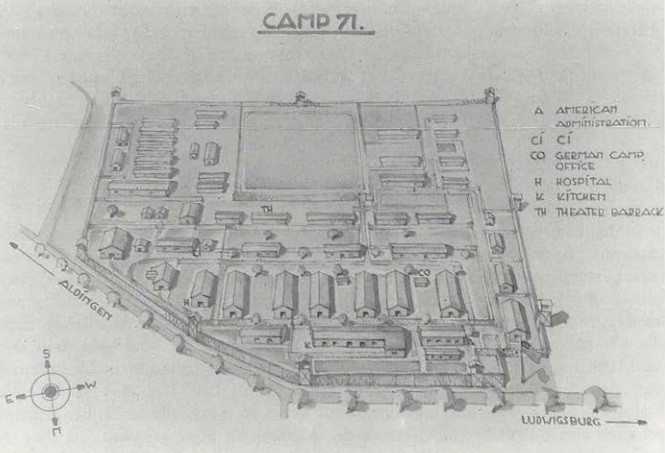
In 1946 the military government for Württemberg-Baden published a 74 page illustrated camp book about Camp 71, printed in Stuttgart, evidently produced by the internees under American supervision. Historians read it as a propaganda piece meant to give a relaxed impression of internment, although it also shows the daily roll call and the delousing plant.
The Polish DP camp, 1946 to 1947
By mid 1945 the Americans had gathered up to 15,000 displaced persons in the empty Ludwigsburg barracks for repatriation. Transport was lacking at first, and as communist rule in Poland became clear many Poles refused to go home. Supplying the Polish camps was difficult and complaints about crime were constant, so the Americans decided to move Polish DPs into fenced camps that had previously held prisoners of war or internees. The Aldingen camp was one of these: the Polish DPs moved in in April 1946, according to the local history society, while the Arolsen inventory dates its first records to 1 August 1946.
The camp was looked after by UNRRA Team 91, subordinate to the military command in Ludwigsburg, and carried the assembly centre number 717. It normally held about 950 Polish DPs. The first precise UNRRA statistic, dated 7 December 1946, lists four camps in Ludwigsburg and Aldingen with 3,094 residents in total, almost all Poles: the Jägerhof, Luitpold and Karls barracks, and Aldingen Camp No. 717 with 905 residents. The society’s reading that 3,094 people passed through Camp 71 appears to rest on this four-camp total and should be treated with caution.
The 164 pages of occupancy lists in the Arolsen Archives show a camp with equal numbers of men and women. Change reports record Polish DPs being transferred to Aldingen from other camps, above all from Schwäbisch Hall, Ulm and Waiblingen, and Polish Ukrainians being transferred out to Ukrainian DP camps of their own. Repatriation remained slow: the first list, in August 1946, named 44 residents willing to return, and later months brought 68 in November 1946, 57 in December, 8 in January 1947 and 40 in February. October 1946, with 342 returnees, was the one exception.
On 29 May 1947 the remaining 621 residents were moved to the Luitpold barracks in Ludwigsburg and Camp 71 was dissolved. The Arolsen inventory places the closure between 20 May and 20 June 1947, and the 1947 town chronicle records that the barracks of the Aldinger Lager were handed back by the occupation authorities in the summer of that year.
Arolsen Archives DP camp inventory, entry 666
| Field | Catalogue entry |
|---|---|
| Location and building | Aldingen, DP-Camp 71 (Aldinger Kaserne) |
| Region and district | DP US, District 1 |
| Opening | 1 August 1946 |
| Closing | Between 20 May and 20 June 1947 |
| Capacity | Not recorded (capacity date 31 October 1947) |
| Assembly centre | AC 717 |
| UNRRA team | T 91 Ludwigsburg; Area Team AT 1002 Ludwigsburg; Area A 2 Ludwigsburg |
| Nationality recorded | Polish |
| Archive reference | ITS lists including occupancy and change reports for Aldingen, document IDs 81960082 to 81960232 |
Residents listed for repatriation, from the Arolsen occupancy lists
| Month | Residents listed |
|---|---|
| August 1946 | 44 |
| October 1946 | 342 |
| November 1946 | 68 |
| December 1946 | 57 |
| January 1947 | 8 |
| February 1947 | 40 |
| 29 May 1947 | 621 transferred to the Luitpold barracks at closure |
UNRRA statistic for the Ludwigsburg area, 7 December 1946
| Camp | Number | Residents |
|---|---|---|
| Jägerhof barracks | 643 | 914 |
| Luitpold barracks | 644 | 890 |
| Karls barracks | 646 | 385 |
| Aldingen Camp | 717 | 905 |
| Total | 3,094 |
From camp to Grünbühl
The barracks did not stay empty. From 1947 they housed German expellees and refugees, and the settlement that grew there acquired its own shops, schools and small industrial sites. Its administration was awkward because the ground belonged partly to Ludwigsburg, partly to Aldingen and partly to Kornwestheim, although Ludwigsburg looked after the residents. In the same year about 450 former DPs, mostly Poles and Ukrainians whose DP status had been withdrawn by UNRRA or the IRO, were assigned to Ludwigsburg as refugees; that figure covers the town as a whole, not the Aldingen camp.
For Polish DPs who stayed in Germany, the state hostel Aldingen-Neuheim was built on the Aldingen part of the site in 1950 as part of the Grünbühl settlement, and in 1951 to 1952 an IRO emigration camp was set up to the west on Kornwestheim land. In 1956 Aldingen and Kornwestheim ceded the ground to Ludwigsburg and Grünbühl became a district of the town; Pattonville, the housing estate for the US Army, rose on the eastern part of the old parade ground from 1954. The 1989 study concluded that Ludwigsburg had to house displaced persons longer than most towns, until 1951, and that the DPs themselves left almost no written trace of their own.
Sources
- Das DP-Camp 71 in Aldingen
Beth Shalom, Haus des Friedens, Remseck am Neckar · May 2026
Local history society article read in full. Gives the 1946 to 1947 DP phase, UNRRA Team 91, the prewar Alter See barracks, the reading of 164 pages of Arolsen occupancy lists including transfers of Polish Ukrainians to Ukrainian camps, monthly repatriation figures and the closure on 29 May 1947. Also the source of the reproduced 1946 camp plan.
- Das Aldinger Camp 71 1945/46 als Internierungslager
Beth Shalom, Haus des Friedens, Remseck am Neckar · 3 June 2026
Companion article on the internment phase from May 1945 to mid 1946, the 2,500 internees, the internal camp administration and the 74 page camp book printed for the military government in 1946.
- Displaced Persons (DPs) in Ludwigsburger Kasernen 1945–1951
Ulrich Müller, Ludwigsburger Geschichtsblätter 43, Badische Landesbibliothek digital copy · 1989
Printed pp. 130 to 139 read. Supplies the UNRRA statistic of 7 December 1946 listing four camps with 3,094 residents, of which Aldingen Camp No. 717 held 905, the resettlement centre nationalities of March 1950 and the 1950 Aldingen-Neuheim hostel. The article closes: “Länger als andere Gemeinden hatte Ludwigsburg den displaced person Unterkunft gewähren müssen. … Die DPs selbst haben fast keine Spuren oder Zeugnisse hinterlassen, so daß wir nichts von ihren Sorgen, Hoffnungen und Wünschen erfanren.”
- Ludwigsburger Geschichtsblätter 45: the internment camps in and around Ludwigsburg, and Ludwigsburg 1945 to 1948
Ulrich Müller and others, Ludwigsburger Geschichtsblätter 45, Badische Landesbibliothek digital copy · 1991
Two contributions read: the internment camp survey (printed pp. 174 to 175, with the note on the 1946 brochure Camp 71 in Hauptstaatsarchiv Stuttgart J 171) and the town chronicle for 1947 (printed pp. 137 to 139) on the return of the Aldinger Lager barracks in summer 1947, the UNRRA camps administered in spring 1947 and the 450 former DPs reassigned as refugees.
- DP camp inventory: Aldingen, DP-Camp 71 (Aldinger Kaserne), entry 666
Arolsen Archives · 26 October 2023
Row 666 read from the downloaded spreadsheet: opening 1 August 1946, closing between 20 May and 20 June 1947, nationality Polish, assembly centre AC 717, UNRRA Team T 91 Ludwigsburg, Area Team AT 1002 Ludwigsburg, document IDs 81960082 to 81960232.
- Letter from the Director of the UNRRA Assembly Center Ludwigsburg to the Oberbürgermeister of Ludwigsburg, 2 April 1947
Stadtarchiv Ludwigsburg, reproduced in Ludwigsburger Geschichtsblätter 43 (1989), p. 135 · 1947
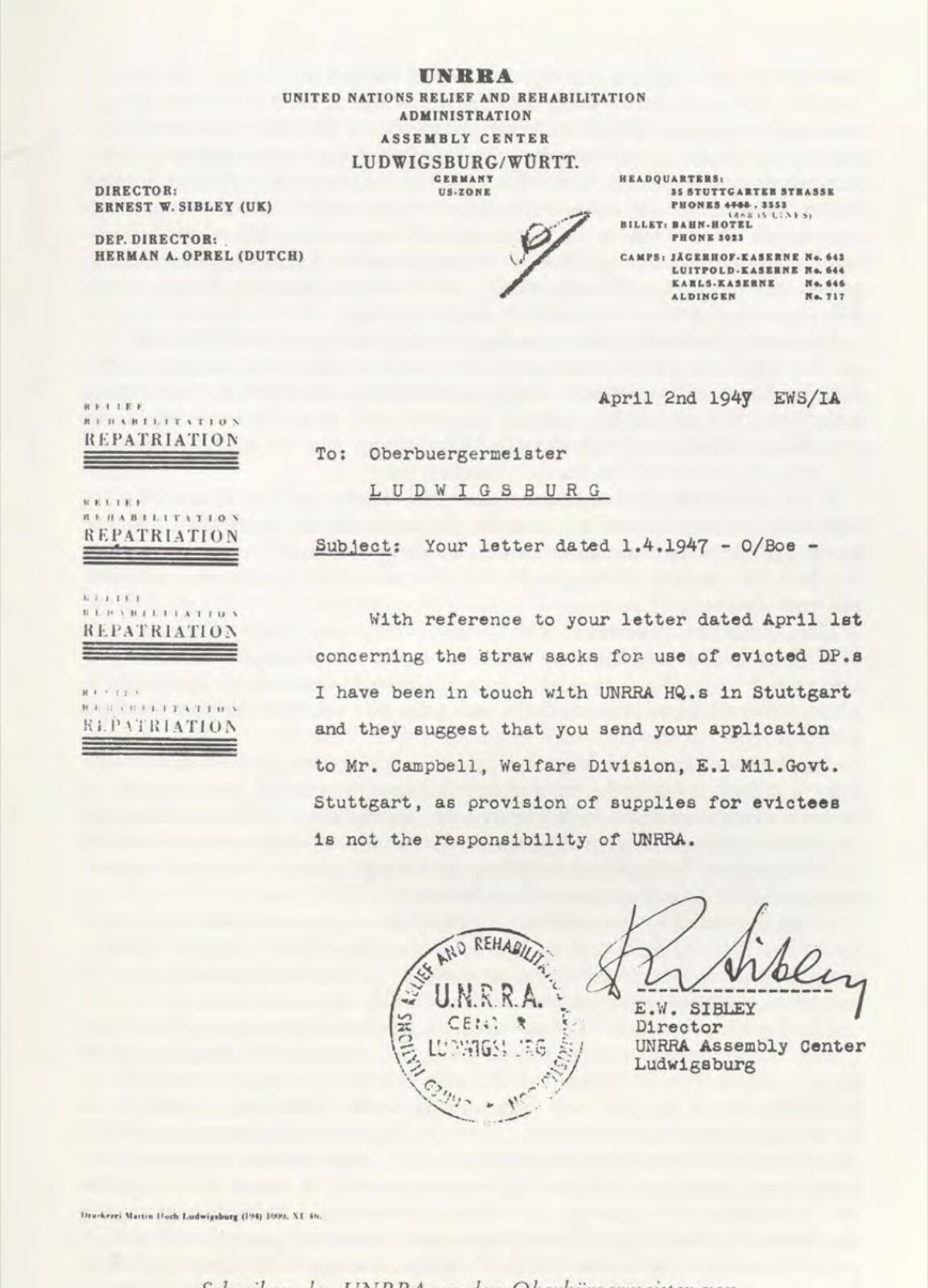
Typed letter on the assembly centre’s printed letterhead, signed by the director E. W. Sibley, declining responsibility for straw sacks for evicted DPs. The letterhead lists the centre’s four camps by number: Jägerhof-Kaserne No. 643, Luitpold-Kaserne No. 644, Karls-Kaserne No. 646 and Aldingen No. 717. The volume’s Bildnachweis credits the illustrations on pages 127 to 139 to the Stadtarchiv Ludwigsburg; the journal states all rights reserved and no reuse licence.
Last researched 12 September 2026