Altöttinger Hof
Displacement in Europe
Altötting, Bavaria, Germany · Postwar resettlement
Altöttinger Hof is a Baroque inn beside Altötting’s pilgrimage quarter which held 50 Yugoslav and Ukrainian residents on 12 August 1947. It was one of four town buildings named in that return, and it was never registered as an assembly centre in its own right.
Introduction
Altöttinger Hof is a Baroque inn beside Altötting’s pilgrimage quarter which held 50 Yugoslav and Ukrainian residents on 12 August 1947. It was one of four town buildings named in that return, and it was never registered as an assembly centre in its own right.
A history in dates
- 1685Building constructed.
- 1803–1805House passed to the state during secularisation.
- 1870Georg Wasner purchased the house.
- 1928Alois and Maria Stechl acquired the inn.
- 24 August 1946UNRRA summary counts 92 Ukrainians at Altötting.
- 5 May 1947Ukrainian sports society Prolom founded in the town.
- 31 May 1947UNRRA summary counts 169 Ukrainians at Altötting.
- 12 August 194750 Yugoslav and Ukrainian residents recorded together at the inn.
- Autumn 1947Prolom dissolves itself.
- July 1950Inn named as a pilgrimage gathering place.
Sources for this section
- Der Gasthof und seine Geschichte, Altöttinger Hof
- Bavarian monuments list: Altötting
- Ihor Stebelsky, Table 8: Ukrainians in the UNRRA or IRO camps of the United States zone
- Dzerkalo sportovykh tovarystv, in Almanakh Rady Fizychnoi Kultury 1945–1948
- Patrick Charell, Altötting, Haus der Bayerischen Geschichte
- Riesengebirgsheimat, July 1950, page 20
A seventeenth-century building
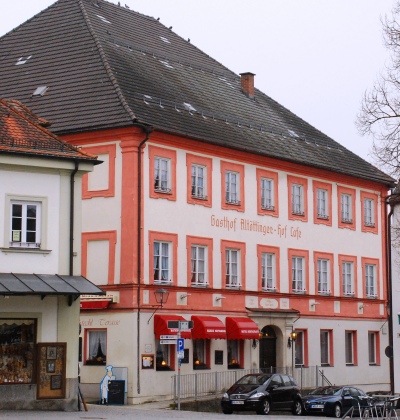
The Bavarian monuments register describes a substantial three-storey Baroque building with a hipped roof and two rear wings. Its three-wing arrangement distinguishes the inn from a purpose-built barrack camp. The protected building stands at Mühldorfer Straße 1, adjoining the central pilgrimage quarter.
Sources for this section
From religious house to family inn
The inn’s own history says monks first occupied the house, which passed to the state during secularisation in 1803–1805. Brewery owner Georg Wasner bought it in 1870. Alois and Maria Stechl acquired the inn in 1928, beginning the family ownership described in its later history. These changes place the displaced-person accommodation within the longer life of a working town inn.
Sources for this section
The return of 12 August 1947
Christian Haringer’s enumeration for 12 August 1947, quoted by Haus der Bayerischen Geschichte, names four buildings. It records 200 Polish Jews at the Gasthaus Bayerischer Hof, 200 Ukrainians at the Gasthof Zwölf Apostel, 50 Yugoslavs and Ukrainians together at the Gasthof Altöttinger Hof, and 200 Yugoslavs in the former domestic science school Josefsburg of the Englische Fräulein. Individual people were lodged elsewhere, among them the inns Schex, Alte Post and Huber, and private houses.
The 50 recorded here is the smallest of the four figures and the only one that combines two nationalities without dividing them. It is a count on one day and not a total of everyone who passed through the inn. Ukrainians at Altötting therefore lived across at least two separate inns rather than in a single compound.
The four buildings named for 12 August 1947
| Building | Recorded residents | Scope |
|---|---|---|
| Gasthaus Bayerischer Hof | 200 | Polish Jews |
| Gasthof Zwölf Apostel | 200 | Ukrainians |
| Gasthof Altöttinger Hof | 50 | Yugoslavs and Ukrainians combined |
| Former Josefsburg domestic science school | 200 | Yugoslavs |
Sources for this section
Registered centres and unregistered houses
Displaced-person work at Altötting was run by UNRRA Team 305, with Watson recorded as team director from January 1946 and Brooke as field supervisor. From November 1946 the town was served by the area teams at Traunstein and Bad Reichenhall in the Munich area A 7. The American military government kept its district base at the Hotel Zur Post on the Kapellplatz, and displaced people drew ration cards centrally and spent them in the town’s shops.
The Arolsen inventory registers four numbered Altötting centres: the Polish House, opened on 23 December 1945; the Bayerischer Hof, recorded as Jewish with a capacity of 312 and closed on 12 April 1948; Altötting III, recorded as Yugoslav with a capacity of 126; and Altötting IV, for which no nationality is recorded. Altöttinger Hof is not among them, and neither is Zwölf Apostel.
The inn accordingly has no registered opening date, capacity or assembly-centre number. Its displaced residents were quartered in a working town inn under requisition, and they survive in a local historian’s enumeration rather than in an assembly-centre register.
The registered Altötting assembly centres
| Centre | Opened | Closed | Recorded nationalities | Capacity at 31 October 1947 |
|---|---|---|---|---|
| Altötting I, Polish House | 23 December 1945 | Between 25 August and 20 September 1947 | Jewish, Polish, Polish-Ukrainian, Yugoslav | not recorded |
| Altötting II, Bayerischer Hof | 24 January 1946 | 12 April 1948 | Jewish | 312 |
| Altötting III | 24 January 1946 | Between 30 January and 30 September 1948 | Yugoslav | 126 |
| Altötting IV | 24 January 1946 | Between 25 August and 20 September 1947 | not recorded | not recorded |
Ukrainians counted at Altötting
Stebelsky’s table of Ukrainians in the camps of the American zone enters Altötting by town, not by building. It gives 136 from questionnaire returns collected during 1946 and 1947, 92 in the UNRRA summary of 24 August 1946 and 169 in the UNRRA summary of 31 May 1947, and prints no figure in the summary compiled for the Preparatory Commission of the International Refugee Organisation on 2 January 1948.
None of these totals can be assigned to Altöttinger Hof, and the town figure for May 1947 is smaller than the August 1947 figure for Zwölf Apostel alone. The two sets of numbers were compiled on different principles and should be read side by side rather than added together.
Ukrainians counted at Altötting, by return
| Return | Ukrainians |
|---|---|
| Questionnaires collected during 1946 and 1947 | 136 |
| UNRRA summary, 24 August 1946 | 92 |
| UNRRA summary, 31 May 1947 | 169 |
| PCIRO summary compiled 2 January 1948 | no figure printed |
Ukrainian community life in the town
The Munich almanac of the Ukrainian Council for Physical Culture records one Ukrainian society at Altötting. Prolom was founded on 5 May 1947 under the chairmanship of Osyp Liskevych, in a town the almanac describes as famous for its pilgrimages and as holding 130 Ukrainians. Only the men’s volleyball section was active, and the society dissolved itself in the autumn of 1947 without having developed a programme.
A community spread across inns and private houses had no camp hall or sports ground of its own, which is the likeliest reason the society failed so quickly. The almanac’s 130 is its own figure for the town and belongs to no single building.
Sources for this section
Keeping the Altötting houses apart
The four buildings in the 1947 return served different populations and must not be merged. The Bayerischer Hof at Neuöttinger Straße 5 was the administrative seat and social centre of the Jewish displaced-persons community and contained its prayer room; it had been a Wehrmacht auxiliary hospital and was demolished in the 1960s. The Josefsburg was a former domestic science school. Zwölf Apostel stands at Kapuzinerstraße 3. Altöttinger Hof, at Mühldorfer Straße 1, is a separate protected building and the only one of the four recorded with a mixed Yugoslav and Ukrainian household.
A place for gatherings
A July 1950 pilgrimage notice named Altöttinger Hof as the midday gathering place for Egerland participants. This records another use of the inn after the 1947 population return. Pilgrimage hospitality and displaced-person accommodation belong to the same building’s history, although the notice gives no end date for the latter.
Sources for this section
The inn and its changing surroundings
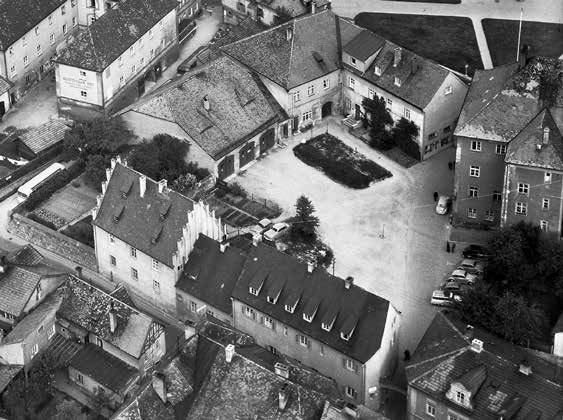
A 1957 aerial photograph preserved by Altötting’s city archive shows the inn’s surroundings in the Bezirksamtshof. The published caption identifies the neighbouring Feuerhaus and explains that much of the courtyard’s building stock disappeared when a modern Stations of the Cross route was created in 1964. The municipal tourism photograph provides a later street-level view of the inn’s red-and-white façade.
Sources
- Patrick Charell, Altötting, Haus der Bayerischen Geschichte
Undated
Quotes Christian Haringer’s 12 August 1947 accommodation figures; underlying return not independently inspected.
- Riesengebirgsheimat, July 1950, page 20
Undated
Original pilgrimage notice previously visually read. Describes event arrangements, not displaced-person accommodation dates.
- Der Gasthof und seine Geschichte, Altöttinger Hof
Undated
Inn’s own historical account: 1685 building, 1803–05 secularisation, 1870 purchase, 1928 Stechl family.
- Bavarian monuments list: Altötting
Undated
Page 8, D-1-71-111-44, Mühldorfer Straße 1; 1685 Baroque three-wing building.
- Anton Grundner, Bedeutende Bauwerke, Stadtblatt Altötting, June 2022
Undated
Printed page 20: 1957 aerial photograph from Stadtarchiv, neighbouring Feuerhaus and subsequent 1964 changes.
- Gasthof Altöttinger Hof, municipal tourism listing
Undated
Official listing gives address and exterior photograph credited to Altöttinger Hof. Undated photograph.
- Arolsen Archives DP-Camp Verzeichnis: the Altötting rows
Arolsen Archives · Inventory of 26 October 2023
Rows 685 to 688: the four registered Altötting assembly centres under UNRRA Team 305, with dates, nationalities, capacities and assembly-centre numbers. Neither Altöttinger Hof nor Zwölf Apostel appears in the inventory under its own name.
- Dzerkalo sportovykh tovarystv, in Almanakh Rady Fizychnoi Kultury 1945–1948
Molode Zhyttia, Munich · 1951
Printed pages 22 and 84 read from the original scan with Ukrainian optical character recognition and checked against the page images. Entry 45 covers the Prolom society at Altötting.
- Ihor Stebelsky, Table 8: Ukrainians in the UNRRA or IRO camps of the United States zone
Ukrainskyi Istoryk 3 · 1986
Printed pages 53 and 54: column definitions and the Altötting row, read by word co-ordinates and confirmed against the rendered page image.
- Christian Haringer, Jüdisches Leben im Nachkriegs-Altötting, Stadtblatt Altötting 273
Stadt Altötting · September 2020
Printed pages 22 to 24. Describes the military government’s district base at the Hotel Zur Post, the requisitioning of the Bayerischer Hof as a former Wehrmacht auxiliary hospital, and the central issue of ration cards to all displaced persons in the town.
Last researched 12 September 2026