Aufbauschule Camp
Displacement in Europe
Amberg, Upper Palatinate, Germany · Postwar displaced-persons camp, opened 24 January 1946, closed 31 July 1949
A former teacher-training school in Amberg was registered as a displaced-persons camp for seven hundred people between January 1946 and July 1949. Contemporary Latvian newspapers record a theatre company and family tracing at the address, and the register lists Polish-Ukrainians among its residents.
Introduction
Amberg’s Aufbauschule was a residential displaced-persons camp, entered in the Arolsen inventory as Aufbauschool / Area Vocational School. Its recorded population categories were Estonian, Polish, Latvian, Lithuanian and Polish-Ukrainian. The last of these supplies its documented Ukrainian connection; the surviving sources describe a mixed community rather than an exclusively Ukrainian camp.
This was one of several separately registered sites in the town, and it should not be confused with the Kaiser-Wilhelm-Kaserne camp, which has its own record, its own capacity and a different set of recorded nationalities. The two shared the same UNRRA teams and adjacent assembly-centre numbers, so the identifiers are easy to run together.
A history in dates
- 1880 to 1935A royal teacher-training institution occupies the site, replaced in 1935 by the Deutsche Aufbauschule.
- May 1945UNRRA takes over the school building for displaced people.
- 18 August 1945A Latvian theatre company gives an opening performance in the camp.
- 15 November 1945The displaced German school restarts teaching in the Landgericht building.
- 24 January 1946The inventory records the assembly centre as opening.
- 27 April 1946A contemporary family-tracing notice records the camp address.
- 31 October 1947Capacity is recorded as 700.
- 31 July 1949The inventory records the camp as closing.
- December 1951The war-damaged school building is reoccupied by the German school.
A school building put to new use
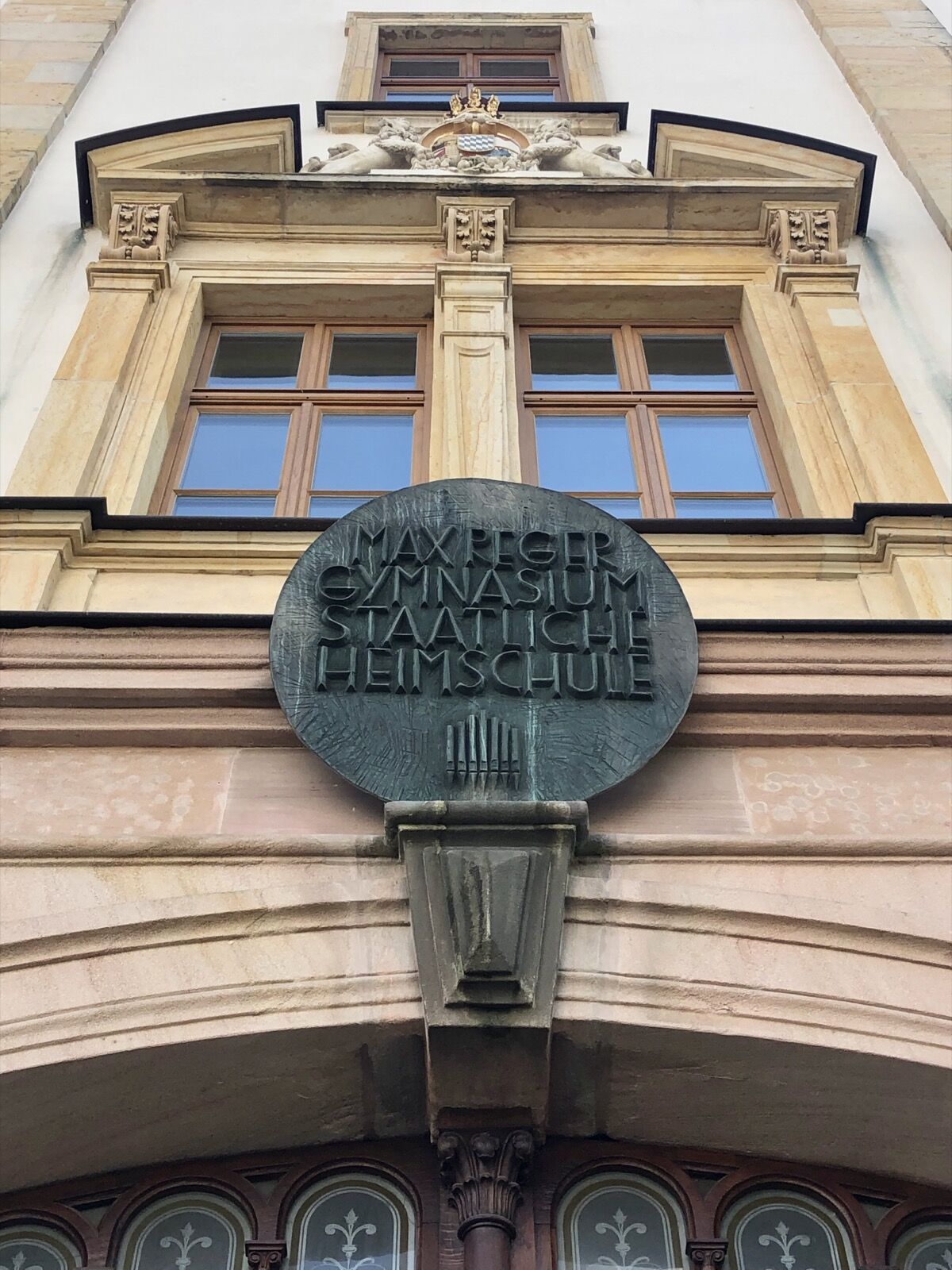
The Aufbauschule belonged to the institutional history of today’s Max-Reger-Gymnasium. A royal teacher-training institution had opened on the site in 1880 and ran until 1935, when the Deutsche Aufbauschule took its place with a six-year course leading to the Abitur. After the war, UNRRA took over the school building for displaced people. The German school’s teaching moved elsewhere in Amberg, illustrating how the same institution and its building could follow different paths during the emergency.
The school-history account records lessons restarting in the Landgericht building on 15 November 1945. Another move followed in 1947. Those were changes in the German school’s location, not dates for the arrival or departure of all displaced people at the original building. The school’s own chronology states that the war-damaged building was reoccupied in December 1951, more than two years after the register’s closing date for the camp; no source read here explains what happened in the interval.
Dates, capacity and administration
The inventory gives an opening date of 24 January 1946 and a closing date of 31 July 1949, a capacity of 700 recorded on 31 October 1947, and assembly-centre identifiers AC 93-549 and AC 93-375, later NBO 455. Supervision came from UNRRA Team 133 at Amberg and Team 570 at Vilseck. Capacity describes accommodation provision on one date, not occupancy and not a count of Ukrainian residents. No verified Ukrainian-only total has been established for this particular building.
The record cites documentation in two places: monthly returns for Amberg among the papers of the International Tracing Service, and files at the Staatsarchiv Amberg, including the collection of monthly reports by the parishes of the Amberg district to the military government on their inhabitants, refugees and displaced persons for 1945 to 1950.
A third documentation lead lies in the archives of the International Refugee Organisation. A catalogue description in the EHRI Portal, drawn from the Archives Nationales de France, lists a dossier of IRO administrative documents from the American zone of Germany that includes documents concerning “Aufbauschule, Amberg” dated October to November 1947. Only the catalogue entry has been read here; the contents of the dossier are not known.
The camp in the register
| Record | Detail |
|---|---|
| Name in the register | Aufbauschool / Area Vocational School |
| Opening | 24 January 1946 |
| Closing | 31 July 1949 |
| Capacity | 700 on 31 October 1947 |
| Assembly centre | AC 93-549; AC 93-375; later NBO 455 |
| UNRRA teams | T 133 Amberg; T 570 Vilseck |
| Population categories | Estonian, Polish, Latvian, Lithuanian, Polish-Ukrainian |
A theatre in the camp hall
On 18 August 1945, a Latvian theatre company gave its opening performance in the Aufbauschule camp. The company had moved from Marienbad through Weiden to Amberg. It staged Rūdolfs Blaumanis’s comedy No saldenās pudeles before Latvian refugees, UNRRA officials and invited Estonian, Lithuanian and Polish representatives. The performance is five months earlier than the inventory’s opening date, which shows that people were housed in the building before the assembly centre was formally registered.
The contemporary report describes flowers presented to the performers and a later performance in the school hall filled to capacity. The troupe hoped to visit other Latvian camps, although transport difficulties stood in its way. This is evidence of Latvian cultural life at the shared site; it is not an account of a Ukrainian theatre company.

Sources for this section
Residents, tracing and the Ukrainian question
A family-tracing notice published on 27 April 1946 used “DP Camp, Aufbauschule, Amberg” as a return address. Alongside the theatre report, it confirms that the school name functioned as a residential address for displaced families.
The published Ukrainian population table has a single row for Amberg covering the whole town rather than any one building. It records no figure in the questionnaire returns collected in 1946 and 1947, then 10 Ukrainians in the UNRRA return of 24 August 1946, 135 in the UNRRA return of 31 May 1947 and 86 in the return compiled for December 1947. These are small numbers for a town with several camps, and none of them can be assigned to the Aufbauschule rather than to the Kaiser-Wilhelm-Kaserne or the other sites.
The town’s own reconstruction record shows how crowded Amberg was around the camp. In January 1946 there were 11,856 refugees and expellees spread across 39 camps, quartered in schools, inns and the town towers and fed from four kitchens. By January 1949 there were 10,132 refugees alongside 5,152 displaced persons in four named facilities. The Aufbauschule is not among those four, although the inventory records it as open until July 1949; the two records have not been reconciled. Refugees and expellees are a separate category from displaced persons and the figures cannot be added together.
Ukrainians recorded at Amberg
| Return | Ukrainians | Scope |
|---|---|---|
| Questionnaire returns, 1946 to 1947 | No figure | Amberg town |
| UNRRA, 24 August 1946 | 10 | Amberg town |
| UNRRA, 31 May 1947 | 135 | Amberg town |
| PCIRO, December 1947 | 86 | Amberg town |
Sources
- DP camp inventory, record 689: Aufbauschool / Area Vocational School
Arolsen Archives
Catalogue row read again in full: Amberg/Oberpfalz, US zone; categories Estonian, Polish, Latvian, Lithuanian and Polish-Ukrainian; opening 24 January 1946; closing 31 July 1949; AC 93-549 and AC 93-375, later NBO 455; Teams 133 Amberg and 570 Vilseck; capacity 700 on 31 October 1947; archive references to ITS monthly returns for Amberg and to Staatsarchiv Amberg files 16832, 6437 and 6762.
- Latvian theatre at Amberg
Bavārijas Latviešu Vēstnesis / National Library of Latvia
8 September 1945 p. 3: opening performance 18 August 1945 at the Aufbauschule camp, before Latvian refugees and invited UNRRA, Baltic and Polish representatives; repeat performance to a full hall. Original scan checked.
- 125 years of the Max-Reger-Gymnasium: radio-feature research
School-history research paper
Full school-history account checked: UNRRA takes the building in May 1945; the German school uses the Landgericht, lessons resume 15 November 1945, and it moves again in 1947. Accusations of arson and damage by residents are omitted as not independently verified.
- Government school bulletin, February 2001
Government of the Upper Palatinate
p. 47 confirms Max-Reger-Gymnasium institutional succession from teacher-training college through Aufbauschule and Deutsches Gymnasium.
- Family-tracing notices, April 1946
Latviešu Vēstnesis / National Library of Latvia
27 April 1946, notice 1527, explicitly addressed to DP Camp Aufbauschule, Amberg. No identifying names reproduced here.
- Ukrainian DP population table, Table 7
Ihor Stebelsky, in The Refugee Experience, 1992
Printed page 48, Bavaria section, row Amberg: no figure in the questionnaire returns of 1946 to 1947, then 10 (24 August 1946), 135 (31 May 1947) and 86 (December 1947). The table has a single Amberg row and does not distinguish the town’s camps. Page rendered from the PDF at 300 dpi and read visually.
- Wiederaufbauatlas: Amberg
Haus der Bayerischen Geschichte
City entry read: 11,856 refugees and expellees in 39 camps in January 1946, quartered in schools, inns and town towers; 10,132 refugees and 5,152 displaced persons in four named facilities in January 1949; 7,368 expellees in September 1950. All figures are city-wide.
- Max-Reger-Gymnasium Amberg
German Wikipedia
Institutional chronology only: teacher-training institution 1880 to 1935, Deutsche Aufbauschule from 1935 with a six-year course to the Abitur, Aufbauschulen converted back to teacher-training institutions in 1946, war-damaged building reoccupied in December 1951. The article does not mention displaced persons.
- The main portal of 1880, Max-Reger-Gymnasium, Amberg
Regerman, via Wikimedia Commons · 28 May 2020
Photograph licensed CC BY-SA 4.0. Shows the 1880 main portal of the school building that housed the Aufbauschule camp, now the Max-Reger-Gymnasium.
- EHRI Portal: IRO administrative documents, American zone of Germany, series 34/2, dossier 61
EHRI Portal; descriptions from Archives Nationales de France
Search-result entry d_1_2_5_6_10_13 on results page 212, within 'Documents provenant des services de l'O.I.R. à l'étranger / Zone américaine d'Allemagne / Documents administratifs III': dossier 61 lists documents on named camps, including 'Aufbauschule, Amberg, octobre - novembre 1947'. Only the catalogue listing was read; the dossier itself was not consulted.
Last researched 13 September 2026