Annsmuir Hostel
Arrival and settlement
Ladybank, Fife, Scotland · German working camp 1945 to February 1948; European volunteer workers’ camp from 1948
Annsmuir near Ladybank was Camp 77, a German working camp that closed in February 1948 and passed into civilian use. By that November it held European volunteer workers employed in agriculture, a Ukrainian directory names Ansmuir Hostel among Scottish hostels with significant Ukrainian numbers, and a 1953 Catholic directory records Sunday Mass inside the camp.
Introduction
Annsmuir, near Ladybank in Fife, was a prisoner-of-war camp and later a hostel included in Peter Kormylo’s directory of accommodation used by Ukrainians. The directory spells its name Ansmuir. A contemporary Catholic directory also uses that spelling when recording regular services in the camp in 1953.
Sources for this section
A history in dates
- 1939The site began as a Territorial Army training camp.
- 14 and 15 August 1945James Grant inspected Camp 77 and called it a rather new camp; English, Russian, mathematics, German and history classes had begun.
- 9 April 1946RAF aerial photography records the fenced compound, surrounding huts, sports field and sewage works.
- 20 February 1947The Foreign Office camp list records 77 (G.W.C.), Annsmuir Camp, Ladybank, under Lieutenant Colonel D. H. G. McCririck.
- 2 to 6 February 1948The camp held 767 men and was recorded as due to close during February, to be taken over as a group of hostels by 63 Camp.
- 23 November 1948The Secretary of State for Scotland told the Commons that European volunteer workers employed in agriculture were resident in Annsmuir Camp.
- PostwarAnsmuir Hostel forms part of the network of accommodation used by Ukrainians in Scotland.
- 1953Sunday Mass is scheduled at 10 a.m. inside the camp; the same entry carries no camp service in 1950 or 1956.
- 2005The heritage record identifies Annsmuir Caravan Park on the former camp site.
- August 2019Two photographic surveys record surviving camp buildings and the reunion memorial stone at the entrance.
Sources for this section
- Annsmuir: Overview of Annsmuir
- James Grant’s visit report and the February 1948 re-educational survey, FO 939/157
- Annsmuir, Camp 77, German Working Camp
- Foreign Office list of prisoner-of-war camps, page 9
- Volunteer Workers’ Camp, Ladybank, written answer
- In which ways is the Ukrainian community in Scotland a diaspora?
- Scottish Catholic Directory 1953
- Scottish Catholic Directory 1950 and 1956, Cupar entries
- PHO 704 Sustainable Prospects, first blog entry
- PoW Camp 77 Annsmuir
A camp within a larger complex
RAF aerial photographs taken on 9 April 1946 show a square fenced compound surrounded by further buildings. The national heritage record identifies at least 37 huts inside the enclosure and about 33 outside it. A sports field and sewage works lay to the north. The distinction between buildings inside and outside the fence reveals a complex extending beyond the prisoners’ enclosure.
The heritage record identifies this as Camp 77, a German working camp, at grid reference NO 3108111554. The Foreign Office list of camps gives its full address as Annsmuir Camp, Ladybank, Fife, in Scottish Command, with the telegraphic address Priswar, Ladybank, the telephone number Ladybank 92 and Lieutenant Colonel D. H. G. McCririck as commandant. The Annsmuir Caravan Park later occupied the site.
The site in the 1946 aerial survey
| Feature | Recorded detail |
|---|---|
| Inside fenced compound | At least 37 huts |
| Outside compound | About 33 huts |
| North side | Sports field and sewage works |
| Photograph date | 9 April 1946 |
Sources for this section
Camp 77 and its closure
The camp opened during the war. When James Grant visited on 14 and 15 August 1945 he called it “a rather new camp” with no library, gramophone records or films, but found the atmosphere very good and the commandant, Lieutenant Colonel McCrerick, proud of what had been achieved. English instruction had already begun, and courses in Russian, mathematics, German and history were under way without books. One of the three named teachers was also the choirmaster, and a Lutheran clergyman ran a Bible class in the camp.
By the time S. Denham Jacobs made his fourth visit, from 2 to 6 February 1948, the camp held 767 men under Lieutenant Colonel Fleming, with 429 at headquarters and the rest at hostels at Beeches, Dunino, Dunning and Belgowan or in billets. The report opens with the decisive sentence: “This camp is due to close down during February and will be taken over as a group of hostels by 63 Camp.” A hundred and twenty-eight prisoners were being civilianised for the former hostels at Auchtermuchty, Dunning and Lathockar. The inspector also noted how relations stood outside the wire: contacts in Perth and Dunfermline had ceased, those that remained ran mainly to St Andrews, and both Ladybank and Cupar were “inclined to be hostile”.
The Gazetteer for Scotland records an earlier use of the ground. It states that the site began as a Territorial Army training camp in 1939, that during the Second World War it became prisoner-of-war camp No. 77, that the camp housed German and Italian prisoners between 1945 and 1948, and that it was afterwards described as an agricultural hostel. A geocaching listing describing the site records the camp as completed in December 1942, a square formation of wooden huts with lookout towers on each corner, surrounded by barbed wire and bounded on one side by an anti-tank ditch that formed part of the Fife Stop Line.
Camp 77 at the re-educational survey of 2 to 6 February 1948
| Location | Strength |
|---|---|
| Headquarters | 429 |
| Beeches Hostel | 130 |
| Dunino Hostel | 80 |
| Dunning Hostel | 33 |
| Belgowan | 30 |
| Billetees | 65 |
| Total | 767 (3 officers and 764 other ranks) |
European volunteer workers and the Ukrainian hostel
Within months the camp had a new population. On 23 November 1948 the member for East Fife, James Henderson-Stewart, asked the Secretary of State for Scotland about rations and wages for displaced persons in the camp near Ladybank. Arthur Woodburn replied that the European volunteer workers employed in agriculture and resident in Annsmuir Camp received rations on the scale allowed to Category A Industrial Group establishments, and that the agricultural workers and the domestic staff were paid at the minimum and overtime rates set by the Scottish Agricultural Wages Board and the Industrial and Staff Canteen Undertakings Wages Board respectively. The exchange fixes the character of the place: a working agricultural hostel, with its own kitchen staff, paid at statutory rates.
Kormylo’s original directory names Ansmuir Hostel at Ladybank among establishments that housed ethnic Ukrainians. This establishes the Ukrainian connection to the postwar hostel, while the earlier military designation describes another phase of its use. No source found gives the number of Ukrainians at Annsmuir, the name of the body that ran the hostel or the date it closed. The general pattern, set out in the Ukrainians in the United Kingdom encyclopaedia, was that former prisoner-of-war camps were taken over by civilian authorities and redesignated as hostels, that hostels usually held workers of more than one nationality, and that most had closed by the mid-1950s.
Sunday Mass in 1953
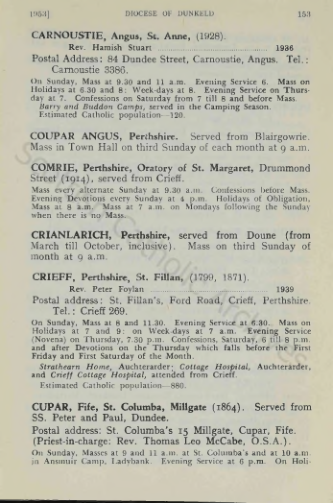
The Scottish Catholic Directory for 1953 lists Sunday Mass at 10 a.m. in Ansmuir Camp, Ladybank. The service appears under St Columba’s, Cupar, whose priest-in-charge was the Reverend Thomas Leo McCabe, O.S.A. St Columba’s was served from SS. Peter and Paul in Dundee.
The entry places camp worship within the surrounding Catholic parish network. It records a Roman Catholic service; it does not identify a separate Ukrainian-rite congregation or assign the parish’s other services to the hostel. It was also not a permanent fixture. The Cupar entry in the directory for 1950 itemised no services at all and named no camp, and by 1956 the entry listed its outlying duties in detail, naming Stratheden Hospital, the Adamson Hospital and Hill Tarvit Home, with no camp among them. Neither of those volumes contains the name in any spelling.
Camp service in 1953
| Place | Service | Time |
|---|---|---|
| Ansmuir Camp, Ladybank | Sunday Mass | 10 a.m. |
Sources for this section
Buildings after camp life
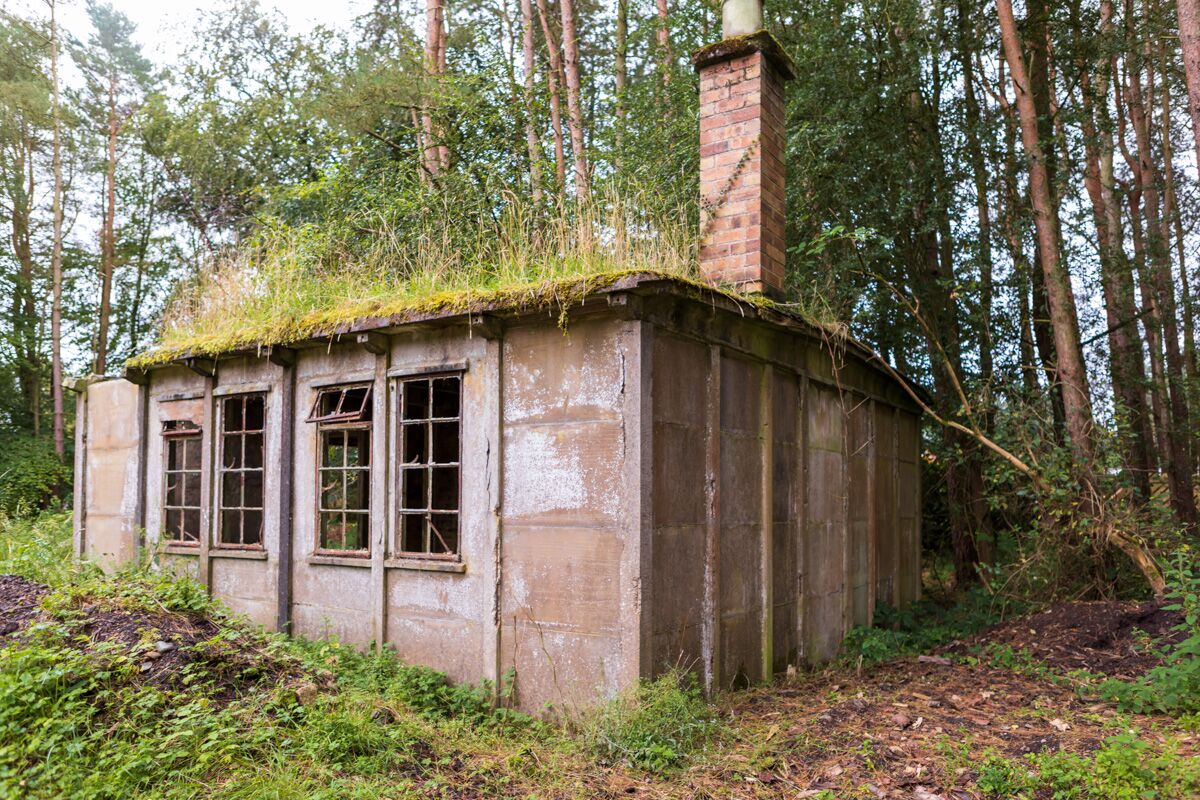
By the 2005 heritage record, the site was occupied by Annsmuir Caravan Park. During an August 2019 photographic journey, Syston Images documented a surviving Camp 77 building. The photograph shows a low structure with panelled walls, a brick chimney, broken windows and vegetation spreading across its roof.
The Repatriated Landscape project, which visited in the same month, describes what became of the rest: most of the ground turned into a holiday and residential caravan site, now Annsmuir Park and Holiday Homes, while a former farm at the back retained huts adapted for pigs by cutting flaps in their bases. Former prisoners returned over the years with family and friends, and a memorial stone at the entrance, inscribed in German and English, commemorates their reunions. The surviving hut and the 1953 service entry preserve different aspects of the same place: its physical accommodation and the continuing use of a camp as a centre of everyday religious life after the war.
Sources
- In which ways is the Ukrainian community in Scotland a diaspora?
Peter David Kormylo, University of Glasgow · 2021
Original appendix xii, printed 323, entry 30. Names Ansmuir Hostel, Ladybank, Fife under Ukrainian accommodation directory.
- Annsmuir, Camp 77, German Working Camp
RCAHMS / Historic Environment Scotland · Notes 2005 and 2007
Full archaeology note read. RAF frames 106 G/UK 1385, 6321 to 6323, 9 April 1946. Hut counts are structures visible in aerial imagery, not population totals. Earlier 1908 military camp pictures not used to imply exact footprint continuity.
- Scottish Catholic Directory 1953
Scottish Catholic Archives, digital copy · 1953
Printed 153, PDF 163, Cupar entry. Original page visually inspected. Sunday 10 a.m. Mass in Ansmuir Camp. Thomas Leo McCabe named as Cupar priest-in-charge, not asserted to have personally celebrated each camp service.
- PHO 704 Sustainable Prospects, first blog entry
Syston Images · 25 September 2019
Photographer’s own account of August 2019 visit. Figure 5 explicitly captioned PoW Camp 77 Annsmuir. Original photograph retrieved and visually inspected.
- James Grant’s visit report and the February 1948 re-educational survey, FO 939/157
The National Archives, FO 939/157, photographed by the Repatriated Landscape project · 1945
Page 32 downloaded and read. Report of Mr James Grant’s visit to Annsmuir Camp, 14 and 15 August 1945, Camp 77: a rather new camp, no library, no gramophone records, no films; commandant Lt Col McCrerick; English instruction begun with Russian, mathematics, German and history under way; a choirmaster among the teachers; a Lutheran clergyman running a Bible class. German prisoner-of-war phase only.
- Foreign Office list of prisoner-of-war camps, page 9
The National Archives, FO 1120 series, photographed by the Repatriated Landscape project · Captioned as the list at 20 February 1947
Image downloaded and read. Row for 77 (G.W.C.) Annsmuir Camp, Ladybank, Fife, with telegraphic address Priswar Ladybank, telephone Ladybank 92, railway station Ladybank and commandant Lt Col D. H. G. McCririck. The publishing project cites FO 1120/183 while the image file name gives 1120/182.
- Volunteer Workers’ Camp, Ladybank, written answer
Hansard, HC Deb 23 November 1948 vol 458 c101W · 23 November 1948
Read in full. Question by Mr Henderson Stewart, answer by Mr Woodburn: European volunteer workers employed in agriculture and resident in Annsmuir Camp; Category A Industrial Group ration scale; wages under the Scottish Agricultural Wages Board and the Industrial and Staff Canteen Undertakings Wages Board. No numbers or nationalities given.
- Roman Krawec, Post-war camps and hostels
Ukrainians in the United Kingdom online encyclopaedia · Published 10 February 2013
Read in full. Redesignation of former POW camps as hostels, mixed nationalities, closure of most hostels by the mid-1950s. General framework; Annsmuir is not named in the article.
- Scottish Catholic Directory 1950 and 1956, Cupar entries
Scottish Catholic Archives, digital copies · 1950 and 1956
Both volumes downloaded in full and searched. The 1950 Cupar entry, printed 160, reads only that Sunday Mass and other services were as announced and names no camp. The 1956 entry, printed 146, names Stratheden Hospital, the Adamson Hospital and Hill Tarvit Home and no camp. Negative evidence only: the 1950 entry itemises nothing and cannot prove absence.
- PoW Camp 77 Annsmuir
Repatriated Landscape · Site visit August 2019
Narrative read in full. The site as a holiday and residential caravan park, the surviving farm huts adapted for pigs, former prisoners returning for reunions and the memorial stone at the entrance inscribed in German and English. The author’s account of the camp’s wartime population comes from conversations with two residents on the day and is reported as such.
- Annsmuir: Overview of Annsmuir
The Gazetteer for Scotland (School of GeoSciences, University of Edinburgh; Royal Scottish Geographical Society) · 2021
Single-page gazetteer entry read in full. It records that the caravan park began as a Territorial Army training camp in 1939, that during the Second World War the site became prisoner-of-war camp No. 77, that the camp housed German and Italian prisoners between 1945 and 1948, and that it was afterwards described as an agricultural hostel.
- Fife Stop Line — PoW Camp 77 (geocache listing GC15KVY)
Geocaching.com, listing by Kryten · Hidden 9 February 2007
Listing description read in full. It describes the camp as completed in December 1942, a square formation of wooden huts with lookout towers on each corner, barbed wire and an anti-tank ditch of the Fife Stop Line, in use until 1948. An enthusiast listing citing no sources, used only for that dated description of the layout.
Last researched 13 September 2026