DP Camp Arolsen No. 511
Displacement in Europe
Arolsen · Germany · 1946–1952
Arolsen’s displaced persons camp was created for people who worked for UNRRA and the Central Tracing Bureau, the forerunner of today’s Arolsen Archives. Spread across six sites in the small Hessian town, it appears in the files as DP Camp Arolsen No. 511, the DP Labor Camp and, from July 1948, the K-181 I.T.S. Employees Camp.
Introduction
Arolsen, a former princely seat in northern Hesse with nearly 5,000 inhabitants in 1945, received a displaced persons camp in 1946 that differed from most others in the American zone. It was set up for DPs who, from 1946, worked for the United Nations Relief and Rehabilitation Administration and for the Central Tracing Bureau, the predecessor of the International Tracing Service and of today’s Arolsen Archives. Unlike most camps in the zone, its residents were not housed separately by nationality.
The camp did not occupy a single compound. Its housing was scattered across the town, and the documents in the Arolsen Archives and the United Nations Archives refer to the sites collectively as DP Camp Arolsen No. 511, the DP Labor Camp and, from July 1948, the K-181 I.T.S. Employees Camp. Camp numbers changed frequently in this period, and the same number could be applied to different camps.
Sources for this section
A history in dates
- Spring 1935The SS regiment Germania moves into the barracks on the Grosse Allee.
- 1943–1945The Buchenwald sub-camp Arthur operates on the barracks grounds; it is cleared on 29 March 1945.
- January 1946The Central Tracing Bureau moves to Arolsen; communal DP housing opens in the barracks, the Bergischer Hof, Kasernenstrasse 19 and Am Tannenkopf.
- April 1946350 DPs are registered in Arolsen.
- March 1947A Vocational Training Center for DPs opens on the barracks grounds.
- July 1948The camp is listed as the K-181 I.T.S. Employees Camp.
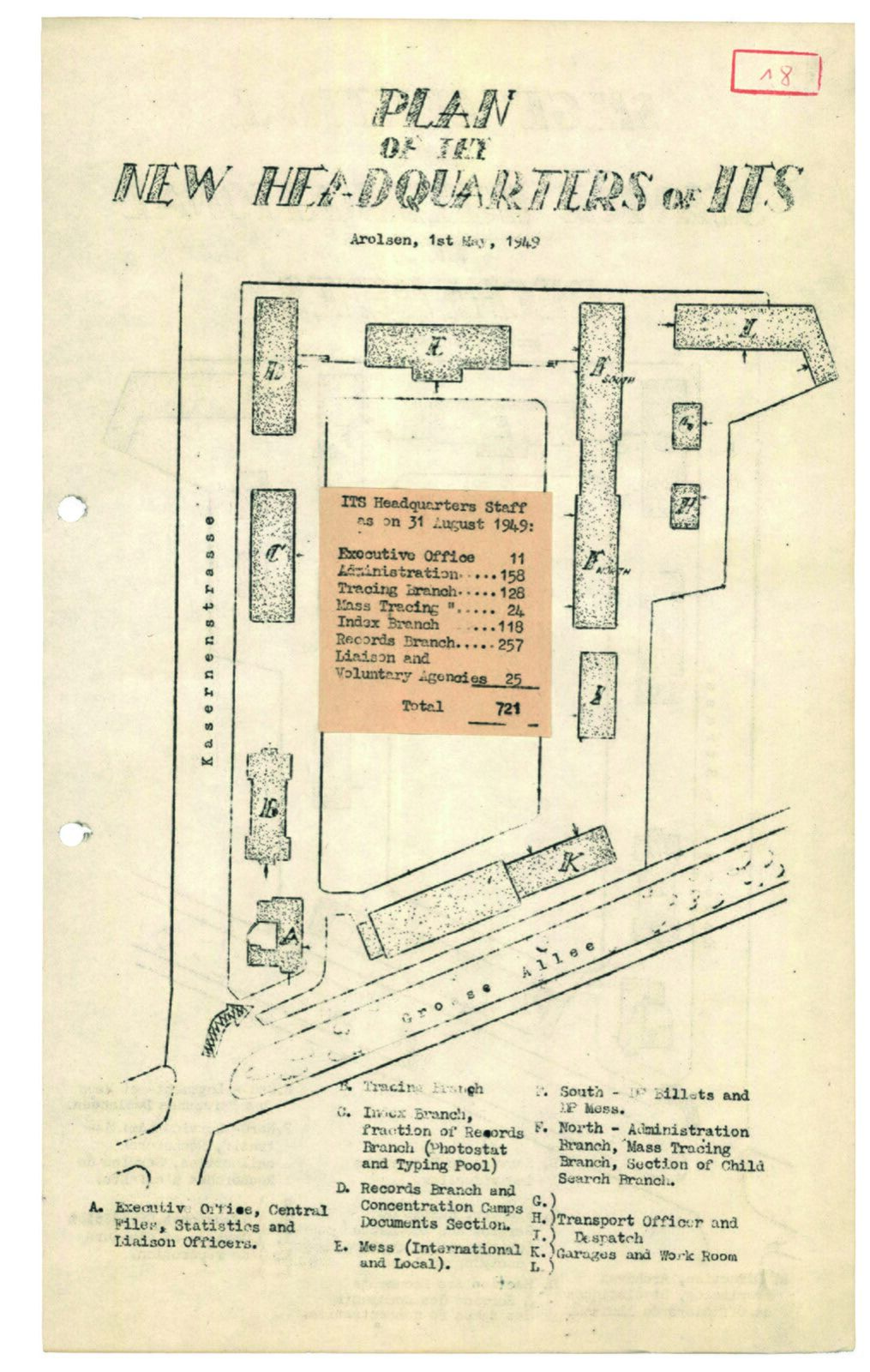
- May 1949The ITS takes over the entire barracks; Block F houses DP employees.
- February 1950The barracks camp is handed over to the ITS administration; the other sites close in spring 1950.
Sources for this section
The barracks before 1946
Arolsen became a garrison town again in spring 1935, when the 2nd Regiment of the SS-Verfügungstruppe Germania moved into the barracks on the Grosse Allee. In December 1935 the office of the SS-Oberabschnitt Fulda-Werra took over the Neues Schloss. The regiment stayed in the barracks until 1939; from 1943 to 1945 the complex held an SS leadership school and an SS clothing store.
A sub-camp of Buchenwald known by the cover name Arthur was located on the barracks grounds from 1943 to 1945. Its roughly 100 male prisoners first worked on extending the leadership school and later in its large kitchen, in the clothing store and as cleaners and hairdressers. The SS cleared the sub-camp on 29 March 1945, immediately before the US Army entered the Waldeck area.
Sources for this section
The tracing service as employer
At the end of 1945 UNRRA moved its Central Headquarters for Germany to Arolsen, and in January 1946 the Central Tracing Bureau followed from Frankfurt-Höchst. Its offices were at first scattered around the town. When UNRRA was wound up in the summer of 1947 the International Refugee Organisation took over the bureau, which worked under the name International Tracing Service from January 1948.
From 1945 both organisations employed mostly DPs, alongside Allied military and civilian staff and some Germans. DPs did clerical work and translation, kitchen and transport duties, and worked in nearly every department of the tracing service, where their command of Slavic languages was particularly valued. The bureau had 80 employees in 1945 and 1,758 by 1949. The number of DPs on its staff rose from 63 in June 1947 to 109 in January 1948, 150 a year later and 204 in the summer of 1949, before falling to 85 by January 1952 as people emigrated.
Sources for this section
Six housing sites
In early 1946 the Allies requisitioned 96 residential buildings, three flats, six public buildings and the former barracks in Arolsen. Communal DP housing was set up in the former Hitler Youth centre Am Tannenkopf, in the Hotel Bergischer Hof at Fürstenallee 9, in the former military hospital at Kasernenstrasse 19, in a master painter’s house at Kasernenstrasse 15 and in the barracks; the Neues Schloss was added in 1949, after UNRRA and then the tracing service had used it as offices. A few DP employees lived in requisitioned private homes.
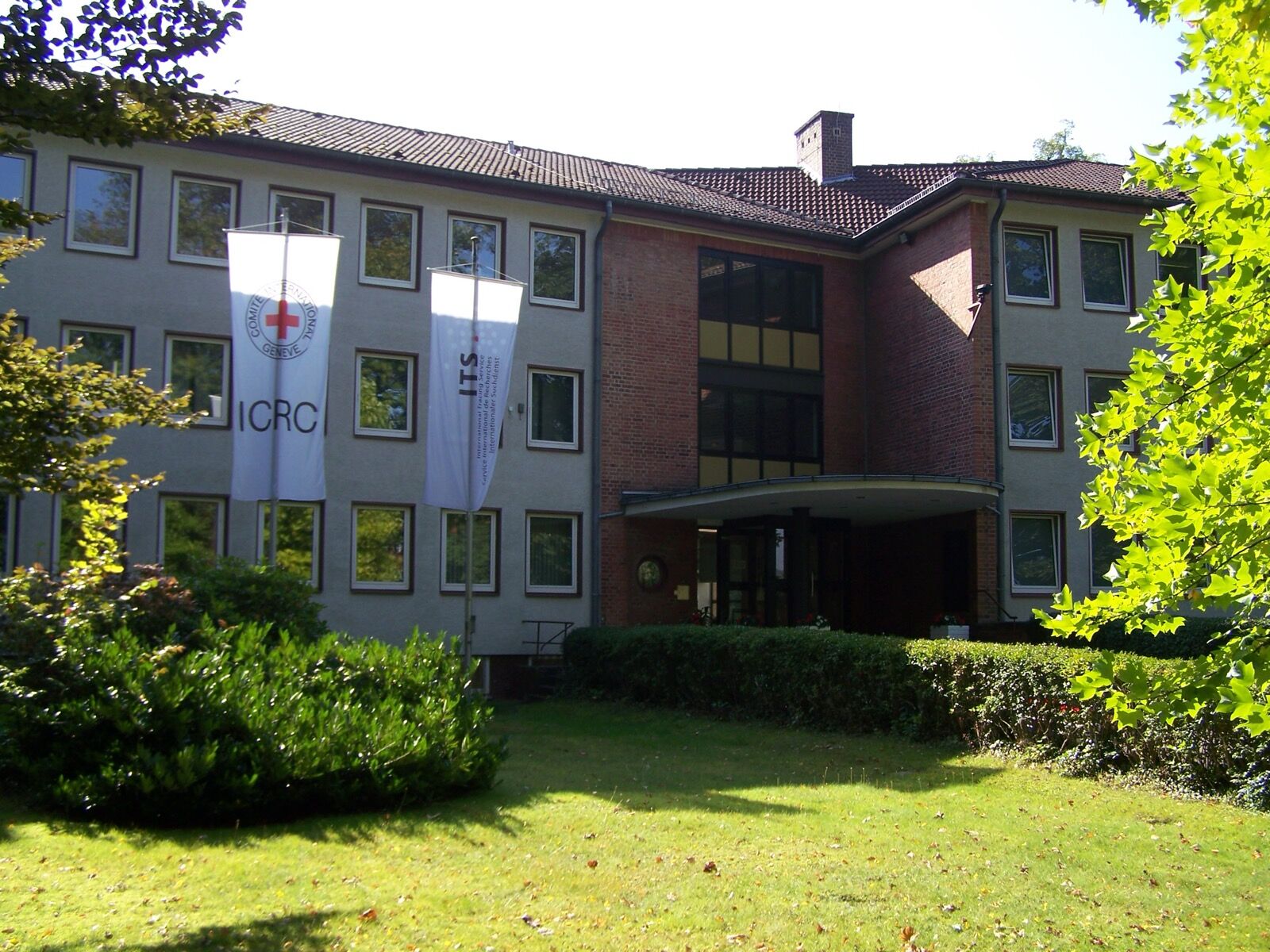
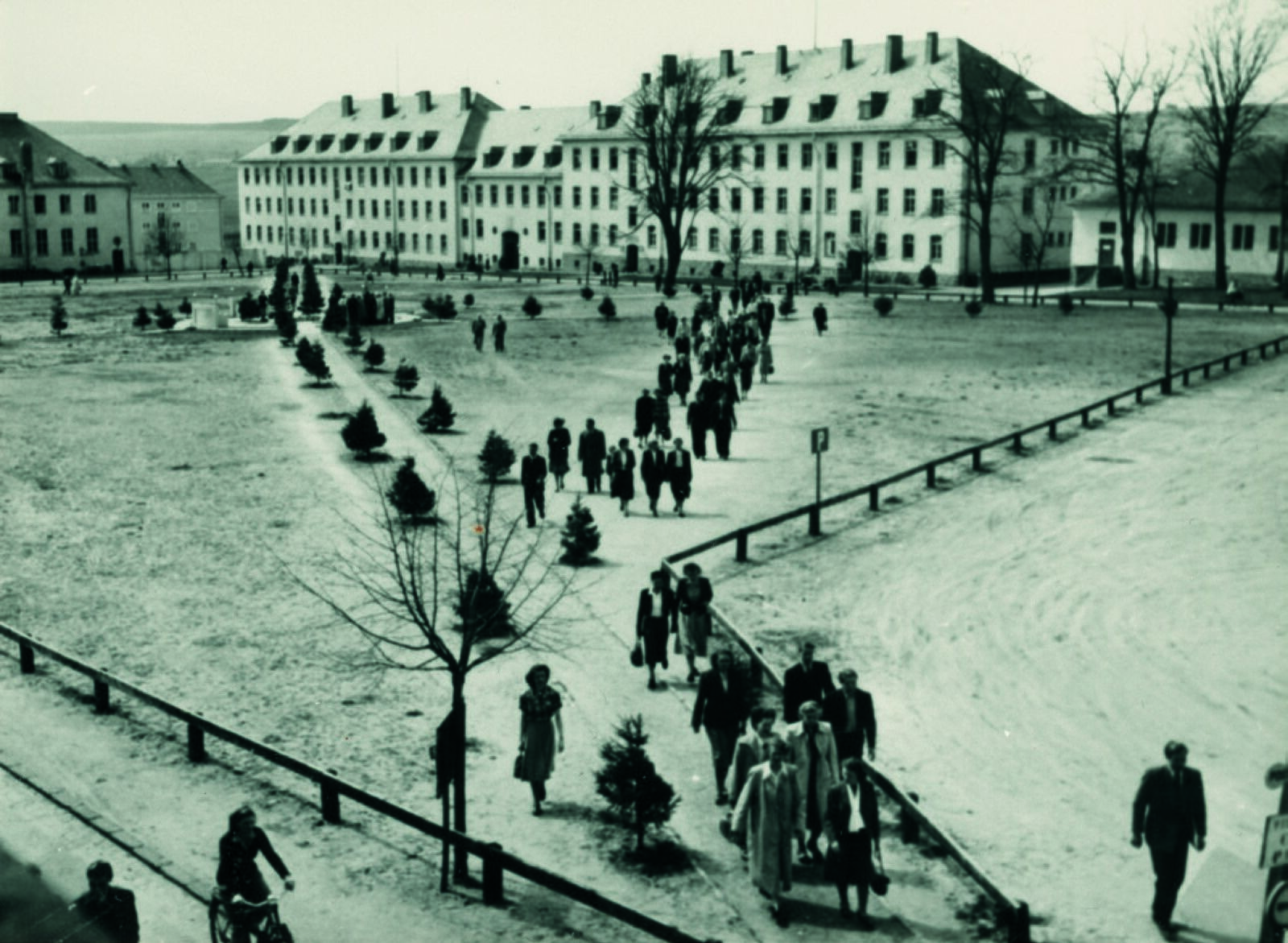
The barracks were the largest and longest-standing site, in use from January 1946 probably until the summer of 1952. In spring 1946 three of its buildings housed DPs. From March 1947 the complex also held a Vocational Training Center for DPs, with classrooms and lodgings for course participants; the centre had around 400 participants in spring 1947 and 675 in January 1948, and moved to Neuburg an der Donau in 1949. In May 1949 the tracing service took over the whole barracks, and Block F was fitted out with around 305 residential units and its own canteen for DP employees.
Conditions varied between the sites. The Bergischer Hof had around 27 residential units in May 1949, with a canteen on the ground floor. In the former youth centre and in the barracks residents had hardly any private space, and a 1950 renovation report shows that they had divided the large rooms with lightweight partitions and installed extra stoves, water pipes and drains themselves.
Sources for this section
Who lived in the camp
The DPs were not registered by name in the UNRRA statistics, but the reports record their countries of origin. In April 1946, 350 DPs were registered in Arolsen: 140 Poles, 75 Lithuanians, 33 Latvians, 19 Estonians, 16 Jews, 23 stateless people and 44 whose nationality was not recorded. There were 408 registered in October 1946 but only 114 in June 1947, after which the number grew again with the expansion of the tracing service. The figures include family members who moved with the employees, and turnover was high.
The published chart of the camp population for 1946 to 1949 uses the categories Poland, Ukraine (Polish minority), Belarus (Polish minority), Soviet Union, Lithuania, Latvia, Estonia, Jews, Yugoslavia, stateless or Nansen, and not specified. Polish and Baltic DPs were consistently the largest groups. The chapter gives no separate count for the Ukrainian category, so the presence of Ukrainians is documented but their number is not. The biographies it reconstructs include a Ukrainian-born chemist who followed the bureau from Frankfurt-Höchst because of his languages, and a doctor deported from western Ukraine in 1944 who provided medical care in the camp.
With the training centre, more than 800 DPs lived in Arolsen at times, and in March 1949 more than 1,000. Many of the residents were former forced labourers from Poland and the Soviet Union, former prisoners of war, concentration camp survivors and some Jews; a large group had come from the Baltic states in the last months of the war.
Administrative identifiers and recorded figures
| Item | Value | Source scope |
|---|---|---|
| Camp designations | DP Camp Arolsen No. 511; DP Labor Camp; K-181 I.T.S. Employees Camp from July 1948 | Panek, 2019, p. 36 |
| Occupation zone | US zone, Hesse | Panek, 2019 |
| UNRRA Area Team | Area Team 51; renumbered 1024 at the end of 1946 and 1025 from April 1947 | Panek, 2019, footnote 28 |
| Registered DPs, April 1946 | 350 (140 Poles, 75 Lithuanians, 33 Latvians, 19 Estonians, 16 Jews, 23 stateless, 44 not specified) | UNRRA reports cited by Panek |
| Registered DPs, October 1946 | 408 | UNRRA reports cited by Panek |
| Registered DPs, June 1947 | 114 | UNRRA reports cited by Panek |
| DPs employed by the tracing service | 63 (June 1947); 109 (January 1948); 150 (January 1949); 204 (summer 1949); 85 (January 1952) | Panek, 2019, p. 28 |
| DPs in Arolsen, 1950 | 357 at the start of 1950; 237 in early summer | Panek, 2019 |
| Nationality categories in camp statistics, 1946–1949 | Poland; Ukraine (Polish minority); Belarus (Polish minority); Soviet Union; Lithuania; Latvia; Estonia; Jews; Yugoslavia; stateless or Nansen; not specified | Panek, 2019, p. 30 |
| Archive reference | 3.1.1.0 Generalia: Camps, Correspondence, Service Regulations, folders 7–10, ITS Digital Archive, Arolsen Archives | Panek, 2019, footnote 11 |
Sources for this section
Running the camp and daily life
UNRRA Area Team 51, which also looked after the camps in Korbach, Landau and Rhoden, handled provisioning and registration; it was renumbered Area Team 1024 at the end of 1946 and 1025 from April 1947. DPs served as camp leader, assistant leader and secretarial staff, chosen by the team and voted on by the residents, and took on maintenance, kitchen and sanitary duties, fire and police services and translation for new arrivals. The camp police were mostly Polish DPs, and DP doctors provided everyday medical care. In April 1946 the UNRRA field supervisor noted the awkward position of a camp whose residents included over 300 people living and employed at the headquarters next door.
Residents formed their own sports and entertainment committees and a band. Bingo evenings, balls, cabaret and film screenings took place regularly; swimming classes used the old open-air pool Am Tannenkopf, and teams played against DPs from surrounding camps. Until the summer of 1949 events were held in the Kurhaus at Grosse Allee 23 and in the Altes Schloss, where a carnival ball took place in February 1949; afterwards most gatherings moved to the large canteen in Block E of the barracks. The DPs organised themselves in national groups, and Baltic residents mounted an arts and crafts exhibition for an international tracing conference in autumn 1949.
Many residents were families. More than 50 children were registered at the start of 1950, around 20 of them born in Arolsen or Korbach after the war, and families celebrated Christmas and Thanksgiving together. The local population was rarely invited to these events.
Closure and the site afterwards
Between 1947 and 1950 most DP camps in the western zones were dissolved. In December 1949 only 2,859 DPs were living in the whole of Hesse; besides the ITS Employees Camp in Arolsen there was one other camp in Hanau and three centres for repatriation and emigration. Arolsen’s DP population fell from 357 at the start of 1950 to 237 in early summer, as most residents emigrated to the USA, Canada or Australia.
The sites Am Tannenkopf, at Kasernenstrasse 19 and 15 and in the Neues Schloss closed in spring 1950, and the camp in the barracks was handed over to the ITS administration in February 1950, although communal housing there probably continued until the summer of 1952. The town’s history records the DP camp as existing from 1946 to 1951. The tracing service remained on the former barracks grounds; the old SS clothing store later became a hardware store and Block F a supermarket and electrical shop. The International Tracing Service was renamed Arolsen Archives in May 2019.
Sources for this section
Sources
- Between Waiting and New Beginnings: Displaced Persons in Arolsen
Isabel Panek, in Christian Höschler and Isabel Panek (eds), Two Kinds of Searches: Findings on Displaced Persons in Arolsen after 1945, Arolsen Archives · 2019
Pages 27 to 42 and document captions on pages 63 to 65 read in full. Camp designations, housing sites, population statistics, employee numbers, Area Team numbers, daily life and closure all taken from this chapter and its footnotes.
- Bad Arolsen: Tracing the history of the Nazi era
Arolsen Archives, Stories · Accessed 12 September 2026
Institutional account of the town: arrival of US troops in spring 1945, UNRRA headquarters staff of nearly 1,000, the 1949 move of the tracing service to the barracks, and DPs organising themselves in national groups. Section ‘The barracks: An important SS site’: “From 1935 to 1939, the 800-strong 2nd Battalion of the SS-Verfügungstruppe ‘Germania’ occupied the buildings. … In 1939, the unit took part in the attack on Poland and then remained in active service.” This source calls the unit a battalion rather than a regiment.
- Bad Arolsen
Wikipedia (German), history section · Accessed 12 September 2026
Checked for the 1935 garrison, the SS regiment in the barracks on the Grosse Allee, the SS-Oberabschnitt office in the Neues Schloss, the Buchenwald sub-camp Arthur, the DP camp of 1946 to 1951 and the 1946 population of 4,726.
- Arolsen Archives
Wikipedia (German) · Accessed 12 September 2026
Checked for the January 1946 move to Arolsen, the DP camp of 1946 to 1951 created for UNRRA and CTB employees, the ITS name from January 1948 and the 2019 renaming.
- File: ITS Bad Arolsen.jpg (photograph)
Wikimedia Commons · 26 September 2008
Photograph of the tracing service headquarters on the former barracks grounds on the Grosse Allee, the camp’s largest and longest-standing housing site. Released under the Creative Commons Attribution-ShareAlike 3.0 Unported licence (also GFDL 1.2 or later); author, date and licence read from the file page. The photographer is credited in full under the image.
- Plan of the new headquarters of ITS, Arolsen, 1 December 1949
ITS Digital Archive, Arolsen Archives, 6.1.1/82505819; reproduced in Two Kinds of Searches: Findings on Displaced Persons in Arolsen after 1945 · 1949
Site plan of the former barracks between Kasernenstraße and the Grosse Allee, lettering each block by its use and carrying a panel of headquarters staff numbers totalling 721 at 31 August 1949. Published as Document 8 in the Arolsen Archives volume, which gives the archive reference but states no reuse licence.
- Employees crossing the former exercise yard, Arolsen, circa 1950
ITS Photo Collection, Arolsen Archives; reproduced in Two Kinds of Searches: Findings on Displaced Persons in Arolsen after 1945 · about 1950
Photograph of tracing-service employees walking across the old parade ground of the barracks on their way to work, with Block F, in which the displaced-persons employees were housed, in the background. Published on page 38 of the Arolsen Archives volume with the collection credit but no reuse licence.
Last researched 12 September 2026