Artillerie-Kaserne
Displacement in Europe
Aschaffenburg, Bavaria, Germany · 1946–1949
Artillerie-Kaserne was the largest and longest-lived of Aschaffenburg’s Ukrainian displaced-persons camps, with its own Orthodox parish, co-operatives, veterans’ clubroom and elected camp leadership. Contemporary Ukrainian reporting and the camp inventory follow it from the barracks of 1938 to closure in July 1949.
Introduction
Artillerie-Kaserne was one of four Aschaffenburg camps with large Ukrainian communities. The former artillery barracks became a place of refuge in a city severely damaged by war. Residents shared relief services and maintained links with the other camps around them.
A contemporary Ukrainian newspaper places a Polish priest from the Artillerie camp at a religious celebration in January 1946. Later Ukrainian population returns count more than a thousand residents here. The two kinds of evidence reveal a mixed camp connected to the city’s wider displaced community.
A history in dates
- 1938The artillery barracks are built on Würzburger Straße.
- June 1939The first battalion of Artillery Regiment 15 moves in.
- 5 April 1945An American military government detachment takes over the city.
- 30 October – 1 November 1945A Ukrainian congress in Aschaffenburg founds the Central Representation of the Ukrainian Emigration.
- 19 January 1946A priest from the Artillerie camp joins Epiphany celebrations at Lagarde.
- 3 April 1946The inventory records the camp’s administrative opening date.
- 21 October 1946Artillerie residents join a large church gathering with Pionier and Lagarde.
- 22 December 1946About 300 residents vote in the election of camp leaders.
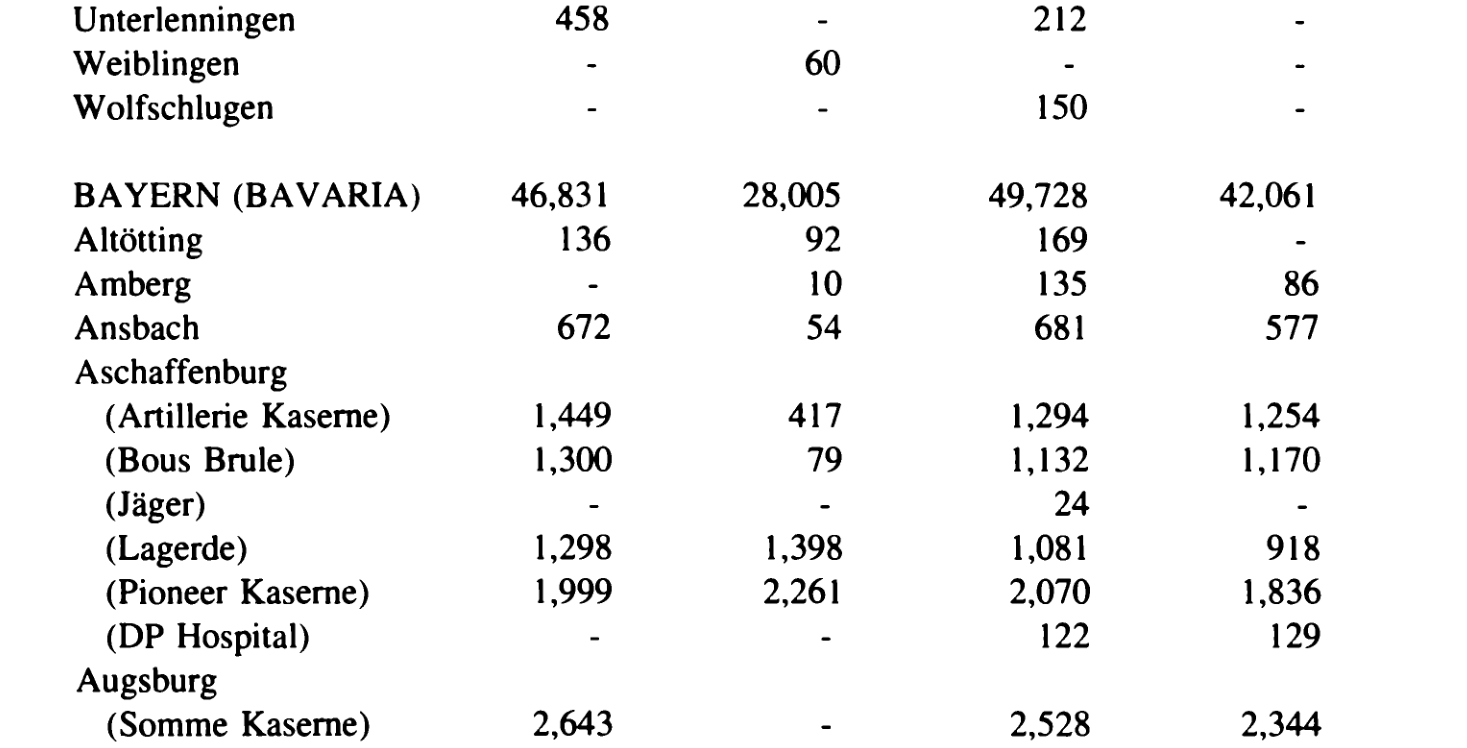
- 31 May 1947A return records 1,294 Ukrainian residents.
- 11 September 1947The Ukrainian National Council votes to wind up the camp co-operative.
- 30 May 1948A joint memorial service for Symon Petliura is held on the camp square.
- September 1948The later camp identifier UF 309 comes into use.
- 19 March 1949Residents found a committee to support the Ukrainian National Council.
- 25 April 1949About 2,000 Ukrainians assemble on the camp square in protest.
- 31 July 1949The camp inventory records closure.
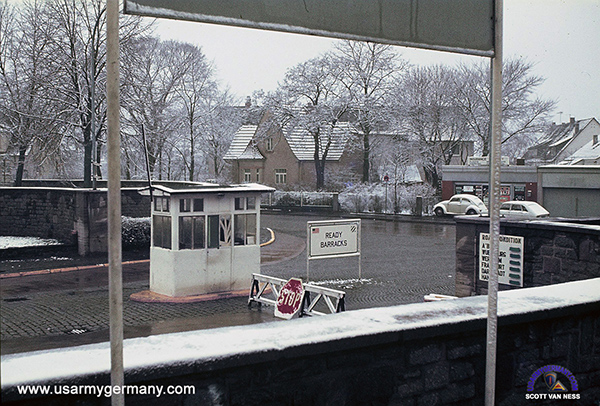
- 1952The barracks are renamed Ready Barracks.
Sources for this section
- Aschaffenburg als amerikanischer Militärstandort: Vom Kriegsende bis zur Konversion
- “Building a Home Abroad”: A Comparative Study of Ukrainian Migration, Immigration Policy and Diaspora Formation in Canada and Germany after the Second World War
- Information Bulletin of the Ukrainian Group, Aschaffenburg, no.3 (37)
- Inventory of displaced-persons camps
- Geschichte der Ukrainisch-Katholischen Kirche in Deutschland vom Zweiten Weltkrieg bis 1956
- Nedilia: Ukrainian independent weekly, Aschaffenburg
- The Refugee Experience: Ukrainian Displaced Persons after World War II
From artillery barracks to a displaced community
The barracks were the last of four new complexes built for the Wehrmacht at Aschaffenburg after conscription was reintroduced in 1935. An American staff-college study dates the city’s designation as a garrison city to 1934/35, after which the further barracks were built in quick succession. Work on the Pionier barracks began in 1936, the Lagarde barracks followed in 1936 and 1937 and the Bois-Brûlé barracks in 1937; the Artillerie barracks on Würzburger Straße came last, in 1937/38, each complex costing about five million Reichsmarks. The first battalion of Artillery Regiment 15 moved in during June 1939.
After the fighting of late March and early April 1945 the military complex became part of the accommodation available for displaced people. The camp inventory records an administrative opening on 3 April 1946, but the Ukrainian camp bulletin shows residents already there in January 1946.
Its administrative identities included Assembly Centre 255, later written AC 91-255, and UF 309 from September 1948. UNRRA Team 119 appears in the camp inventory. The register lists Polish, Ukrainian and Russian populations.
Camp identifiers and recorded capacity
| Record | Value |
|---|---|
| Assembly centre | AC 255 / AC 91-255 |
| From September 1948 | UF 309 |
| UNRRA team | Team 119 |
| Capacity, 31 October 1947 | 1,600 |
| Recorded closure | 31 July 1949 |
The camp and the city
Detachment A-220 of the 3rd Military Government Regiment reached Aschaffenburg on 5 April 1945, two days after the city surrendered, and took over the government of a place that was largely destroyed. Alongside the returning inhabitants it had to accommodate what one estimate put at up to 20,000 displaced people, housed above all in the barracks but at first also in schools and private flats.
The military government’s own report of 18 October 1945 described armed bands formed by a minority among the displaced population of the Aschaffenburg camps, and the intimidation of other residents. A list of suspects was handed over after the Polish DPs’ informal leader, Father Kaldunski, promised co-operation, and a search of the camps followed. The report describes the city’s camps as a group and does not attribute the crimes to any one barracks.
Sources for this section
Church, elections and public life
On 19 January 1946, the Polish Catholic priest serving Artillerie attended the Epiphany celebrations at nearby Lagarde. The service was followed by a procession and blessing of water. This small notice in the Ukrainian camp bulletin records contact across both camp boundaries and religious communities.
On 21 October 1946, worshippers from Artillerie, Pionier and Lagarde came together for the 350th anniversary of the Union of Brest. A church report describes more than 3,000 people at a Roman Catholic church on the outskirts of Aschaffenburg. The number covers the combined gathering, not Artillerie’s population.
Camp leaders were elected in all four Ukrainian camps of the town on Sunday 22 December 1946. At Artillerie the poll was advertised by posters through every block, and by midday about 300 people had voted, roughly a quarter of those entitled. A visiting Canadian relief delegate inspected the churches of the Lagarde, Artillerie and Pionier camps on 1 February 1947.
The camp’s Orthodox parish was dedicated to the Protection of the Mother of God. Archbishop Hennadii was announced to celebrate in its church in July 1947, and in June 1949 Archbishop Hryhorii, head of the Great Council of the Ukrainian Autocephalous Orthodox Church, was met at the station by the parish council and sisterhood of that church and held hierarchical services in the camp on 11 and 12 June.
Residents also ran co-operatives, though not always successfully: the Ukrainian National Council in Aschaffenburg voted on 11 September 1947 to wind up the co-operative Vzaiemodopomoha at Artillerie, and in July 1949 the board of a second co-operative, Ideal, called on its members to reclaim their shares. A camp economy column of 1947 noted that much ground at Artillerie was still lying unused for vegetable gardens.
The camp square became the meeting place for the town’s Ukrainians. On Sunday 30 May 1948, flags flew at half mast in the Aschaffenburg camps and Orthodox clergy held a joint memorial service there for Symon Petliura, attended by the emigration’s representative body, veterans, Plast, the youth association, school pupils and camp police. The Aschaffenburg branch of the Union of Veterans kept its clubroom in the camp, and on 19 March 1949 residents founded a committee there to support the Ukrainian National Council.
The Central Representation of the Ukrainian Emigration came into being at a Ukrainian congress held in Aschaffenburg on 30 October – 1 November 1945. The account that records the congress does not say where in the city it met.
Sources for this section
- Information Bulletin of the Ukrainian Group, Aschaffenburg, no.3 (37)
- Geschichte der Ukrainisch-Katholischen Kirche in Deutschland vom Zweiten Weltkrieg bis 1956
- Nedilia: Ukrainian independent weekly, Aschaffenburg
- “Building a Home Abroad”: A Comparative Study of Ukrainian Migration, Immigration Policy and Diaspora Formation in Canada and Germany after the Second World War
The Ukrainian population
Successive returns show a marked difference between the 417 Ukrainians reported in August 1946 and 1,294 in May 1947. By December 1947 the figure was 1,254. The separate 1946–1947 questionnaire collection gives 1,449; it is not a census from one precise day.
In the same May 1947 return, Pionier was the largest of the Aschaffenburg camps with 2,070 Ukrainians, ahead of Artillerie with 1,294, Bois-Brûlé with 1,132 and Lagarde with 1,081. A separate entry for the town’s DP hospital counts 122. The barracks therefore held the second largest Ukrainian community in the town.
The inventory also records a capacity of 1,600 on 31 October 1947. That describes accommodation capacity, whereas the figures in the population table count Ukrainian residents. It cannot be used as the number of Ukrainians living in the barracks.
A camp collection taken on 10 April 1949 was reported with the note that Artillerie then had about 1,200 residents and Bois-Brûlé about 1,100. Those are round figures for all residents at that date rather than a Ukrainian census, and they come from the last months of the camp.
Ukrainian residents in successive returns
| Return | Ukrainian residents |
|---|---|
| 1946–1947 questionnaire collection | 1,449 |
| August 1946 UNRRA return | 417 |
| May 1947 UNRRA return | 1,294 |
| December 1947 PCIRO return | 1,254 |
Ukrainians in the Aschaffenburg camps, May 1947 return
| Entry | Ukrainian residents |
|---|---|
| Pioneer Kaserne | 2,070 |
| Artillerie Kaserne | 1,294 |
| Bois-Brûlé | 1,132 |
| Lagarde | 1,081 |
| Jäger | 24 |
| DP hospital | 122 |
Residents recorded in the final year
| Date | Figure | Meaning |
|---|---|---|
| 10 April 1949 | About 1,200 | All residents of Artillerie, reported with a camp collection |
| 10 April 1949 | About 1,100 | All residents of Bois-Brûlé, given for comparison in the same report |
The end of the displaced-persons camp
By the spring of 1949 Artillerie and Bois-Brûlé were the only camps left in the town. On Easter Monday, 25 April 1949, about 2,000 Ukrainians gathered on the Artillerie square to protest against religious persecution and the camps of the Soviet Union, marching over from Bois-Brûlé behind some thirty banners with delegations from Gießen, Hanau and Frankfurt. Speeches, a combined choir and the reading of a memorandum to the United Nations followed.
The camp inventory records closure on 31 July 1949. The barracks returned to military use, and in 1952 the American garrison named them Ready Barracks after Sergeant John P. Ready of the 32nd Field Artillery Battalion. The photograph below shows the later American entrance in 1975–1977, long after the displaced-persons period.
Records that preserve the story
Aschaffenburg’s archive completed a new description of its former UNRRA holdings in 2022. The collection includes 2,846 post-war investigation sheets, alongside earlier forced-labour registration and employment documents. These records concern the city and must be distinguished from a register of one barracks camp.
Sources for this section
Sources
- Inventory of displaced-persons camps
Arolsen Archives · 26 October 2023
Camp-specific register entry; Excel serial dates decoded using 1899-12-30. Capacity is not a census.
- The Refugee Experience: Ukrainian Displaced Persons after World War II
Canadian Institute of Ukrainian Studies Press · 1992
Ihor Stebelsky chapter, table 7: headers p. 47, Aschaffenburg rows p. 48, source notes p. 51. Four returns have different collection dates and methods.
- Aschaffenburg als amerikanischer Militärstandort: Vom Kriegsende bis zur Konversion
Geschichts- und Kunstverein Aschaffenburg; Christian Th. Müller · 2016
Municipal archive-hosted monograph. Barracks building programme and garrison PDF pp. 19–21; military government, displaced persons in the city and the report of 18 October 1945, PDF pp. 40–43; clearance of the barracks and the 1952 renaming after Sergeant John P. Ready, PDF pp. 59–61.
- Aschaffenburg
Encyclopedia of Modern Ukraine / National Academy of Sciences of Ukraine · 2001
Ukrainian camp network, city-wide representative institutions and education. Lagarde gymnasium is not reassigned to other barracks.
- Aschaffenburg military installations: historical photographs
US Army Germany historical collection · Various photographic dates
Barracks identities and attributed historical photographs; later military photographs are labelled with their actual dates.
- UNRRA: Originaldokumente digital erfasst und verzeichnet
City and Collegiate Archive of Aschaffenburg · 4 August 2022
Institutional account of wartime forced-labour documents and post-war UNRRA investigation records, catalogued in 2021–2022.
- Geschichte der Ukrainisch-Katholischen Kirche in Deutschland vom Zweiten Weltkrieg bis 1956
Harrassowitz; Bernadetta Wojtowicz · 2000
Pages 170–171: October 1946 Union of Brest anniversary; more than 3,000 worshippers from Lagarde, Pionier and Artillerie. Based on contemporary church report of 31 December 1946.
- Information Bulletin of the Ukrainian Group, Aschaffenburg, no.3 (37)
Ukrainian Museum-Archives / United States Holocaust Memorial Museum · 22 January 1946
Original issue, printed p. 3 / PDF p. 41, camp chronicle: Artillerie Polish priest at Lagarde Epiphany. Issue date checked on PDF p. 39; not 1947.
- Nedilia: Ukrainian independent weekly, Aschaffenburg
Ukrainian Museum-Archives of Cleveland / United States Holocaust Memorial Museum · 1946–1949
Digitised run of 1,053 pages, CC BY-NC-ND 4.0. Issues used: no. 54, 7 January 1947 (camp elections); 9 February 1947 (visit to the three camp churches); 13 July 1947 (services in the Artillerie church); 28 September 1947 (co-operative wound up); no. 127, 6 June 1948 (Petliura service on the camp square); no. 171, 17 April 1949 (collection and resident numbers); no. 172, April 1949 (support committee); no. 174, 15 May 1949 (Easter Monday assembly); no. 180, 26 June 1949 (archiepiscopal visit); nos. 181 and 183, July 1949 (veterans’ clubroom, second co-operative).
- “Building a Home Abroad”: A Comparative Study of Ukrainian Migration, Immigration Policy and Diaspora Formation in Canada and Germany after the Second World War
Universität Hamburg, Staats- und Universitätsbibliothek Hamburg; Julia Lalande · 2006
Doctoral dissertation, read in full. Printed page 49 records the founding congress of the Central Representation of the Ukrainian Emigration at Aschaffenburg, 30 October – 1 November 1945.
- The Battle of Aschaffenburg: An Example of Late World War II Urban Combat in Europe
U.S. Army Command and General Staff College, Fort Leavenworth, Kansas; Major Quentin W. Schillare · 1989
Master's thesis, approved for public release. Chapter 2, endnote 28, printed page 41 gives the garrison-city designation of 1934/35 and the sequence in which the Aschaffenburg barracks were built; the glossary at printed page 169 dates the Artillerie Kaserne on Würzburger Straße to 1937/38.
Last researched 13 September 2026