Asten Camp
Displacement in Europe
Asten, near Linz, Upper Austria · Camp built 1941; documented community to 1964
A wartime resettlement camp near Linz became a home for displaced people of many nationalities, among them Ukrainians. Church reporting, relief photographs, camp returns and the provincial files follow it from 1941 through the transit-camp years to its dissolution in 1964.
Introduction
Asten Camp stood near Linz in Austria’s American occupation zone. Ukrainians lived within a larger, changing population of displaced people. The site appears in later Austrian administrative records as residential settlement 117, linking its international relief years with its longer life as refugee accommodation.
Its history stretched across very different circumstances. The camp had been built during the war; afterwards it offered accommodation to people uprooted from several countries. Some families left for new lives overseas while others remained in Austria. The local parish history places the departure of its last residents in 1963.
A history in dates
- Summer 1941The original camp is established.
- 12 February 1947A church report records 300 Byzantine-rite faithful in Asten.
- May 1947The ITS list records Team 339 at Asten under Area Team II, Linz on the Danube.
- 30 September 1948An IRO return records 361 Ukrainians.
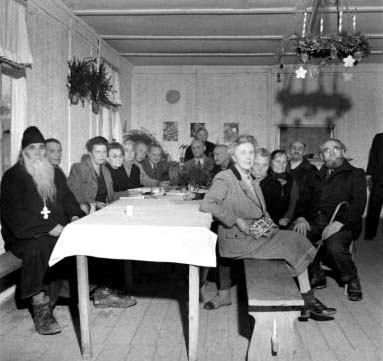
- Christmas 1949A photograph records residents gathered in the dining hall.
- 30 June 1950An IRO return records 149 Ukrainians.
- 7 February 1951The camp numbered 100 at Asten is named for the last time in the ITS list.
- 1952Provincial files concern new transfers into settlement 117.
- 1953A return of illness in the Upper Austrian settlements records 119 residents of Asten as tubercular.
- 1954A barrack in settlement 117 burns down.
- 1963The local parish history records the final residents leaving.
- 1963Settlement 117 is handed to the justice administration.
- 1964Settlement 117 is formally dissolved.
- 28 November 1982A new parish church is consecrated for the greatly enlarged community.
From wartime camp to postwar home
The original compound was established in summer 1941 for people displaced from eastern and southeastern Europe. The parish history recalls as many as 26 nationalities and more than 3,000 residents at certain times across the camp’s history. These broad figures describe successive populations, not the number of Ukrainians in the postwar camp.
The parish history describes it as a large resettlement camp for people forcibly moved and for refugees from eastern and south-eastern Europe, its nationalities reaching from Lithuania to Yugoslavia. Before the war the parish had held steadily just under 600 souls; the camp changed the character of the place.
By the UNRRA period, Asten was a place where relief work and ordinary family routines happened side by side. Its surviving photographic record includes a community garden, greenhouses, children’s practical education and shared meals. The records show a residential community as well as an administrative stop in the displacement system.
Numbers, teams and administration
The International Tracing Service’s alphabetical list of displaced persons camps in Austria carries three Asten entries: a camp numbered 100, still named on 7 February 1951; a camp numbered 117; and an entry against Team 339, recorded in May 1947. All three sit under Area Team II at Linz on the Danube.
Austrian administration used the second of those numbers. Through the 1950s the provincial government carried the place as DP-Wohnsiedlung 117, Asten, and later as Durchgangslager 117, a transit camp; the numbering survives in the province’s resettlement files from 1952 to the settlement’s dissolution.
Asten in the ITS list of Austrian camps
| Entry | Camp number | Team | Area team | When mentioned |
|---|---|---|---|---|
| D.P.-Lager | 100 | — | AT II Linz/Donau | 7 February 1951 |
| D.P.-Lager | 117 | — | AT II Linz/Donau | — |
| — | — | T 339 | AT II Linz/Donau | May 1947 |
The Ukrainian community
A church report dated 12 February 1947 recorded 300 Byzantine-rite faithful in the Asten DP camp. It placed them within a regional congregation of 3,100 served through the Diocese of Linz. The report describes clergy supported by diocesan charity and church registers kept centrally in Linz, connecting the camp with a wider Ukrainian religious network.
Later IRO returns counted 361 Ukrainians in Asten on 30 September 1948 and 149 on 30 June 1950. These are dated nationality counts. They differ from the church figure in both date and definition, and they do not identify where each departing person went.
The report was written by Myron Hornykewytsch, the first vicar general of the Byzantine ordinariate, to Cardinal Tisserant at the Congregation for the Oriental Churches. It counted 26 clergy for Upper Austria under the dean, Emilian Stasiuk, of whom nineteen were married, six single and one a widower, with one deacon; their keep came from the diocesan Caritas at between 150 and 250 schillings a month. Liturgy was celebrated in Linz in the old cathedral with a mixed choir, and elsewhere in the parish churches where the priests lived. About a hundred Orthodox Ukrainians in Linz had no priest of their own and attended the Catholic service.
Sources for this section
Growing food and learning
UNRRA’s photographic captions give an unusually concrete picture of daily work. Teenagers spent part of their school time tending the community garden. The activity combined practical lessons with a relief campaign to conserve food and increase production inside DP camps.
Other captions record greenhouses and a discussion between a welfare officer and the chief gardener. Yugoslav women and children also appear in the series, reflecting the camp’s mixed population. Gardening was shared work undertaken amid the food shortages of postwar Austria.
One caption names the UNRRA welfare officer at Asten as Lindsay, an Australian, discussing the prospects of the hot houses with his chief gardener.
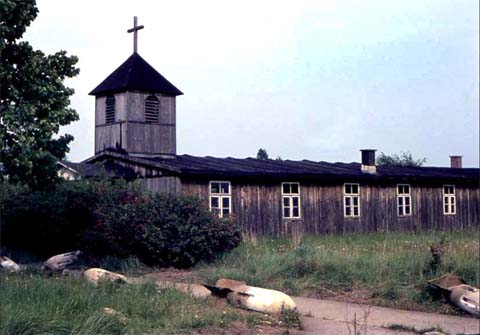
A photograph captioned Christmas 1949 shows residents gathered around tables in a decorated dining room. An undated photograph records a wooden camp church. Together they preserve spaces for celebration and worship alongside the everyday work described in the relief archive.
Sources for this section
Life in settlement 117
The provincial files show an institution with its own civil life. The settlement had kindergartens, a Jewish camp committee whose members were elected, a hut built for ritual slaughter, film shows put on by a travelling company, language courses for people preparing to emigrate, a mother-and-baby advice centre and a gendarmerie post. Residents held leases for a canteen, a dental surgery, a cinema, a fruit shop and a garage, and the local sports club ATSV Asten rented ground inside the settlement.
Health was a persistent problem. A 1953 return of illness in the Upper Austrian settlements records 119 residents of Asten as tubercular. A barrack fire in 1954 has its own file. Tension between groups of residents appears in the papers more than once, including between Yugoslav and other residents and among the Ukrainians of the camp.
Sources for this section
Departures and new arrivals
Recollections collected by DP camps.org describe families leaving Asten for Canada, the United States and Australia. One former resident remembers Ukrainian and Polish families settling in Winnipeg. These accounts establish individual routes out of the camp; they do not provide a complete destination breakdown.
The population continued to change after the early overseas departures. The Upper Austrian archive catalogues 1952 records concerning the transfer of Jewish residents from Wels to Asten and the reception of Jewish refugees from Vienna’s Rothschild hospital. Asten therefore remained part of a network of accommodation and transfers within Austria.
Asten also became a place of departure for other camps. An emigration office of the resettlement department was set up there, with its own X-ray equipment and international vaccination books, and it was later moved away again. From the middle 1950s the transit camp kept monthly summaries of arrivals and departures alongside statistics of emigration.
Sources for this section
The camp’s longer life
The 1952 administrative files include a description of settlement 117 alongside the larger settlement at Haid. Such records show that Asten’s history continued beyond the main 1940s displacement years. The parish account records the final departures in 1963, after which the surrounding community increasingly grew as a residential area for workers employed around Linz.
The settlement was handed to the justice administration in 1963 and formally dissolved the following year; a short history of it was written into the closing file. Meanwhile the industry of Linz, and the steelworks and nitrogen works in particular, drew workers who tired of commuting and settled in Asten. The population grew tenfold, and the old parish church of 1724 to 1735, with its 200 seats, was too small; a new church was consecrated on 28 November 1982.
The most useful surviving evidence describes different parts of that history: IRO returns count Ukrainians, church reporting records a religious community, relief photographs document daily activities, and provincial files follow later housing administration. Read together, they show how a temporary camp became a home for years.
What survives for a researcher
The Upper Austrian provincial archive holds the resettlement files, and its catalogue names several kinds of record that identify people: lists of residents’ names, the electoral registers drawn up for the settlement councils in 1953, which give name, date of birth and sometimes the barrack lived in, monthly returns of arrivals and departures, and lists of blood donors. The files themselves are not digitised.
For the Greek Catholic community the 1947 report gives a plain direction: the registers for the whole province were kept only in Linz.
Sources for this section
Sources
- Pfarre Asten-St. Jakob
Marktgemeinde Asten · Accessed September 2026
Local parish history: camp established 1941, successive residents, last departures 1963.
- Population Migration after World War II, Table 5
Ihor Stebelsky, The Refugee Experience (1992) · Accessed September 2026
Printed p 43, PDF 70 visually checked. Ukrainian camp counts 361 on 30 September 1948 and 149 on 30 June 1950. Original IRO reports cited at ANF AJ 43 Box 1119.
- 15 Jahre ukrainische gr.-kath. Gemeinde in Linz
Archdiocese of Vienna, 2017 · Accessed September 2026
Reproduces 12 February 1947 church report: 300 Byzantine-rite faithful in Asten, 3100 region-wide. Not a whole-camp census.
- UNRRA Photographs: Asten garden series
United Nations Archives · Accessed September 2026
Original archival captions S-0800-0001-0017-00008–00011,00013,00021,00028–00032 inspected. Photograph files themselves behind browser challenge; no claim of visual inspection.
- Umsiedlungsakten
Oberösterreichisches Landesarchiv · Accessed September 2026
Printed pp 8 and 33: 1952 transfers into Asten 117, settlement descriptions Ums 6007/52. Catalogue inspected; underlying files not digitised here.
- Asten camp: photographs and recollections
DP camps.org · Accessed September 2026
Contemporary dining-hall photograph captioned Christmas 1949, church photograph undated. Community recollections distinguish overseas departures; no individual names published.
- Alphabetisches Verzeichnis der DP-Lager in Österreich
International Tracing Service, Bad Arolsen · 1963
Open-access ITS list of 36 printed pages, read directly. The Asten entries stand on printed page 2: D.P.-Lager number 100, Area Team II Linz/Donau, last mentioned 7 February 1951; D.P.-Lager number 117, Area Team II Linz/Donau; and an entry against Team T 339, Area Team II Linz/Donau, May 1947.
- Umsiedlungsakten: the Asten entries
Oberösterreichisches Landesarchiv · Catalogue, Linz 2003
Finding aid of 253 pages searched in full for Asten. The settlement is carried throughout as DP-Wohnsiedlung, later Durchgangslager, 117 Asten. Entries used here: Ums. 13/52 (general file); Ums. 3374/52 and 3989/52; Ums. 113/53 (119 residents recorded with tuberculosis); Ums. 4048/56 (monthly summaries of arrivals and departures, and emigration statistics); Ums. 1255/63 (barrack fire of 1954); Ums. 572/63 (handover to the justice administration); Ums. 519/64 (dissolution); Ums. 712/64 (a short history of the settlement). Catalogue entries only; the files themselves are not digitised.
Last researched 12 September 2026