Kriegsschule Camp
Displacement in Europe
Bad Hersfeld, Hesse, Germany · Documented 1945–1947
Ukrainian displacement in Hersfeld brought together a camp at the former military school, an Orthodox congregation, the first Ukrainian newspaper of the postwar emigration and resistance to forced return.
Introduction
Hersfeld’s former Kriegsschule, or military school, housed a displaced-persons camp in Germany’s American occupation zone. The Arolsen Archives inventory lists it under the town with Polish, Latvian, Ukrainian and Lithuanian residents recorded and a capacity of 700, running from its first listing in January 1946 to a closing date of 27 May 1949. Ukrainian residents appear in four successive population returns for 1946 and 1947.
There was more in the town than the camp. Hersfeld supported St Volodymyr’s Ukrainian Orthodox parish, a Ukrainian relief committee that issued its own bulletin, and the earliest Ukrainian refugee newspaper of the postwar years; it was also the seat of the UNRRA area team that administered a large part of Hesse. It was not yet called Bad Hersfeld — the spa title came in March 1949, two months before the camp closed.
Sources for this section
- DP camp inventory: Hersfeld (Kriegsschule), Hersfeld DP-Hospital, Hersfeld Transient-Camp and Bad Hersfeld
- Ukrainians in American-zone camps, Table 7
- St Volodymyr Church (Hersfeld displaced persons camp) records
- Publications by Ukrainian Displaced Persons and Political Refugees, 1945–1954, in the John Luczkiw Collection
- The First Post-World War II Periodicals
- Geschichte der Stadt Bad Hersfeld
A history in dates
- 22 April 1945The first issue of Korotki visti appears in Weimar, typed and passed from hand to hand.
- 1945Korotki visti moves from Weimar to Hersfeld by its ninth issue; the Ukrainian relief committee in the town issues its own bulletin.
- 24 January 1946First listing of the Hersfeld Kriegsschule camp in the Arolsen inventory, under UNRRA Team 715 Hersfeld.
- Early postwar periodA Ukrainian appeal from the Hersfeld UNRRA centre protests threatened removal.
- 20 August 1946A DP hospital opens at Hersfeld under the same assembly centre number; it closes within weeks.
- August 1946The Kriegsschule return records 217 Ukrainians.
- 1946–1947St Volodymyr’s parish register records baptisms, marriages and funerals.
- May 1947The Kriegsschule return records 246 Ukrainians.
- 3–5 June 1947Hersfeld hosts the seventh meeting of the Initiative Group for the Unification of the Ukrainian Autocephalous Orthodox Church.
- 26 September 1947A fifty-place transient camp opens in the town; it holds four people at the end of October.
- 31 October 1947The inventory records a capacity of 700 at the Kriegsschule.
- December 1947The recorded Ukrainian population is 41.
- September 1948The assembly centre number AC 548 is replaced by the IRO designation K 120.
- 4 March 1949Hersfeld is recognised as a spa and becomes Bad Hersfeld.
- 27 May 1949Closing date of the Kriegsschule camp in the Arolsen inventory.
Sources for this section
- The First Post-World War II Periodicals
- Publications by Ukrainian Displaced Persons and Political Refugees, 1945–1954, in the John Luczkiw Collection
- DP camp inventory: Hersfeld (Kriegsschule), Hersfeld DP-Hospital, Hersfeld Transient-Camp and Bad Hersfeld
- Declaration from the UNRRA centre in Hersfeld
- Ukrainians in American-zone camps, Table 7
- St Volodymyr Church (Hersfeld displaced persons camp) records
- The Ukrainian Autocephalous Orthodox Church in West Germany, 1945–50
- Geschichte der Stadt Bad Hersfeld
The war school by the abbey
The building stood near the abbey ruins. A barracks was put up opposite the main portal of the Stiftsruine after Prussia annexed Hesse, and in 1871 the fusilier battalion of the 2nd Thuringian Infantry Regiment No. 32 was quartered in it; from 1890 the building housed a Prussian Kriegsschule. The Hessian state historical atlas records the same site’s successive uses as infantry barracks, military school and tax office. That physical history locates the camp within the town rather than at the separate Cornberg settlement.
The Kriegsschule should not be confused with the town’s other barracks. The Langemarck-Kaserne, built during the rearmament of the 1930s on the Hohe Luft above the town, was taken over by the United States Army in 1945 and renamed McPheeters Barracks, and American troops remained there for nearly half a century. The displaced persons went into the old school beside the abbey, not the newer barracks on the hill.
Sources for this section
The camp in the records
The Arolsen inventory gives the camp its administrative shape. It carried the assembly centre number AC 548, replaced in September 1948 by the IRO designation K 120, and a capacity of 700 entered against 31 October 1947. It was served by UNRRA Team 715 Hersfeld, with a team director recorded as Shorthose and a field supervisor recorded as Jonckheere, and it lay in Area 1, Frankfurt am Main. The lists and change reports for Hersfeld are held at Bad Arolsen under document identifiers 81964322 to 81964379.
Two smaller installations shared the town and the same assembly centre number. A DP hospital opened at Hersfeld on 20 August 1946 and closed again within weeks. A transient camp, entered in the inventory as the Soviet Transient Camp, opened on 26 September 1947 with fifty places; at the end of October 1947 it held four people, and it had gone by the end of January 1948. For anyone being moved eastwards, that small annexe rather than the Kriegsschule was the last address in the town.
Hersfeld was also an administrative centre in its own right. Area Team 1023 Hersfeld covered more than twenty camps across northern and eastern Hesse: the large Polish and Ukrainian camp at Cornberg, the Constantin barracks at Fulda, the Braunsfels barracks at Wetzlar, the Jewish centres at Ziegenhain, Bad Nauheim and Bad Salzschlirf, the Polish camps at Allendorf, the Russian camp at Neukirchen and the hospitals at Fulda, Wetzlar, Haina and Marburg. A resident of the Kriegsschule was living at the seat of the office that ran them all.
Arolsen Archives inventory entries for Hersfeld
| Field | Value |
|---|---|
| Building | Kriegsschule |
| Opening (first listing) | 24 January 1946 |
| Closing | 27 May 1949 |
| Capacity | 700 |
| Capacity date | 31 October 1947 |
| Assembly centre | AC 548; from September 1948 K 120 |
| UNRRA team | T 715 Hersfeld |
| Team director | Shorthose |
| Area team | AT 1023 Hersfeld |
| Area | A 1 Frankfurt/Main |
| Field supervisor | Jonckheere |
| Nationalities recorded | polnisch, lettisch, ukrainisch, litauisch |
| Archive references | ITS Dok-ID 81964322-81964379 |
| Other Hersfeld entries | DP-Hospital, opened 20 August 1946, AC 548; Transient-Camp / Soviet-Transient-Camp, opened 26 September 1947, capacity 50, headcount 4 at 31 October 1947, AC 548 A |
The struggle against forced return
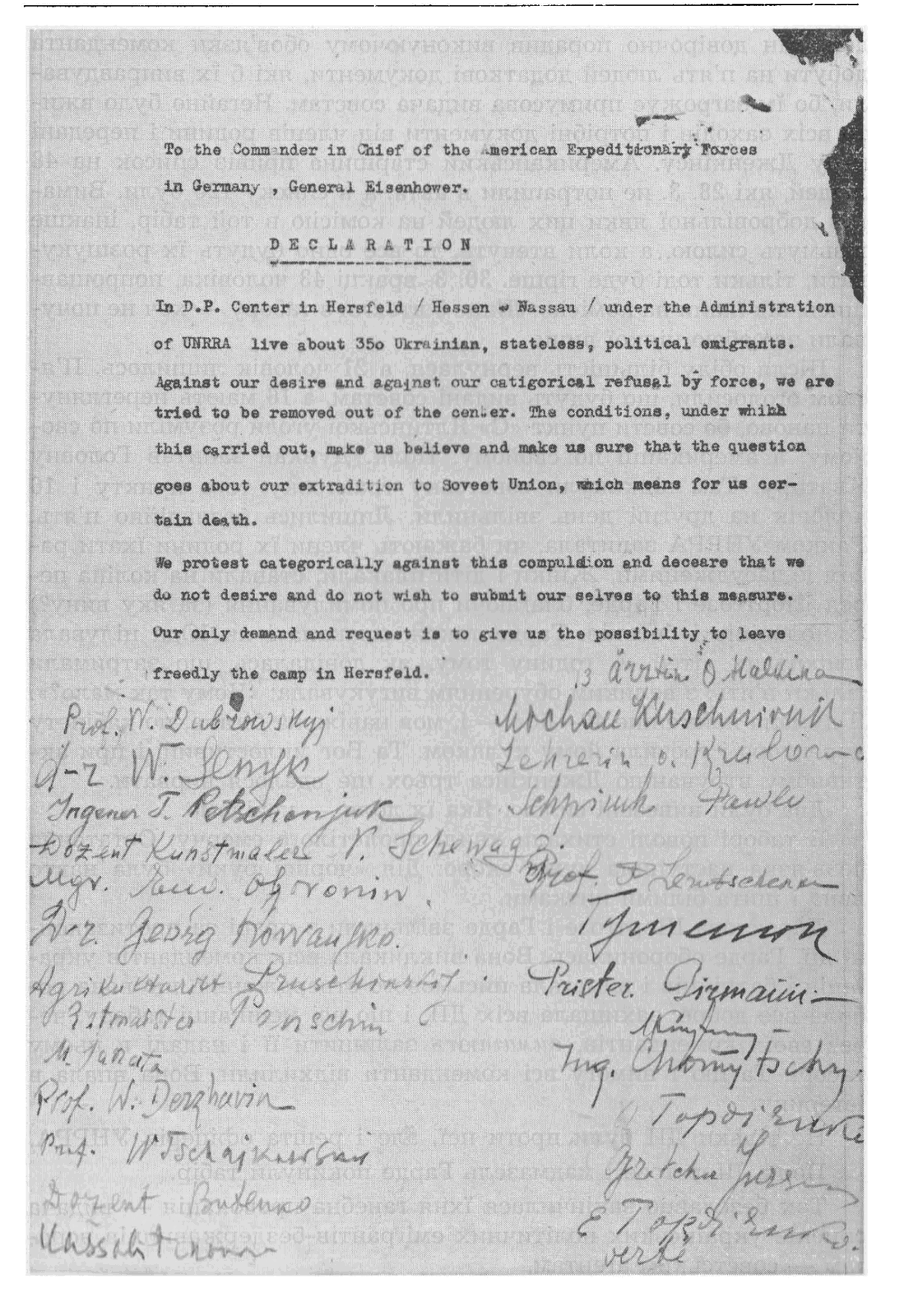
A declaration reproduced in the 1985 Ukrainska zemlia described about 350 Ukrainian political emigrants at the UNRRA centre in Hersfeld. Its authors feared that their threatened removal meant extradition to the Soviet Union and appealed to the American commander for freedom to leave the camp. The appeal records the residents’ understanding of the danger they faced.
Marta Dyczok’s history describes an American officer refusing to hand over a group assembled at Hersfeld and seeking to move them farther from Soviet control. Together, the appeal and historical account show how protection from repatriation could depend on decisions taken by local military authorities.
Repeated screening added to the insecurity. Marta Dyczok’s study describes nine examinations within one year, followed by the announcement of a tenth. Residents protested to their UNRRA repatriation officer and then appealed to American military authorities. An investigation led to the officer’s removal. This episode shows refugees organising to challenge administrative treatment as well as seeking protection from forced return.
An account published by the Foreign Intelligence Service of Ukraine, drawing on declassified archival documents, lists Hersfeld among the German cities whose camps held the greatest numbers of Ukrainians, alongside Regensburg, Mittenwald, Berchtesgaden, Neu-Ulm, Augsburg, Aschaffenburg, Ellwangen, Munich, Hanover, Heidenau, Weiden and Traunstein. The account gives no further detail about Hersfeld, and does not say which camp in the town the documents referred to.
Ukrainians at the military-school camp
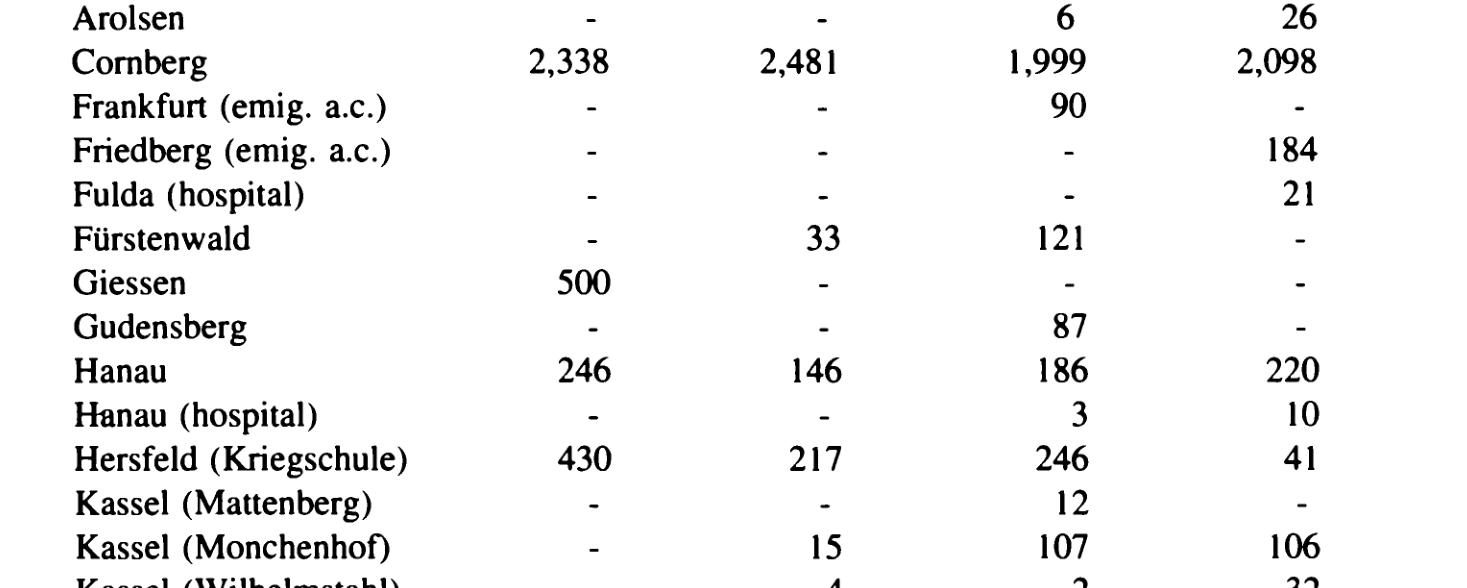
The successive administrative returns for Hersfeld’s Kriegsschule record 430 Ukrainians in the questionnaire returns collected during 1946 and 1947, then 217 in August 1946, 246 in May 1947 and 41 in December 1947. The sharp fall establishes a change in the recorded community; these figures alone do not identify where each family went or establish the camp’s closure.
The four columns are not four snapshots of one kind. The first comes from the Central Representation of the Ukrainian Emigration’s own questionnaire, gathered across two years; the second and third are UNRRA assembly-centre summaries; the fourth is the PCIRO summary compiled at Heidelberg on 2 January 1948. Land Hessen as a whole runs 6,528, 3,972, 5,340 and 4,941 across the same four columns, so the collapse at Hersfeld to 41 is a local movement rather than a zone-wide one.
Against a recorded capacity of 700, a Ukrainian population in the low hundreds means that the Kriegsschule was a mixed camp throughout its life, holding Poles, Latvians and Lithuanians alongside Ukrainians.
Ukrainians at Kriegsschule Camp, and in Land Hessen
| Return | Kriegsschule | Land Hessen |
|---|---|---|
| 1946–47 questionnaire | 430 | 6,528 |
| August 1946 | 217 | 3,972 |
| May 1947 | 246 | 5,340 |
| December 1947 | 41 | 4,941 |
St Volodymyr’s parish in Hersfeld
The Ukrainian Autocephalous Orthodox parish kept a register of baptisms, marriages and funerals during 1946–1947. It survives as a small, distinct collection at the Ukrainian History and Education Center. These are traces of a family community maintaining religious life during displacement.
The surviving description identifies the parish with the Hersfeld DP camp, without specifying its address. Its records preserve a further dimension of the Ukrainian refugee community in the town, alongside the population returns that explicitly name the Kriegsschule.
The congregation was formally constituted: a statute for a parish of the Ukrainian Autocephalous Orthodox Church was printed at Hersfeld and is catalogued in the standard bibliography of Ukrainian displaced persons’ publications. A parish that prints its own statute is organising itself, not merely gathering.
Hersfeld also had a part in the wider quarrel over the government of that church. From 3 to 5 June 1947 the town hosted the seventh meeting of the Initiative Group for the Unification of the Ukrainian Autocephalous Orthodox Church of the 1921–1942 formation — the conciliar opposition to the emigre episcopate. The meeting discussed Archbishop Ioann Teodorovych’s letter of 28 April 1947 to Ivan Harashchenko and his correspondence with Bishop Mstyslav Skrypnyk on the terms of any union between the two churches. The group’s following meetings were held at Aschaffenburg in July and August.
News and a sense of home
Korotki visti was, on the best available account, the first Ukrainian periodical of the postwar emigration. It was published by the Ukrainian Organized Community, headed by Volodymyr Dolenko, Mykhailo Vietukhov and Vasyl Dubrovsky, and its first issue appeared in Weimar on 22 April 1945, before the war had formally ended. The first four issues were typed, and readers were asked to retype copies and pass them on; from the fifth the bulletin went over to letterpress. By its ninth issue it had moved to Hersfeld, in the American zone, where publication ended.
The bibliographies show what the move left behind. Korotki visti is catalogued at Hersfeld under the imprint of the Information Service of the Organized Ukrainian Community, with issues 3 (11) and 5 (13) of 1945 surviving — the double numbering of a bulletin that started again at Hersfeld while keeping its running total. A second Hersfeld title, the Bulletin of the Ukrainian Relief Committee in Hersfeld, survives in numbers 8 to 10 (25 to 27) and 12 to 13 (29 to 30), all of 1945, so that committee had put out about thirty numbers before the year was out.
Books were made there too. Vasyl Dubrovsky, one of the three men behind Korotki visti, reissued his Batko Nestor Makhno at Hersfeld in 1945, and a political pamphlet under the imprint U.N.D.I. was published in the town the same year. For a few months in 1945 this small Hessian town was one of the places where Ukrainian print was being produced.
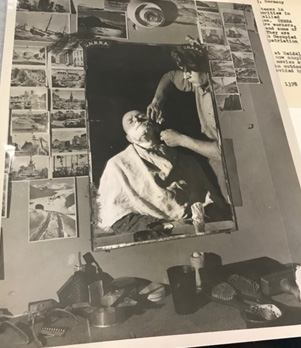
A surviving photograph records a Hersfeld camp barber’s mirror surrounded by smaller photographs. Images of people and places filled the space around an everyday service. This arrangement brought personal memory into camp life, making room for familiar faces and earlier homes within temporary accommodation.
Sources for this section
- The First Post-World War II Periodicals
- Publications by Ukrainian Displaced Persons and Political Refugees, 1945–1954, in the John Luczkiw Collection
- Political Refugees and Displaced Persons, 1945–1954: Research Report No. 2 — Hersfeld imprints
- Hopeful and Obligatory Remembering: Mediated Memory in Refugee Camps in Post-War Germany
Closure and the spa town
The inventory gives the camp a closing date of 27 May 1949. By then the town had changed its own name: from 4 March 1949 Hersfeld was recognised as a spa and entitled to call itself Bad Hersfeld, and the inventory carries a separate entry for Bad Hersfeld which notes that the prefix has been used since 1949 and refers the reader back to Hersfeld.
The building outlived both the war school and the camp. The site opposite the abbey ruins that had been an infantry barracks and then a Prussian military school became the town’s tax office, which is what stands there today.
The record of the community
Camp statistics, parish records, a collective appeal and a refugee bulletin preserve complementary parts of Hersfeld’s story. They connect practical needs with efforts to maintain a community: finding protection, recording family events, circulating news and keeping memories visible during a period of uncertainty.
Sources
- Ukrainians in American-zone camps, Table 7
The Refugee Experience · 1992
Table 7, “Ukrainians in UNRRA and IRO Camps of the American Zone of Germany”, printed pages 47–51. The Hersfeld (Kriegschule) row on printed page 47 reads 430 (1946–7 questionnaire), 217 (August 1946), 246 (May 1947), 41 (December 1947); the Land Hessen line on the same page reads 6,528, 3,972, 5,340, 4,941. Column definitions and the underlying UNRRA and PCIRO summaries are set out in the table’s source notes on printed page 51.
- St Volodymyr Church (Hersfeld displaced persons camp) records
Ukrainian History and Education Center · 1946–1947
Findingaidr-6; exact building not given.
- The First Post-World War II Periodicals
The Refugee Experience · 1992
Roman Ilnytzkyj, “A Survey of Ukrainian Camp Periodicals, 1945–50”, printed page 272 read in full: Korotki visti published by the Ukrainian Organized Community under Volodymyr Dolenko, Mykhailo Vietukhov and Vasyl Dubrovsky; first issue Weimar, 22 April 1945; first four issues typed with readers asked to retype and circulate them; letterpress from the fifth; moved to Hersfeld by the ninth, where it ceased.
- Hessischer Städteatlas: Bad Hersfeld
Hessian Office for Regional History · 2007
2007 atlas, site entry F: infantry barracks, military school and tax office.
- Declaration from the UNRRA centre in Hersfeld
Ukrainska zemlia, no.12 · 1985
Facsimile inspected on printed page 26 (PDF page 29). Signatures and names are not reproduced.
- The Grand Alliance and Ukrainian Refugees
Marta Dyczok, Macmillan / St Antony’s Series · 2000
Title page and full Hersfeld passages read: printed pages 68,139–141. Archive references underpin the discussion.
- Hopeful and Obligatory Remembering: Mediated Memory in Refugee Camps in Post-War Germany
Philipp Seuferling, Media Studies · 2020
Figure 1, printed page 22: UN Archives, Germany Mission photographs, S-1058-0001-01. Original embedded image extracted. The caption locates it at Hersfeld without naming a particular building.
- DP camp inventory: Hersfeld (Kriegsschule), Hersfeld DP-Hospital, Hersfeld Transient-Camp and Bad Hersfeld
Arolsen Archives · 26 October 2023
Entries for Hersfeld read in full: Kriegsschule — first listing 24 January 1946, closing 27 May 1949, nationalities polnisch, lettisch, ukrainisch, litauisch, capacity 700 at 31 October 1947, AC 548 and from 09.1948 K 120, UNRRA Team T 715 Hersfeld, team director Shorthose, Area Team AT 1023 Hersfeld, Area A 1 Frankfurt/Main, field supervisor Jonckheere, ITS Dok-ID 81964322-81964379. DP-Hospital — opened 20 August 1946, closed between 20 August and 15 September 1946, AC 548. Transient-Camp / Soviet-Transient-Camp — opened 26 September 1947, capacity 50, headcount 4 at 31 October 1947, AC 548 A, closed between 31 October 1947 and 30 January 1948. Bad Hersfeld — “siehe Hersfeld; der Zusatz Bad wird seit 1949 geführt”. The camps of Area Team 1023 Hersfeld were also listed from the same spreadsheet. Serial dates converted from the Excel epoch.
- Publications by Ukrainian Displaced Persons and Political Refugees, 1945–1954, in the John Luczkiw Collection
Yury Boshyk and Włodzimierz Kiebalo, Canadian Institute of Ukrainian Studies · 1988
Printed page 9: “Biuleten ukrainskoho dopomohovoho komitetu v Hersfeldi. Herzfeld: Ukrainskyi dopomohovyi komitet”, holdings ch. 8-10 (25-27), 12-13 (29-30) (1945). Printed page 52: “Korotki visti. Herzfeld: Informatsiina sluzhba Orhanizovanoho ukrainskoho hromadianstva”, holdings ch. 3 (11), 5 (13) (1945).
- Political Refugees and Displaced Persons, 1945–1954: Research Report No. 2 — Hersfeld imprints
Yury Boshyk and Boris Balan, Canadian Institute of Ukrainian Studies · 1982
Printed page 268: “Dubrovsky, Vasyl. Batko Nestor Makhno. Reprint. Hersfeld, 1945.” Printed page 327: a political pamphlet published at Hersfeld by U.N.D.I. in 1945. Printed page 339: “Statut parafii U.A.P.Ts. Hersfeld, n.d.”
- The Ukrainian Autocephalous Orthodox Church in West Germany, 1945–50
Bohdan R. Bociurkiw, in The Refugee Experience, Canadian Institute of Ukrainian Studies Press · 1992
Chapter printed pages 158–184; notes 35 and 44 on printed pages 178–179 read in full. Note 44 cites “Protokol ch. 7 Zasidannia Initsiiatyvnoi Hrupy Iednannia Ukrainskoi Avtokefalnoi Pravoslavnoi Tserkvy, formatsii 1921-1942 rr.” (Hersfeld, 3-5 June 1947), followed by meetings at Aschaffenburg on 15 July and 8 August 1947; note 35 records that the Hersfeld meeting discussed Archbishop Ioann Teodorovych’s letter of 28 April 1947 to Ivan Harashchenko and his letter of 13 June 1947 to Bishop Mstyslav Skrypnyk.
- Geschichte der Stadt Bad Hersfeld
Wikipedia (German) · Accessed 14 September 2026
Read for the garrison and the spa title: the barracks opposite the main portal of the Stiftsruine, the fusilier battalion of the 2nd Thuringian Infantry Regiment No. 32 stationed there in 1871, the Prussian Kriegsschule in the building from 1890 and the tax office there today; the Langemarck-Kaserne taken over by the United States Army in 1945 and renamed McPheeters Kaserne; “Ab dem 4. März 1949 ist Hersfeld Heilbad und darf sich Bad Hersfeld nennen”.
- Launch Intelligence and Propaganda Work on Ukrainian Emigrés
Foreign Intelligence Service of Ukraine (szru.gov.ua) · 22 March 2023
Web article read in full; the relevant passage is the paragraph beginning “Archival documents mention the camps”, which lists the cities whose camps held the greatest numbers of Ukrainians. No author is stated; the article draws on the Archive of the Foreign Intelligence Service of Ukraine.
Last researched 12 September 2026