Bad Kohlgrub UNRRA Hospital
Displacement in Europe
Bad Kohlgrub · Germany · 1945–1947
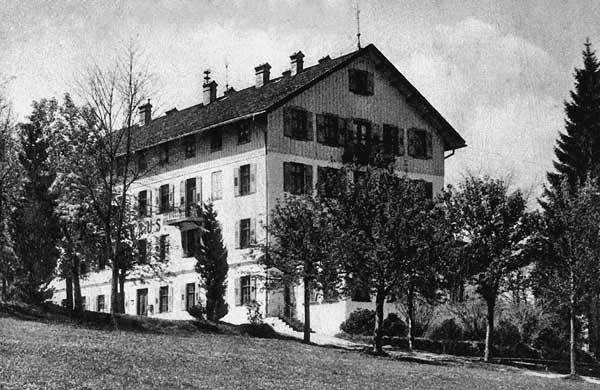
The lower spa house at Kohlgrub was taken over by UNRRA in May 1945 and run as a sanatorium where displaced people too weak or ill for camp life were treated before being sent on. Its patients were counted separately in Ukrainian and in Jewish returns, and the building was demolished less than twenty years after it closed.
Introduction
The Lower Kurhaus at Bad Kohlgrub became a UNRRA hospital for displaced people after the Second World War. Former forced labourers, people weakened by persecution and mothers giving birth received care in a building originally designed for spa visitors. Ukrainian patients were among this mixed medical community.
This was a medical facility rather than a residential camp, and the distinction matters for anyone tracing a family. The Bavarian historical account states plainly that patients were moved on to displaced-persons camps or to communities once they had recovered, so a Kohlgrub record marks a stage in a journey rather than a home.
A history in dates
- 1914 to 1922The spa serves as a convalescent home for soldiers.
- February 1942The spa operation becomes a Luftwaffe hospital.
- 29 April 1945American troops reach Kohlgrub.
- May 1945UNRRA takes over the Lower Kurhaus.
- March 1946Limited spa operation is permitted again and the village takes in 820 German expellees.
- August 1946The Jewish register records 36 Jewish patients, rising to 54 in September.
- May 1947A population return records 140 Ukrainians at the hospital; the Jewish register records eighteen.
- 1947Institutional histories tentatively place the end of the sanatorium in this year.
- 30 June 1948The Upper Kurhaus, a separate building, reopens to spa guests.
- 1964 and 1965The derelict lower Kurhaus is demolished after its last occupants move into new housing.
The Lower Kurhaus
The spa property had been modernised during the 1930s, including a drinking fountain supplied by its own mineral water. In February 1942 the spa operation was handed over to the Luftwaffe as a military hospital. American troops reached Kohlgrub on 29 April 1945; UNRRA took over the Lower Kurhaus the following month.
The building had a longer history of medical use. In the First World War the spa had served as a convalescent home for soldiers, treating what was then called trench disease until 1922. The whole spa business in the Gagers district, comprising some 50 hectares, passed into the single ownership of Else Windhäuser in 1932 and was handed over complete to the Luftwaffe ten years later.
This was the Lower Kurhaus. The Upper Kurhaus was a different building whose reopening for spa guests on 30 June 1948 does not establish the hospital’s closure date.
Successive uses of the Kurhaus buildings
| Period | Use |
|---|---|
| 1914 to 1922 | Convalescent home for soldiers |
| From 1932 | Whole spa business, lower and upper houses, in single ownership |
| February 1942 to 1945 | Luftwaffe hospital |
| May 1945 to 1947 | UNRRA sanatorium for displaced persons in the lower Kurhaus |
| From March 1946 | German expellee families housed in the lower Kurhaus |
| From 30 June 1948 | The upper Kurhaus, a separate building, reopens to spa guests |
| 1964 and 1965 | The derelict lower Kurhaus is demolished |
Sources for this section
Treatment and maternity care
The existing medical staff cared for former forced labourers and women after childbirth from eastern European war zones. The municipality records numerous births here. Its role therefore encompassed both recovery from wartime suffering and the practical medical needs of families beginning the postwar years.
The Bavarian historical account describes a sanatorium for particularly weakened or ill displaced people, set up by UNRRA doctors in a building the American military government had requisitioned. After recovery, patients moved into other DP camps or communities. A stay at Kohlgrub could consequently be one medical stage within a longer displacement journey, rather than a family’s permanent camp residence.
Sources for this section
Different communities, different counts
A published Ukrainian population return records 140 people at the UNRRA hospital in May 1947. A separate history of Jewish DPs records eighteen Jewish residents in that month. These figures classify people differently, so they should be read as separate source measures rather than added together into a supposedly complete hospital population.
Jewish returns varied substantially: 36 in August 1946, 54 in September, 49 in November, two in January 1947, eighteen in May, forty in June and one in August. The sequence reflects a changing medical community, but it does not by itself explain each admission or departure. Three men are named in that register as the representatives of the Jewish patients.
Stebelsky’s table gives Bad Kohlgrub a row of its own, labelled UNRRA hospital, with a figure only in the column for 31 May 1947. The blanks in the other three columns are not zeros; they mean that the hospital does not appear in the returns used for those dates.
Separate published population measures
| Group / source | Date | Recorded people |
|---|---|---|
| Ukrainian return (Stebelsky, Table 7) | 31 May 1947 | 140 |
| Jewish community register | August 1946 | 36 |
| Jewish community register | September 1946 | 54 |
| Jewish community register | November 1946 | 49 |
| Jewish community register | January 1947 | 2 |
| Jewish community register | May 1947 | 18 |
| Jewish community register | June 1947 | 40 |
| Jewish community register | August 1947 | 1 |
Another Ukrainian presence in the village
A published recollection records a separate Ukrainian presence at Kohlgrub. While barracks at Oberammergau were being repaired over the winter of 1945 to 1946, the women and children of one group of Ukrainian families were billeted in the village’s summer cottages, with their own administrator, while the men worked at Oberammergau and returned at weekends. This was holiday accommodation in the village and has nothing to do with the sanatorium in the Lower Kurhaus.
Sources for this section
The end of the sanatorium phase
The available institutional histories place the end of the UNRRA sanatorium tentatively in 1947. An exact final day is not established. The Jewish register gives 1946 as the year the facility opened, against the municipal record of a takeover in May 1945; the discrepancy has not been resolved here.
The building outlived the hospital by less than twenty years. The municipal chronology records that in March 1946 the village took in 820 expellees from the eastern territories and that the lower Kurhaus was filled with those families, and that in 1964 and 1965, once they had moved into new cooperative housing, the derelict lower Kurhaus was pulled down. Those families were German expellees, a different group from the displaced persons treated in the sanatorium, and the chronology does not explain how the two occupations of the building overlapped.
The wider recovery of the spa town followed its own timetable. Limited spa operation was permitted again in March 1946, the Upper Kurhaus reopened on 30 June 1948, and the whole village received the title Bad on 13 July 1948.
Sources
- Lower Kurhaus and the UNRRA hospital
Gemeinde Bad Kohlgrub · Accessed September 2026
Municipal account records May 1945 UNRRA takeover, existing medical staff, treatment of former forced labourers and maternity care.
- Bad Kohlgrub displaced persons sanatorium
Haus der Bayerischen Geschichte · Accessed September 2026
Identifies the Lower Kurhaus, treatment of weakened DPs and transfer after recovery. Tentative closure in 1947.
- UNRRA sanatorium: population and photograph
After the Shoah / Jim G. Tobias · 3 July 2016
Photograph of the actual Kurhaus, source Martin Doll private historical archive, published publicly. Register entry re-read on 13 September 2026: address Unteres Kurhaus; Jewish population 36 August 1946, 54 September 1946, 49 November 1946, 2 January 1947, 18 May 1947, 40 June 1947, 1 August 1947; opened 1946, closed 1947 with a query.
- Ukrainians at Bad Kohlgrub UNRRA Hospital
Canadian Institute of Ukrainian Studies Press · 1992
Stebelsky, Table 7, printed page 48, re-read visually at 2.6x on 13 September 2026: the row “Bad Kohlgrub (UNRRA hosp.)” carries 140 in the column for 31 May 1947 and dashes in the other three columns. Ukrainians only.
- 150 Jahre Bad Kohlgrub
Gemeinde Bad Kohlgrub, chronology compiled by Martin Doll, Heimatpfleger · Accessed September 2026
Municipal chronology: 1914 to 1922 convalescent home, February 1942 handover to the Luftwaffe, 1945 UNRRA takeover of the Lazarett, March 1946 spa permission and 820 expellees, 30 June 1948 reopening of the upper Kurhaus, 13 July 1948 grant of the title Bad, 1964 and 1965 demolition of the lower Kurhaus.
- Bad Kohlgrub: Jüdisches Leben in Bayern
Haus der Bayerischen Geschichte · Accessed September 2026
Full German entry read on 13 September 2026: requisition of the Unteres Kurhaus by the US military government, UNRRA doctors, treatment of especially weakened and ill displaced persons, transfer to camps or communities after recovery, named representatives of the Jewish patients, 36 in August and 54 in September 1946, and closure probably during 1947.
- Yurij Kuzmycz, The Road to Camp Luttensee
Society of Former Residents of the Ukrainian Displaced Persons’ Camps in Mittenwald, Warren, Michigan · 2001
Mittenwald 1946–1951, printed page 419, read visually from the scanned volume. Records Ukrainian women and children billeted in the summer cottages at Kohlgrub over the winter of 1945 to 1946, a separate arrangement from the sanatorium.
- Kohlgrub Bad, Upper Bavaria, photochrom print no. 17173
Photochrom Print Collection, Library of Congress, LCCN 2002696239 · between 1890 and 1900
Public domain photochrom print held by the Library of Congress. A general view of the spa village, with the village church below and large spa houses standing on the open slope above.
Last researched 13 September 2026