Balhary Hostel
Arrival and settlement
Balhary, near Alyth, Perthshire, Scotland · POW camp documented 1945–1947; postwar Ukrainian hostel
At Balhary Estate, a hutted camp became the headquarters of a wide network of working-prisoner hostels. Inspection reports describe its classrooms, library, theatre and daily frustrations; the site later appears in the directory of Ukrainian hostels.
Introduction
Balhary, near Alyth, is listed in Peter Kormylo’s directory of Ukrainian hostels. The site had an earlier life as Camp 63, a prisoner-of-war camp whose headquarters administered accommodation across a much larger area. Its surviving records are unusually detailed about education and everyday life in 1945–1947.
Those inspection reports concern German prisoners. They provide the history of the accommodation before its Ukrainian hostel phase, while Kormylo’s directory establishes the later Ukrainian connection. The estate’s photograph collection adds views of the camp’s buildings, music and religious activity.
A history in dates
- 1942 to 1948A published camp list gives these as the operating dates of camps 3 and 63 at Balhary, with associated hostels.
- 2 October 1945Inspection describes the hutted camp and three levels of English classes.
- 17–19 March 1947Headquarters inspection records 653 men at Balhary and 2,122 across the administered network.
- 15–21 April 1947Follow-up inspection covers headquarters and outlying hostels.
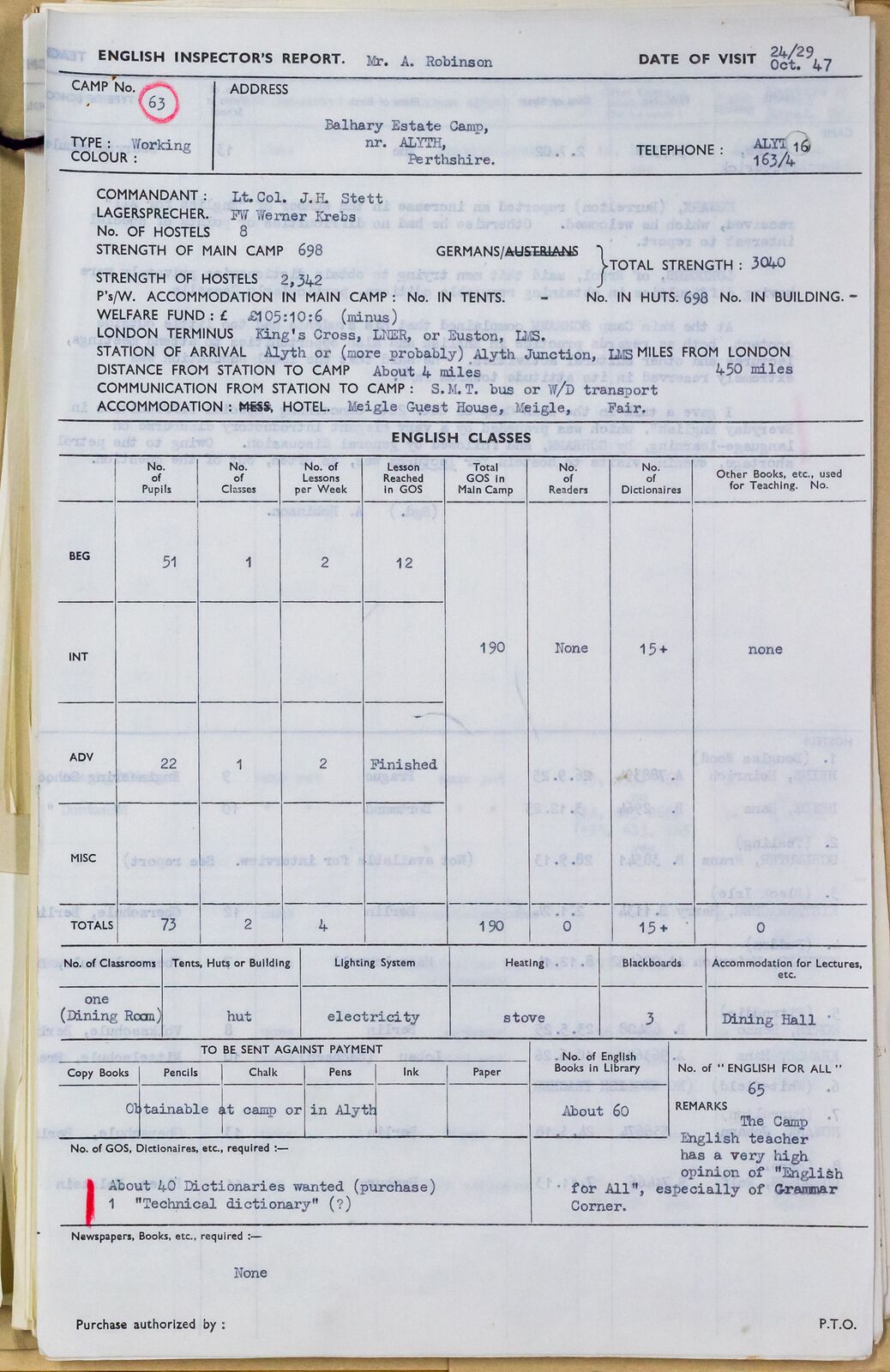
- 24–29 October 1947Headquarters return records 698 men and 73 English students.
- PostwarBalhary appears in the directory of Ukrainian hostels near Alyth.
- August 2019Field visit records the surviving tower and estate photograph collection.
Sources for this section
A camp on Balhary Estate
An inspector visiting on 2 October 1945 described a hutted camp with flower beds. By March 1947, Balhary was the headquarters of an extensive labour-camp organisation. The headquarters population and the total administered population were different measures: many men lived in satellite hostels or billets rather than at Balhary itself.
The March return counted 653 men at headquarters within a total of 2,122. In October, a different network and return recorded 698 at headquarters and 2,342 elsewhere, a combined 3,040. These are snapshots of the German POW organisation, not Ukrainian hostel population figures.
The camp carried two numbers in the published lists. The Secret Scotland summary list records Balhary Camp, Perthshire, as Prisoner of War Camp No. 3 and Balhary East Camp, Alyth, Perthshire, as Camp No. 63, each entry cross-referenced to the other and both at grid reference NO26554645. A second camp list enters the numbers together, as 3 / 63 against Balhary Camp, Perthshire, and dates the camp from 1942 to 1948, with associated hostels.
Headquarters and administered population
The March 1947 network
| Accommodation | Men recorded |
|---|---|
| Balhary headquarters | 653 |
| Calvine | 564 |
| Douglas Wood | 94 |
| Tealing | 137 |
| Tannadice | 6 |
| Pitroddrie | 65 |
| Bankfoot | 65 |
| Burrelton | 57 |
| Whitfield | 70 |
| Errol | 99 |
| Billets | 312 |
Balhary in the prisoner-of-war camp lists
| Camp number | Name as listed | Grid reference | Status or dates | List |
|---|---|---|---|---|
| 3 | Balhary Camp, Perthshire | NO26554645 | Destroyed; cross-referenced to No. 63 | Secret Scotland, PoW Camp Summary WW II |
| 63 | Balhary East Camp, Alyth, Perthshire | NO26554645 | Destroyed; cross-referenced to No. 3 | Secret Scotland, PoW Camp Summary WW II |
| 3 / 63 | Balhary Camp, Perthshire | Not given in the row | 1942 to 1948, plus hostels | Second camp list (camps by lowest number) |
Learning English
English classes were already operating in October 1945. The report described about 60 beginners, 30 intermediate students and 16 advanced students, with three periods each week for every group. Some 200 books had arrived for use after the harvest, placing education alongside the demands of agricultural work.
By October 1947, the headquarters return listed 73 English students: 51 beginners and 22 advanced learners. Two classes each met twice weekly. Teaching took place in a dining room fitted with a stove and electric light. The English library contained approximately 60 books and more than 15 dictionaries.
Teacher Schramm wanted more contact with English speakers and more opportunities for cultural visits. The inspector, A. Robinson, gave a talk on everyday English on 28 October. Petrol shortages restricted evening visits to outlying hostels, showing how transport shaped access to education as well as employment.
Sources for this section
Books, newspapers and performance
In March 1947 the library held around 1,000 volumes, although light German novels were in short supply. Weekly discussions attracted up to 40 men. Repatriation reduced participation as prisoners left the camp.
The camp newspaper, Huettenboten, appeared twice a month under editor Knaake. An anniversary number had recently been produced despite limited paper. A separate press review was also held twice monthly. A press exhibition opened on 16 March, though the visiting inspector criticised its presentation.
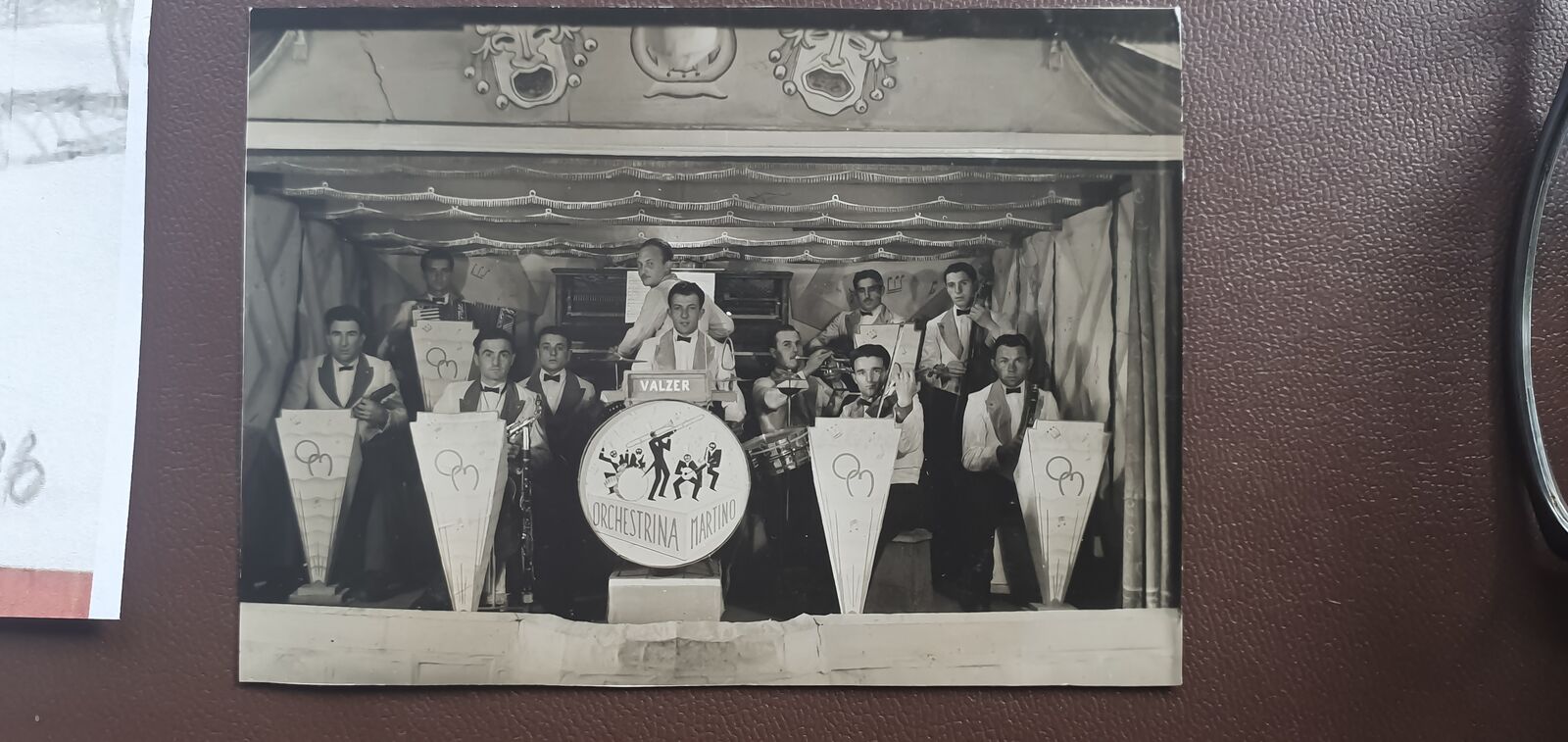
Theatre activity received support from British staff. An orchestra needed additional instruments, and transport costs made performances at distant hostels difficult. The report’s requests for instruments and equipment were proposals rather than a record that those items arrived.
An undated photograph in the estate collection shows the Orchestrina Martino performing on a stage. It preserves a separate visual record of music at the camp; the photograph does not identify it as the orchestra described in the German inspection report.
Sources for this section
Worship and gathering space
The March 1947 inspection found no dedicated church in the camp. A Protestant minister lacked both a suitable meeting place and a private room for pastoral conversations. Catholics attended local services, while the timing of Protestant services could be inconvenient for camp residents.
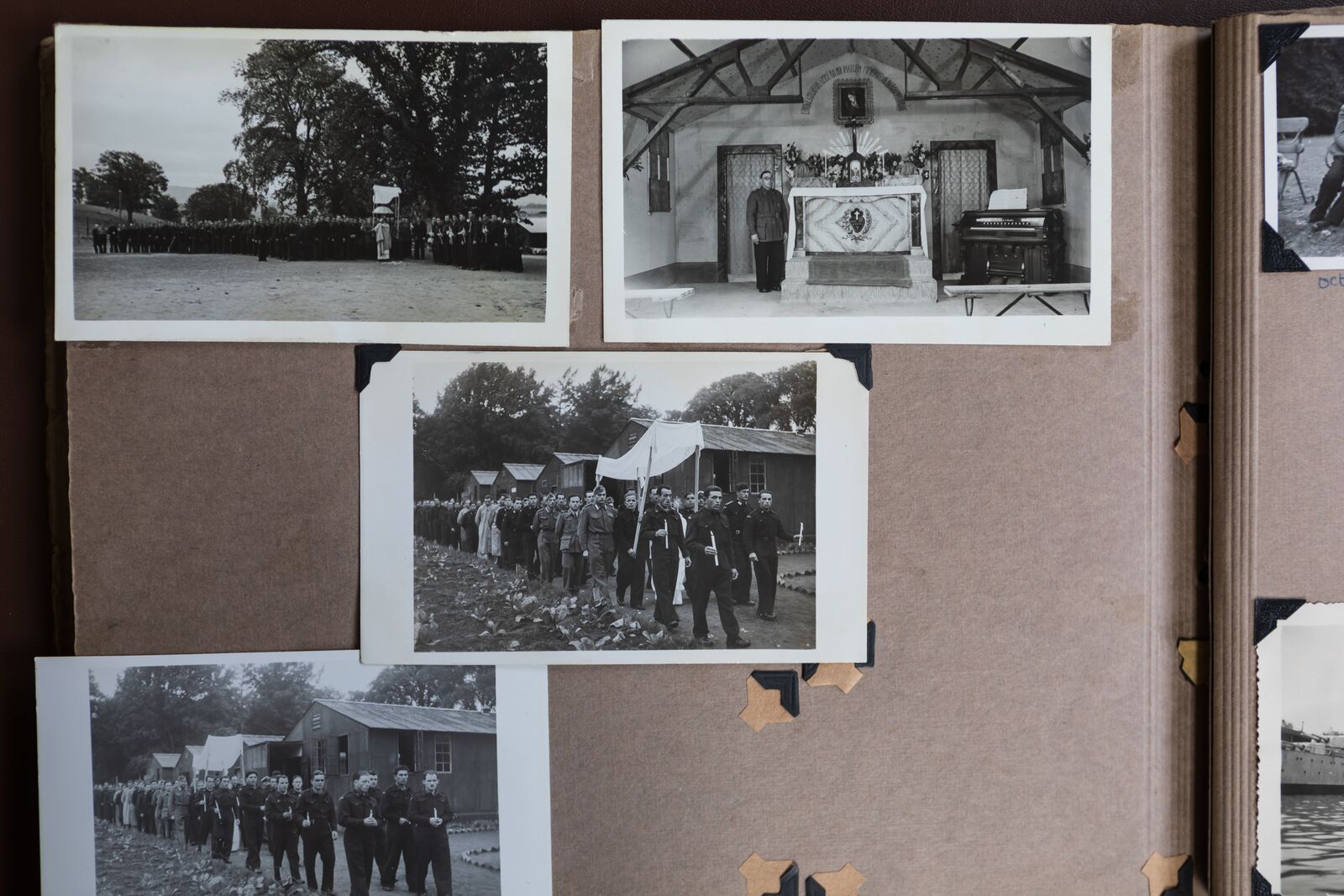
Undated estate photographs show a religious procession, an altar and rows of wooden huts. They document another moment in the camp’s history, without fixing the date or identifying the participants. Their presence alongside the written reports illustrates how spaces and religious arrangements could change over time.
Sources for this section
Work, weather and morale
Snow and flooding disrupted the March 1947 inspection and prevented visits to some outlying hostels. Bad weather also interrupted work. The report associated low morale with lack of money, complaints about food and tobacco, and anxiety about conditions in Germany.
Residents also encountered practical limits on recreation: film admission cost sixpence, and English dialogue could be difficult to follow. Radio was appreciated. Classroom, reading-room and meeting-space shortages recur in the reports, alongside efforts to maintain a library, discussion groups and performances.
Sources for this section
The Ukrainian hostel
Kormylo’s directory identifies Balhary as a hostel near Alyth within its list of Ukrainian accommodation. It places this former camp in the geography of postwar Ukrainian settlement in Scotland. The dated prisoner returns belong to the preceding German POW administration and remain separate from that later community.
The estate collection and surviving landscape
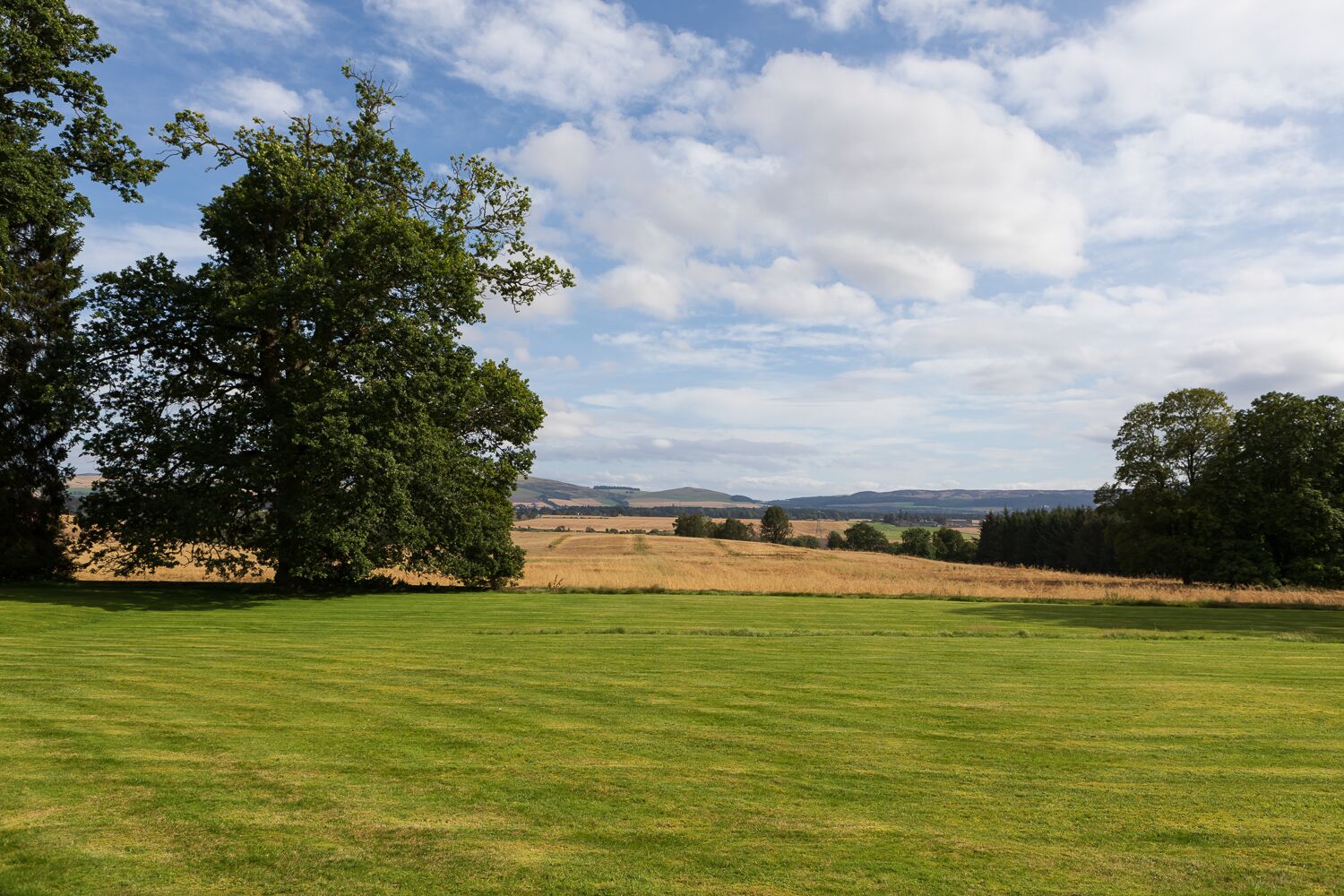
A field visit in August 2019 found the larger water tower standing at the edge of a wheat field, with its tank removed. The visitor also examined photographs, sketches and entertainment material preserved by the estate family. These retain a view of camp life after most of the accommodation disappeared.
The family’s account described huts being removed in stages and the eventual clearance of remaining buildings, bases and paths. The surviving landscape photograph and the earlier album views show the contrast between an occupied camp and the largely cleared estate setting.
Both Secret Scotland entries mark the site as destroyed. Neither entry dates the clearance.
Sources for this section
Sources
- Ukrainian hostels in Scotland: directory, entry 37
Peter David Kormylo, University of Glasgow · 2021
Original thesis appendix, printed page 323: Balhary, near Alyth, in the Ukrainian hostel directory.
- Camp 63, Balhary Estate: site visit and estate collection
Banged Up Abroad, POW Sites in Scotland · 2019 site visit
Field account and photographs of material preserved by Balhary Estate. Album photographs are undated.
- Balhary inspection, 2 October 1945
The National Archives, FO 939/144; facsimile reproduced by Banged Up Abroad · 1945-10-02
FO 939/144, scan 51; Grant’s account of the hutted camp and English classes.
- Camp 63 inspection, 17–19 March 1947
The National Archives, FO 939/144; facsimile reproduced by Banged Up Abroad · 1947-03-22
FO 939/144, scans 25–28, all visually read. Headquarters and satellite returns, education, library, religion and entertainment.
- Camp 63 follow-up, 15–21 April 1947
The National Archives, FO 939/144; facsimile reproduced by Banged Up Abroad · 1947-04
FO 939/144, scans 41–43, all visually read. Follow-up distinguishes headquarters from outlying hostels.
- Camp 63 inspection, 24–29 October 1947
The National Archives, FO 939/144; facsimile reproduced by Banged Up Abroad · 1947-10
FO 939/144, scans 12–14, all visually read. A. Robinson’s return, English teaching and educational contact.
- PoW Camp Summary WW II
Secret Scotland (SeSco) · Page last modified 10 September 2019
Camp summary list read online. Entry No. 3 names Balhary Camp, Perthshire, at grid reference NO26554645, marked destroyed and cross-referenced to No. 63; entry No. 63 names Balhary East Camp, Alyth, Perthshire, at the same grid reference, marked destroyed and cross-referenced to No. 3. A community-compiled wiki list, used only for the numbering, grid reference and destroyed status.
- Camps listed under lowest number allocated
Second World War prisoner-of-war camps in the United Kingdom (website) · Undated; table revised 2020 to 2026
Camp list table read online. The row for 3 / 63 names Balhary Camp, Perthshire, dated 1942 to 1948, with associated hostels. A community-compiled list, used only for the numbering and the date range it gives.
Last researched 12 September 2026