Prinz-Leopold-Kaserne
Displacement in Europe
Bayreuth, Germany · 1945–1949
A large Ukrainian community in Bayreuth built schools and a choir, held literary meetings, exhibited its craftwork and ran a camp postal service inside the former Prinz-Leopold barracks.
Introduction
The Prinz-Leopold-Kaserne was the principal Ukrainian displaced-persons camp in Bayreuth. The barracks name matters: Bayreuth also contained other camps and a hospital, and their populations should not be merged into a single institutional history. The Ukrainian relief committee’s June 1948 report identifies Leopoldkaserne explicitly among its main camps in the American zone.
The camp stood in the barracks quarter south of the town centre, in a garrison built out after 1871 and stretching from what is now Rathenaustraße to Justus-Liebig-Straße. Ukrainians had been brought to Bayreuth long before they were counted as displaced persons: hundreds of Ukrainian girls were deported there for labour in 1941, and fifty-five of them were killed in the Allied air raids of April 1945.
A history in dates
- 1877–1878The Prinz-Leopold-Kaserne is built on Kasernstraße for the first battalion of the 7th Infantry Regiment.
- 1941Hundreds of Ukrainian girls are brought to Bayreuth as forced labourers.
- 8 April 1945Bayreuth’s barracks quarter is bombed; fifty-five of the Ukrainian women brought there for labour are killed in the April raids.
- 25 June 1945A registration in the Prinz-Leopold-Kaserne counts 3,158 Poles, 271 Lithuanians, 58 Russians and two stateless people.
- 29 August 1945Recorded opening of Assembly Centre 92-255.
- 1945A choir is founded in the camp gymnasium.
- June 1946The camp postal service begins.
- 4–5 October 1946The Artistic Ukrainian Movement holds its critical conference at Bayreuth.
- December 1947A published return records 2,610 Ukrainians at Leopold-Kaserne.
- 1948The Bayreuth sub-headquarters of Area 3 exhibits and catalogues work by displaced persons, twenty-three plates of it from Leopold Kaserne.
- 19 February 1948The Bayreuth Plast novice nest Diti Sontsia announces the death of one of its members, a girl in her ninth year.
- August 1949About 1,500 people remain in the camp, predominantly Ukrainians.
- 1 October 1949Administrative end date in the camp inventory.
- 1950The barracks are converted into 68 flats for former residents of mass refugee camps.
- 20 February 1951The Leopoldkaserne appears as an item on the Bavarian cabinet’s agenda.
- 1972The barracks are demolished and the site becomes a car park.
Sources for this section
- Kasernenviertel (Bayreuth)
- Байройт
- DP camp inventory: Bayreuth entries 794, 796 and Wendelhöfen 1600
- Байройт
- Ukrainian camp postal services
- Мистецький український рух
- The Refugee Experience: Ukrainian Displaced Persons after World War II
- Handicrafts of Displaced Persons and Refugees
- Art of Displaced Persons and Refugees. Artistic paintings, plastics and graphics
- Na slidi: zhurnal plastovoho iunatstva (On the Trail: journal of Plast youth)
- Bavarian cabinet minutes, protocol 14 of 20 February 1951, item XI: Leopoldkaserne in Bayreuth
The barracks before the camp
The Prinz-Leopold-Kaserne was built in 1877 and 1878 on what was then Kasernstraße, now Rathenaustraße, and housed the first battalion of the 7th Infantry Regiment. Bayreuth knew it simply as the Siebenerkaserne, the seven-ers’ barracks, and it was the largest building on the site.
The garrison suffered heavily in the air raid of 8 April 1945; in the neighbouring Hans-Schemm-Kaserne alone as many as 170 soldiers were killed while collecting their food. Within weeks of the American occupation the surviving barrack blocks were holding displaced persons instead of soldiers.
Sources for this section
A community in former barracks
The administrative inventory identifies this camp as Assembly Centre 92-255 and later OMF 319. It records an opening on 29 August 1945 and an end date of 1 October 1949. These are the inventory’s administrative dates, rather than dates of arrival and departure for every resident. Its nationality field describes the camp as Ukrainian.
The camp was not Ukrainian from the beginning. A registration of 25 June 1945 counted 3,158 Poles, 271 Lithuanians, 58 Russians and two stateless people in the Prinz-Leopold-Kaserne. The Ukrainian character the camp is remembered for was the result of the sorting and consolidation of the following years, and by August 1949 the roughly 1,500 people still living there were predominantly Ukrainians, with Hungarians, Poles and Yugoslavs among them.
A separate Bayreuth entry, Camp Mack, had different identifiers and a mixed Baltic and Polish-Ukrainian population. Another entry concerns Mack at Wendelhöfen. A reference simply to Bayreuth therefore needs its barracks name or camp number to establish which site it describes.
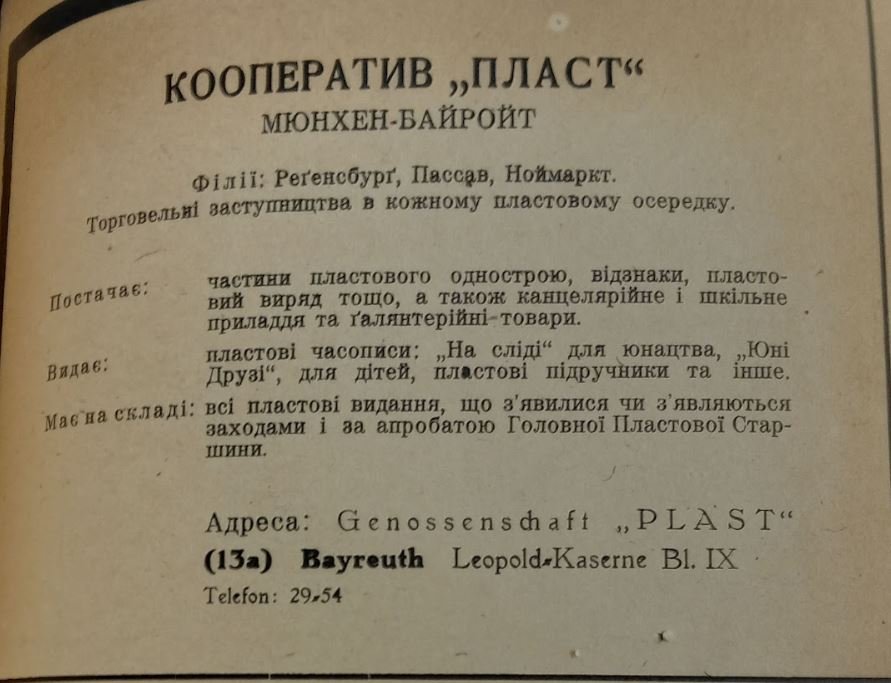
A Ukrainian almanac published at Munich in 1948 carried an advertisement for the PLAST co-operative, which the advertisement placed at Munich and Bayreuth with branches at Regensburg, Passau and Neumarkt. It sold products including magazines connected with Plast, the Ukrainian scouting organisation. The co-operative’s own advertisements in the Plast youth journal Na slidi give its Bayreuth address as Block IX of the Leopold Kaserne, and one of them adds the words DP Camp to that address.
The co-operative’s own notices set out what it did from that address. It supplied, in its own words, all the equipment needed for scouting, Plast literature, and school and stationery supplies, and it advertised publications that could be obtained there. It also advertised to buy up offcuts of khaki cloth so that it could make Plast badges for participants, rovers and helpers.
The journal was run from the same address. Readers were told that Na slidi could be ordered and subscribed to at the Plast co-operative, Bayreuth, Leopold-Kaserne, at two Reichsmarks an issue, and that all material for the journal should be sent to the co-operative at Leopold Kaserne, Block IX. Its philately column records that a set of stamps was produced by the Neumeister printing works in Bayreuth, in sheets of thirty, with a print run of 3,000 of each stamp.
The journal also shows Bayreuth’s scouts away from the barracks and records the youngest end of the organisation. A photograph caption describes Plast members from Bayreuth on a hike in the Alps. A death notice announces that the novice nest Diti Sontsia, or Children of the Sun, at Bayreuth had lost one of its members on 19 February 1948, in her ninth year.
Administrative identity
| Period | Identifier |
|---|---|
| Earlier UNRRA record | AC 92-255; Team 186 |
| From September 1948 | OMF 319 |
| 31 October 1947 capacity | 3,270 |
The changing population
Published returns record 1,301 Ukrainians at Leopold-Kaserne in August 1946, 1,432 in May 1947 and 2,610 in December 1947. These dated counts reveal substantial change within an established camp. They should not be confused with the inventory’s capacity of 3,270 in October 1947.
Ukrainian reference works give the swing rather than a single figure, putting the camp between 500 and 4,000 people across the years 1945 to 1949 and placing it among the large Ukrainian camps of the American zone. One account of the camp settles on about 1,900 Ukrainians and names Dr Mykola Tsenko as its commandant.
Ukrainians recorded at Leopold-Kaserne
| Return | People |
|---|---|
| August 1946 | 1,301 |
| May 1947 | 1,432 |
| December 1947 | 2,610 |

Education and literary life
Schooling at Bayreuth ran from a gymnasium and a secondary modern school through a commercial school to teacher-training courses, and youth and sports organisations worked alongside them. Among the teachers were the pedagogues Vasyl Lev and Kost Kysilevskyi and the composer Ivan Nedilskyi.
A choir was founded in the camp gymnasium in 1945. Nedilskyi taught its music theory and Anastasiia Ohrodnyk-Zhylava conducted it, and some of its singers, the basses in particular, were called on to strengthen the town choir at the Festival Theatre. A camp sports society, UST Dnipro, carried the same name into competition.
Bayreuth had a Ukrainian lower commercial school. It also hosted the Ukrainian Artistic Movement’s conference on literary criticism on 4–5 October 1946. These institutions connected practical training with intellectual debate: a camp could be both a temporary home and a meeting place for a dispersed literary community.
The literary meeting belonged to a wider circuit. The Artistic Ukrainian Movement, founded at Fürth near Nuremberg on 25 September 1945, held its congresses and conferences in one displaced-persons town after another — Aschaffenburg, Augsburg, Bayreuth, Ulm, Berchtesgaden, Mainz-Kastel, Stuttgart. The Bayreuth meeting was its critical conference, at which Borys Podoliak spoke on the problems of contemporary Ukrainian literary criticism in emigration, Leonid Bilets’kyi on the writer and the critic, and Ostap Hrytsai, Yurii Kosach, Ihor Kostets’kyi, Vasyl Chaplenko and Volodymyr Derzhavyn on criticism, genre and the reader.
Schoolwork itself has survived. The Shevchenko Scientific Society Archives in New York lists fifteen school notebooks from Bayreuth DP-camp educational facilities in a collection dated 1945–1949. These exercise books provide a further archival route into classroom life, alongside the published accounts of the town’s schools.
Craft and art on show
In 1948 the Bayreuth sub-headquarters of Area 3, working for the Preparatory Commission of the International Refugee Organisation, mounted an exhibition of work made by the displaced persons of its camps and published two illustrated catalogues of it, one of handicrafts and one of paintings, sculpture and graphics. Joseph M. Lisiak, the field supervisor, presented both; E. Paramanoff took the photographs with his own equipment and supplies; and an exhibition committee of displaced persons ran the sections, with Professor E. Lipeckyj responsible for art.
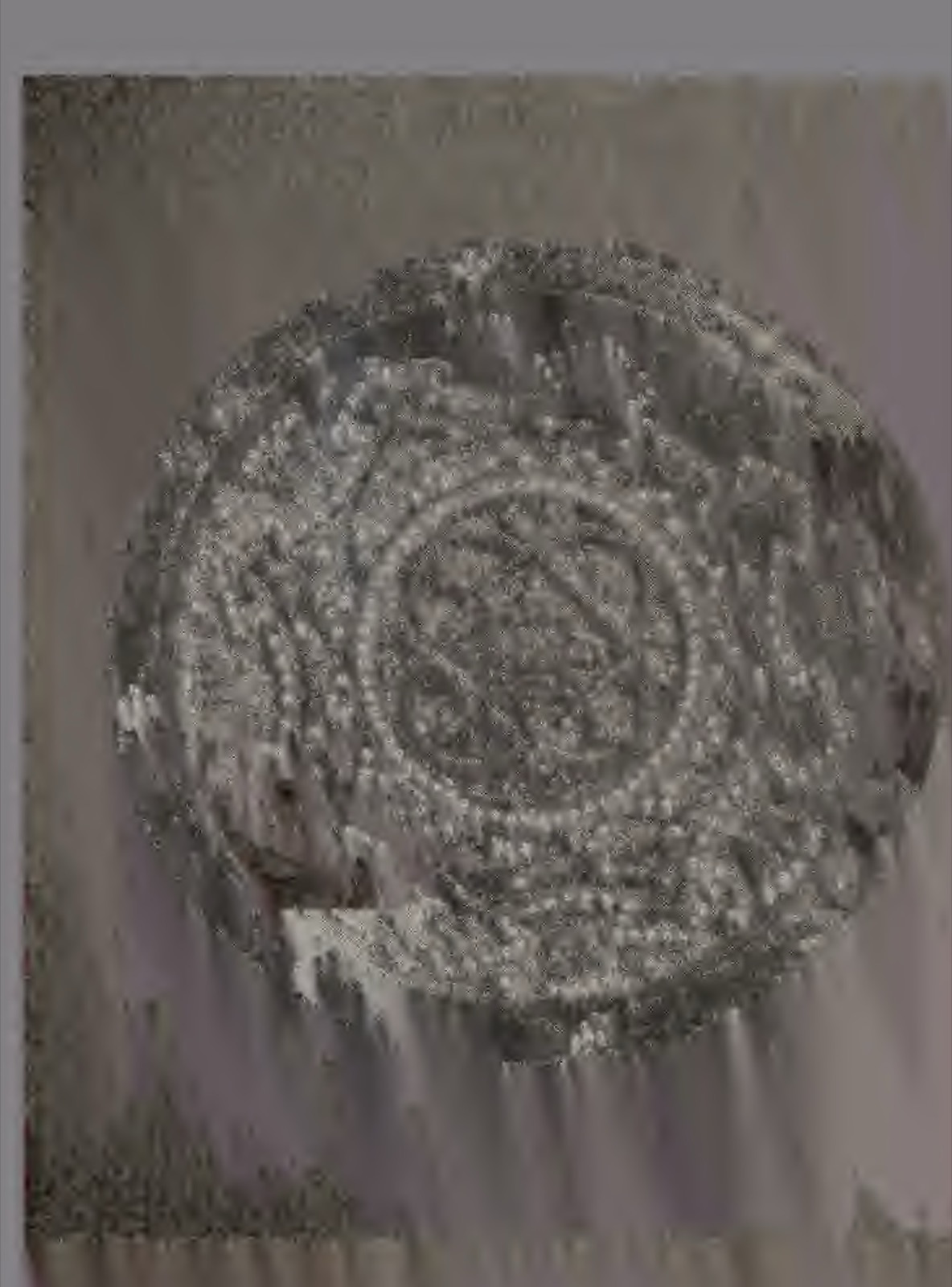
The handicrafts catalogue lists its exhibits by nationality and by the camp they came from, and twenty-three of the eighty plates are Ukrainian work from Leopold Kaserne: a bead-inlaid plate, three wood carvings and a carved plaque, a candy bowl, a cross, albums, national dresses, three blouses, an ikon shawl, a pillow case, two carpets, table centres, two embroidered table cloths, embroidered linen, an embroidered pillow case and pillow cover, and a table d’oyley. They are set beside Baltic work from Camp Mack, Camp Pegnitz and the Baltic camp at Bamberg, White Ruthenian straw boxes and Russian carving from Camp Mainleus, Jewish metalwork and candlesticks from the Ulanen-Kaserne at Bamberg and the Marktredwitz community, and Polish dolls and metalwork from Camp Coburg.
The catalogue’s introduction is an argument as much as a list. Its compilers set out to answer the charge that displaced persons lived in idleness on charity, describing over-crowded and run-down buildings, families sharing rooms, and constant inspection by army and IRO officers that left a displaced person, in their words, as much privacy as a goldfish in its bowl. Against that they set the camp kitchens, fire squads, camp police, building repairs, gardens and vegetable patches, the schools that had to be established and staffed, and the vocational courses, all of it managed by the residents and largely at their own cost, with many of the exhibited pieces made from scrap and with self-made tools.
The companion volume names the artists. Its Ukrainian contributors were Osyp Bobyns’kyi, Mykola Yaroshenko, born in Ukraine on 18 February 1919 and a student of the Kyiv architectural institute until the war stopped him, Yurii Kodak, born in 1916 and trained at the academies of fine art in Lviv and Kyiv, Leonid Kostiushko, born at Lviv on 25 February 1909, brought to Germany as a forced labourer in 1942 and by then cultural leader of the camp at Mainleus, and Yevsevii Lipets’kyi, born at Verbivtsi in northern Bukovina in 1889, a teacher of art at the Ukrainian high school in Chernivtsi until the Soviet occupation of 1940 drove him out. The catalogue calls Lipets’kyi the acknowledged cultural leader of the Ukrainian community in Bayreuth. Their subjects were the places they were living in: Bayreuth streets and churches, the Festival Theatre birches, Coburg, Kulmbach, Bamberg and Pegnitz, alongside portraits of UNRRA and IRO staff and a bust of a camp leader.
Camps represented in the 1948 handicrafts catalogue
| National section | Camps named in the captions |
|---|---|
| Ukrainian | Leopold Kaserne (23 plates) |
| Baltic | Camp Mack; Camp Pegnitz; Baltic Camp, Bamberg |
| White Ruthenian | Camp Mainleus |
| Russian | Camp Mainleus |
| Jewish | Ulanen-Kaserne, Bamberg; Marktredwitz community |
| Polish | Camp Coburg |
Books for learning and cultural survival
Bayreuth also appears on Ukrainian books produced during the camp years. A research bibliography records a 1947 manual of theoretical mechanics, a 1948 dairying handbook, a 1949 guide to practical pig husbandry and a 1948 volume of selected poetry. These were publications in the town’s Ukrainian milieu; their imprints alone do not establish that each was printed inside Leopold-Kaserne.
The range is striking: technical instruction and agriculture sat alongside literature. Such books could support interrupted education and help readers prepare for work after migration. Their survival also provides evidence of a community concerned with building a future, beyond the immediate administration of relief.
Sources for this section
A postal service of its own
The camp post office began operating in June 1946. Ukrainian camp postal services handled the local stage of correspondence and developed their own stamps and cancellations, making surviving postal material a distinctive record of community organisation. The Bayreuth service belonged to a wider network that included Regensburg.
The postal history follows the movement of people. When the Bayreuth and Regensburg settlements closed and residents were transferred, new services appeared at Neu-Ulm in autumn 1949 and at Sedan-Kaserne in Ulm in May 1950. These links show why an envelope from a later camp can belong to the history of an earlier community.
A catalogue of the Ukrainian camp issues compiled by Borys Fessak covers sixty-six camp stamps and four souvenir sheets, with their colour varieties, camp cancellations and souvenir folders. Its publisher’s description names Regensburg, Bayreuth, Neu-Ulm and Ulm/Donau as the four Ukrainian camps that prepared such postage. The count of sixty-six covers all four camps together, not Bayreuth alone.
Sources for this section
After the displaced-persons camp
The barracks answered an urgent housing need once the camp closed. In 1950 the building was converted into 68 flats for people who had been living in mass refugee camps, with room for three small businesses including a butcher and a bicycle shop; the Leopoldkaserne came before the Bavarian cabinet again as item XI of its protocol of 20 February 1951. Those later residents form a different population from the Ukrainian camp counts of 1946 and 1947. The barracks were pulled down in 1972 and nothing was put up in their place; the site became a car park.
Camp records themselves travelled abroad. The 1982 research guide records a box of Bayreuth DP camp archives at Oseredok, the Ukrainian Cultural and Educational Centre in Winnipeg. This is a separate archival trail from the administrative lists preserved in Germany.
A personal account of the camp is recorded in a scholarly bibliography. The reference list of a 2020 article in the historical series of the Ostroh Academy journal cites a six-sheet typescript memoir by Nataliia Palidvor-Sonevytska on the Second World War and the displaced-persons camp at Bayreuth seen through the eyes of a teenager. The citation does not say where the typescript is held.
Sources for this section
- Bavarian cabinet minutes, protocol 14 of 20 February 1951, item XI: Leopoldkaserne in Bayreuth
- Kasernenviertel (Bayreuth)
- Political Refugees and Displaced Persons, 1945–1954: a bibliography and research guide
- Наукові записки Національного університету «Острозька академія». Серія «Історичні науки». Випуск 31
Sources
- DP camp inventory: Bayreuth entries 794, 796 and Wendelhöfen 1600
Arolsen Archives · 26 October 2023
Local inventory read; Excel dates converted with 1899-12-30 epoch.
- Report of the United Ukrainian American Relief Committee
United Ukrainian American Relief Committee · 30 June 1948
Main camps list, printed p. 18.
- The Refugee Experience: Ukrainian Displaced Persons after World War II
Canadian Institute of Ukrainian Studies · 1992
Table 7 pp 47–48; commercial schools p 192; literary conference p 238.
- Ukrainian camp postal services
Ukrainian Philatelist, no.84 · 2001
Indexed full passages read; PDF endpoint presently unavailable directly.
- Bavarian cabinet minutes, protocol 14 of 20 February 1951, item XI: Leopoldkaserne in Bayreuth
Historical Commission and Bavarian State Archives · 1951; scholarly digital edition
Scholarly digital edition consulted. The table of contents of protocol 14 carries the agenda item [XI. Leopoldkaserne in Bayreuth]; the text of the item itself was not retrievable.
- Political Refugees and Displaced Persons, 1945–1954: a bibliography and research guide
Yury Boshyk and Boris Balan, Canadian Institute of Ukrainian Studies · 1982
Original pp 20,261–265,285 and 344 examined. Publication towns not assumed to establish printer inside camp.
- Iryna Bekhmetiuk-Verbyts’ka collection on the Displaced Persons camp in Bayreuth, Germany, Collection 218
Shevchenko Scientific Society Archives · Records dated 1945–1949
Collection description inspected on 12 September 2026. Fifteen school notebooks; collection-level date span. Description does not establish their individual subjects or assign every notebook to Leopold-Kaserne.
- Kasernenviertel (Bayreuth)
German Wikipedia, citing Kurt Herterich, Südliches Bayreuth (2009) and Peter Engelbrecht, Ende und Neubeginn (2022) · Article read 14 September 2026
Full article read. Gives the building date of the Prinz-Leopold-Kaserne, the regiment that occupied it, the 8 April 1945 air raid, the 25 June 1945 registration of camp residents, the August 1949 population, the 1950 conversion into flats and the 1972 demolition. The underlying figures are attributed there to Engelbrecht’s 2022 volume, which has not been inspected.
- Байройт
Ukrainian Wikipedia, citing Volodymyr Maruniak in the Encyclopedia of Ukraine, the Encyclopedia of Ukrainian Studies (1955) and a 2010 memoir in Svoboda · Article read 14 September 2026
Section on the Leopold-Kaserne camp read in full: camp commandant, the gymnasium choir founded in 1945 and its teachers, singers at the Festspielhaus and the camp sports society. The 2010 Svoboda memoir behind the choir passage has not been inspected.
- Байройт
Енциклопедія Сучасної України (Encyclopedia of Modern Ukraine) · Article read 14 September 2026
Full entry read: Ukrainian forced labourers brought to Bayreuth in 1941, deaths in the April 1945 air raids, the Leopold-Kaserne camp of 1945–1949 and its range of 500 to 4,000 residents, its gymnasium, secondary and commercial schools and teacher-training courses, and the named pedagogues and composer.
- Handicrafts of Displaced Persons and Refugees
Collected and presented by Area 3 Sub-headquarters, Bayreuth; Joseph M. Lisiak, field supervisor; scan published by diasporiana.org.ua · Cover dated 1948
All 93 pages of the scanned catalogue read. Front matter, dedication, acknowledgement, sub-headquarters staff list, exhibition committee, introduction, the contents list and all eighty plates, twenty-three of which are captioned as Ukrainian work from Leopold Kaserne. No reuse licence stated.
- Art of Displaced Persons and Refugees. Artistic paintings, plastics and graphics
Collected and presented by Area 3 Sub-headquarters, Bayreuth; Joseph M. Lisiak, field supervisor; scan published by diasporiana.org.ua · Undated; companion volume to the 1948 handicrafts catalogue
All 93 pages of the scanned catalogue read: introduction, the contents list of works by artist and nationality, the plates, and the biographical notes on the exhibiting artists at pp. XV–XVIII of the printed pagination. No reuse licence stated.
- Мистецький український рух
Ukrainian Wikipedia · Article read 14 September 2026
Full article read: the founding of MUR at Fürth on 25 September 1945, the sequence of its congresses and conferences, and the papers read at the Bayreuth critical conference of 4–5 October 1946.
- Ukrainian Philatelic and Numismatic Society publications bookstore
Ukrainian Philatelic and Numismatic Society · Undated; read 14 September 2026
Bookshop listing read in full for the entry describing Borys Fessak’s catalogue “Ukrainian DP Camp, POW Camp, Government in Exile, and National Council Issues (Second Edition)”. The description gives the count of camp stamps and souvenir sheets and names the four Ukrainian camps that prepared postage.
- A Ukrainian almanac for 75 years ago: the January 2023 UL Slavonic item of the month
Cambridge University Library, Language Collections blog; Mel Bach · 28 January 2023
Library blog post read in full, describing the advertisements in a Ukrainian almanac published at Munich in 1948, among them one for the PLAST co-operative.
- Наукові записки Національного університету «Острозька академія». Серія «Історичні науки». Випуск 31
Видавництво Національного університету «Острозька академія», Острог · 2020
Reference list of Iryna Rybachok’s article read at printed pages 94–95; item 2 is the bibliographic citation of a typescript memoir on the Bayreuth camp. The memoir itself was not inspected.
- Na slidi: zhurnal plastovoho iunatstva (On the Trail: journal of Plast youth)
Kooperatyva "Plast", Bayreuth; Ukrainian Museum-Archives, Cleveland, DP Camp Periodicals Collection; digitised by the Internet Archive · 1947-1948
Bound run of the Plast youth journal published at Bayreuth, read as page images from the Internet Archive item (128 images). Read: the co-operative's advertisements and the editorial notices on printed pages 9, 12, 14, 15 and 16 and on an unnumbered back page carried as a supplement to Chas; the philately column on printed page 14 of no. 2; and a death notice from a Bayreuth novice nest on printed page 14 of no. 1(6), January 1948. Item licence Creative Commons BY-NC-ND 4.0.
Last researched 14 September 2026