Beauregard camp, La Celle-Saint-Cloud
Displacement in Europe
La Celle-Saint-Cloud, Yvelines · France · Soviet repatriation camp: late 1944 to November 1947
The central assembly camp of the Soviet repatriation mission in France, in the park of a ruined château west of Paris, through which former prisoners of war, forced labourers and later interwar émigrés, Ukrainians among them, passed on their way to the USSR until French police closed it in November 1947.
Introduction
When France was liberated in 1944 it held a large population of Soviet citizens: prisoners of war of the Germans, many of them pressed into German service, and civilians deported for forced labour. A Soviet repatriation mission arrived in Paris in November 1944 and set up a network of assembly camps across the country. The camp in the park of the Château de Beauregard at La Celle-Saint-Cloud, in what was then the Seine-et-Oise, became its principal centre. The site had been a German prisoner of war camp during the occupation, and at the liberation several hundred Soviet prisoners were already living in its huts. Ukrainians were among the people the mission sought to return, and the camp’s closure in November 1947 became a diplomatic incident between France and the USSR.
A history in dates
- 1852 onwardsMiss Howard rebuilds the château in a neoclassical style and walls an estate of more than 184 hectares.
- 1870Prussian forces make Beauregard their headquarters and fortify it.
- 1872Baron Maurice de Hirsch buys the estate and has the château restored.
- 1896The estate passes to Maurice-Arnold de Forest, comte de Bendern, and falls into neglect.
- 1914 to 1918The grounds are used as a cattle park under the entrenched camp of Paris.
- October 1944The Soviet repatriation administration is created under Colonel-General Golikov.
- November 1944The Soviet repatriation mission opens on the avenue Bugeaud in Paris and organises assembly camps, with Beauregard as its principal centre.
- August 1944 to May 1945A photograph album records the daily life of Assembly Point for Soviet Citizens No. 13 at Beauregard.
- 1944The Seine-et-Oise police open files on Soviet nationals at Beauregard; the series runs to 1949.
- April 1945Eighty-three repatriation camps hold some 58,000 Soviet prisoners of war across France.
- 29 June 1945The Franco-Soviet repatriation agreement is concluded.
- Summer 1945Provincial camps close and repatriates are directed to central camps such as Beauregard for mass departures.
- 1946Fresnes prison opens the penitentiary centre of La Châtaigneraie on the estate, with room for 1,400.
- 22 June 1946A Soviet decree restores citizenship to former subjects of the Russian Empire living in France; repatriation is extended to interwar émigrés, in particular Ukrainian and Belarusian workers.
- 14 November 1947Four hundred gendarmes and security police, sixty vehicles and two Renault tanks surround and search the camp; the children are found, weapons are seized and the Soviet staff are expelled.
- 1947 to 1948French and Soviet repatriation missions are closed following the Beauregard incident.
- 1949The comte de Bendern gives the estate to the City of Paris.
- April 1953The Châtaigneraie penitentiary centre closes with 776 detainees.
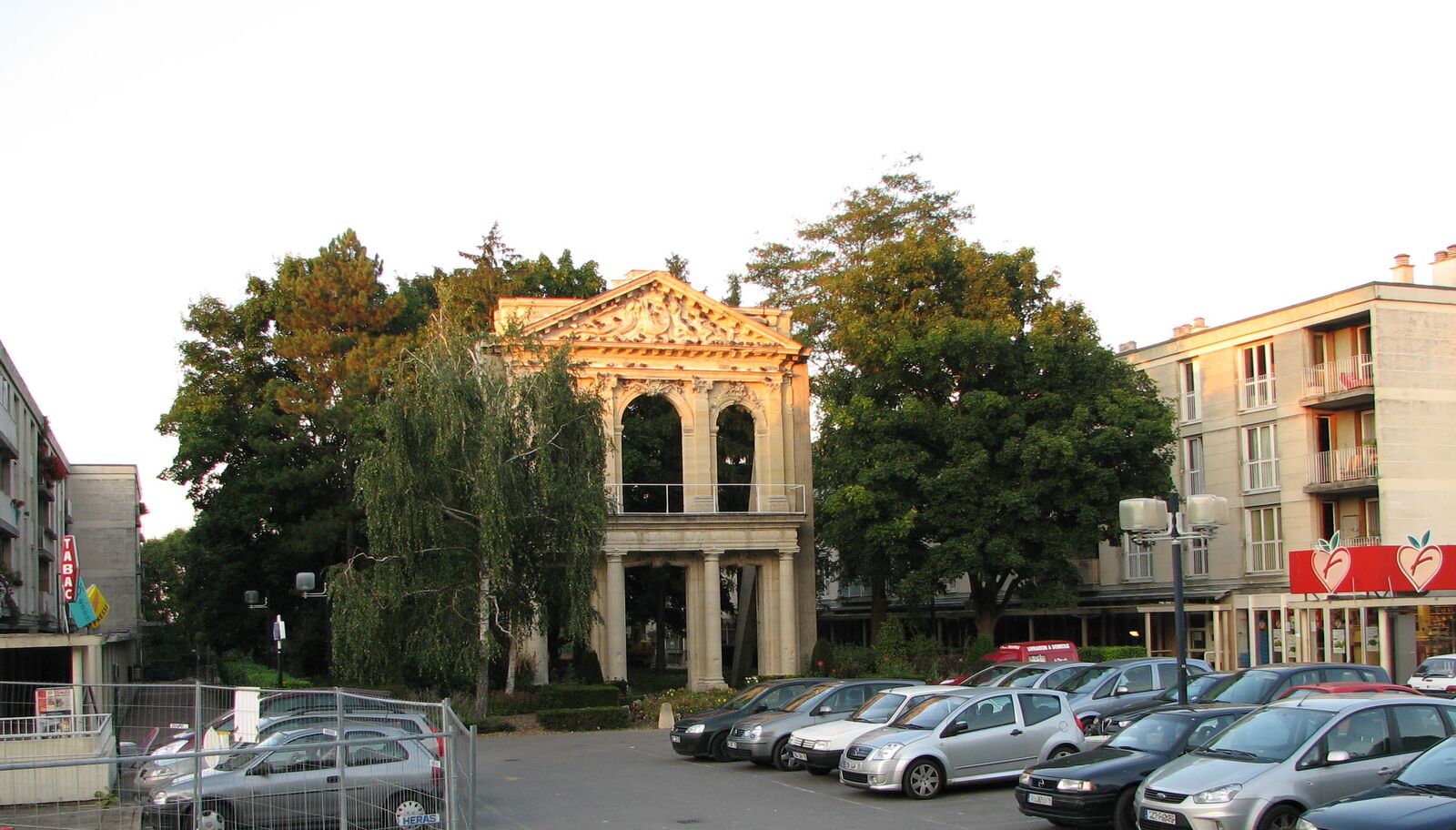
- 1956The château is demolished except for the central avant-corps and its pediment.
- 1959 to the later 1960sThe Beauregard I and Beauregard II housing blocks are completed on the estate.
Sources for this section
- Château de Beauregard (La Celle-Saint-Cloud)
- GULAG pod Parizhem: the history of the Beauregard camp
- Police générale, sous-fonds 300 W, répertoire méthodique (edition 2019), entries 300 W 84 and 300 W 96
- The Repatriation of Soviet Prisoners of War and Displaced Peoples from the Auvergne after the Second World War
- Répertoire numérique des archives rapatriées de l’ambassade de France à Moscou 1945–1964, 448 PO/B, article 355
- Retour au pays forcé ou rêvé: le rapatriement des Soviétiques depuis la France (1944–1947)
The estate before the camp
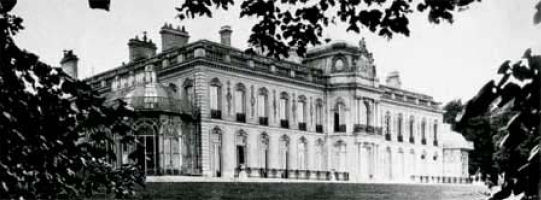
The name of the domain goes back to the Middle Ages. In the early seventeenth century the château belonged to the du Val family, and it passed through several hands before Elizabeth Ann Haryett, known as Miss Howard, bought it in the middle of the nineteenth century. She rebuilt the house in a neoclassical style, added a glasshouse and walled the whole estate of more than 184 hectares; from there she financed the rise of Louis-Napoléon Bonaparte, who made her countess of Beauregard after taking the imperial title. She died there in 1865.
Her son sold the property in 1870 to the duchesse de Bauffremont, and within months the Franco-Prussian war broke out; the Prussians, quartered in La Celle-Saint-Cloud, made Beauregard their headquarters and fortified it. The ruined duchess could not restore the house, and in 1872 it was bought by Baron Maurice de Hirsch, who had it entirely restored and stayed there often with his family. On his death in 1896 it went to Maurice-Arnold de Forest, comte de Bendern, who had properties across Europe, came rarely and left the château to decay. During the First World War the army used the grounds as a cattle park under the entrenched camp of Paris, and during the occupation the Germans used the site as a prisoner of war camp.
Sources for this section
A central camp for repatriation
The Soviet repatriation administration was set up in Moscow in October 1944 under Colonel-General Filipp Golikov, and his representative in France was Major-General Vasily Dragun. The mission opened in November 1944 in a large white house on the avenue Bugeaud in Paris and spread a network of assembly points across the country — more than 130 of them by the Izvestia account, opening and closing as their occupants left. Beauregard was its unofficial capital from the start: there had been a German prisoner of war camp there, more than four hundred Russians were living in its huts at the liberation, Paris was close, and there was an aerodrome beside it.
By April 1945 the French ministry for prisoners, deportees and refugees, with the army, had established eighty-three repatriation camps holding some 58,000 Soviet prisoners of war. During the summer of 1945 smaller provincial camps were closed and their occupants were to be transferred to larger central camps such as Beauregard or Châlons-sur-Marne, from which mass repatriations were beginning. A Franco-Soviet agreement of 29 June 1945 governed the return of Soviet nationals; its text and application are preserved among the files of the French embassy in Moscow.
The repatriation from France was forced at first and later offered. Research based on French and Russian archives describes about 120,000 former Soviet prisoners of war and forced labourers in 1944, and from 1946 a little under 5,000 émigrés of the interwar years, in particular Ukrainian and Belarusian émigré workers, encouraged to return for the reconstruction of the country. A decree of 22 June 1946 restored Soviet citizenship to former subjects of the Russian Empire living in France, and thousands took Soviet passports and packed for a country most of them had never seen. The published summary of a French study of these camps likewise describes the deported civilians as people rounded up in the occupied villages of Ukraine and Belarus, and devotes a chapter to the Ukrainian case alongside its chapter on Beauregard as the model camp. These accounts concern the whole programme; they do not give a count of Ukrainians at Beauregard itself.
Published figures for Soviet repatriation from France
| Measure | Figure | Source scope |
|---|---|---|
| Repatriation camps in France, April 1945 | 83 | Burgess, 2017, national |
| Soviet prisoners of war held in those camps, April 1945 | about 58,000 | Burgess, 2017, national |
| Former prisoners and forced labourers repatriated from 1944 | about 120,000 | Laggoune, 2023, national |
| Interwar émigrés repatriated from 1946 | a little under 5,000 | Laggoune, 2023, national |
| Soviet prisoners living in the huts at Beauregard at the liberation | more than 400 | Izvestia, 2003, camp level |
| Assembly camps in France, Izvestia account | more than 130 | Izvestia, 2003, national |
Sources for this section
- GULAG pod Parizhem: the history of the Beauregard camp
- The Repatriation of Soviet Prisoners of War and Displaced Peoples from the Auvergne after the Second World War
- Répertoire numérique des archives rapatriées de l’ambassade de France à Moscou 1945–1964, 448 PO/B, article 355
- Retour au pays forcé ou rêvé: le rapatriement des Soviétiques depuis la France (1944–1947)
- Les camps soviétiques en France: chapter list and publisher’s summary
Assembly Point No. 13
The camp’s own name in the Soviet records was Assembly Point for Soviet Citizens No. 13, and a photograph album survives covering its life from August 1944 to May 1945. Its pictures show morning exercises, political classes, the canteen, drill, the club and the pond used for swimming, a mechanic teaching an engine, and rifle practice with captured German weapons. The choir was led by Tamara Soshalskaya. The commandant was Lieutenant Kazakov, the political officer junior politruk Kovalenko, the chief of staff Lieutenant Alik; Lieutenant Klushin commanded one of the companies and Lieutenant Belenchenko ran physical training.
Life was organised on army lines because there was no other model to hand: a guardhouse, passes to leave, strict discipline, and three tolerable meals a day. Everyone in the camp had come out of captivity or forced labour, everyone was crowded together with nothing to do, and the routine was a way of holding the place together. Among the residents were people who wanted to go home, people who hesitated and people who did not want to go at all.
The aerodrome beside the camp was used hard. Soviet Douglas transports flew from it to Leipzig and Berlin, carrying repatriates out and officials in. One of the men flown out of Beauregard in 1946 was Viktor Maltsev, who had commanded the air force of the Vlasov army and was handed over by the Americans; he was taken to Moscow in May 1946 and hanged in August. Others taken to the camp were less prominent but no less closely watched.
Staff of Assembly Point No. 13 named in the album
| Post | Name |
|---|---|
| Commandant | Lieutenant Kazakov |
| Political officer | Junior politruk Kovalenko |
| Chief of staff | Lieutenant Alik |
| Company commander | Lieutenant Klushin |
| Physical training instructor | Lieutenant Belenchenko |
| Choir leader | Tamara Soshalskaya |
Sources for this section
French police records
The papers of the Seine-et-Oise prefecture’s general police contain a file on Soviet nationals at the Beauregard camp, La Celle-Saint-Cloud, dated 1944 to 1949, together with files on Soviet nationals at the Bossut quarter of the Pontoise barracks, the Luxembourg camp at Meaux and the La Rochette camp at Melun, incidents caused by the Soviets and arrests. A separate file records arrests of Soviet subjects in 1944. These entries show the camp remained a matter for the French police for two years after the Soviet mission left.
The Beauregard affair of November 1947
By 1947 the French authorities suspected that the extraterritorial camp was being used to hold Soviet citizens who did not wish to return, and later said they held material on nearly sixty cases of people taken to Beauregard against their will, émigrés and French citizens among them. The occasion came from a family quarrel in Nice, where a Russian émigré reported that his wife had disappeared with their three small daughters ahead of a divorce; counter-intelligence traced the children to Beauregard. With the Communist ministers gone from the government and the Cold War beginning, the foreign minister Georges Bidault decided to act in the last days of the Ramadier government.
On the evening of 14 November 1947 four hundred gendarmes and republican security police, with sixty vehicles and two Renault light tanks, surrounded the camp. There was no fighting: when the tank stopped in front of the gate the Soviet officers ordered it opened. The girls were in the camp and were handed to their father. Several captured machine guns and sub-machine guns and some grenades were found. The head of the repatriation group, Colonel Filatov, and twenty-four activists of the Union of Soviet Citizens were expelled from France, and Moscow expelled in return Colonel Marquier, who headed the French repatriation mission in the USSR. The camp passed under French control, and the embassy files in Nantes record the closure of both missions as a consequence.
The affair marked the hardening of relations between the French government and the Communist party, and between France and the Soviet Union, in the year of the great strikes and the Marshall Plan. The traffic it ended had already dwindled: between 1947 and 1951 only 218 people went back to the USSR from France.
The site today
A second camp had been running beside the Soviet one. In 1946 the prison administration of Fresnes opened a detention centre on the estate with room for 1,400, deliberately named the penitentiary centre of La Châtaigneraie so as not to spoil the name of Beauregard. It held collaborators among others. In 1950 a special wing was opened for a dozen blind and otherwise sick prisoners, and in 1951 a second for men over sixty. The centre closed in April 1953 with 776 detainees, and in the autumn of that year the huts that remained served as the set for the film Le Défroqué, released in 1954.
The comte de Bendern, unable to turn the ruined estate into the public forest reserve he had in mind, gave it to the City of Paris in 1949 on condition that decent housing be built there for French working people in a green setting. The château, badly damaged, was pulled down in 1956; only the central avant-corps, the doorway and its pediment, was kept. Two waves of building followed, Beauregard I completed in 1959 and Beauregard II in the later 1960s, and about 2,500 of the resulting flats remain social housing belonging to the City of Paris, managed by a company the city created for the purpose in 1955.
The fronton stands today at the centre of the place du Comte-de-Bendern, three hundred metres north of the A13, surrounded by the blocks of the Domaine de Beauregard. Nothing of the camp remains above ground.
Sources
- Police générale, sous-fonds 300 W, répertoire méthodique (edition 2019), entries 300 W 84 and 300 W 96
Archives départementales des Yvelines · 2019
Finding aid: Soviet nationals, Beauregard camp, La Celle-Saint-Cloud (1944–1949); incidents and arrests.
- Répertoire numérique des archives rapatriées de l’ambassade de France à Moscou 1945–1964, 448 PO/B, article 355
Centre des archives diplomatiques de Nantes · 2006–2022
Agreement of 29 June 1945; closure of the French and Soviet repatriation missions after the Beauregard camp incident, 1947–1948.
- The Repatriation of Soviet Prisoners of War and Displaced Peoples from the Auvergne after the Second World War
Greg Burgess, Proceedings of the George Rudé Seminar, vol. 7, H-France · 2017
Camp network figures for April 1945 and the transfer of repatriates to the central camp at Beauregard in summer 1945.
- Retour au pays forcé ou rêvé: le rapatriement des Soviétiques depuis la France (1944–1947)
Amine Laggoune, doctoral thesis, EHESS (abstract) · 2023
Abstract: about 120,000 former prisoners and forced labourers in 1944; from 1946 nearly 5,000 interwar émigrés, particularly Ukrainian and Belarusian workers; expulsion of the Soviet military mission.
- Les camps soviétiques en France: chapter list and publisher’s summary
Georges Coudry, Albin Michel, 1997, as reproduced by BEMALPA · Accessed 2026
Chapters on the model camp of Beauregard and on the Ukrainian case; summary describing civilians rounded up in Ukraine and Belarus.
- GULAG pod Parizhem: the history of the Beauregard camp
Sergei Nekhamkin, Izvestia · 23 September 2003
Full archived text read. Gives the opening of the Soviet repatriation mission in November 1944 in a mansion on the avenue Bugeaud in Paris, General Golikov’s administration and Major-General Vasily Dragun as its representative in France, a network of more than 130 assembly camps, the German prisoner of war camp at Beauregard with more than 400 Russians living in its huts at the liberation, the aerodrome beside the camp and the Soviet transport flights to Leipzig and Berlin, the photograph album of Assembly Point No. 13 covering August 1944 to May 1945 with its staff and its daily routine, the decree of 22 June 1946 restoring Soviet citizenship to former subjects of the Russian Empire living in France, and the operation of 14 November 1947 with its outcome and expulsions.
- Château de Beauregard, La Celle-Saint-Cloud, photographed in 1872
M. Chochon; via the commune of La Celle-Saint-Cloud and Wikimedia Commons · 1872
Photograph in the public domain by reason of age. Shows the château itself, in whose park the Soviet repatriation camp was later established and which no longer stands.
- Château de Beauregard (La Celle-Saint-Cloud)
Wikipédia (French) · Accessed 14 September 2026
Full article read. Used for the descent of the estate from the du Val family through Miss Howard to the barons de Hirsch and the comte de Bendern, the Prussian headquarters of 1870, the First World War cattle park, the German prisoner of war camp, the decision of Georges Bidault and the operation of 14 November 1947, the Châtaigneraie penitentiary centre of 1946 to 1953, the gift of the estate to the City of Paris in 1949, the demolition of the château in 1956 and the building of Beauregard I and II. The article cites Philippe Loiseleur des Longchamps Deville’s local histories of La Celle-Saint-Cloud.
- Avant-corps central de la façade sud du château de Beauregard, La Celle-Saint-Cloud (photograph)
TCY, Wikimedia Commons, CC BY-SA 3.0 · September 2008
File description and licence read on the Commons file page. Photograph of the surviving fronton of the château among the Beauregard blocks.
Last researched 14 September 2026