Bela River Hostel
Arrival and settlement
Whassett, near Milnthorpe, Westmorland, England · Prisoner-of-war camp 1943–1948; agricultural hostel for displaced persons; open prison 1953–1974
Camp 104 beside the River Bela at Whassett held Italian and then German prisoners of war until January 1948, after which the site became an agricultural hostel for displaced persons and appears in a Ukrainian directory as YMCA Hostel, Bela River. It later served as an open prison, was sold in 1980 and now carries a residential school.
Introduction
Bela River Hostel stood near Milnthorpe in Westmorland. Peter Kormylo lists it as a YMCA hostel among accommodation centres used by ethnic Ukrainians. The site had previously been a prisoner-of-war camp, also written Beela River and numbered 104. Its German prisoners produced their own newspaper and formed close links with nearby Beetham parish.
A history in dates
- 3 June 1943An International Red Cross inspection finds Italian prisoners at Beela River Camp, capacity 750.
- May and November 1944The camp is listed as an Italian Labour Battalion under Western Command.
- 1945The ICRC camp list records Labour Camp 104, Beela River Camp, Milnthorpe, Westmorland.
- January 1946Alexander MacLeod Murray moves to Beetham and develops close links with the nearby camp.
- 24–29 August 1946A Foreign Office re-education visit records 3 officers and 1,242 other ranks in the headquarters, three hostels and billets.
- Christmas 1946German prisoners give their handmade Nativity scene to Beetham church, with a dedication signed by Bruno Baumann, Werner Janicke and Erich Schmidt.
- 4 January 1947The first issue of Die Neue Zeit appears at Camp 104.
- January 1948The camp closes; many prisoners are transferred to Merry Thought Camp 76.
- After the campThe site is used as an agricultural hostel for displaced persons, and Bela River appears as a YMCA hostel used by Ukrainians.
- 21 January 1953A public inquiry at Milnthorpe hears objections to turning the camp into an open prison.
- 30 May 1953The Westmorland Gazette reports the Home Secretary’s decision that the open prison should proceed, for a temporary period.
- 2 August 1974The Gazette reports that Bela River Prison, then holding 195 inmates with 60 staff, is to close by the end of the year.
- 1980The prison site is sold; by 1983 its owners are using it for agricultural purposes.
- 7 April 2003The Home Office states that it has no current plans to use the former camp for asylum accommodation.
- 2018Beetham parish reports the prisoners’ Nativity scene still in regular use.
Sources for this section
- Camp 104 - Beela (Bela) River Camp, Milnthorpe, Westmorland
- Rev Alexander MacLeod Murray 1893–1978
- Beetham Parish Profile 2018
- Die Neue Zeit: Beela River Camp: Zeitung des Lagers 104
- In which ways is the Ukrainian community in Scotland a diaspora?
- Westmorland Gazette reports on Bela Camp, 30 May 1953 and 2 August 1974
- Bela River Prison: Former Capacity and Use
- Asylum Seekers: Bela River
The camp on the river
The camp stood on former farmland about two kilometres south-east of Milnthorpe, at grid reference SD 513 803, beside the hamlet of Whassett in Beetham parish. It occupied roughly eleven acres requisitioned from the Dallam Estate. Roger Thomas’s 2003 survey for English Heritage lists it as number 104, Beela River (Bela River) Camp, a German Working Camp.
Italians, then Germans
An International Red Cross inspection on 3 June 1943 found Italian prisoners and a capacity of 750, and in 1944 the camp was listed as an Italian Labour Battalion under Western Command. By 1946 it was a German working camp under Major E. Selby.
Foreign Office re-education visits recorded the strength. In August 1946 there were 1,242 other ranks and three officers across the headquarters, hostels at Borwick, Sedbergh and Silecroft, and billets; by January 1948 the total was 830. The camp closed that month and many of those left went to Merry Thought Camp 76. These are prisoner-of-war figures, not hostel figures.
Prisoner-of-war strength at Camp 104 and its hostels
| Date | Bela (main camp) | Borwick | Sedbergh | Silecroft | Billets | Total |
|---|---|---|---|---|---|---|
| June 1943 | 750 (capacity, Italian prisoners) | |||||
| August 1946 | 651 | 142 | 68 | 164 | 220 | 1,245 |
| January 1947 | 613 | 104 | 50 | 90 | 121 | 978 |
| April 1947 | 590 | 89 | 55 | 85 | 114 | 933 |
| July 1947 | 596 | 116 | 49 | 102 | 190 | 1,053 |
| September 1947 | 493 | 99 | 62 | 88 | 165 | 907 |
| November 1947 | 508 | 93 | 54 | 66 | 143 | 861 |
| January 1948 | 629 | 65 | 52 | 84 | 830 |
Sources for this section
Work and camp life
A local biography of the Reverend Alexander MacLeod Murray describes about 200 prisoners and work on farms, in quarries, at a milk factory and on roads. These are prison-camp figures, not Ukrainian hostel totals.
The camp library grew from 1,250 books in early 1947 to 2,888 by January 1948. There were language and science classes, a theatre group, an orchestra and football matches with Camp 76. Morale was reported as low at nearly every visit.
Friendships with Beetham
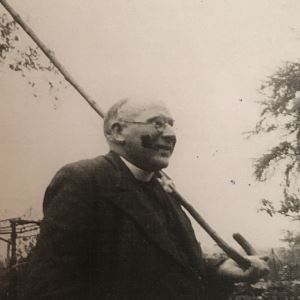
Murray moved to Beetham in January 1946. He treated the prisoners as parishioners, encouraged invitations into local homes and supported concerts and German-language worship. The camp’s Lutheran and Catholic congregations shared a hut chapel. Erich Schmidt, a German chaplain, also travelled to other camps by motorcycle.
Heribert Moser helped with the parish magazine; Gabriel Fabian showed films in neighbouring camps. Letters preserved by Murray’s family record friendships that continued after prisoners left. Bruno Baumann made a crucifix and Christmas crib associated with the camp’s thanks to Murray and the parish.
Matthew Barry Sullivan’s history of German prisoners in Britain records that Murray, finding Camp 104 within his parish, asked Beetham to become a little sanctuary for its inmates.
The camp newspaper
On 4 January 1947 the camp issued the first number of Die Neue Zeit. The Wiener Holocaust Library holds this eleven-page German-language newspaper, edited by Rudolph Sehm and circulated internally. Its catalogue records an edition of 120 copies. This gives a specific glimpse of organised publishing inside Camp 104.
The re-education reports trace the print run further, to 200 copies a fortnight in early 1947 and 250 by that summer.
Die Neue Zeit, issue 1
| Item | Detail |
|---|---|
| Date | 4 January 1947 |
| Editor | Rudolph Sehm |
| Language | German |
| Extent | 11 pages |
| Print run | 120 copies |
| Distribution | Internal camp circulation |
A handmade gift
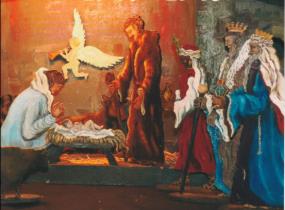
Beetham parish dates the gift of its Nativity scene to Christmas 1946. German prisoners at Bela carved and painted its figures as a thank-you for the welcome they had received. In its 2018 parish profile, the church reported that the scene remained in good condition and was still regularly used.
Sullivan quotes its dedication: the German prisoners of Beela River Camp gave the stable and figures, made by Bruno Baumann and his assistant Gabriel Fabian, in gratitude for the brotherhood shown them. It was signed at Christmas 1946 by Baumann, the camp leader Werner Janicke and the camp padre Erich Schmidt.
The photograph reproduced here comes from that parish profile. The figures are an object made by the camp’s German prisoners; they belong to that part of Bela’s history, alongside the later Ukrainian hostel connection.
The YMCA hostel
The postwar directory names YMCA Hostel, Bela River, near Milnethorpe, Westmorland. Its placement under accommodation used by Ukrainians provides the explicit Ukrainian connection. The name links the hostel to the former camp, but the directory does not assign its Ukrainian residents the biographies or activities of the earlier German prisoners.
The WW2 prisoner-of-war camps project independently records that after the camp closed the site was used as an agricultural hostel for displaced persons.
The site in later years
On 21 January 1953 a public inquiry at Milnthorpe heard objections from Westmorland County Council and others to a proposal to turn the camp into an open prison. The Westmorland Gazette reported on 30 May 1953 that the Home Secretary had decided the scheme should proceed, for a temporary period.
That period lasted about twenty years. On 2 August 1974 the Gazette reported that Roy Jenkins had named Bela River among open establishments to be closed; it then held 195 inmates and 60 staff. A written answer in 1983 confirmed closure in 1974 with a capacity of 250 places and sale of the site in 1980.
In April 2003 a parliamentary question asked whether the former camp would become accommodation for asylum seekers. The Home Office replied that there were currently no plans to use it for that purpose, while adding that it would consider the accommodation if offered. That records a proposal discussed, not a reopened reception centre. The Wings School now occupies the site.
Sources
- In which ways is the Ukrainian community in Scotland a diaspora?
Peter David Kormylo, University of Glasgow · 2021
Appendix xii, printed 323, entry 33; original directory previously visually verified. Lists YMCA Hostel, Bela River, Nr. Milnethorpe, Westmorland.
- Die Neue Zeit: Beela River Camp: Zeitung des Lagers 104
Wiener Holocaust Library · Issue 1, 4 January 1947
Full original catalogue record read and re-read 13 September 2026: editor Rudolph Sehm, 11 pages, 120 copies, internally distributed, place of publication Milnthorpe. Digital facsimile link returned 403; no article contents inferred from catalogue subject tags.
- Rev Alexander MacLeod Murray 1893–1978
Cumbrian Lives; John Maguire · Undated online biography
Full original biography read, particularly Move to Beetham. Draws on Murray family documents, letters, camp account and Kendal oral histories. Personal and work descriptions are POW-phase evidence, not Ukrainian memoirs. Unrelated genealogical inconsistencies in early-life section not used.
- Beetham Parish Profile 2018
St Michael and All Angels, Beetham · 2018
Printed 17, PDF 9. Original text and Nativity photograph visually inspected; explicit Christmas 1946 gift and continuing use. Other secondary church records give 1947; parish’s own date retained with source provenance.
- Asylum Seekers: Bela River
UK Parliament, Hansard · 7 April 2003
Commons written answer, HC Deb 7 April 2003 vol 403 col 35W, question by Mr Collins answered by Beverley Hughes. Full original question and reply re-read. States there are currently no plans, and that the accommodation would be considered if offered; it does not record any reopening.
- Camp 104 - Beela (Bela) River Camp, Milnthorpe, Westmorland
WW2 POW Camps in the UK · Updated 14 February 2025
Full compilation document downloaded and read. Transcribes and summarises the Foreign Office re-education survey reports in TNA FO 1120/224 (duplicates in FO 939/93), the 1945 ICRC camp list, the 1947 camp list, WO 32/10737, FO 939/270, Roger Thomas’s 2003 survey and a long extract from Matthew Barry Sullivan, Thresholds of Peace (Hamish Hamilton, 1979), pp. 278–9. Also states that after the camp the site was an agricultural hostel for displaced persons, then an open prison. The underlying archive files were not read directly.
- Bela River Prison: Former Capacity and Use
UK Parliament, Hansard · 13 April 1983
Lords written answer, HL Deb 13 April 1983 vol 441 c301WA. Lord Inglewood to Lord Elton. Full question and reply read: closed 1974, capacity then 250 places, site sold 1980, owners then using it for agricultural purposes.
- Westmorland Gazette reports on Bela Camp, 30 May 1953 and 2 August 1974
Westmorland Gazette, transcribed by the Holme History Project · 1953 and 1974
Site now offline; both transcriptions read in full through the Internet Archive Wayback Machine on 13 September 2026. Transcriptions, not the original newspaper pages; the British Newspaper Archive was not searched.
- Prisoner of War Camps (1939–1948): Twentieth Century Military Recording Project report
Roger J. C. Thomas, English Heritage · 2003
Gazetteer row for camp 104 and the survival classification key read from the project report PDF (the Historic England copy returned 403; an identical copy of the same report was read). Grade 5 means evidence not visible or inconclusive from maps and aerial photographs.
- Whasset
Wikipedia · Accessed 13 September 2026
Used only for the present occupant of the site: the Wings School, a residential school, on the site of Bela River Camp. Its two supporting citations are the Westmorland Gazette transcriptions used as source 8.
- Discovery catalogue searches for Bela River
The National Archives, Kew · Searched 13 September 2026
Catalogue entries only; no file read. HO 383/121-124 (welfare arrangements 1965–1976, proposed pre-release course 1966, inspector’s reports 1966–1974, annual reports 1967–1974) and ED 149/92/4 (educational activities at H.M. Prison, Bela River, 1953–1955). Searches for the hostel phase and for a camp 104 working-camp file returned nothing.
Last researched 13 September 2026