Lager Lindele
Displacement in Europe
Biberach an der Riß · Germany · Wartime camp 1939–1945 · DP camp April to June 1945
Biberach’s wartime prisoner-of-war and internment camp became, for a few weeks after its liberation by French troops, a displaced-persons camp in which Jewish and Ukrainian people were recorded. The site then served as a refugee camp and hospital before the police took it over.
Introduction
Lager Lindele takes its name from a lime-planted moraine hill on the northern edge of Biberach an der Riß, a viewpoint and a place for a Sunday walk, which gave the camp below it its name. The Arolsen Archives inventory lists the camp as a displaced persons camp of the French zone with Jewish and Ukrainian residents, closing on 1 June 1945. That entry describes only a short episode, the weeks between the arrival of French troops in April 1945 and the clearing of the camp in early summer, but it belongs to a site through which, by the reckoning of the exhibition now standing on it, about five thousand people from many countries passed as prisoners during the Second World War.
The Ukrainian presence at the Lindele itself rests on the inventory entry alone. Ukrainians appear more plainly in the district around it: the Russian cemetery laid out by the French occupation authorities on the Memminger Straße holds Soviet prisoners of war, forced labourers from across the Soviet Union and about seventy children gathered in from village and parish graveyards throughout the southern French zone, from Blumberg to Erolzheim and from Laupheim to Isny.
A history in dates
- June 1939Biberach becomes a garrison town; the Wehrmacht builds a barracks camp at the Lindele for a replacement battalion of Infantry Regiment 56.
- August 1940The first British officer prisoners arrive; the camp is guarded as Oflag VB.
- December 1940Nine hundred French prisoners are held at the camp; British officers follow at Easter 1941.
- September 1941Twenty-six British officers escape through a tunnel more than forty metres long; four reach Switzerland.
- November 1941Five to six hundred Soviet prisoners of war are brought up from the station; 146 die in the first weeks. The camp is a shadow camp of the Ludwigsburg base camp until February 1942.
- March to September 1942Serbo-Croat officers are held at the camp; more than forty escape during a football match and all are recaptured.
- September 1942The Lindele becomes the internment camp Ilag VB for about a thousand civilians deported from the Channel Islands, some nine hundred of them from Guernsey.
- 30 October 1942Some six hundred civilian prisoners, men, women and children, are transferred from the Lindele to Oflag VC at Wurzach Castle.
- December 1942The Wehrmacht hands the guarding of the camp to the Schutzpolizei.
- August 1943The internees hold a British summer carnival, photographed and filmed as German propaganda.
- November 1944149 North African Jews from Tripoli and Benghazi are brought from Bergen-Belsen, among them 29 children, 56 women and 64 men.
- January 1945An exchange train bound for Switzerland stops at Biberach; a further group of Jews from Bergen-Belsen is set down, given as 133 by Alemannia Judaica and as 92 by Adler. The camp holds more than 1,300 people, its wartime peak.
- 23 April 1945French troops liberate the camp.
- 26 May 1945Henriette Redner leaves the Lindele and is repatriated to the Netherlands, before the camp itself is wound up.
- 1 June 1945Closing date of DP-Camp Lindele in the Arolsen inventory; the Channel Islanders are flown home in early June.
- January 1946The Lindele dead buried in Biberach are moved to the Jewish cemetery at Laupheim.
- 1 March 1947The Gaisental camp for displaced persons, predominantly Polish, closes.
- 1 July 1950DP-Camp No. 10 at the Jordanbad closes.
- 1951The riot police take over the site; the wartime huts remain in use into the 1970s.
- 1970 to 1976The site is rebuilt.
- 2002The town of Biberach publishes Reinhold Adler’s history of the camp.
- September 2002A Guernsey delegation attends the dedication of a memorial at the former camp naming those who died at the Lindele.
- 2014The site becomes part of the Hochschule für Polizei Baden-Württemberg.
- 23 April 2023The memorial sculpture Der Schrei by Robert Schad is set up outside the former camp.
Sources for this section
- Biberach und Laupheim: Das Lager Lindele und der jüdische Friedhof im Zweiten Weltkrieg und in der Nachkriegszeit
- Ausstellung Lager Lindele: Zeittafel
- Ilag VC: Civilian Internees from Jersey
- Biberach an der Riß: Jüdische Geschichte
- Lager Lindele: Leben hinter Stacheldraht
- DP camp inventory: Biberach, DP-Camp Lindele, entry 540
- DP camp inventory: the other Biberach entries, rows 541 to 550 and 1666
- Newsletter, February 2003
- Skulptur DER SCHREI, Robert Schad, Lager Lindele, Biberach an der Riß (photograph)
The barracks on the hill
Biberach became a garrison town in June 1939, a few months before the war, and the Wehrmacht put up a barracks camp north of the town at the Lindele. Its first occupants were the soldiers of a replacement battalion of Infantry Regiment 56, moved there from Weinsberg; they marched out again at the beginning of September, and the camp stood largely empty until the first prisoners arrived in August 1940.
Through the war it was an isolated run of huts with no greenery inside the wire, far from the edge of the town, surrounded by fields and meadows with a dark line of fir wood on the horizon that the inmates took to calling the Black Forest. A main building with a small clock tower in the middle of it is the thing former internees remembered best. Those huts were still standing when the riot police moved in and were used well into the 1970s.
Garrison, prisoners and deportees
The first prisoners were British officers taken around Dunkirk and later in Greece, who arrived from August 1940; the camp was guarded as Oflag VB, the second officers’ camp in the Stuttgart military district. In December 1940 nine hundred French prisoners were held there, and the British followed at Easter 1941. Shortly before the British were moved on, twenty-six of them escaped in September 1941 through a tunnel more than forty metres long, dug from under the stove plate of a hut close to the wire. Four reached the Swiss border near Schaffhausen and returned to England by way of France, Spain and Gibraltar.
From November 1941 several transports brought an estimated five to six hundred Soviet prisoners of war, exhausted and close to starvation, driven up from Biberach station by back streets under guard from the base camp at Ludwigsburg. In the first weeks after their arrival 146 of them died. Until February 1942 the Lindele was a shadow camp, meaning that it had no guard unit of its own and was administered from Ludwigsburg. Between March and September 1942 the camp held Serbo-Croat officers, more than forty of whom got out through a hole in the fence during a football match on the parade ground; all were recaptured.
At the end of September 1942 the transports from the station were no longer of soldiers but of older men, women and whole families, and the change was noticed in the town. The Lindele became the civilian internment camp Ilag VB, holding around a thousand people deported from the occupied Channel Islands; about nine hundred of them came from Guernsey, while those from Jersey went to the castle at Wurzach and the young men to Laufen near Salzburg. An account of the Jersey internees records that on 30 October 1942 some six hundred civilian prisoners, men, women and children, were transferred out of the Lindele to the former prisoner-of-war camp Oflag VC at Wurzach Castle. In December 1942 the Wehrmacht declined to go on guarding women and children and handed the camp to the Schutzpolizei.
Responsibility for the camp lay with the Württemberg interior ministry in Stuttgart, which paid the German staff of the camp administration through the district office at Biberach, while the Wehrmacht provided only the buildings, the basic rations and a paymaster. Representatives of the foreign ministry visited regularly, the Gestapo kept sight of what went on, and all incoming and outgoing mail for Biberach and for the neighbouring camps at Wurzach and Liebenau was censored at Biberach. The internee report forms filled in at the camp carried two annotations: whether the person was willing to be exchanged, and whether they were counted as Aryan.
Groups held at Lindele before liberation
| Period | Group | Figure |
|---|---|---|
| August 1940 | British officer prisoners | Oflag VB |
| December 1940 | French prisoners of war | 900 |
| November 1941 to February 1942 | Soviet prisoners of war | 500 to 600 brought; at least 146 deaths |
| March to September 1942 | Serbo-Croat officers | More than 40 escaped and were recaptured |
| From September 1942 | Channel Islands deportees | About 1,000, some 900 of them from Guernsey |
| November 1944 | North African Jews from Tripoli and Benghazi, via Bergen-Belsen | 149: 29 children, 56 women, 64 men |
| January 1945 | Jews from Bergen-Belsen, mostly Dutch | 133 (Alemannia Judaica) or 92 (Adler) |
| Early 1945 | Total occupancy | More than 1,300 in a camp planned for 800 to 900 |
| 1939 to 1945 | All prisoners and internees | About 5,000 (permanent exhibition) |
Life inside the wire
The internees’ complaint was first of all of crowding: as many as nineteen people to a room. The Lindele was laid out as a family camp, but men and women slept in separate huts, which bore hardest on younger couples; twenty-six children were nonetheless born there. The climate was unfamiliar to people from the Channel Islands — washing froze stiff on the line in the winter of 1942 to 1943 — and wood and coal were rationed, so the huts were cold. They were locked at night, and guards patrolled outside with dogs running loose.
Against that, the internees were fed better than the German population around them, through the International Red Cross. Parcels came from India, Canada and later America, some of them addressed to individuals, and all were taken to a hut of their own where the contents were stored, portioned and distributed. The German guards are said to have joked that the wire was there to keep the people of Biberach off the food.
In August 1943, once the first difficulties had settled, the internees held a British summer carnival, dressing up and parading, dancing, and putting on entertainments for children and adults. The people of Biberach thought the British were keeping Shrovetide in August. Photographs and a sixteen-millimetre film were made of it as German propaganda, to show how well the civilians were being treated; the internees did not object, taking it as a demonstration that they were not being ground down. The Lindele was, in that sense, a camp meant to be shown.
The exchange Jews
Towards the end of the war the Lindele served the SS and the foreign ministry as a kind of exchange camp. The German authorities had found that Britain would release a limited number of Germans abroad in return for Jews allowed into Palestine, and that the United States would admit a limited number of named Jews from the occupied territories. Many of those named had already been killed, so from 1943 the SS gathered other Jews — people who had fled to the Netherlands, people held by the Italians in North Africa and in Italy, people with family ties to Britain or America, and holders of provisional South American papers — in particular sections of Bergen-Belsen. In the language of the time they were exchange Jews.
In November 1944 a transport brought 149 North African Jews to Biberach, arrested by the Italians in Tripoli and Benghazi, interned in camps in Italy and taken to Bergen-Belsen when Italy changed sides in 1943; among them were 29 children, 56 women and 64 men. All of them suffered from an infectious eye disease and from ulcers. In January 1945 a second group arrived when an exchange train bound for Switzerland stopped at Biberach and again at Meckenbeuren, the station for the camp at Liebenau, taking on internees holding valid American passports and putting off an equal number of Jews from Bergen-Belsen. Alemannia Judaica gives that January group as 133 people, mostly Dutch Jews, of them 26 children, 39 men and 68 women; Reinhold Adler, writing from the camp records, puts the number set down at the Lindele at 92. Both accounts describe the arrivals as half starved and lice-ridden.
A camp designed for eight or nine hundred people now held more than 1,300, its highest occupancy of the whole war. The permanent exhibition on the site counts more than three hundred Jews brought from Bergen-Belsen in 1944, of whom seven died, and at least nine deaths among the exchange Jews altogether.
Seven of the dead of those transports lie in the Jewish cemetery at Laupheim: Arthur Nathan, born in Trieste in 1891, who reached Biberach on 17 November 1944 and died in the camp hospital eight days later; Franz Lassally, born in Hamburg in 1901, and John Hasenberg, born in Neumünster in 1892, both of whom died on the January transport on 23 January 1945; Leon Julius Redner, a Hamburg hide merchant born in 1916, who died at the end of January; Hermann Feinstein, born in 1876; Elazar Schönberg, born in Auschwitz in 1885; and Dierck Simon Langedyk, born in Groningen in 1891, blind, and president of the league of blind Jews in Amsterdam. Several were first buried in the Catholic or Protestant cemeteries in Biberach and moved to Laupheim in December 1945 and January 1946. Leopold Caspary, whose arrival at the Lindele the British camp register recorded on 17 November 1944, died at the Jordanbad in 1947 and was buried at Laupheim too.
The Lindele dead buried in the Jewish cemetery at Laupheim
| Name | Born | Died |
|---|---|---|
| Arthur (Arturo) Nathan | 17 December 1891, Trieste | 25 November 1944, camp hospital, Biberach |
| Franz Lassally | 28 April 1901, Hamburg | 23 January 1945, on the transport from Bergen-Belsen |
| John Hasenberg | 8 October 1892, Neumünster | 23 January 1945, on the transport from Bergen-Belsen |
| Leon Julius Redner | 4 October 1916, Hamburg | End of January 1945, Biberach |
| Hermann Feinstein | 17 March 1876 | 5 February 1945, camp hospital, Biberach |
| Elazar Schönberg | 1 October 1885, Auschwitz | Late February 1945, Lager Lindele |
| Dierck Simon Langedyk | 7 June 1891, Groningen | 3 March 1945, camp hospital, Biberach |
| Leopold Caspary | 1884 | 1947, Jordanbad |
Liberation and the DP camp of 1945
French troops liberated the camp on 23 April 1945. The end of the camp did not come at once: the Channel Islanders were flown to England only at the beginning of June, and the Jewish families, who could not return to the Netherlands, were treated as stateless and cared for by UNRRA at the Jordanbad, the spa outside the town, where they stayed until they had recovered and were released. It is this interval that the Arolsen inventory records as DP-Camp Lindele, with Jewish and Ukrainian people among those held and a closing date of 1 June 1945.
The Lindele was one entry in a whole town’s worth of displaced persons accommodation. In the French zone Biberach lay in district Süd, under UNRRA Team 209 with Mr J. J. de Marnhac as team director, Area Team AT 5 at Ravensburg from 1 June 1947, Area A 3 Württemberg, and a field supervisor at Waldsee, Mr R. Rodie. Besides the Lindele the inventory lists the Gaisental camp in the former Reich Labour Service huts, predominantly Polish, closing on 1 March 1947; DP-Camp No. 1 at Karlstraße 9–11 in the former district command; DP-Camp No. 7 in the Ulmer Straße; DP-Camp No. 10 at the Jordanbad, the former spa, closing on 1 July 1950; DP-Camp No. 13 at Laupheim; a former girls’ school at Wielandstraße 30; the former Ottenbacher huts in the Freiburger Straße; a private house at Dinglingerstraße 24; and the Schussenried asylum, queried as No. 6.
A further entry covers displaced persons living free in the town rather than in a camp, lodged in the former municipal inn in the Gymnasiumstraße, the Drei Könige, the old Schlee factory, the Café Müller, the former agricultural school, a former party welfare kindergarten, the Gasthaus Rössle, the Hotel Biber and the Goldener Adler at Aufhofen. Anyone tracing a family through Biberach is therefore looking not at one camp but at a network of addresses, and the inventory points at the papers that record them: the occupancy and change reports for the town and district in the ITS collections, document IDs 81970458 to 81970734, and the district administration’s displaced persons files of 1945 to 1951 in the Kreisarchiv Biberach.
Arolsen Archives DP camp inventory, entry 540
| Field | Catalogue entry |
|---|---|
| Location and building | Biberach, DP-Camp Lindele |
| Region and district | DP French, Süd |
| Opening | Not recorded |
| Closing | 1 June 1945 |
| Capacity and date | Not recorded |
| Assembly centre | Not recorded |
| UNRRA team | Team 209; Area Team AT 5 Ravensburg (from 1 June 1947); Area A 3 Württemberg |
| Nationalities recorded | Jewish, Ukrainian |
| Archive reference | ITS lists including occupancy and change reports for the town and district of Biberach, document IDs 81970458 to 81970734; Kreisarchiv Biberach, Bestand 14 UVB and files on DPs 1945 to 1951 |
Displaced persons accommodation at Biberach in the Arolsen inventory
| Entry | Building | Recorded detail |
|---|---|---|
| DP-Camp Lindele | The wartime camp on the Lindele | Closing 1 June 1945; Jewish and Ukrainian |
| Gaisentallager | Former Reich Labour Service camp | Closing 1 March 1947; predominantly Polish |
| DP-Camp No. 1 | Karlstraße 9–11, former district command | |
| DP-Camp No. 7 | Ulmer Straße, private house | |
| DP-Camp No. 10 | Jordanbad, former spa | Closing 1 July 1950 |
| DP-Camp No. 13 | Laupheim | |
| Wielandstraße 30 | Former girls’ school | |
| Freiburger Straße | Former Ottenbacher huts | |
| Dinglingerstraße 24 | Private house | |
| Heilanstalt Schussenried | Asylum | Queried in the inventory as DP-Camp No. 6 |
| Free-living displaced persons | Inns and former works in the town |
Sources for this section
Refugee camp, hospital and police school
After the liberation the site became a refugee camp and a hospital for returning German prisoners of war, a use the police university’s chronology runs to 1962; the published excerpt from the 2002 camp history adds that German prisoners of war were held there first and that the camp later served as a reception camp for expellees and refugees. In 1951 the riot police of Württemberg-Hohenzollern moved in. The wartime huts were cleared only gradually: they were still in use in the 1970s, with the administration in the old main building under its clock tower, and the site was rebuilt between 1970 and 1976. Since 2014 it has been part of the Hochschule für Polizei Baden-Württemberg.
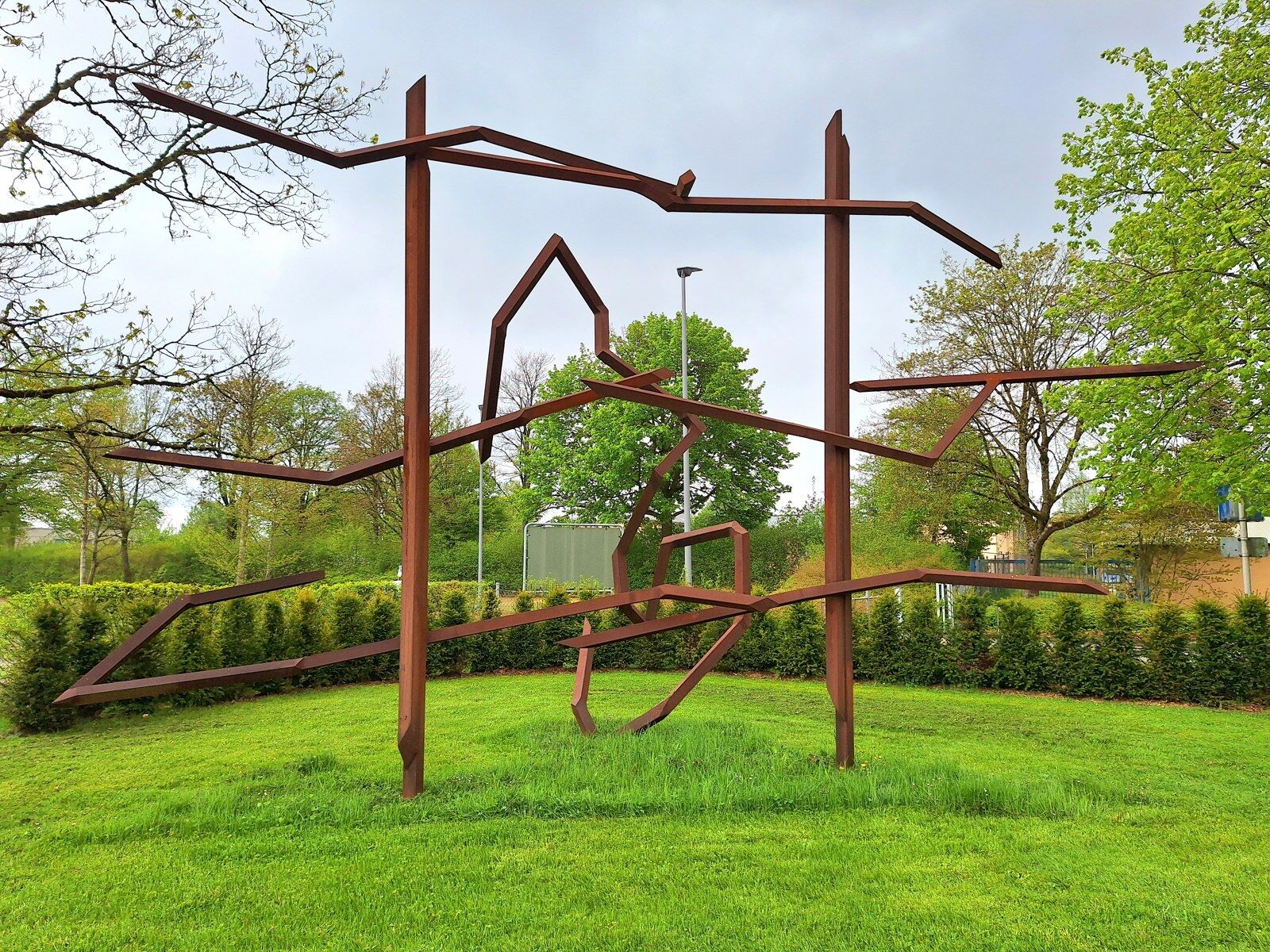
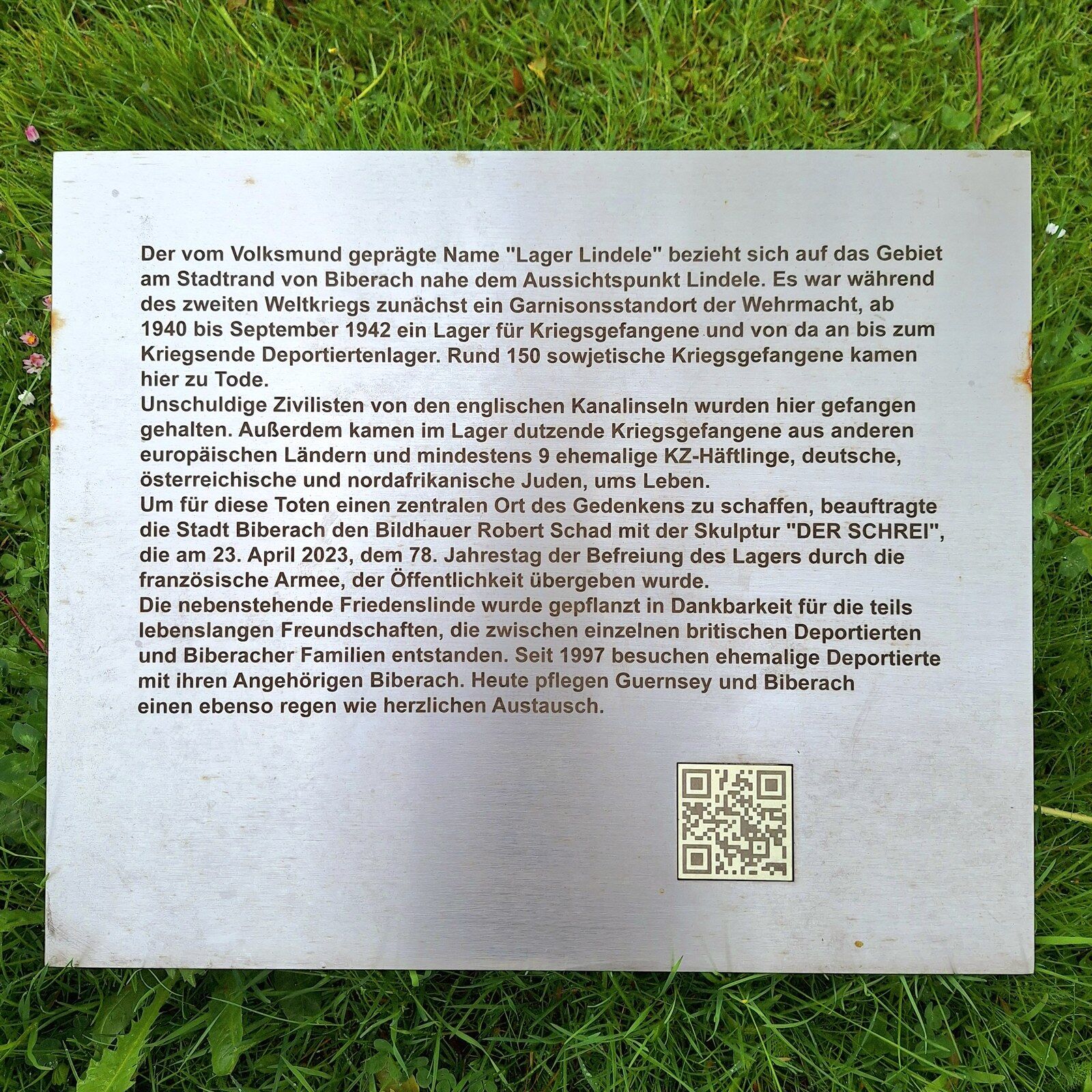
The town of Biberach published Reinhold Adler’s history of the camp in 2002, and a permanent exhibition built on panels from the Museum Biberach now stands on the police campus. On 23 April 2023 a sculpture by Robert Schad, Der Schrei, was set up outside the former camp at the town’s commission in memory of the victims of the Lindele.
The connections made in the camp outlasted it. Guernsey and Biberach are partner towns because of the deportees, and the Jewish families who passed through wrote about it afterwards: Marietta Moskin, born in Vienna in 1928, who told the story of her group in a book for American schoolchildren that Biberach pupils translated in 2002 and 2003, and Irene Hasenberg-Butter, whose father died on the January 1945 transport and whose body was unloaded at Biberach station.
The deportees kept returning. In September 2002 a group of around thirty people, including the Bailiff and members of the Deportees’ Association and the Council of Churches, travelled from Guernsey to Biberach for the dedication of a new memorial commemorating by name those who died at the Lindele.
Sources for this section
- Ausstellung Lager Lindele: Zeittafel
- Das Internierungslager Biberach an der Riß (1942–1945)
- Biberach und Laupheim: Das Lager Lindele und der jüdische Friedhof im Zweiten Weltkrieg und in der Nachkriegszeit
- Skulptur DER SCHREI, Robert Schad, Lager Lindele, Biberach an der Riß (photograph)
- Gedenktafel für das Lager Lindele, Biberach an der Riß (photograph)
- Newsletter, February 2003
Sources
- Ausstellung Lager Lindele: Zeittafel
Hochschule für Polizei Baden-Württemberg, Biberach · Accessed 12 September 2026
Full page and chronology read live in September 2026. Gives the exhibition’s account of about 5,000 people interned at the Lindele during the Second World War, the camp’s role as a showcase camp for British officers, the Channel Islands deportees, the shadow camp for Soviet prisoners with around 150 deaths, more than 300 Jews brought from Bergen-Belsen in 1944 with seven deaths and at least nine deaths among the ‘exchange Jews’, and the chronology from the 1939 barracks through the 1945 refugee camp and hospital for returnees (to 1962), the 1951 police takeover and rebuilding of 1970–76, to the police university in 2014. Records the sculpture Der Schrei by Robert Schad, set up outside the former camp on 23 April 2023 at the town’s commission. The exhibition panels come from the Museum Biberach.
- Biberach und Laupheim: Das Lager Lindele und der jüdische Friedhof im Zweiten Weltkrieg und in der Nachkriegszeit
Reinhold Adler, Gesellschaft für Geschichte und Gedenken, Laupheim · Accessed 12 September 2026
Full lecture text read. Used for the 1939 garrison and the replacement battalion of Infantry Regiment 56; Oflag VB and the British officers from August 1940; the tunnel escape of September 1941; the Soviet prisoners of November 1941 and the shadow camp of Stalag Ludwigsburg to February 1942; the Russian cemetery on the Memminger Straße; the Serbo-Croat officers of 1942; the conversion to Ilag VB in September 1942 and the transfer of guard duty to the Schutzpolizei that December; the administration of the camp by the Württemberg interior ministry through the Landratsamt Biberach and the censorship of mail for Biberach, Wurzach and Liebenau; conditions in the camp, the Red Cross parcels and the Carnival of August 1943; the exchange scheme and the Bergen-Belsen transports of November 1944 and January 1945; overcrowding above 1,300; the liberation of 23 April 1945; the flight of the Channel Islanders in early June; the UNRRA care of the stateless Jewish families at the Jordanbad; and the seven Lindele dead buried in the Jewish cemetery at Laupheim, with Leopold Caspary who died at the Jordanbad in 1947.
- Das Internierungslager Biberach an der Riß (1942–1945)
Zukunft braucht Erinnerung, excerpt from Reinhold Adler, Das war nicht nur Karneval im August (Städtische Archive Biberach, 2002) · Accessed 12 September 2026
Summary of the camp’s designations (garrison, Oflag, shadow camp of Stalag Ludwigsburg for Soviet prisoners, Ilag) and of its postwar use for German prisoners of war, expellees and refugees, and as a hospital for returnees before the police.
- Lager Lindele: Leben hinter Stacheldraht
Städtepartner Biberach · Accessed 12 September 2026
Local partnership society’s history of the camp; used for the December 1940 arrival of French prisoners, the liberation of the deportees by French troops on 23 April 1945 and the post-1945 refugee camp and hospital.
- Biberach an der Riß: Jüdische Geschichte
Alemannia Judaica · Accessed 12 September 2026
Full section on the persecution years read. Gives the composition of the two Jewish groups brought from Bergen-Belsen — 149 from Tripoli and Benghazi in November 1944, of them 29 children, 56 women and 64 men, and 133 in January 1945, mostly Dutch Jews, of them 26 children, 39 men and 68 women — their condition, the names of those buried at Laupheim, and the move of the survivors to the Jordanbad after 23 April 1945.
- DP camp inventory: Biberach, DP-Camp Lindele, entry 540
Arolsen Archives · 26 October 2023
Row 540 read from the downloaded spreadsheet: French zone, district Süd, location Biberach, building DP-Camp Lindele, closing 1 June 1945, nationalities Jewish and Ukrainian, UNRRA Team 209, team director Mr J. J. de Marnhac, Area Team AT 5 Ravensburg from 1 June 1947, Area A 3 Württemberg, field supervisor at Waldsee Mr R. Rodie, with archive references in the ITS occupancy and change reports for the town and district of Biberach, document IDs 81970458–81970734, and Kreisarchiv Biberach, holding 14 UVB.
- Skulptur DER SCHREI, Robert Schad, Lager Lindele, Biberach an der Riß (photograph)
Wikimedia Commons, user Reutlingendorf, CC BY-SA 4.0 · 26 April 2025
Licence and description checked through the Commons API; photograph of the 2023 memorial sculpture outside the former camp.
- Gedenktafel für das Lager Lindele, Biberach an der Riß (photograph)
Wikimedia Commons, user Reutlingendorf, CC BY-SA 4.0 · 26 April 2025
Licence and description checked through the Commons API; the plaque text summarises the camp’s history and names no internees.
- DP camp inventory: the other Biberach entries, rows 541 to 550 and 1666
Arolsen Archives · 26 October 2023
Rows read from the downloaded spreadsheet. Biberach in the French zone, district Süd, under UNRRA Team 209: Gaisentallager, a former Reich Labour Service camp, predominantly Polish, closing 1 March 1947; DP-Camp No. 1 at Karlstraße 9–11, the former district command; DP-Camp No. 7 in the Ulmer Straße; DP-Camp No. 10 at the Jordanbad, a former spa, closing 1 July 1950; DP-Camp No. 13 at Laupheim; Wielandstraße 30, a former girls’ school; the former Ottenbacher huts in the Freiburger Straße; a private house at Dinglingerstraße 24; the Schussenried asylum, queried as DP-Camp No. 6; and a row for free-living displaced persons lodged in named inns and former works in the town.
- Newsletter, February 2003
Guernsey Biberach (Guernsey Deportees Association / twinning association) · February 2003
Section “Deportees’ Visit to Biberach” read: a group of around thirty people, including the Bailiff and members of the Deportees’ Association and the Council of Churches, travelled to Biberach in September 2002 for the dedication of a new memorial commemorating by name those who died at the Lindele; the former camp was then a police training school and the visitors attended the launch of Reinhold Adler’s history of the camp.
- Ilag VC: Civilian Internees from Jersey
redhouses.de · Accessed 14 September 2026
Page read in full: one group of Channel Islands deportees went to the internment camp Lindele at Biberach, and on 30 October 1942 some 600 civilian prisoners, men, women and children, were transferred from the Lindele to the former prisoner-of-war camp Oflag VC at Wurzach Castle. A privately maintained site about the Jersey internees.
Last researched 14 September 2026