Fliegerhorst-Kaserne
Displacement in Europe
Böblingen · Germany · 1945–1950
A Polish displaced-persons camp on Böblingen’s former airfield, recorded in the camp inventory as holding Polish and Ukrainian residents, stood beside a separate Russian camp, an internment camp and a United States Army repair works. When it closed in October 1950 the remaining 580 people were directed into housing in the towns where they worked.
Introduction
At Böblingen’s former military airfield, a Polish displaced-persons camp became a temporary home after the war. Ukrainians are also recorded in its administrative inventory. Families received food and medical care while rebuilding their lives; in 1950 the remaining residents were directed into accommodation in the towns where they worked. This was one of two DP camps on the airfield, alongside a separate Russian camp, and the inventory records a third, Yugoslav camp at Böblingen in 1946.
A history in dates
- May 1936Development of the future Fliegerhorst site between Sindelfinger Allee and the Sindelfingen railway begins.
- 1937–1939The barracks are built on concrete piles and the first flying units move in.
- 22 April 1945A French unit takes over the Fliegerhorst and sets up an internment camp and a camp for about 3,000 displaced people.
- July 1945The municipal record counts 82 residents in the Polish camp and 2,800 in the Russian camp.
- 15 October 1945The camp inventory dates the opening of the Polish DP camp, Assembly Centre 607.
- 1947IRO takes over the relief administration.
- 31 October 1947Recorded capacity is 2,050 places.
- 15 October 1950Deadline for vacating the remaining airfield DP accommodation; 580 people remain.
- 1956The Bundeswehr occupies the former Fliegerhorst barracks as the Wildermuthkaserne.
From airbase to accommodation
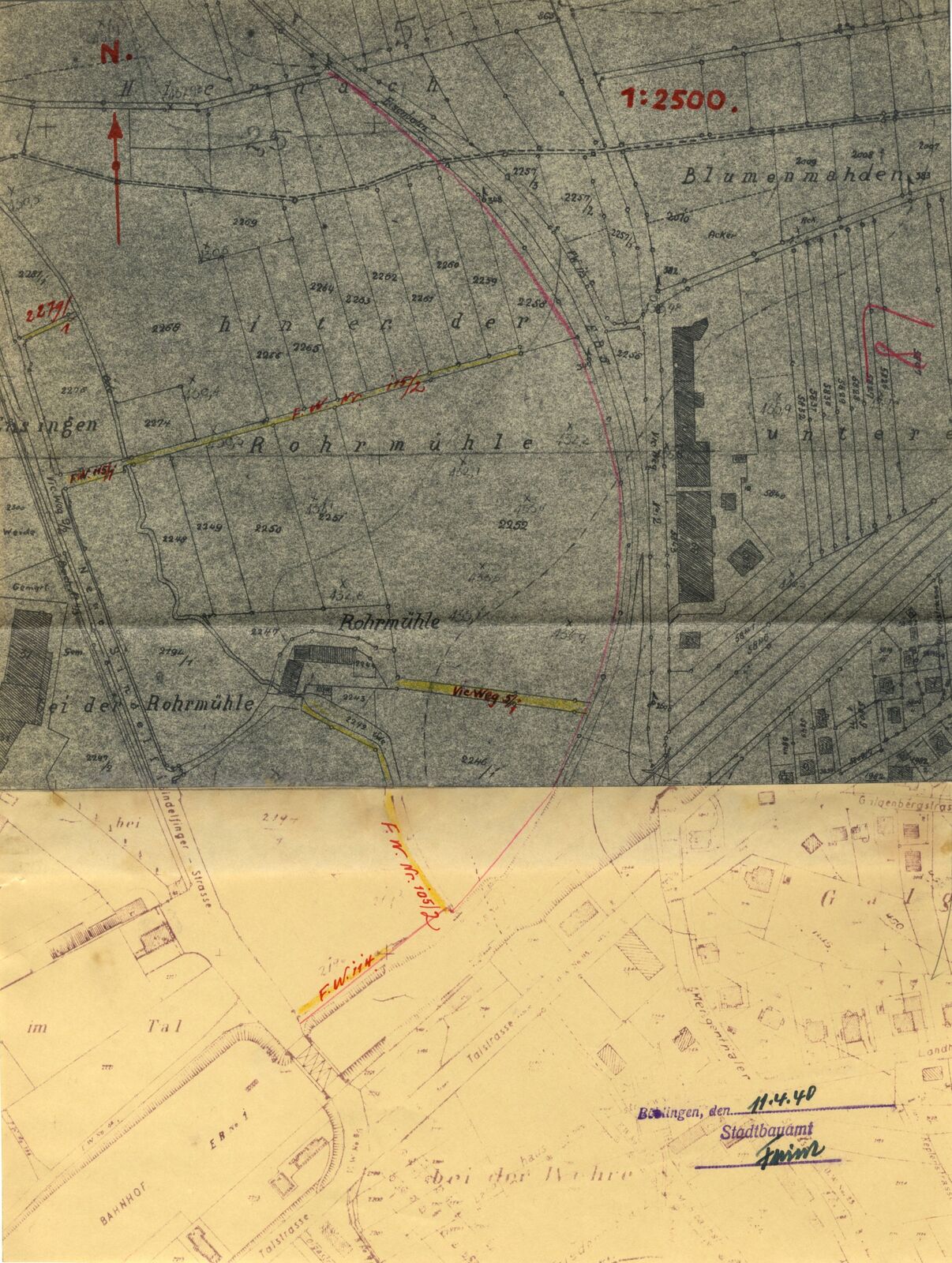
The Fliegerhorst barracks stood between Sindelfinger Allee and the railway to Sindelfingen. Development of the site began in May 1936, at the same time as the new civil airport at Echterdingen, and the barracks buildings themselves were begun in spring 1937. The difficult, wet ground required concrete piles beneath the barracks. New facilities included accommodation, a command building, workshops, water supply from a new works at Aidlingen and sewage disposal through a treatment plant built jointly with Sindelfingen under a contract of 16 December 1937. The surviving municipal plan of April 1940 shows the physical setting before its postwar use.
A French unit took over the Fliegerhorst and its barracks on 22 April 1945. It first housed German prisoners of war there, then established an internment camp for civilians and a camp for about 3,000 people left without a home, in the majority Poles and Russians. The American army took over the Böblingen district from early June, and by July was installed in the Fliegerhorst and the tank barracks, adding a large vehicle repair works on the former airfield. These were distinct populations with different circumstances. The camp discussed here is the Polish DP accommodation at Fliegerhorst-Kaserne, listed as Assembly Center 607 and later WG 228, under UNRRA Team 506.
Two camps on the airfield
The municipal archive records 82 people in the Polish camp in July 1945, compared with 2,800 in the Russian camp. The later inventory gives the Polish facility a capacity of 2,050 and lists both Polish and Ukrainian nationalities, with an opening date of 15 October 1945 and closure between 30 September 1950 and 31 March 1951. These figures describe different dates and measures: the early census cannot be compared directly with a later accommodation capacity.
The Polish name therefore describes the camp’s administrative identity without exhausting the nationalities in its records. The available evidence does not give a separate Ukrainian population total. Böblingen does not appear at all in Stebelsky’s tabulation of Ukrainians in American-zone camps, so no published Ukrainian figure exists for this site. UNRRA looked after the camp initially, with the International Refugee Organisation taking over in 1947.
Team 506 at Böblingen also administered several camps in the surrounding district, and two of them were recorded as Ukrainian: Dätzingen, Assembly Centre 608, and Herrenberg, Assembly Centre 610. A further camp at Sindelfingen held Estonians and Latvians and one at Unterjettingen Czechoslovaks. Ukrainian residents of the district therefore appear under several separate administrative entries, and figures for one must not be carried across to another.
Population and capacity
| Date | Scope | Number |
|---|---|---|
| April 1945 | All displaced people on the airfield under French control | about 3,000 |
| July 1945 | Polish camp, residents | 82 |
| July 1945 | Separate Russian camp, residents | 2,800 |
| 31 October 1947 | Polish DP camp, capacity | 2,050 |
| 1950 clearance | Remaining airfield DPs | 580 |
Camps of UNRRA Team 506 Böblingen in the inventory
| Place and building | Nationality recorded | Assembly centre |
|---|---|---|
| Böblingen, Fliegerhorst-Kaserne | Polish, Ukrainian | AC 607, later WG 228 |
| Böblingen, Yugoslav DP camp | Yugoslav | AC 710 |
| Dätzingen | Ukrainian | AC 608 |
| Herrenberg | Ukrainian | AC 610 |
| Sindelfingen | Estonian, Latvian | AC 609 |
Families and medical care
Residents received meals and care from camp doctors and nurses at a sick bay inside the camp. Patients were also treated at the district hospital in Böblingen and the hospital in Sindelfingen, and some children of the Polish camp are documented as having died in the Böblingen hospital. The city archivist notes that hygiene in the camp was certainly poor, and that some displaced people lived outside it. Civil death registers preserve evidence of children from the camp who died of illnesses, including whooping cough, and congenital conditions.
A group of 32 children’s gravestones on the Old Cemetery remains the visible trace of this community. They are the graves of Polish children and of one German boy, made between about 1945 and 1950. Neighbouring children’s graves were later cleared, but these were protected as public graves under the 1965 federal law on the graves of victims of war and tyranny, and the weathered stones were restored or replaced in 1998 and 1999 after a proposal from Böblingen residents.
Sources for this section
Homes beyond the barracks
The military authorities required the airfield DP accommodation to be vacated by 15 October 1950. The municipal history records 580 people remaining, to be housed in the places where the adults worked. This final movement was into local communities rather than necessarily overseas. It connects the history of the camp with the longer process of settlement and employment in postwar Germany. State-wide, Württemberg-Baden took on about 7,500 people of the so-called hard core at first, and later more than 10,000.
The Bundeswehr moved into the buildings of the former Fliegerhorst barracks in 1956, and the site became the Wildermuthkaserne. The last soldiers’ hostel of the Fliegerhorst, latterly used as accommodation for asylum seekers, was demolished in September 2004 during the redevelopment of the former airfield.
The surviving record
Administrative records can be traced through the ITS lists cited in the camp inventory, documents 81971100 to 81971566, and the Böblingen district archive. The cited district holdings are files 2618, 2619, 2679, 2715, 2725, 3201 and 7952 within OA/krBB/Hb 1. The city archive’s published account adds evidence from municipal civil registers, while the historical airfield plan supplies a view of the premises before families arrived. What is missing is any account of the community’s own life: no camp school, church, newspaper or association at this site has been traced in the sources read.
Administrative identifiers
| Record | Identifier |
|---|---|
| Assembly centre | AC 607 |
| Later camp code | WG 228 |
| UNRRA team | 506, Böblingen, director recorded as Mobro or Mobre |
| Area teams | 1003 Stuttgart and 1002 Ludwigsburg, from November 1946 |
| Opening and closing | 15 October 1945; between 30 September 1950 and 31 March 1951 |
| ITS documents | 81971100–81971566 |
| District archive | Kreisarchiv Böblingen, OA/krBB/Hb 1, Bü 2618, 2619, 2679, 2715, 2725, 3201, 7952 |
Sources
- The Polish children’s graves and the airfield camp
Stadtarchiv Böblingen · Accessed 13 September 2026
Municipal archival essay, section Polnische Kindergräber: two airfield camps, July 1945 populations, medical provision, the October 1950 clearance with 580 people remaining, and the protection and restoration of the 32 children’s graves. On the clearance of the surrounding graves: “Ursprünglich waren die heute bestehenden Kindergräber von anderen Kindergräbern umgeben, denen dieser Bereich des Friedhofs vorbehalten war. Nach und nach wurden die anderen Kindergräber aufgelassen, so dass am Ende nur noch die vereinzelte Gruppe von Gräbern übrig blieb.”
- DP camp inventory: Fliegerhorst-Kaserne, entry 811
Arolsen Archives · 26 October 2023
Row 811: Polish and Ukrainian nationalities, AC 607, WG 228, UNRRA Team 506 Böblingen, capacity 2,050 on 31 October 1947, opening 15 October 1945, closure between 30 September 1950 and 31 March 1951, ITS 81971100–81971566 and Kreisarchiv Böblingen references. Rows 812, 849, 1041, 1466 and 1550 for the other camps of the same team.
- 1938–1945: Fliegerhorst
Böblinger Flughafengeschichten, working with Stadtarchiv Böblingen material · Accessed 13 September 2026
Local historical research reproducing original plans and documents. Site development from May 1936 between Sindelfinger Allee and the railway; concrete piles; the sewage contract of 16 December 1937 and the Aidlingen waterworks; 1940 plan Stadtarchiv A15/3541; the French takeover of 22 April 1945 and the camp of about 3,000 displaced people.
- Böblingen: Garnison ab 1936, with the addendum Böblinger Kasernen nach 1945
Zeitreise BB, reproducing Erwin Funk, Böblingen im Dritten Reich, Band II (1987), p. 112 · Accessed 13 September 2026
Construction of the Fliegerhorst barracks from spring 1937 and the arrival of the first fighter group in April 1939; the American takeover in early July 1945 and the three parallel uses of the former airfield; the Bundeswehr’s arrival in 1956 and the 2004 demolition.
- Displaced Persons im deutschen Südwesten
Paul Düring, Landeszentrale für politische Bildung Baden-Württemberg · Accessed 13 September 2026
State-level context: at least 28 camps in what is now Baden-Württemberg, and the hard core of about 7,500 people taken on by Württemberg-Baden, later more than 10,000.
- Ukrainians in the Displaced Persons Camps of Austria and Germany, Table 8
Ihor Stebelsky, Ukrainskyi Istoryk 3 · 1986
PDF page 56, printed page 54. Checked for Böblingen: the Württemberg-Baden section lists Herrenberg with 24 Ukrainians on 31 May 1947 but has no row for Böblingen at any of the four dates.
- Aerial reconnaissance photograph of Böblingen airfield after air attack, 22 March 1945
United States Army Air Forces, via Wikimedia Commons · 22 March 1945
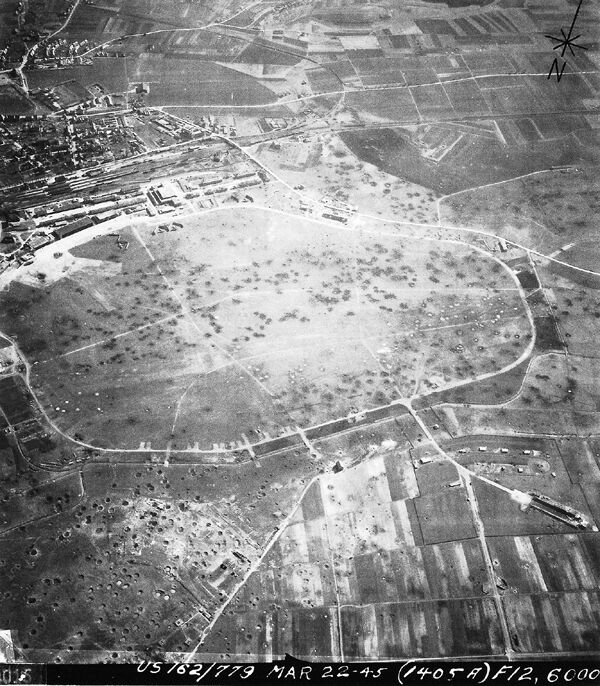
Public domain as a work of the United States federal government. Shows the cratered landing ground with the Fliegerhorst barracks along its north-western edge, seven months before the displaced-persons camp opened.
Last researched 13 September 2026