Bois-Brûlé-Kaserne
Displacement in Europe
Aschaffenburg, Bavaria, Germany · 1946–1949
A Ukrainian community grew inside a 1937 infantry barracks on Aschaffenburg’s Würzburger Straße, one of five camps in the town’s barracks quarter. Population returns, an art lottery for two Ukrainian painters and the surviving military buildings document different parts of its history.
Introduction
Bois-Brûlé-Kaserne was a separate displaced-persons camp in Aschaffenburg, later renamed Graves Barracks. Ukrainians formed a substantial community here, alongside other national groups, in a town where the barracks quarter held several camps at once. Population returns, an art fundraiser and the surviving military buildings document different parts of its history.
A history in dates
- 1937The Bois-Brûlé barracks are built on Würzburger Straße, named after fighting in Burgundy in 1914.
- Autumn 1937The first battalion of Infantry Regiment 106 occupies the barracks.
- November 1944The local Volkssturm battalion is trained in the barracks.
- 1 April 1945American infantry take the barracks on Easter Sunday.
- 3 April 1946The camp inventory records the start of its administrative period.
- 24 August 1946A UNRRA return counts 79 Ukrainian residents.
- 31 May 1947The UNRRA return reaches 1,132 Ukrainians.
- 31 October 1947A capacity of 1,420 places is recorded.
- September 1948The camp is renumbered UF 307.
- 1949Hromadianka reports an art lottery at Bois-Brûlé raising 520.60 marks.
- 7 August 1949The inventory records closure of the displaced-persons camp.
- 1952The compound is renamed Graves Barracks.
A former military compound
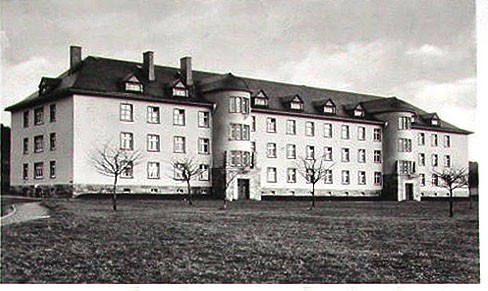
Aschaffenburg was rebuilt into a large garrison after conscription returned in 1935. Four new barracks complexes went up at about five million Reichsmark each: the Pionierkaserne on Schweinheimer Straße in 1936, then the Lagardekaserne in 1936 and 1937, the Bois-Brûlé-Kaserne in 1937 and the Artilleriekaserne in 1938, the last three all on Würzburger Straße. The two names commemorated engagements of the town’s Jäger battalion in 1914, at Lagarde in Lorraine and in the Bois Brûlé in Burgundy.
In the autumn of 1937 the first battalion of Infantry Regiment 106 occupied the new barracks, and by the outbreak of war the garrison had grown to about 3,500 men. In November 1944 instructors of the regiment’s replacement and training battalion drilled the local Volkssturm battalion there in the use of light infantry weapons. On Easter Sunday 1945 the third battalion of the American 157th Infantry Regiment took the Artilleriekaserne and then the Bois-Brûlé-Kaserne by five in the afternoon before pushing on along Würzburger Straße.
Its postwar camp identity was Assembly Centre 257, also written AC 91-257, followed by UF 307 from September 1948. The camp catalogue links it to UNRRA Team 119 and to the Würzburg area, and lists Polish, Polish-Ukrainian and Russian populations. These administrative descriptions sit alongside Ukrainian community surveys that identify Bois-Brûlé separately from Artillerie, Pionier, Jäger and Lagarde.
Camp identifiers and recorded capacity
| Record | Value |
|---|---|
| Assembly centre | AC 257 / AC 91-257 |
| From September 1948 | UF 307 |
| UNRRA team | Team 119 Aschaffenburg |
| Area team and area | AT 1049 Würzburg, Bad Brückenau and Kitzingen; A 3 Würzburg |
| Nationalities recorded | Polish, Polish-Ukrainian, Russian |
| Capacity, 31 October 1947 | 1,420 |
| Recorded opening | 3 April 1946 |
| Recorded closure | 7 August 1949 |
A growing Ukrainian presence
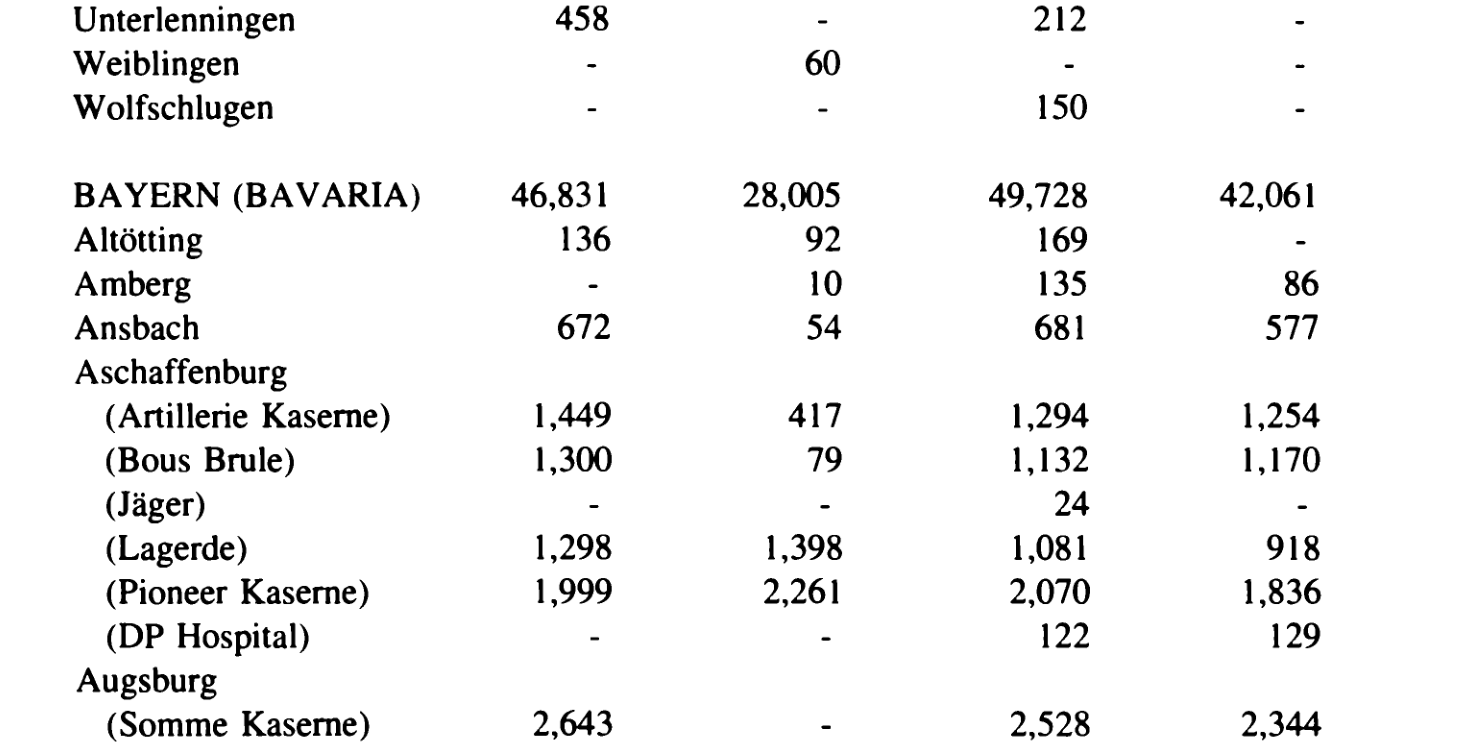
The UNRRA return of 24 August 1946 records 79 Ukrainians at Bois-Brûlé. The UNRRA return of 31 May 1947 gives 1,132, followed by 1,170 in the PCIRO figures compiled at the start of January 1948. The questionnaire survey collected by the Ukrainian central representation during 1946 and 1947 lists 1,300. The figures establish a substantial Ukrainian presence without treating the camp’s entire population as Ukrainian.
A recorded capacity of 1,420 dates from 31 October 1947. Capacity and resident counts answer different questions: one concerns accommodation, while the other describes people present when a particular return was made.
Ukrainian residents in successive returns
| Return | Source of the figure | Ukrainian residents |
|---|---|---|
| 1946–1947 questionnaire collection | Central Representation of the Ukrainian Emigration | 1,300 |
| 24 August 1946 | UNRRA summary, American zone | 79 |
| 31 May 1947 | UNRRA summary, American zone | 1,132 |
| December 1947 | PCIRO summary compiled 2 January 1948 | 1,170 |
A city full of displaced people
The town’s military history records that by some estimates up to 20,000 displaced people were accommodated in Aschaffenburg, housed above all in the barracks but at first also in schools and private flats. A military government report of October 1945 described armed bands among a minority of the camp population and a serious crime problem in the district, followed by a raid on the Aschaffenburg camps in which 43 people were arrested. These are city-wide accounts of the camp quarter as a whole; the report names no individual camp, and none of its figures belongs to Bois-Brûlé.
Sources for this section
An art lottery in the camp
A short report in the Ukrainian women’s periodical Hromadianka describes a lottery held in the Bois-Brûlé camp in which paintings by the well-known women artists L. Morozova and O. Liaturynska were offered as prizes. It reports considerable interest and a return of 520.60 marks in cash. Published in the 1949 double issue numbered 7 and 8, the notice provides a rare glimpse of cultural fundraising inside this particular camp.
The report belongs to the wider work of Ukrainian women’s organisations in displacement. The same page records that many active women had been transferred from the Aschaffenburg camps to both Mittenwald camps, and discusses the practical problems of emigration. It does not identify Bois-Brûlé as the origin of any particular transfer.
Sources for this section
Part of a wider Ukrainian centre
Aschaffenburg hosted Ukrainian representative bodies whose work included legal and material assistance and support for resettlement abroad. Bois-Brûlé was one component of this local network. The city’s better-documented institutions belonged to other camps: the Ukrainian secondary school to Lagarde, and the surviving Greek Catholic parish reports of 1945 and 1946 to the Lagarde and Eger barracks and the vocational school. None of those accounts should be transferred to this compound.
The Aschaffenburg camps kept apart
| Camp | Capacity, 31 October 1947 | Recorded closure |
|---|---|---|
| Artillerie-Kaserne | 1,600 | 31 July 1949 |
| Bois-Brûlé-Kaserne | 1,420 | 7 August 1949 |
| Pioneer-Kaserne | 2,000 | 9 February 1949 |
| Jägerkaserne | 1,240 | 15 March 1949 |
| Lagarde-Kaserne | 1,170 | 12 February 1949 |
| DP general hospital | 310 | 31 January 1949 |
Sources for this section
Closure and a new military use
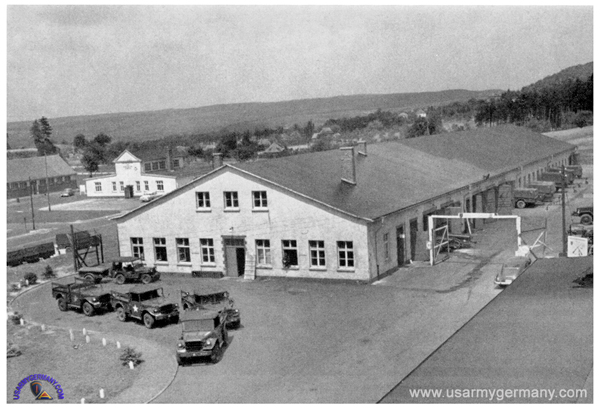
The camp inventory records closure on 7 August 1949, the last of the five Aschaffenburg barracks camps to close. The town’s barracks had by then served nearly four years as accommodation for displaced people, and in March 1949 the military government ordered the German services out of the Pionier- and Lagarde-Kaserne by 5 April so that troops could move back in. The Bois-Brûlé compound was rebuilt by the autumn of 1950 in 120 working days by a thousand workers at a cost of 4.5 million marks, and in 1952 it was renamed Graves Barracks after Staff Sergeant William E. Graves. Its 1954 photograph shows the later American motor pool, preserving the appearance of the site after displaced residents had left.
The surviving documentary record
Municipal archivists reorganised Aschaffenburg’s UNRRA records in 2021 and 2022, linking postwar investigations with surviving wartime documents. The camp catalogue points to the same city and collegiate archive for the registry office death books and a ten-page list of displaced people, and to a run of tracing-service documents for Aschaffenburg.
Sources for this section
Sources
- Inventory of displaced-persons camps
Arolsen Archives · 26 October 2023
Camp-specific register entry; Excel serial dates decoded using 1899-12-30. Capacity is not a census.
- The Refugee Experience: Ukrainian Displaced Persons after World War II
Canadian Institute of Ukrainian Studies Press · 1992
Ihor Stebelsky, Table 7 “Ukrainians in UNRRA and IRO Camps of the American Zone of Germany”: table headed printed p. 47, Aschaffenburg rows p. 48, column notes p. 51. The four columns are a questionnaire collection of 1946 and 1947, the UNRRA summary of 24 August 1946, the UNRRA summary of 31 May 1947 and the PCIRO summary of 2 January 1948. In this 1992 edition the British Zone is Table 6, printed pp. 44–46; the tables are numbered one higher in Stebelsky’s earlier 1986 printing, where the American zone is Table 8.
- Aschaffenburg als amerikanischer Militärstandort: Vom Kriegsende bis zur Konversion
Geschichts- und Kunstverein Aschaffenburg; Christian Th. Müller · 2016
Municipal archive-hosted monograph. Barracks construction and naming pp. 8–10; the Volkssturm and the fighting for the barracks quarter pp. 15–16 and 23; up to 20,000 displaced people in the town and the 1945 military government report pp. 30–33; return to military use, renaming in 1952 and reconstruction pp. 49–52.
- Aschaffenburg
Encyclopedia of Modern Ukraine / National Academy of Sciences of Ukraine · 2001
Ukrainian camp network, city-wide representative institutions and education. Lagarde gymnasium is not reassigned to other barracks.
- Aschaffenburg military installations: historical photographs
US Army Germany historical collection · Various photographic dates
Barracks identities and attributed historical photographs; later military photographs are labelled with their actual dates.
- UNRRA: Originaldokumente digital erfasst und verzeichnet
City and Collegiate Archive of Aschaffenburg · 4 August 2022
Institutional account of wartime forced-labour documents and post-war UNRRA investigation records, catalogued in 2021–2022.
- Hromadianka, year IV, no. 7–8
Association of Ukrainian Women in Exile · 1949
Original periodical, read from the page image at 400 dpi because the OCR mis-read the sum. The notice names the painters L. Morozova and O. Liaturynska and gives 520.60 marks in cash. The same page reports women transferred from Aschaffenburg camps to both Mittenwald camps without naming the camp of origin.
- DP camp inventory: the Aschaffenburg camps
Arolsen Archives · 26 October 2023
Records 712 to 717 keep the town’s camps distinct: Artillerie (capacity 1,600, closed 31 July 1949), Bois-Brûlé (1,420, closed 7 August 1949), Pioneer (2,000, closed 9 February 1949), Jäger (1,240, closed 15 March 1949), Lagarde (1,170, closed 12 February 1949) and a general hospital (310, closed 31 January 1949).
- File:Bois-Brule Kaserne Aschaffenburg.jpg
Wikimedia Commons, from usarmygermany.com · 1950
File description page read: a photograph of the Bois-Brûlé-Kaserne at Aschaffenburg dated 1950, sourced from usarmygermany.com and uploaded on 25 January 2009. The page records the image as public domain as a work of the United States federal government.
Last researched 13 September 2026