Bonegilla Migrant Reception and Training Centre
Arrival and settlement
Near Lake Hume, north-east Victoria, Australia · 1947–1971
A first Australian address for thousands of newcomers, Bonegilla connected Ukrainian arrivals with work, schools, worship and new communities across the country.
Introduction
Bonegilla Migrant Reception and Training Centre opened in December 1947 in a former army camp near Lake Hume in north-east Victoria. For Europeans displaced by war and postwar upheaval, it could be the first address in Australia: a place to sleep, receive medical attention, learn enough English for work and wait for a job or transfer. The centre was never exclusively Ukrainian. Its first contingent consisted of 839 people from Estonia, Latvia and Lithuania, while later residents came from many national and linguistic backgrounds. Ukrainians lived, worked and worshipped within this wider population.
Within the government centre, residents built a temporary neighbourhood. Ukrainian worship, choirs and classes helped people maintain familiar ties while employment placements carried them towards new towns and cities. Individual journeys reveal how opportunity, family separation and the search for a permanent home shaped life at Bonegilla.
A history in dates
- 1940An army camp is established near Lake Hume in north-east Victoria.
- December 1947Bonegilla opens as a migrant reception centre. The first contingent numbers 839 people from Estonia, Latvia and Lithuania.
- Early 1949Vasyl Matiash organises a choir that performs at Bonegilla and Albury; Markiian Struk is also associated with a Bonegilla choir.
- April 1949The Army withdraws as the Department of Immigration expands civilian migrant accommodation and services.
- June 1949A group of Ukrainians moves from Bonegilla to the government hostel at Brighton, Tasmania.
- 13 August 1949Pavlo Smal celebrates a service in Melbourne after his earlier ministry at Bonegilla.
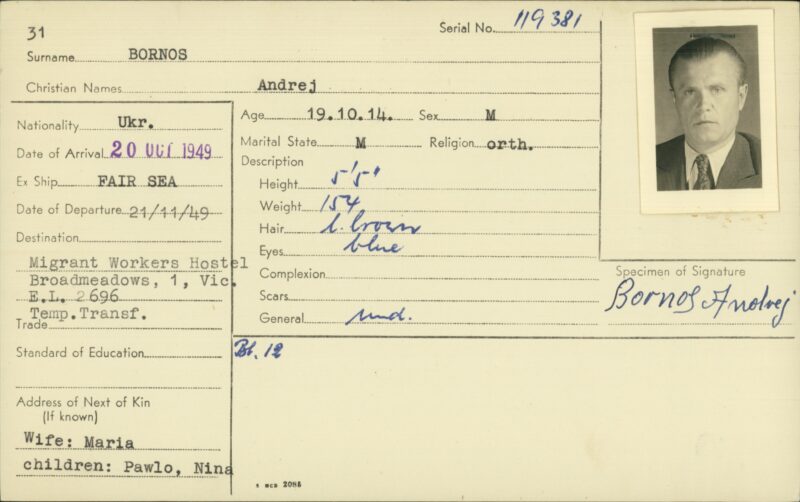
- 20 October–24 November 1949Andrej Bornos arrives at Bonegilla and later transfers temporarily to the Migrant Workers Hostel at Broadmeadows.
- 1949–1951Arrivals increase sharply; the centre expands accommodation, uses tents when required and dispatches residents to employment at a rapid rate.
- 1 April 1951A Ukrainian community branch is founded in Wodonga, after Ukrainian families begin settling nearby.
- 5 February 1952Bonegilla Special School No. 4634 opens with 150 pupils.
- End of 1952The special school’s enrolment reaches 483 pupils.
- 1952 and 1961Protests occur over delays in employment and onward placement.
- November 1971The last arrivals reach Bonegilla.
- End of 1971The migrant reception centre closes.
- 7 December 2007Bonegilla is included in the National Heritage List.
Sources for this section
- Receiving Europe’s Displaced at Bonegilla
- Bonegilla Migrant Reception and Training Centre
- Ukrainians in Australia, volume 1
- Overview: Australia’s Ukrainian Catholic Church
- Andrej Bornos, Bonegilla identity card, serial 119381
- Bonegilla Migrant Experience Site Guide
- Bonegilla Migrant Centre Special School No. 4634
- So Much Sky: Becoming Australian
- Bonegilla Migration
From army camp to migrant centre
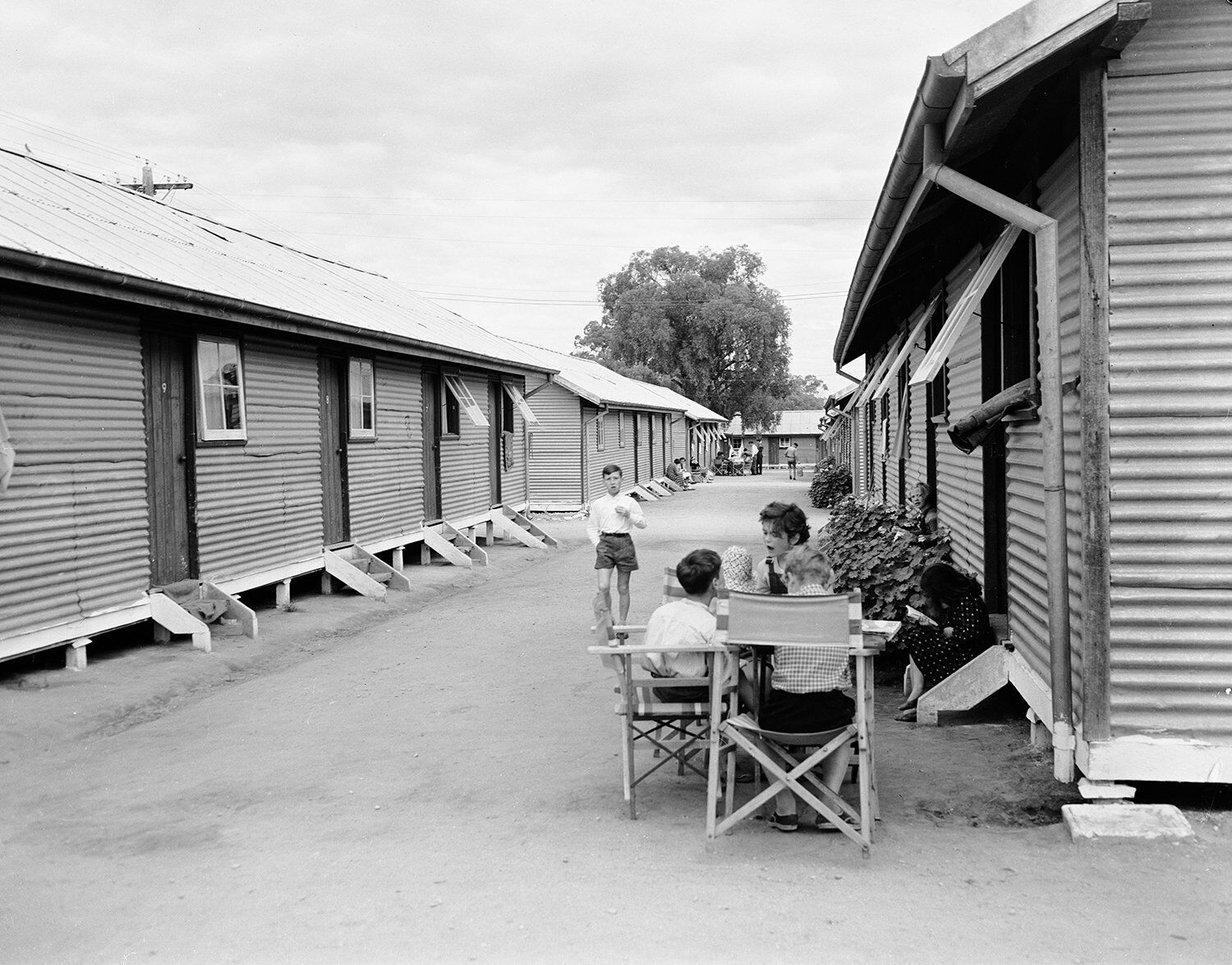
The camp was established by the Australian Army in 1940. Its military layout remained visible after the Department of Immigration began using it for migrants: timber-framed huts clad in corrugated iron stood in blocks around communal kitchens, dining rooms, washing facilities, offices and medical services. Sleeping huts commonly held about twenty people without internal partitions. A resident was issued an army bed, mattress, pillow, locker and chair. In the early years, army personnel continued to provide staff and services.
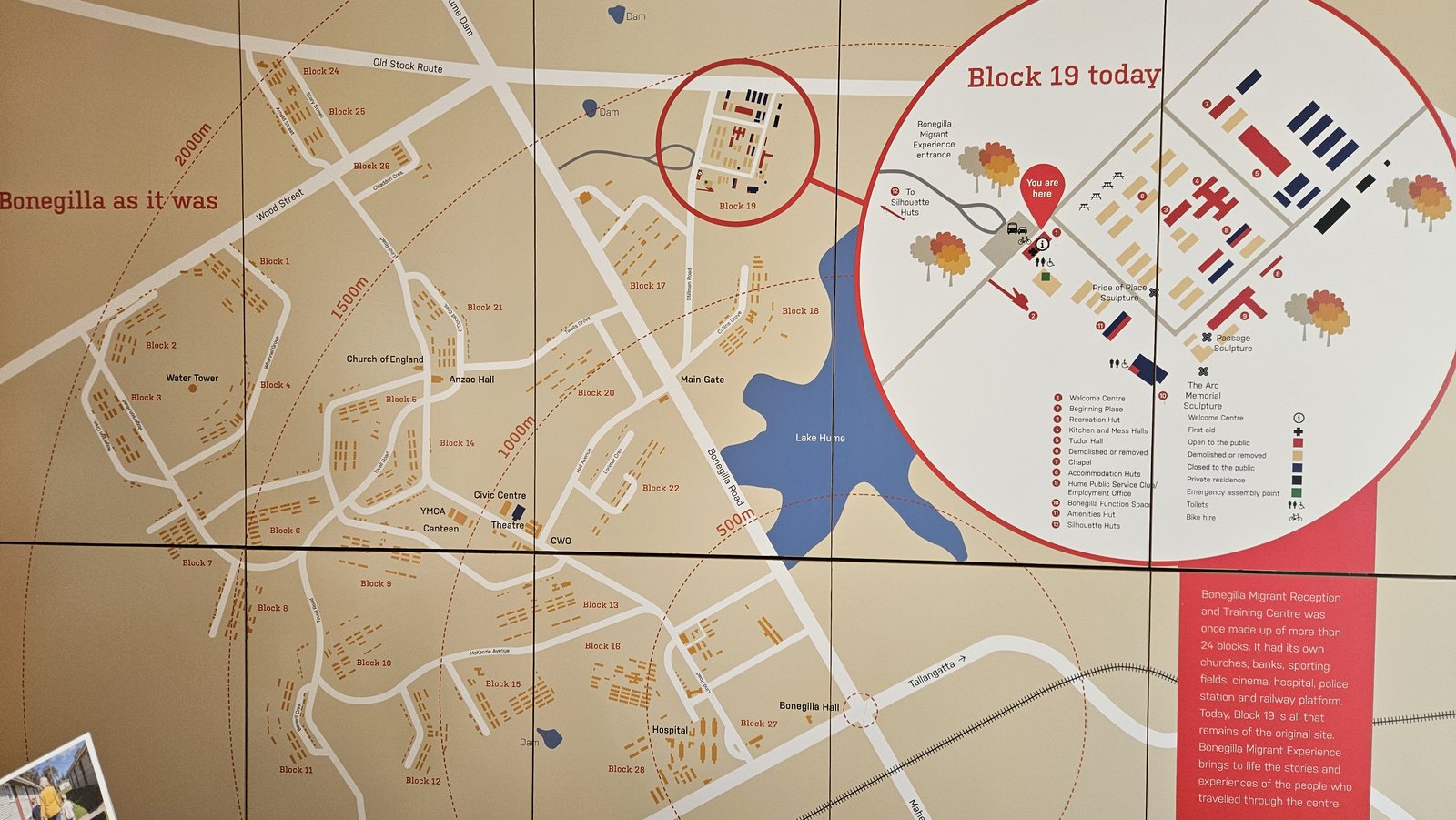
The Army withdrew in April 1949, as the immigration programme required more accommodation and a larger civilian operation. Bonegilla was not a single surviving building but a broad, changing settlement of blocks, halls, kitchens, offices, hospitals and accommodation huts. The present Block 19 site represents only a portion of the former centre. The later site guide describes a complex in which buildings were moved, adapted or sold as demand changed.
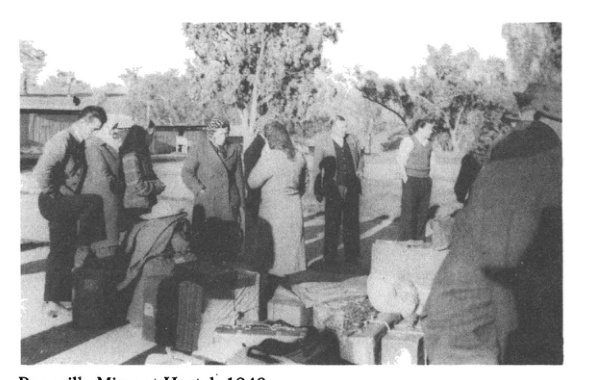
Reception was carefully sequenced. New arrivals were allocated to a hut, given bedding and utensils, fed, assessed for language ability, interviewed for employment, registered with social services, issued an alien registration certificate and medically examined. Their stored luggage was checked as well. The employment interview mattered especially because it could determine the next town, industry and stage of family life.
Sources for this section
Population, housing and the scale of movement
The centre expanded rapidly during the arrival surge of 1949–1951. The historical booklet describes accommodation capacity of 7,700 people, with another 1,600 places available in tents if necessary. A newer site guide describes the busiest centre as housing up to 8,000 people, sometimes in tents but usually in large huts. These figures describe capacity or maximum occupancy, not a Ukrainian population count and not necessarily the same measurement.
Housing arrangements changed over time. Women and children were initially housed separately from men; later, huts were partitioned into cubicles for families, and large families could receive adjacent cubicles. The accommodation provided basic necessities rather than privacy. Residents queued for meals, cared for their own crockery and cutlery and listened for others speaking their language. The same barracks could be remembered as protection after wartime deprivation or as another form of confinement.
The centre’s population was exceptionally mobile. During some periods in 1950, employment officers dispatched as many as 100 people a day to jobs, while a teleprinter helped coordinate departures before more ships arrived. Instructional huts were converted to accommodation as pressure grew. Fast turnover made Bonegilla a place of waiting, but often not a long one: residents could be moved on before language lessons were complete or personal preferences could be accommodated.
Later institutional accounts place the centre's total throughput far above any single year's capacity. AlburyCity states that between 1947 and 1971 Bonegilla was the first home in Australia for up to 320,000 migrants from more than 30 nations, while the National Heritage List entry and the National Film and Sound Archive's educational material each give a figure of over 300,000 people passing through before closure in 1971. These are cumulative totals for the centre's whole operation, not resident populations at any one time, and none of them is broken down by nationality.
The displaced-persons cohort formed a large share of that movement. The National Heritage List entry records that over 170,000 displaced or homeless persons came to Australia between 1947 and 1953, naming Ukrainians among the principal national groups alongside Poles, Yugoslavs, Latvians, Hungarians, Lithuanians, Czechoslovaks, Estonians, Russians, Germans and Romanians. The Dutch Australian Cultural Centre's account states that nearly half of these displaced persons lived at Bonegilla on arrival, some for weeks and others for months.
Descriptions of the wider settlement survive in later community histories. The Australian Lithuanians' camp history records the centre as once made up of 24 blocks, with its own churches, banks, sporting fields, cinema, hospital, police station and railway platform. An account in Il Globo dates the partitioning of huts into family cubicles to 1951 and describes them as just under four metres by three metres, each intended to hold a whole family.
Different measures of Bonegilla’s scale
| Measure | Figure | Scope |
|---|---|---|
| First contingent, December 1947 | 839 | Estonian, Latvian and Lithuanian arrivals |
| Expanded accommodation, 1949–1951 | 7,700 | Capacity described in the booklet |
| Additional tents if required | 1,600 | Contingency capacity |
| Busiest centre | 8,000 | Maximum described in the site guide |
| School opening, February 1952 | 150 | Pupils |
| School end of 1952 | 483 | Pupils |
Sources for this section
- Receiving Europe’s Displaced at Bonegilla
- Bonegilla Migrant Experience Site Guide
- Bonegilla Migration
- Bonegilla Migrant Reception and Training Centre, National Heritage List entry
- Bonegilla Migrant Camp, Australian history and immigration
- Where Water Meets: Bonegilla, the Dutch migrant experience
- Australian migrant camps, Bonegilla, Victoria
- Bonegilla: a temporary home, suspended in time
Work, language and daily life
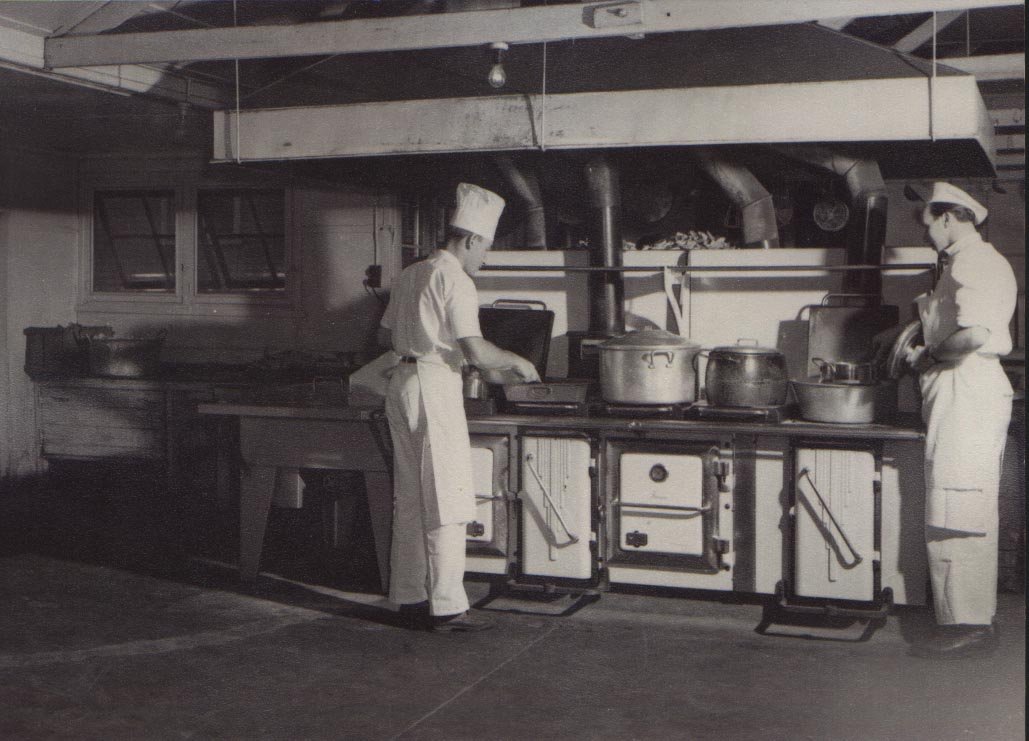
The displaced-persons programme treated employment as the route into Australian life, but its labour assumptions were narrow. Men were frequently placed as labourers and women as domestic workers, even when they had held skilled or professional occupations in Europe. Some residents worked inside Bonegilla in kitchens, transport, maintenance, offices or the hospital. Nikola Kitt, identified in the booklet as Ukrainian and associated with 1948, worked first as a kitchen hand and cook and later in hygiene and boot repair. His experience shows how the centre could be both temporary accommodation and a workplace, alongside other migrants employed in the centre.
English teaching concentrated on practical speech for work, shopping and official encounters. Repetition and simple sentence patterns were favoured over extended grammatical explanation. Attendance was connected to employment, and night classes were available for staff. Learning English offered mobility, but the demand to abandon familiar speech could also unsettle identity and belonging.
Recollections preserve sharply different impressions of ordinary life. Recollections from people associated with Ukraine describe the isolation of a camp without a nearby town. Dmytro Chub’s literary account evokes rows of beds, sparse furnishings and enormous moths around the lights. Other residents remembered plentiful meals and relief after hunger, alongside repetitive mutton, summer heat and winter cold. Sport, cinema, concerts and the landscape around Lake Hume offered diversions, but no single recollection can stand for every resident or every year.
Health care and family welfare became urgent issues in 1949, when the deaths of newly arrived children exposed weaknesses in reception arrangements. The booklet reports thirteen deaths at Bonegilla within a wider group of nineteen and describes an inquiry critical of prolonged shipboard feeding practices and an understaffed, inadequately equipped hospital. Later improvements included hospital renovation, improved sterilisation and obstetric facilities, heated family rooms, infant-feeding facilities, extra milk and eggs for children, a crèche, kindergartens and outdoor play equipment. The evidence concerns the centre as a whole and does not provide a Ukrainian death count.
Directed labour was a formal condition of passage for this cohort. National Archives educational material states that displaced persons who arrived through assisted passage schemes between 1947 and 1953 had to work for two years in a job chosen for them by the government. The National Film and Sound Archive's background material describes a two-year directed-labour contract offered to voluntary and refugee migrants in return for their passage to Australia.
Ukrainian community, education, culture and religion
Ukrainian religious life began before permanent community buildings were available. A retrospective history of Australia’s Ukrainian Catholic Church records the Reverend Pavlo Smal celebrating divine liturgies at Bonegilla before moving to Melbourne, where his service is dated 13 August 1949. The 1966 Ukrainian community history separately records Pavlo Smal and D. Kachmar spending time at Bonegilla after arriving in Australia in 1949.
Orthodox pastoral work followed a related but distinct regional pattern. The same 1966 history records Dmytro Burtan’s 1949 assignment to Bonegilla, Benalla, Rushworth and other Victorian camps. These assignments show how clergy served dispersed arrivals across several temporary settlements rather than a single established parish.
Music carried Ukrainian identity beyond the huts. The 1966 community history recalls Markiian Struk organising a Bonegilla choir that performed in Albury. It also records Vasyl Matiash organising a choir early in 1949 and appearing as conductor and soloist in Bonegilla and Albury. Both later moved to Sydney. These accounts connect cultural activity inside the reception centre with Ukrainian networks forming in nearby towns and larger cities.
Ukrainian education also began in provisional conditions. M. Danylak’s 1989 overview includes Bonegilla among the arrival camps where Ukrainian ethnic schools first developed around 1949. The centre’s official Special School No. 4634 opened on 5 February 1952 with 150 pupils and had 483 by the end of that year; children of more than forty-four nationalities attended over its lifetime. The special school was a general camp institution, not a Ukrainian school.
Communities formed after departure as well as inside Bonegilla. Yaroslav Bulka’s history records a larger group moving from Bonegilla to Tasmania in June 1949, first entering the government hostel at Brighton, near Hobart. Single men went first to jobs across Tasmania, followed by childless couples and then families with children. In nearby Wodonga, more than forty Ukrainian families reportedly found work and established homes over several years, and a Ukrainian community branch was founded on 1 April 1951. These figures describe settlement beyond the centre, not the number of Ukrainians living in Bonegilla at any one time.
Identified residents and individual journeys
Andrej Bornos is one of the clearest documented Ukrainian residents. His identity card, serial 119381, records nationality as Ukrainian, the ship Fair Sea, an arrival stamp of 20 October 1949 and a departure entry of 24 November 1949. His destination was the Migrant Workers Hostel at Broadmeadows, Victoria, marked as a temporary transfer. The card names his wife Maria and children Pawlo and Nina as next of kin, but it does not establish that they travelled with him or shared this transfer.
Dmytro Chub offers a different kind of evidence. In The Australian Bear, a chapter of his 1980 autobiographical literary work, he describes a night train from Melbourne, buses at a siding, accommodation assigned in the camp theatre, medical and employment appointments and conversations about work and the cost of a future home. Its autobiographical scenes convey the emotional texture of arrival.
Later routes show how employment could divide households. Orion Wenhrynowucz, Nikolaus H and Anton Sziller are included in recollections labelled Ukraine. Wenhrynowucz remembered being sent to Ivanhoe while his wife went to the Royal Melbourne Hospital. Nikolaus H went to a Melbourne glass manufacturer while Maria and their daughter Elisabeth went to Cowra; Anton went to Adelaide while Lea went to Cowra.
Andrej Bornos’s identity card
| Field | Recorded detail |
|---|---|
| Nationality | Ukrainian |
| Ship | Fair Sea |
| Arrival stamp | 20 October 1949 |
| Departure | 24 November 1949 |
| Destination | Migrant Workers Hostel, Broadmeadows, Victoria |
| Transfer type | Temporary |
Individual routes recalled after Bonegilla
| Person | Year label in source | Next destination described |
|---|---|---|
| Orion Wenhrynowucz | 1948 | Ivanhoe; wife to Royal Melbourne Hospital |
| Nikolaus H and family | 1949 | Melbourne glass manufacturer; Maria and Elisabeth to Cowra |
| Anton and Lea Sziller | 1949 | Adelaide and Cowra respectively |
Migration, closure and afterlife
The centre changed as the displaced-persons programme gave way to a broader assisted-migration system. During the 1950s, assisted migrants joined earlier displaced residents, and the population’s composition and experiences changed. Protests over delayed employment occurred in 1952 and 1961. An account in Il Globo describes these disturbances as riots during the economic recessions of those years, suppressed by the army in 1952 and by the police in 1961, by migrants frustrated at long waits for promised work.
The last arrivals came in November 1971, and the reception centre closed at the end of that year.
The surviving Block 19 buildings, the Welcome Centre and the site guide represent the centre’s present-day afterlife and help visitors interpret what remains of the former settlement. AlburyCity records that Bonegilla was included in the National Heritage List on 7 December 2007.
National Archives administration files are concentrated in series A2567, while name-index and registration cards appear in A2571 and A2572. Photographs are held in A12111 and AA1971/666.
Local identity-card collections and the Bonegilla Collection at Albury LibraryMuseum provide further routes into personal histories, allowing researchers to connect named individuals and recollections with the institution’s administrative record.
For Ukrainian descendants, Bonegilla is therefore less a single ethnic enclave than a first junction in a scattered settlement story. Some people moved to factories, hospitals, hostels and domestic work across Australia; others helped establish churches, choirs, schools and branches in Wodonga, Albury, Tasmania, Melbourne and Sydney. The surviving evidence preserves the institution’s scale and the individual’s uncertainty at once: a place designed to move people onward, remembered long after its huts ceased to receive them.
The surviving records support family research on a large scale. The Bonegilla Migrant Experience states that identity cards exist for most people who came through the centre and record the dates they arrived and left, where they went, the ship they came on and the block they lived in. AlburyCity reports that the Bonegilla Collection at the Albury LibraryMuseum currently holds 3,545 museum objects and photographs.
Sources for this section
- Bonegilla Migrant Reception and Training Centre
- So Much Sky: Becoming Australian
- Bonegilla: a temporary home, suspended in time
- Bonegilla Migrant Experience Site Guide
- Bonegilla Migration
- Receiving Europe’s Displaced at Bonegilla
- Andrej Bornos, Bonegilla identity card, serial 119381
- So This Is Australia: The Adventures of a Ukrainian Migrant in Australia
- An Overview of Ukrainian Secondary Education in NSW
- Ukrainians in Australia, volume 1
- Looking for someone: Bonegilla identity card lookup
Sources
- Receiving Europe’s Displaced at Bonegilla
Parklands Albury Wodonga; Wodonga Council reprint · 2010; reprinted 2016
Bruce Pennay, assisted by Jayne Persian. Full 28-page booklet read, including references and endnotes. Historical synthesis using contemporary documents and later memories; not all underlying sources were independently inspected.
- Andrej Bornos, Bonegilla identity card, serial 119381
Bonegilla identity-card collection · 1949 record
Original card front visually checked. Records Ukrainian nationality, Fair Sea, arrival on 20 October 1949, departure on 24 November 1949 and temporary transfer to Broadmeadows.
- Bonegilla Migrant Reception and Training Centre
National Archives of Australia
Institutional history and archival-series guide read.
- Bonegilla Migrant Centre Special School No. 4634
Victorian Government
Institutional school history read. It gives the opening date as 5 February 1952, 150 pupils initially and 483 by the end of 1952. Metadata gives 1 January 1971 as a closure date, while the prose gives only the year; no exact school-closing date is adopted here.
- So Much Sky: Becoming Australian
NSW Migration Heritage Centre
Institutional exhibition history read. Supports later protests, the last arrivals in November 1971 and closure at the end of 1971.
- So This Is Australia: The Adventures of a Ukrainian Migrant in Australia
Bayda Books · 1980
Dmytro Chub’s autobiographical literary work. The Bonegilla chapter, photograph on page 18, copyright information and acknowledgements were read. The book is labelled fiction and is not an administrative register. The photograph is credited to V. Tkacz.
- Overview: Australia’s Ukrainian Catholic Church
The Ukrainian Weekly · 8 August 1999
Retrospective anniversary history, page 9. Original newspaper page visually inspected and text read. Supports Pavlo Smal’s early ministry at Bonegilla and Melbourne service, but not an exact Bonegilla liturgy date or dedicated church building.
- An Overview of Ukrainian Secondary Education in NSW
Macquarie University, in Ukrainian Settlement in Australia · 1989
M. Danylak’s retrospective education overview. Printed page 19/PDF page 22 was visually read. It includes Bonegilla among arrival camps where Ukrainian ethnic schools developed around 1949, without a separate opening date or enrolment figure.
- Ukrainians in Australia, volume 1
Ukrainian community publication · 1966
Community history. Relevant pages include 79, 170, 366, 468–469 and 648. The inspected material supports Ukrainian Catholic and Orthodox activity, Bonegilla choirs, Tasmanian migration and Wodonga settlement.
- Bonegilla Migrant Experience Site Guide
Bonegilla Migrant Experience · July 2026 guide; retrieved 12 September 2026
Two-page site guide examined through embedded text. Supports the site layout, accommodation changes, kitchens, mess halls, chapel, Tudor Hall and the description of the busiest centre as housing up to 8,000 people. The complete broader site documentation was not examined.
- Bonegilla Migration
AlburyCity, Albury LibraryMuseum · Undated
Web page read in full. It gives a total of up to 320,000 migrants from more than 30 nations between 1947 and 1971, the National Heritage List inclusion of 7 December 2007, and a current count of 3,545 objects and photographs in the Bonegilla Collection.
- Child at Bonegilla Migrant Reception and Training Centre, Victoria
National Archives of Australia, learning resources · Undated
Educational value section read. It states that displaced persons arriving through assisted passage schemes between 1947 and 1953 had to work for two years in a job chosen for them by the government.
- Bonegilla Migrant Reception and Training Centre, National Heritage List entry
Australian Government, Department of Climate Change, Energy, the Environment and Water · Inscribed 7 December 2007
Heritage entry read. It records over 300,000 people passing through before closure in 1971 and over 170,000 displaced or homeless persons arriving between 1947 and 1953, naming Ukrainians among the principal groups.
- Bonegilla Migrant Camp, Australian history and immigration
National Film and Sound Archive of Australia, Digital Learning · 2009
Background information section read. It describes Bonegilla as the largest and longest operating post-war reception centre, over 300,000 mainly European migrants passing through between 1947 and 1971, and a two-year directed-labour contract offered in return for passage.
- Australian migrant camps, Bonegilla, Victoria
Australian Lithuanians · Undated
Community history page read in full. Used for its description of the centre as once made up of 24 blocks with its own churches, banks, sporting fields, cinema, hospital, police station and railway platform.
- Where Water Meets: Bonegilla, the Dutch migrant experience
Dutch Australian Cultural Centre · Undated
Main body read. Used for its statement that nearly half of the roughly 170,000 displaced persons who came to Australia after the war lived at Bonegilla on arrival, some for weeks and others for months. Its opening-date statement conflicts with the archival record and is not followed here.
- Looking for someone: Bonegilla identity card lookup
Bonegilla Migrant Experience · Undated
Page read. It describes the surviving Bonegilla identity cards as existing for most people who came through the centre and as recording arrival and departure dates, destinations, the ship and the block lived in.
- Bonegilla: a temporary home, suspended in time
Il Globo · About 2022
Article read in full. Used for the 1951 partitioning of huts into cubicles just under four metres by three metres for whole families, and for its account of the 1952 and 1961 disturbances as riots suppressed by the army and by the police.
Last researched 12 September 2026