Brighton Migrant Hostel
Arrival and settlement
Brighton, Tasmania, Australia · Ukrainian arrivals from June 1949; camp cleared in 1951
A transfer from Bonegilla in June 1949 brought Ukrainian families to a former military camp north of Hobart, and work contracts then scattered them across Tasmania. The camp was cleared in 1951, and the community the arrivals went on to build took shape in Hobart and Launceston rather than at Brighton.
Introduction
Brighton, north of Hobart, was an early home for Ukrainian migrants in Tasmania. In June 1949, a group transferred from Bonegilla to a government hostel in the former military camp. Yaroslav Bulka’s community history recalls single men arriving first, followed by couples and families with children. Work and the search for permanent accommodation soon took residents further afield.
Sources for this section
A history in dates
- 1826A military post was established on the Hobart to Launceston road at Brighton.
- From the start of the Second World WarA purpose-built army training camp was laid out on the site.
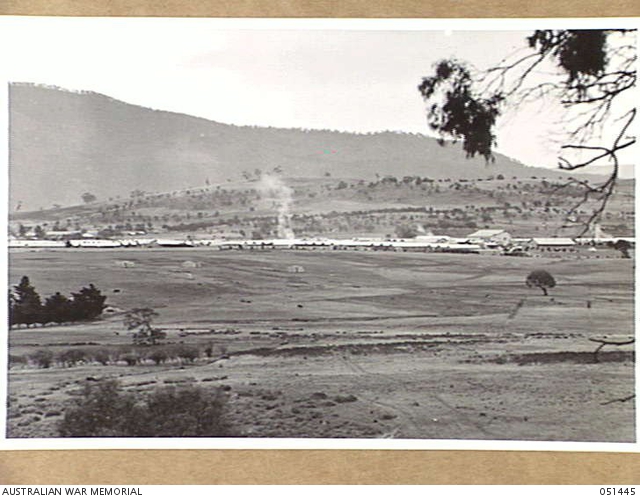
- 28 April 1943A wartime photograph recorded the military camp.
- 1944Italian prisoners of war began arriving at the camp.
- 1948The first postwar Ukrainian arrivals reached Tasmania.
- June 1949A Ukrainian group transferred from Bonegilla to Brighton’s government hostel.
- June 1950A magazine essay records 164 children living in the migrant hostel, with 15 births expected.
- 1951The camp was wound up; some of the Ukrainian residents moved to Melbourne.
- Early 1950sMilitary training again became the camp’s principal use.
- 1952Ukrainian parish centres were founded in Tasmania during the mission of Archpriest Hryhorii Fomichevskyi.
- 1955A Ukrainian Saturday school opened at Hobart with about twenty pupils.
- 1960The Hobart and Launceston communities were constituted as the Ukrainian Community of Tasmania.
- 1962The sports society Dnipro was founded at Hobart with about fifty members.
- 1967The camp was used as an emergency shelter during the Tasmanian bushfires.
- 1999The site accommodated refugees from Kosovo.
- 2011The Pontville Immigration Detention Centre operated nearby for six months; it was a separate facility.
- 2015A remembrance park was created on part of the former camp.
- March 2017BAC presented camp memories in the former hospital.
Sources for this section
- Australian War Memorial, Brighton place history
- Brighton Army Camp Hospital heritage assessment, in Council planning attachments 12 April 2023
- Australian War Memorial, Brighton Military Camp, 28 April 1943, accession 051445
- Brighton’s open hand
- Александер Гергель, Українські поселенці в Тасманії
- Yaroslav Bulka, Ukrainian community of Tasmania, in Ukrainians in Australia, 1966
- James Dryburgh, People and place
- Brigita Ozolins, BAC: Brighton Army Camp, 2017
A military post of long standing
Brighton was one of five sites chosen for Tasmanian townships by Governor Lachlan Macquarie in 1821, and a military post was established on the Hobart to Launceston road there in 1826. That began a military presence lasting more than 170 years. Troops were prepared at Brighton Camp for both world wars, and the camp as it stood in 1949 was a purpose-built training establishment put up at the start of the Second World War. The same ground had earlier held the first aerodrome in southern Tasmania, visited by Charles Kingsford Smith, who established an air base there for Australian National Airways, and it was from Brighton that the first airmail service from Australia to Britain departed.
Italian prisoners of war began arriving at the camp in 1944 and, by local accounts, were a familiar presence to Brighton residents, who talked to them through the fence. A number of them settled in the district after the war, and the camp then took in displaced people from Poland, Ukraine and Yugoslavia. The Ukrainian group that arrived in June 1949 belongs to that phase.
A camp with an earlier history
Brighton’s military camp had served as a training place during both world wars and housed prisoners of war during the later years of the Second World War. After the war, it accommodated refugees from Europe. A photograph taken on 28 April 1943 shows rows of buildings spread across the open landscape before the postwar migrant phase.
A magazine essay published in 2024 describes how the hostel phase began. A section of the camp became known as the Migrant Hostel, and the first group, 180 childless couples described as mostly displaced people from Poland, Germany, Czechoslovakia, Yugoslavia and the Baltic, arrived at Brighton railway station late one night and were trucked to the camp.
From Bonegilla to work across Tasmania
Bulka’s 1966 account recalls men being allocated work across Tasmania under their contracts. Some residents sought an organised Ukrainian community, but frequent arrivals, departures and the search for private housing made this difficult. His account describes about 35 families at one point, without giving a precise census date.
The hostel population changed as the scheme went on. The same essay records that more migrants, many with children, came between 1949 and 1951, and that in June 1950 there were 164 children living in the migrant hostel, with 15 births expected. The figures are given in a magazine essay rather than in an administrative return.
The Ukrainian group in Bulka’s account
| Stage | Recorded experience |
|---|---|
| June 1949 | Transfer from Bonegilla to the government hostel at Brighton |
| Initial arrivals | Single men first; couples and families followed |
| During the hostel period | Men allocated work across Tasmania |
| Undated point in the account | About 35 Ukrainian families |
Work contracts across the state
A memoir by Alexander Herhel, published by the Ukrainian Community of Tasmania in 2019, describes the same movement from the Ukrainian side. The first postwar arrivals reached Tasmania in 1948, and in June 1949 a group of Ukrainians was transferred from the transit camp at Bonegilla in Victoria to the camp at Brighton, which he places 35 kilometres from Hobart. Counting only those who stayed, 422 people of Ukrainian origin had come to Tasmania from 1948 onwards, of whom 61 per cent were men.
Herhel lists the work they were held to under their two-year government contracts: zinc, paper and textile works, fruit processing, and the building of roads, water mains and power stations. People settled across Tasmania, with the densest concentrations at Hobart and Launceston. That dispersal is the reason no Ukrainian organisation formed at Brighton itself.
Ukrainian arrivals in Tasmania as recorded by the community
| Measure | Figure |
|---|---|
| People of Ukrainian origin who came to Tasmania from 1948, excluding those who moved on | 422 |
| Proportion who were men | 61 per cent |
| Pupils at the Hobart Ukrainian Saturday school from 1955 | About 20 |
| Pupils at the Launceston school | About 10 on average |
| Members of the Dnipro sports society at its founding in 1962 | About 50 |
Sources for this section
Temporary housing and surviving buildings
The former hospital, entry gates, roads and open grounds survive as reminders of the larger military establishment. A heritage assessment recognises temporary housing at the site between 1947 and 1951 and its importance to Tasmania’s migrant community. From the early 1950s, military training again became the site’s principal use. The Ukrainian residents’ June 1949 arrival belongs within this brief postwar accommodation phase.
The site is not entered on the Tasmanian Heritage Register or the Brighton planning scheme, although the Tasmanian Heritage Council prepared a draft data sheet assessing it, and it was listed as an indicative place on the Register of the National Estate in 2001. Brighton Council, the present owner, commissioned a conservation management plan, and in January 2023 a heritage impact statement was prepared for a proposal to adapt the former hospital as an early learning centre and community hall. The statement records the camp’s role as housing for immigrants after the war, for Kosovar refugees in 1999 and as an emergency shelter during the bushfires of 1967.
The camp cleared in 1951
Herhel records that the camp was wound up in 1951 and that some of the Ukrainians then moved to Melbourne. The 2023 heritage assessment gives 1947 to 1951 as the site’s period of temporary housing, which agrees with him. From the early 1950s the camp returned to its military purpose, training the Citizens Military Forces and later the Army Reserve, a use that declined after 1993.
What the Brighton residents went on to build was made elsewhere. Ukrainian parish centres serving the faithful of both Australian eparchies were founded in 1952 during the mission of Archpriest Hryhorii Fomichevskyi. Communities formed at Hobart and Launceston in the middle of the 1950s and were constituted as the Ukrainian Community of Tasmania in 1960. A Saturday school opened at Hobart in 1955 with about twenty pupils, its first teacher Liusia Zhemaitis, later Matviienko, followed by A. Herhel in 1957, Petro Cherkaskyi in 1958, Vira Lukianenko in 1959 and 1960, Mariia Vus in 1961 and 1962 and Halyna Solovii in 1963. The Launceston school averaged about ten pupils and was taught by O. Skira and I. Skira.
The dance group Zaporozhets was started at Hobart by Viktor Shevchenko in the middle of 1950, with an accordion and a guitar, seven schoolgirls and three boys, and lasted more than twenty years. The sports society Dnipro was founded at Hobart in 1962 with about fifty members, fielding a league football side, a reserve side, two junior sides and a women’s volleyball team, and closed in January 1981 for want of funds. A branch of the Union of Ukrainian Combatants and a Plast group were also formed in the 1950s. None of these bodies was based at the camp; they are what the people who passed through it made afterwards.
Remembering many arrivals
In 1999 the camp was renovated and renamed the Tasmanian Safe Haven, the first place in Australia to receive people fleeing the Kosovo conflict; about five hundred arrived. They were free to come and go, and the district collected clothes, toys, bicycles and furniture for them. All had been returned by the end of that year. The camp was closed and sold soon afterwards, and a memorial park was made on part of the ground in 2015.
In 2017, artist Brigita Ozolins created BAC inside the old hospital: a replica hut, historical photographs and recorded voices brought together memories of military service, migration and refuge. Former European migrants were among the participants. The installation connected individual memories with a place that had housed successive generations arriving under very different circumstances.
Sources
- Yaroslav Bulka, Ukrainian community of Tasmania, in Ukrainians in Australia, 1966
Parent visually read both pages. Locators: {"printed_pages": [468, 469]}
- Brighton Army Camp Hospital heritage assessment, in Council planning attachments 12 April 2023
Parent visually checked assessment page 4/PDF 27. Other 97 page packet contents not fully reviewed. Locators: {"printed_page": 4, "pdf_page_one_based": 27}
- Australian War Memorial, Brighton place history
Full institutional place history read: military training, postwar European refugees, early-1950s return to training and accommodation for Kosovo refugees in 1999. Distinct phases retained.
- Australian War Memorial, Brighton Military Camp, 28 April 1943, accession 051445
Catalogue and original 640 pximage visually read. Explicit wartime date and public domain mark; illustrates predecessor camp, not migrant occupation.
- Brigita Ozolins, BAC: Brighton Army Camp, 2017
Artist’s original project description read: 2017 installation in the former hospital, replica hut, 40 images and 12 voices. The modern replica is not an original migrant hut.
- Александер Гергель, Українські поселенці в Тасманії
Ekspedytsiia XXI, published at the request of the editors by a veteran of the Ukrainian Community of Tasmania · 14 December 2019
Full Ukrainian-language memoir read. Supplies the June 1949 transfer from Bonegilla to Brighton, the winding up of the camp in 1951 and the move of some residents to Melbourne, the figure of 422 people of Ukrainian origin arriving in Tasmania from 1948 of whom 61 per cent were men, the contract industries, and the later organisations, schools, dance group and sports society at Hobart and Launceston. A community memoir, not an administrative return.
- Brighton’s open hand
Tasmanian Times, reprinted from Island 130 with permission · October 2012
Full essay read. Italian prisoners of war from 1944 and their settlement in the district; displaced people from Poland, Ukraine and Yugoslavia at the old army camp afterwards; the Tasmanian Safe Haven of 1999 and about five hundred Kosovars; the separate Pontville Immigration Detention Centre of 2011 and 2012, which the essay says operated for six months: “Not only did TASS go on to facilitate around 100 community visits a week during the six months the centre was in operation”.
- More displaced persons coming
Advocate (Burnie, Tasmania), page 11 · 13 July 1949
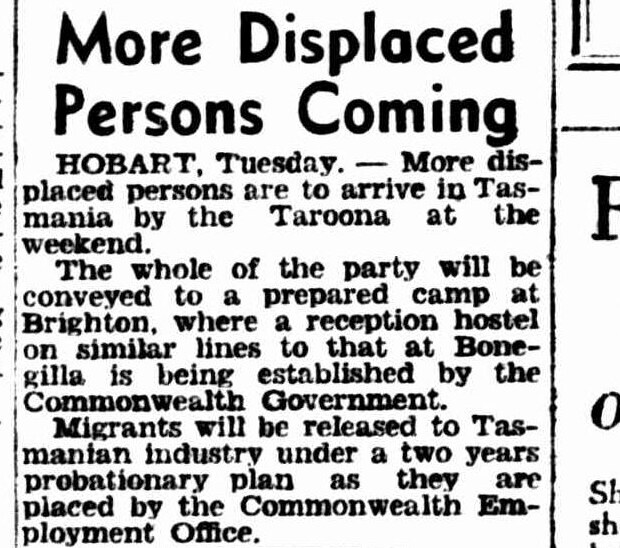
Hobart report that more displaced persons were to arrive in Tasmania by the Taroona at the weekend, that the whole party would be taken to a prepared camp at Brighton where a reception hostel on similar lines to that at Bonegilla was being established by the Commonwealth Government, and that the migrants would be released to Tasmanian industry under a two-year probationary plan as they were placed by the Commonwealth Employment Office. Digitised by the National Library of Australia; Australian material published before 1955 is out of copyright.
- James Dryburgh, People and place
Forty South, first published in issue 80 of the print magazine · 21 December 2024
Web page read from the section beginning ‘Tasmanian Premier Robert Cosgrove wrote to Prime Minister Robert Menzies in 1948’: the naming of a section of the camp as the Migrant Hostel, the first group of 180 childless couples, and the count of 164 children and 15 expected births in June 1950.
Last researched 13 September 2026