Brooklyn
Arrival and settlement
Melbourne · Victoria · Australia · 1949–1968
Seventeen wool stores and a line of Nissen huts on Melbourne’s industrial western edge were turned into family accommodation in 1949. Ukrainian residents were among the thousands who lived there until an inspection closed the hostel in 1967.
Introduction
Brooklyn migrant hostel occupied a large site around Francis Street and Millers Road in Melbourne’s west. It opened in 1949, using wool stores and later military huts as temporary housing. Although predominantly associated with British migration, the Ukrainian community’s 1966 history names Brooklyn among the Melbourne hostels where substantial groups of Ukrainians lived.
A history in dates
- 1926 onwardsWool stores and industry occupy the flat ground between Footscray and Altona.
- 1949The hostel opens in former wool stores.
- By about 1951Thirteen former wool stores and eight Nissen huts are in use.
- 1953Brooklyn State School opens beside the hostel area.
- Early 1960sAnnunciation School expands Catholic education for local and hostel children.
- June 1962Fire destroys the kitchen and dining block.
- May 1967The Minister of Labour inspects the hostel and orders it closed.
- By February 1968The last 300 residents transfer to other hostels, according to the local historical society.
- Late 1970sConstruction of the West Gate Freeway is followed by redevelopment of the site as an industrial estate.
- 2006The Hobsons Bay Heritage Study documents one surviving Nissen hut and two former wool stores.
A wool-storage yard becomes a hostel
Before the hostel the site was a commercial wool-storage yard on the flat, industrial ground between Footscray and Altona. The municipal heritage citation, later summarised in the Victorian Heritage Database, describes three rows of wool stores, seventeen in all, which the hostel took over, together with Nissen or Quonset huts and possibly army ‘N’ or ‘P’ huts. The record dates the hostel to 1949 and associates it with the Commonwealth Government, the authority that ran Australia’s hostel network.
The Altona Laverton Historical Society places the opening in 1949 on the south-eastern side of Millers Road, south of Francis Street, and records that within two years the hostel comprised thirteen former wool stores and eight Nissen huts. Aerial photographs cited in the heritage record suggest the Nissen huts were erected after 1951, so the earliest residents lived in the converted stores alone.
Buildings recorded at the hostel site
| Building type | Recorded detail | Source scope |
|---|---|---|
| Wool stores | Three rows, seventeen in all, taken over by the hostel | Municipal heritage citation; not a count of occupied stores at one date |
| Wool stores in use | Thirteen former wool stores within two years of opening | Local historical society, describing the position by about 1951 |
| Nissen huts in use | Eight Nissen huts within two years of opening | Local historical society |
| Nissen huts, date | Erected after 1951; all but gone by 1982 | Heritage citation, read from aerial photographs |
| Rooms per wool store | About 100 small rooms, unheated and unlined | Local historical society description, not a capacity return |
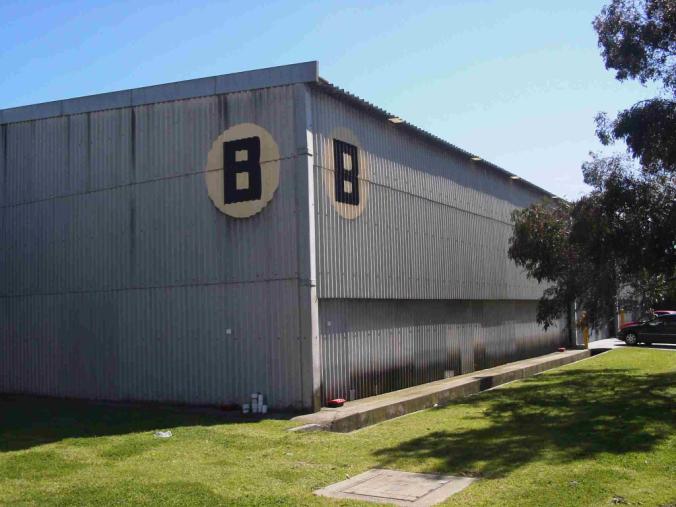
| Surviving fabric | One Nissen hut and two gabled stores, numbers 84 and 85 | Condition recorded in the 2006 heritage study |
Living in converted wool stores
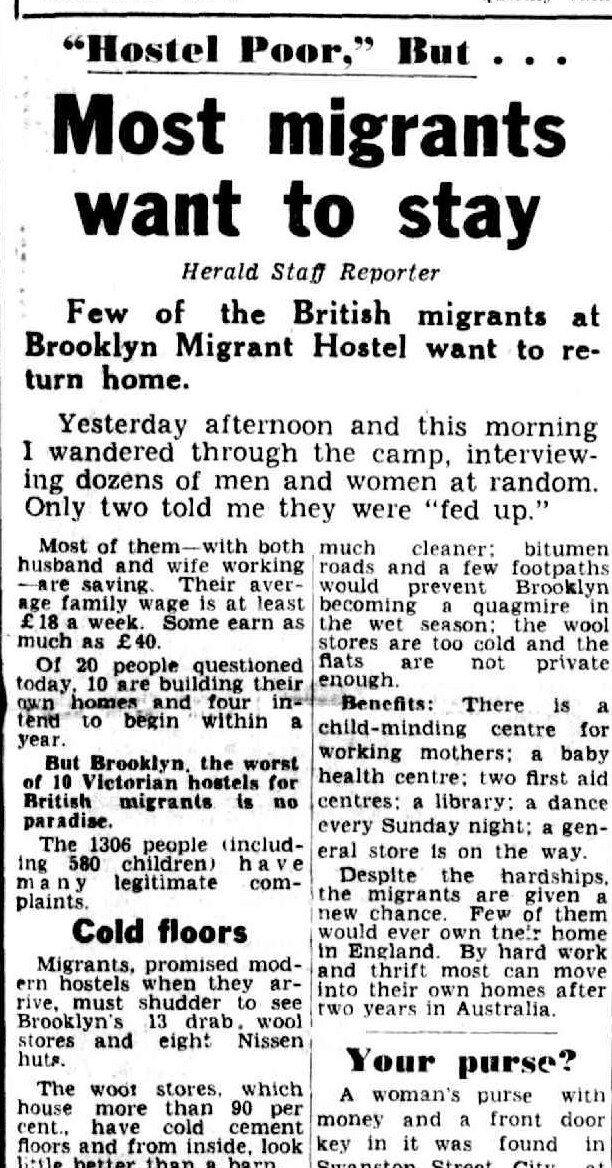
Accommodation varied sharply. Wool stores were partitioned into small rooms, while Nissen huts offered flats of several rooms. The main stores lacked insulation and heating; communal arrangements left families with little privacy.
The historical society is more specific about the difference. The Nissen huts were divided into two, three and four-roomed flats and were considered better than the stores, where about nine in ten residents lived. Each store held about a hundred small rooms, unheated and unlined, in buildings that looked, in the society’s phrase, little better than a barn.
A 1956 application preserved by Museums Victoria records one British family’s transfer from processing at the Royal Exhibition Building to Brooklyn. They had travelled under assisted passage arrangements. Their recollection contrasts the welcome they received with the very different Australia they encountered after reading promotional material in England.
Sources for this section
Food, care and schooling
A crèche, baby-health service, first-aid centres, library and general store supported daily life. A fire destroyed the kitchen and dining block in June 1962. Meals then moved into a youth building while a garage became a temporary kitchen.
Brooklyn State School opened nearby in 1953. Catholic education expanded too: Annunciation School was established in the early 1960s partly to serve the hostel. Its early accommodation included up to six classrooms for as many as 200 pupils. These were neighbourhood schools responding to migrant families, rather than measures of the hostel population.
Services supporting hostel families
| Need | Provision |
|---|---|
| Young children | Crèche and baby-health centre |
| Health | Two first-aid centres |
| Everyday supplies | General store |
| Reading | Library |
| State education | Brooklyn State School, opened 1953 |
| Catholic education | Annunciation School, early 1960s |
Sources for this section
Ukrainians in the working hostel network
The 1966 Ukrainian account describes how employment contracts dispersed new arrivals from reception camps. Workers often lived in relatively basic hostels, while mothers and children could be sent to family camps. It identifies Brooklyn alongside Broadmeadows, Maribyrnong, Williamstown and Watsonia as important Melbourne concentrations of Ukrainian residents.
This placement connects Brooklyn to the transition from arrival to paid work and settled neighbourhoods. Its residents were living in an Australian workers’ and family hostel, following the earlier European stages of displacement. No source consulted gives a Ukrainian count for Brooklyn, and none names Ukrainian residents there.
Sources for this section
Building a way out
Some British residents organised a housing cooperative. Around a hundred hostel families formed an association, acquired land at Seaholme and made timber house frames in a Brooklyn wool shed. The frames were assembled on individual plots, and completed homes allocated by ballot. The municipal heritage study records approximately 45–50 houses built through the scheme.
Sources for this section
Closure and the industrial landscape
After a ministerial inspection in May 1967, poor conditions and surrounding industrial development led to a closure order. The historical society records that the Minister of Labour ordered the closure on the grounds of substandard accommodation and an unsuitable location inside a developing industrial estate, and that the last 300 residents transferred to other Melbourne hostels by February 1968.
Later redevelopment removed much of the hostel landscape. Building the West Gate Freeway in the late 1970s was followed by the industrial estate that stands there now, and the society records no surviving hostel buildings and no interpretive signage at the site.
The heritage record is slightly less absolute. It notes that most timber-framed wool stores had gone by the mid 1990s, but that one corrugated-iron Nissen hut survives in the north-east of the Brooklyn Estate at 431 Francis Street, that two of the old gabled stores, numbers 84 and 85, survive reclad in cement sheet, and that another Nissen hut is said to have been moved to Pier Street, Altona, for a tyre business. The council graded the surviving group of local significance but did not recommend it for the heritage overlay.
Sources
- Hobsons Bay Heritage Study, amended 2014: Brooklyn Migrant Hostel
Hobsons Bay City Council · Undated
Four-page citation, report pages 391–394/PDF 187–190 read. Source distinguishes wool stores, huts and cooperative. Its broad 1949–1970 date differs from more precise family-transfer chronology; no exact final administrative closure asserted.
- Ukrainians in Australia, volume 1
Ukrainian community, Melbourne, 1966 · Undated
Printed page 83 original scan visually read: Brooklyn named as Ukrainian concentration, within explanation of worker/family camp dispersal.
- Migrants: Brooklyn Migrant Hostel
Altona Laverton Historical Society · Undated
Brooklyn subsection read; not confused with adjacent Wiltona/Altona history or its images.
- Application for Board and Lodging, 20 June 1956
Museums Victoria · Undated
Item SH980532 catalogue and family migration context read; names omitted.
- Annunciation School, Brooklyn: History
Melbourne Archdiocese Catholic Schools · Undated
School’s institutional history ties establishment and six-classroom accommodation directly to hostel families.
- Brooklyn Migrant Hostel (Former), Victorian Heritage Database place 15063
Victorian Heritage Database / Hobsons Bay City · Hobsons Bay Heritage Study, 2006
Full record read 13 September 2026: statement of significance, physical description, integrity and record details. Gives 431 Francis Street, operation 1949–70, seventeen wool stores in three rows, Nissen huts erected after 1951 and gone by 1982, surviving hut and stores 84 and 85, association with the Commonwealth Government, and level of significance “Not Recommended”. The record’s broad 1949–70 range is an outside span and does not displace the more precise closure chronology in source 3. The same record distinguishes Brooklyn from the Wiltona complex.
- “Hostel Poor,” But… Most migrants want to stay
The Herald (Melbourne), page 3 · 7 July 1951
A Herald staff reporter’s account of two days spent walking through Brooklyn Migrant Hostel interviewing residents. It gives the hostel’s population as 1,306 people including 580 children, describes thirteen drab wool stores and eight Nissen huts, records that the wool stores housed more than ninety per cent of residents and had cold cement floors, and lists the child-minding centre, baby health centre, two first-aid centres, library, Sunday dance and general store. Digitised by the National Library of Australia; Australian material published before 1955 is out of copyright.
Last researched 13 September 2026