Brucker Lager
Displacement in Europe
Bruckneudorf · Austria · 1945
A permanent military training camp of 1867 became Soviet collection and transit point No. 198 in April 1945. A Lower Austrian security report of 20 August 1945 records the departure of Ukrainian Ostarbeiter from the camp.
Introduction
Brucker Lager at Bruckneudorf served as Soviet collection and transit point No. 198 after the Red Army’s arrival in April 1945. Former forced labourers from the east were assembled here for repatriation. A Lower Austrian security report dated 20 August explicitly records the departure of Ukrainian Ostarbeiter from “Lager Bruck a/L.” This identifies a Ukrainian presence at a specific transit institution.
The camp is documented as a Sammellager and Repatriierungslager run by the Soviet occupying power, in the district of Neusiedl am See in Burgenland, from shortly after 6 April 1945. Its recorded end date, 28 August 1955, belongs to the Soviet military occupation of the training area rather than to the movement of displaced people, which was over within months.
Sources for this section
A history in dates
- 20 April 1866Franz Joseph I approves a permanent troop camp at Bruck.
- 8 January 1867The Brucker Lager is occupied; Bruckneudorf is founded the same year.
- 1873A new cavalry camp allows 10,000 men and 2,300 horses on the site.
- From 1938The Wehrmacht extends the training area to 130 square kilometres and raises capacity to 30,000 men.
- 29 March 1945The separate South-East Wall camps at Bruck are evacuated.
- April 1945Soviet forces take over the training area; the Brucker Lager becomes collection and transit point No. 198.
- 20 July 1945NKVD correspondence addresses the screening and filtration commission at transit point No. 198.
- 18–20 August 1945The final repatriation transports leave; a security report of 20 August records Ukrainian Ostarbeiter departing.
- 1946The properties are declared German assets and pass into USIA administration.
- 28 August 1955Soviet military use ends.
- 1956–1957An Austrian training area command is formed and exercises resume.
- June 1967The tank barracks is renamed the Benedek-Kaserne at the camp’s centenary.
Which Bruck?
The camp belonged to the Bruckneudorf military training area beside Bruck an der Leitha. It was separate from the Kaisersteinbruch camp within the same broader training complex, and separate again from Bruck an der Mur in Styria, which lay in the British zone. The archive’s abbreviated place-name therefore refers to this eastern Austrian site.
The distinction matters because Kaisersteinbruch had its own numbered functions in the same months. It appears as repatriation camp 285 for former prisoners of war and forced labourers, and as camp 306 for internees described as state criminals, who were taken away at the beginning of May 1946. Numbers, dates and populations from one camp cannot be carried across to the other.
Sources for this section
The camp before 1945
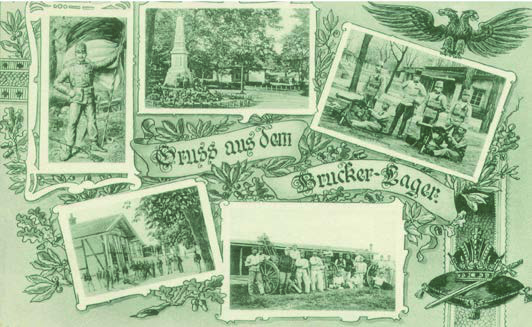
Emperor Franz Joseph I approved a permanent troop camp on 20 April 1866, and the so-called Brucker Lager was occupied on 8 January 1867. The new municipality of Bruckneudorf, Királyhida in Hungarian, was founded south of the Leitha in the same year with financial help from the town of Bruck an der Leitha. A new cavalry camp of 1873 allowed up to 10,000 men and 2,300 horses to be accommodated at once.
During the First World War the camp was enlarged again to hold up to 26,000 men, and the camp at Kaisersteinbruch was built in the same period. In 1935 construction of a tank barracks began within the Brucker Lager for the first Austrian armoured car battalion. These are military strengths, not displaced-person populations.
From 1938 the German Wehrmacht took over the training area, extended the exercise ground to 130 square kilometres and raised the accommodation capacity to 30,000 men. That inheritance of large, serviceable quarters explains how a whole transit population could be gathered on the site within weeks of the fighting ending.
Recorded accommodation capacity of the military camp
| Period | Recorded capacity |
|---|---|
| From 1873, with the new cavalry camp | 10,000 men and 2,300 horses |
| First World War | up to 26,000 men |
| From 1938, under the Wehrmacht | 30,000 men |
Sources for this section
Collection and transit point No. 198
After the Red Army took over the installations in April 1945 it began assembling former forced labourers from the east in the Brucker Lager. The camp was designated a collection and transit point for the reception of Soviet citizens. Correspondence of the NKVD troops guarding the rear areas of the Central Army Group, dated 20 July 1945, addresses the chairman of the NKVD screening and filtration commission at “Collection and Transit Point No. 198 Bruck (East)”, so the camp was a filtration site as well as a staging post.
How many people passed through is not settled. The archival reconstruction gives 6,000 from the Lower Austrian State Archive, 16,000 from the Burgenland State Archive and about 18,800 from the State Archive of the Russian Federation, and flags the source position as uncertain. None of these is a Ukrainian count; the Ukrainian evidence for this camp is the fact of the departure recorded in the security report, not a number.
The last transports of several thousand people left on 18 and 20 August 1945, after which no former forced labourers remained in the camp. The transit function therefore lasted about four and a half months.
Numbers reported in the archival reconstruction
| Archive cited | Reported number |
|---|---|
| Lower Austrian State Archive (NÖLA) | 6,000 |
| Burgenland State Archive (BLA) | 16,000 |
| State Archive of the Russian Federation (GARF) | 18,800 |
Sources for this section
Other camps at Bruck in the preceding months
The name Brucker Lager should not absorb the separate camps of the winter before. From autumn 1944 the Gau Niederdonau put 8,000 to 10,000 people to work on the South-East Wall fortifications at Bruck, among them 3,000 prisoners of war from Kaisersteinbruch. In October 1944 about 1,500 to 2,000 Hungarian Jews were quartered in barns in the town, and one of the Bruck camps stood at the Heidehof in Bruckneudorf municipality. Those camps were evacuated on 29 March 1945 and their dead are buried in a mass grave at the town cemetery, whose stone records 155 victims.
That forced-labour complex ended a week before the Soviet transit point began. The two must be kept apart in any record search, because both are catalogued under the place-name Bruck.
Sources for this section
After the repatriation phase
The Red Army continued to use the training area, including the Brucker Lager, until 28 August 1955. The properties were declared German assets in 1946 and passed into USIA administration, the Soviet-run enterprise administration in eastern Austria.
A training area command for Bruckneudorf and Kaisersteinbruch was set up in 1956 and exercises resumed at the beginning of 1957. The ground was reduced from its wartime extent to 41.3 square kilometres. Troops of the new Austrian federal army moved back into the tank barracks on 13 March 1956, and in June 1967 the barracks was renamed the Benedek-Kaserne at the camp’s centenary. The site’s military history is much longer than its brief role in the movement of displaced people during 1945.
Sources for this section
Sources
- TÜPL Bruckneudorf I: Brucker Lager
Ludwig Boltzmann Institute for Research on Consequences of War, Encampment project
Institutional archival reconstruction checked. Cites NÖLA report Zl. 827/3 of 20 August 1945 explicitly describing transport of Ukrainian Ostarbeiter from Lager Bruck a/L.; also BLA municipal records and GARF correspondence. Distinguishes Bruck from Kaisersteinbruch.
- Truppenübungsplatz Bruckneudorf
Austrian Armed Forces, Denkmal Heer
Official institutional history: establishment in 1867, successive camp and training-ground designations, military expansion and postwar reuse. Military capacity figures are not treated as displaced-person population.
- Aus dem Stadtarchiv: Brucker Lager
Stadtgemeinde Bruck an der Leitha, Amtliche Nachrichten, 2015
Original municipal bulletin, printed page 21, reproduces a historical Brucker Lager postcard while inviting material for the camp’s 150-year history. Exact postcard date is not supplied.
- TÜPL Bruckneudorf II: Kaisersteinbruch
Ludwig Boltzmann Institute for Research on Consequences of War, Encampment project
Second entry on the same institutional camp map, read in full. Used only to keep Kaisersteinbruch distinct from the Brucker Lager and for the 1938 enlargement of the training area.
- Benedek-Kaserne
Austrian Armed Forces, Denkmal Heer
Official property history: imperial approval of 1866, occupation in January 1867, the 1873 cavalry camp, First World War and Wehrmacht capacities, the 1956–1957 Austrian reconstruction and the 1967 renaming. Capacity figures are military strengths.
- Bruckneudorf
REFUGIUS / Forschen & Erinnern Burgenland
Regional research page on the South-East Wall camps at Bruck an der Leitha and the Heidehof camp in Bruckneudorf, 1944–1945. Cited only to distinguish those camps from the 1945 Soviet transit point.
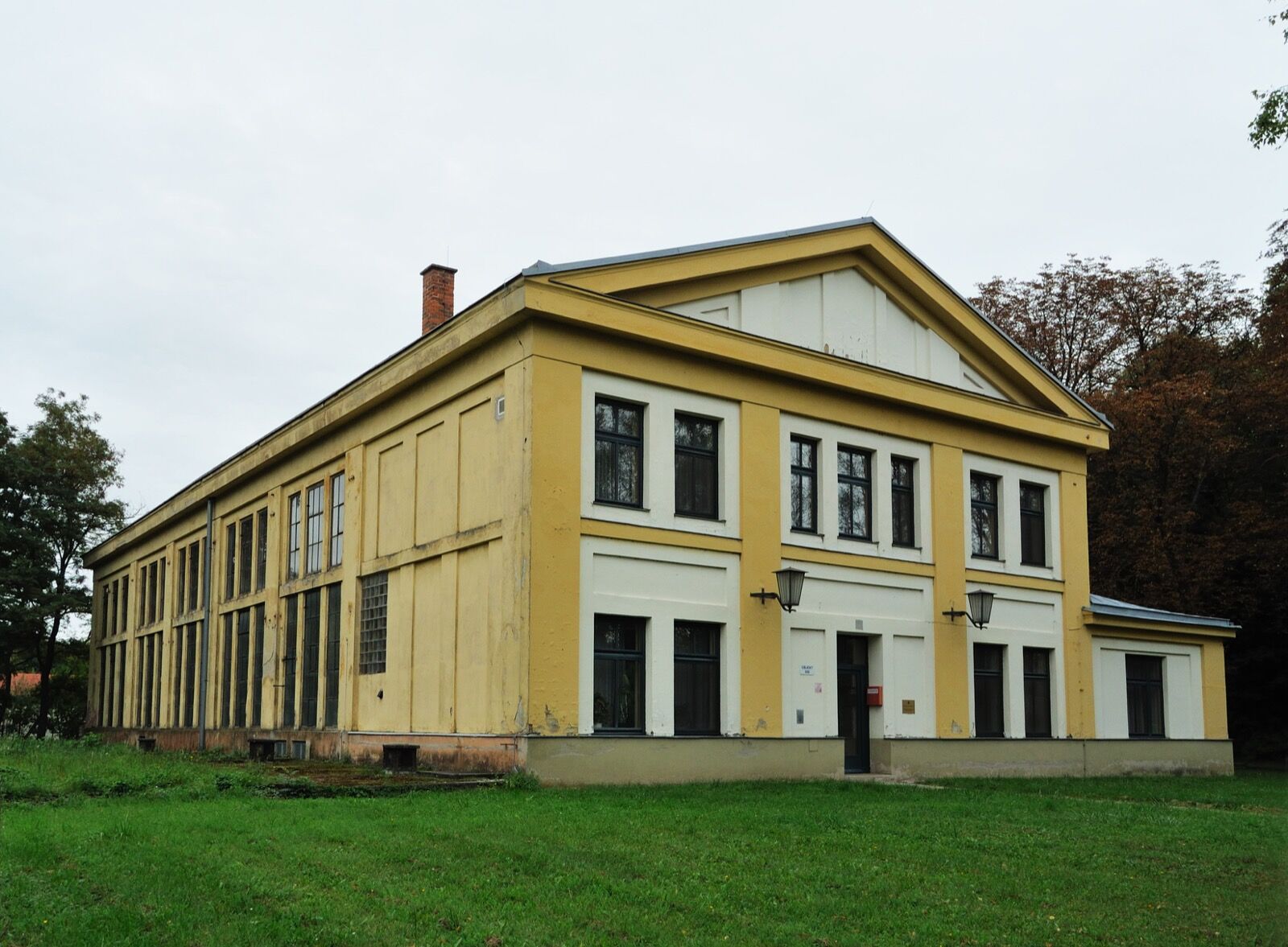
- Administration building of the Benedek-Kaserne, Bruckneudorf
Robert Heilinger, via Wikimedia Commons · 23 September 2012
Photograph licensed CC BY-SA 3.0, uploaded for Wiki Loves Monuments 2012. Shows a listed building of the barracks within the Brucker Lager, renamed the Benedek-Kaserne at the camp’s centenary in June 1967.
Last researched 13 September 2026