Buckenberg-Kaserne
Displacement in Europe
Pforzheim · Germany · 1945–1950/1951
A Ukrainian camp opened in the former Buckenberg infantry barracks at Pforzheim on 20 August 1947, after Polish residents and American troops had used the site. A visiting Ukrainian correspondent found six blocks around a square, two parishes, a school, a theatre in a garage and a Plast troop of sixty.
Introduction
Buckenberg-Kaserne housed a substantial Ukrainian displaced-persons community in postwar Pforzheim. Local research dates the camp’s establishment to December 1945, under UNRRA, and describes an initial Polish group followed by a large Ukrainian community from 1947. The archival inventory records the facility under the spelling Buchenberg-Kaserne and gives it the assembly-centre codes 693 A and 691 A.
A history in dates
- 1936The barracks are built to plans by Karl Kölmel and an infantry battalion moves in that October.
- December 1945Local research dates the establishment of the UNRRA camp.
- January to mid-1946About 1,700 people deported from Poland are described as living at the barracks.
- 20 August 1947A Ukrainian camp is opened at the barracks, numbered 693a.
- September 1947A visiting correspondent describes six blocks, two parishes, a school, a theatre and a Plast troop of sixty.
- December 1947A zone-wide return records 982 Ukrainians at Pforzheim.
- 21 November 1948The camp commemorates the dead of Bazar on its square.
- 1950–1951The archival inventory places camp closure within this interval.
- 1951–1996French forces occupy the barracks as Quartier Burnol.
- 2007Most barracks buildings are demolished; architectural sculptures are salvaged.
- July 2025The city archive presents new research into the surviving sculptures.
Sources for this section
- ZwangsarbeiterInnen im Raum Pforzheim 1940 bis 1945
- Buckenbergkaserne
- Nedilia: Ukrainian independent weekly, Aschaffenburg
- The Refugee Experience: Ukrainian Displaced Persons after World War II
- DP camp inventory: Pforzheim, Buchenberg-Kaserne
- Buckenberg-Kaserne
- Kunst oder Propaganda? Relikte der NS-Zeit aus der Buckenbergkaserne
The former infantry barracks
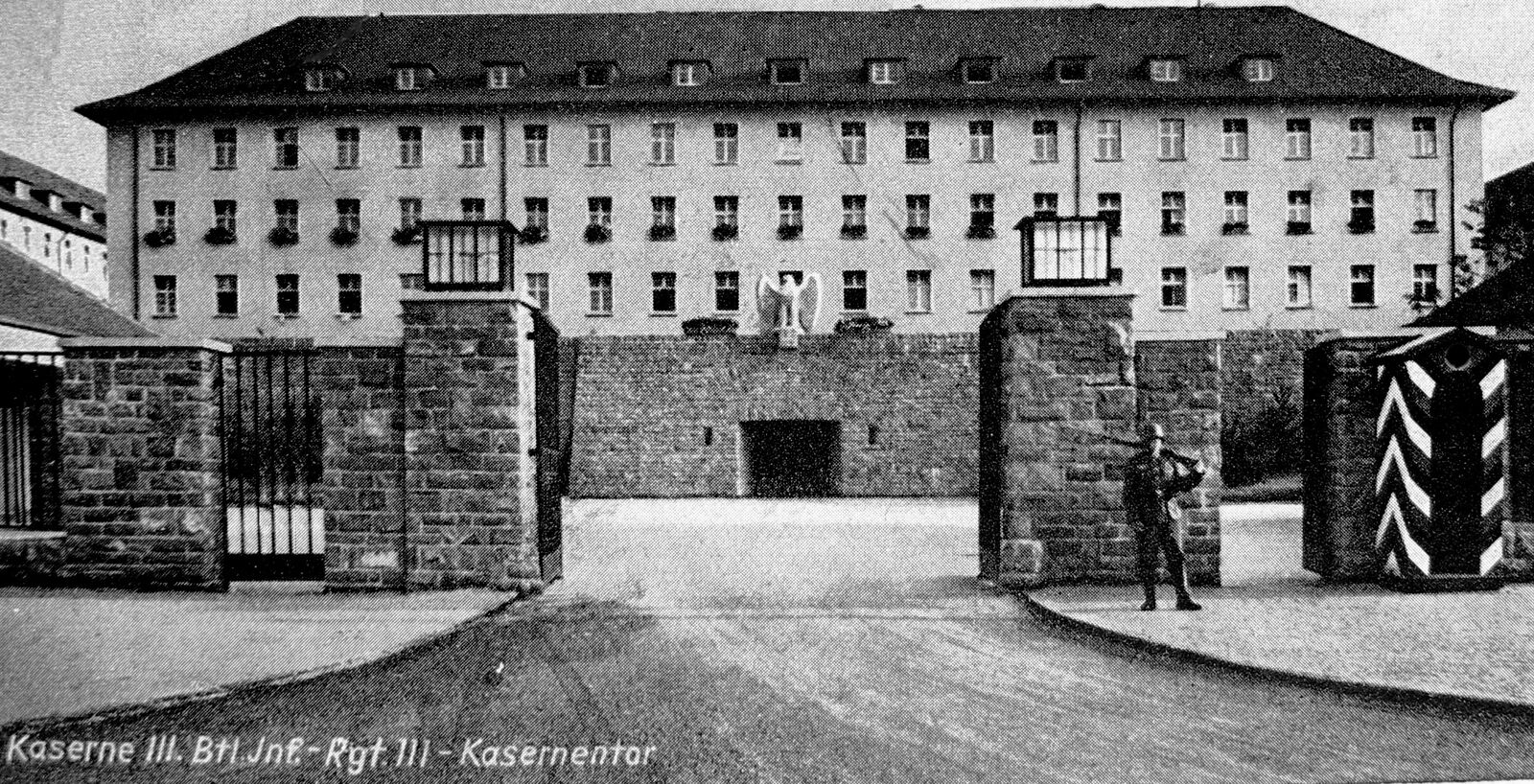
The barracks were built in 1936 to plans by Karl Kölmel, head of the Karlsruhe district building office, and German troops moved in that October when the third battalion of Infantry Regiment 111 took occupation. The complex covered more than eighteen hectares, with its main entrance at the junction of Strietweg and the road later named Straße des 3. Husarenregiments. The surviving postcard shows the gate and a large accommodation block during the military period, before displaced families arrived.
A local compilation of documents on the air raids of 1944 and 1945 records that the light home flak batteries 29/VII and 35/VII were quartered in the Buckenberg barracks, and that the guns of such units, being light flak, could do nothing against high-flying heavy bombers.
A Ukrainian camp from August 1947
A correspondent of the Aschaffenburg Ukrainian weekly Nedilia walked out to the barracks in September 1947 and described a camp only weeks old. One more Ukrainian camp, he wrote, was born on 20 August that year, its people gathered from various Polish camps. He gives its number as 693a, the same assembly-centre code that the archival inventory records, and notes that Poles had been there before the Ukrainians and American soldiers after them.
His description is of six large blocks set around a central square, enclosed by iron railings, little damaged by the war and clean inside, at some distance from a city centre still in ruins. He puts 1,200 Ukrainians there, part of a group moved on from the Karlsruhe camp as that was turned into a transit camp for France. The left edge of the scanned column is cropped, so the sentence carrying the figure is incomplete, though the number itself is legible.
Schools, churches and clubs
The same report lists what the camp had put together within a month: an elementary school and a kindergarten, a Greek Catholic parish under Father Chopei and an Orthodox parish under Father Vurko, both already at work, and a theatre fitted out with much labour in a garage. A board beside the square, marked with the name of the sports club Zoria, carried the next football fixtures. The camp’s Plast troop had sixty members, and the co-operative sold apples, beer, books and newspapers.
The correspondent balanced the good air, the quiet and the space against the drawbacks: no way of earning, distance from any centre, and the camp’s own quarrels. He also noted that the camp police watched his newspaper seller, who nevertheless sold his whole bundle.
What the camp had by September 1947
| Institution | Detail |
|---|---|
| Elementary school and kindergarten | Both reported as working |
| Greek Catholic parish | Parish priest Father Chopei |
| Orthodox parish | Parish priest Father Vurko |
| Theatre | Fitted out in a garage |
| Sports club Zoria | Fixtures posted on a board by the square |
| Plast troop | Sixty members |
| Co-operative | Apples, beer, books and newspapers |
Sources for this section
Commemoration on the camp square
By the autumn of 1948 the camp had a public life of its own. On Sunday 21 November 1948 it commemorated the 359 soldiers of the Ukrainian People’s Republic shot near the town of Bazar in Volhynia on that date in 1921. A symbolic cossack burial mound had been raised in the middle of the camp square, carrying a metre-high white cross that was lit by torches from the Saturday evening.
A solemn liturgy was celebrated in both of the camp’s churches, and at four in the afternoon detachments of veterans, young people and the camp police drew up in front of the mound with their flags and the banners of the youth association, followed by the camp school and the processions of both churches. A memorial service was begun by Father Kanda, the Orthodox parish choir sang under Father Zaiats, and the rector of the Orthodox church, Protopresbyter Umanets, proclaimed the eternal memory. General Sadovsky spoke, and the camp choir and reciters gave the concert that followed.
The same issue reports a lecture in the camp’s youth-association clubroom by Colonel General Mykhailo Omelianovych-Pavlenko on the Ukrainian-Polish war of 1918 and 1919, given to an audience of veterans and young people. Neither report names the barracks, so the identification with Buckenberg rests on this being the Ukrainian camp of Pforzheim in the archival record.
Different communities at different dates
The 2023 study describes approximately 1,700 people deported from Poland living here from January to mid-1946, followed by about 1,500 displaced people of Ukrainian origin from 1947. The authors distinguish these postwar arrivals from people forced to work in Pforzheim during the war. Their research therefore does not support treating every DP resident as a former local forced labourer.
The zone-wide table of Ukrainians in American-zone camps gives a Pforzheim row of 1,127 for the questionnaire collection of 1946 and 1947, only 9 in the UNRRA return of August 1946, nothing in May 1947 and 982 in the PCIRO return of December 1947. The pattern matches a camp that became Ukrainian only in the second half of 1947, but the row carries the town name alone and names no barracks.
Population estimates and recorded capacity
| Date | Figure | Meaning |
|---|---|---|
| January–mid-1946 | Approximately 1,700 | Polish residents described in local research |
| 1946–1947 questionnaires | 1,127 | Ukrainians recorded for Pforzheim in the zone-wide table |
| August 1946 | 9 | Ukrainians recorded for Pforzheim in the UNRRA return |
| September 1947 | 1,200 | Ukrainians at the Buckenberg camp in a correspondent’s report |
| December 1947 | 982 | Ukrainians recorded for Pforzheim in the PCIRO return |
| From 1947 | Approximately 1,500 | Ukrainian residents described in local research |
| 31 October 1947 | 1,250 | Administrative accommodation capacity |
The camp in administrative records
The inventory gives capacity of 1,250 on 31 October 1947 and associates the camp with UNRRA Team 520, assembly-centre codes 693 A and 691 A, and later BN 204. This capacity is a different measure from the historical population estimates. The referenced city-archive files cover official correspondence and DP accommodation, while the Arolsen references include lists and changes in Pforzheim’s camp population.
Sources for this section
Later military use and surviving traces
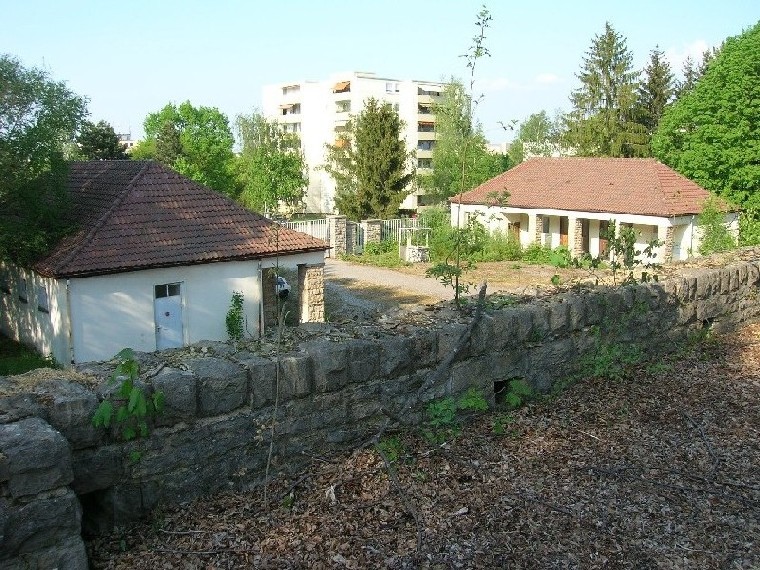
The camp’s administrative closure falls between September 1950 and March 1951. French forces then used the barracks as Quartier Burnol from 1951 until 1996, the 3rd Hussar Regiment being stationed there from 1963. Most buildings were demolished in the summer of 2007, though the armoury, two entrance buildings and the former officers’ quarters survive in new uses.
Monumental stone sculptures were salvaged and stored; new archive-based research about their origins and political meaning was presented by the city archive in July 2025. These surviving objects belong to the barracks’ earlier military architecture.
A United States Army veterans’ website publishes contributors’ accounts of a later military use. One describes Buckenberg Kaserne as an old Wehrmacht barracks occupied by French forces after the war, a section of which eventually housed Battery D of the 3rd Battalion, 71st Air Defense Artillery, and states that it is not clear when that began. Another, who served there between 1981 and 1985, placed the administrative building on the west side of a barracks under French control since the end of the war and reported that the American portion was afterwards torn down. The site publishes recollections sent in by former soldiers rather than official records.
Sources
- ZwangsarbeiterInnen im Raum Pforzheim 1940 bis 1945
Brigitte and Gerhard Brändle, Jürgen Schroth; DGB, 2023
Printed pages 5 and 24: October 1936 military occupation; December 1945 camp establishment and changing Polish/Ukrainian population. Original PDF read.
- Buckenberg-Kaserne
PFENZ regional history wiki
Site location, extent, later French military use and demolition; distinguishes the later Wartberg barracks.
- Kunst oder Propaganda? Relikte der NS-Zeit aus der Buckenbergkaserne
City of Pforzheim, 2025
Municipal account of archival research presented in July 2025 and surviving sculptures from the 1936 barracks.
- DP camp inventory: Pforzheim, Buchenberg-Kaserne
Arolsen Archives
Record 1369: spelling variant, Ukrainian presence, capacity 1,250, Team 520 and closure interval 1950–1951.
- Buckenberg barracks postcard, postally used in 1941
PFENZ image collection
Original postcard reproduction inspected; source describes postal use in 1941, edits by R. Cölsch and Henriette, and presumed public-domain status.
- The Refugee Experience: Ukrainian Displaced Persons after World War II
Canadian Institute of Ukrainian Studies Press · 1992
Ihor Stebelsky chapter, table 7, printed pp. 47–51; Pforzheim row read against the column x-positions: 1,127 (1946–1947 questionnaires), 9 (August 1946), blank (May 1947), 982 (December 1947). Town row, no barracks named.
- Nedilia: Ukrainian independent weekly, Aschaffenburg
Ukrainian Museum-Archives of Cleveland / United States Holocaust Memorial Museum · 1947–1948
Digitised run, CC BY-NC-ND 4.0. Two reports from Pforzheim by the correspondent Anatol Kurdydyk: the issue of 28 September 1947, p. 5, on the new camp at the Buckenberg barracks, camp number 693a; and no. 155, 26 December 1948, on the commemoration of 21 November 1948 and a lecture in the youth-association clubroom. The left edge of the 1947 column is cropped in the scan.
- Buckenbergkaserne
German Wikipedia · Accessed September 2026
Used for the architect Karl Kölmel, the first occupation in October 1936 by the third battalion of Infantry Regiment 111, French use as Quartier Burnol 1951–1996, the demolition of summer 2007 and the surviving buildings. Cross-checked against the PFENZ wiki and the municipal press release.
- Guard building and transformer station, former Buckenberg barracks
Wikimedia Commons · April 2007
Public domain, released by the photographer, who is credited on the file page under a user name recorded in the provenance file for this page. Taken inside the perimeter wall of the former barracks in the months before demolition.
- Luftangriffe auf Pforzheim 1944–45
fgut.wordpress.com (Zeitdokumente) · Accessed 14 September 2026
Section “Angriffsziel Bahnhof” read: the light home flak batteries 29/VII and 35/VII were quartered in the Buckenberg-Kaserne and were equipped only with light anti-aircraft guns whose range could not reach high-flying heavy bombers. A self-published compilation of documents; the underlying imagery it credits was not inspected.
- USAREUR Units: 94th ADA Brigade
usarmygermany.com (Walter Elkins) · Accessed 14 September 2026
Subsection on D Battery, 3rd Battalion, 71st Air Defense Artillery read: a contributor describes Buckenberg Kaserne as an old Wehrmacht barracks occupied by French forces after the war, a section of which eventually housed the battery, adding that it is not clear when; a further contributor who served there from 1981 to 1985 places the administrative building on the west side and reports that the American portion was demolished. Contributors’ emails published on an unofficial veterans’ site, not an official record.
Last researched 13 September 2026