Camp Mack
Displacement in Europe
Wendelhoefen, Bayreuth, Bavaria, Germany · 1945–1949
Baltic and Polish-Ukrainian families made homes in the bombed buildings of Bayreuth’s former psychiatric institution at Wendelhoefen, where the American military government ran a camp for up to 1,400 displaced persons. Its school, shared rooms and craftwork survive in photographs and in an original exhibition catalogue.
Introduction
Camp Mack was a predominantly Baltic displaced-persons community in Bayreuth’s Wendelhoefen district. Families made homes in a former psychiatric institution, children returned to school, and residents produced finely worked objects for a regional exhibition. The camp inventory also records Polish-Ukrainian residents, and its story belongs alongside the city’s large Ukrainian community at Leopold-Kaserne, a separate institution.
A history in dates
- 16 May 1870The Bayreuth district asylum opens at Wendelhoefen.
- 1 October 1940The institution is dissolved on the Gauleiter’s orders; 523 of 651 patients are moved away, and patients from Bayreuth are later killed under Aktion T4.
- 26 October 1940The buildings become a National Socialist welfare evacuation home for 420 girls.
- 11 April 1945An air raid badly damages several buildings.
- January 1946The camp catalogue records the opening of the Bayreuth entry on 24 January and of the Wendelhoefen entry on 30 January.
- 1945–1946Baltic families establish a community in the former institution at Wendelhoefen.
- 1 May 1946A Latvian periodical list of camps in Germany records DP Camp Mack at Wendelhoefen, Bayreuth, among the Latvian camps.
- Autumn 1947Clinical work resumes on the site with about a hundred patients.
- 31 October 1947The inventory records a capacity of 820 places.
- Summer 1948A museum photograph records young people at Camp Mack.
- 1949Residents leave for further camps and overseas destinations; the Bayreuth catalogue entry closes on 31 July.
Sources for this section
- 150 Jahre Bezirkskrankenhaus: von der Kreisirrenanstalt zum Bezirkskrankenhaus 1870–2020
- DP camp inventory: Camp Mack, entry 796
- DP camp inventory: Wendelhoefen, entry 1600
- Primary-school volleyball players
- Four young men in suits: photograph and camp recollections
- Latvian camps in Germany, Mūsu Pagasts, Nr. 1-2
The institution before the camp
The buildings were designed as a hospital. The Bayreuth district asylum opened at Wendelhoefen, outside the town centre, on 16 May 1870, with a main block and wings for 250 patients in six departments, a hall, a chapel and large gardens. Later building took capacity to 567 beds, and the institution was renamed the Upper Franconian asylum and nursing home in 1906.
Its history under National Socialism was destructive. On 1 October 1940 the Gauleiter ordered the institution dissolved. Of the 651 patients, 523 were moved by special train to Erlangen, Ansbach and Kutzenberg, and from there patients previously housed at Bayreuth were taken to killing centres under the Aktion T4 programme. The buildings became a children’s evacuation home of the National Socialist welfare organisation, occupied from 26 October 1940 by 420 girls.
An air raid on 11 April 1945 badly damaged several buildings, and stores and fittings were looted after the welfare organisation abandoned the site at the end of the war. That was the condition in which the camp began.
The Wendelhoefen site before the camp
| Date | Event |
|---|---|
| 16 May 1870 | District asylum opens, built for 250 patients |
| 1906 | Renamed the Upper Franconian asylum and nursing home; capacity 567 beds |
| September 1939 | Reserve military hospital of 80 beds installed in the main building |
| 1 October 1940 | Institution dissolved; 523 of 651 patients moved away |
| 26 October 1940 | Evacuation home for 420 girls opens in the buildings |
| 1942 | The district is made to cede the site to the welfare organisation |
| 11 April 1945 | Air raid badly damages several buildings |
| Autumn 1947 | Clinical work resumes with about 100 patients |
Sources for this section
A former institution becomes a home
The American military government set up Lager Wendelhoefen in the damaged buildings, first for arrested former German officials and then for up to 1,400 displaced persons. The Stadtarchiv’s account names their origins as Poland, Ukraine and above all the Baltic, which matches the mixture the camp records describe.
A recollection preserved by the National Library of Latvia describes an initial stay in a larger Bayreuth camp with many Polish residents, followed by a move into the Baltic camp at Wendelhoefen. Another museum account independently identifies Camp Mack’s premises as a former psychiatric institution. The camp brought together Latvians, Lithuanians and Estonians under UNRRA administration.
Relief records identified it as Assembly Center 92-279 and later OMF 318, under the Bayreuth team. The inventory’s 820 is a capacity entry dated 31 October 1947, rather than a count of Ukrainian residents. The surviving cultural material is particularly rich for Baltic life; the administrative nationality entry establishes the additional Polish-Ukrainian connection without turning the whole camp into a Ukrainian settlement.
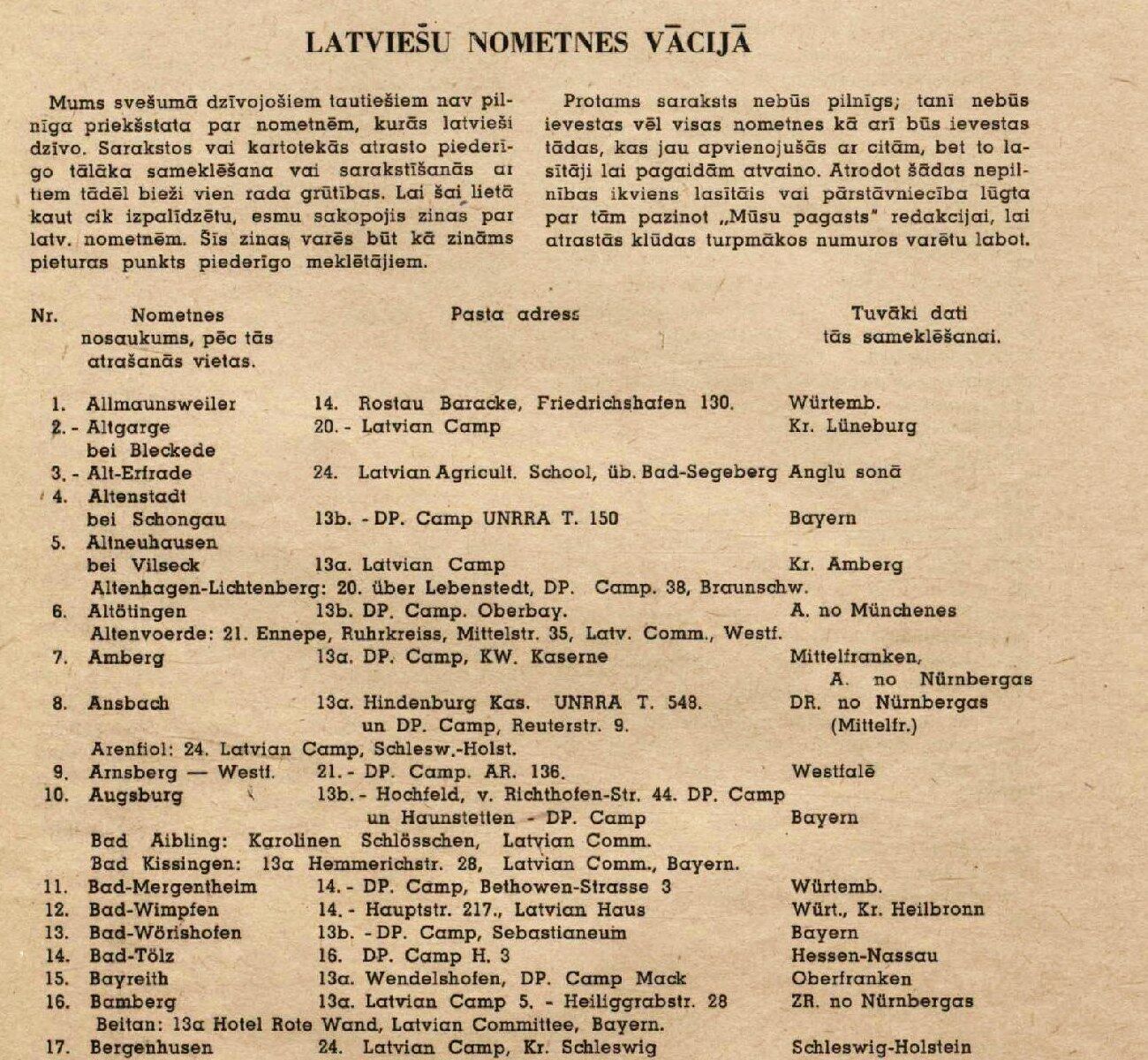
A list of Latvian camps in Germany printed on 1 May 1946 includes the camp, giving its address as “Bayreith 13a. Wendelsnofen, DP. Camp Mack Oberfranken”. The list uses variant spellings for Bayreuth and Wendelhoefen, and places Camp Mack among the Latvian camps within months of its recorded opening.
Sources for this section
- 150 Jahre Bezirkskrankenhaus: von der Kreisirrenanstalt zum Bezirkskrankenhaus 1870–2020
- DP camp inventory: Camp Mack, entry 796
- Primary-school volleyball players
- Four young men in suits: photograph and camp recollections
- Handicrafts of Displaced Persons and Refugees
- Latvian camps in Germany, Mūsu Pagasts, Nr. 1-2
Two catalogue entries, one name
The Arolsen camp catalogue carries two rows using the name Mack. One, for Bayreuth, gives Assembly Center 92-279, later OMF 318, opening on 24 January 1946 and closing on 31 July 1949, with nationalities listed as Estonian, Latvian, Lithuanian and Polish-Ukrainian. The other, for Wendelhoefen in the Bayreuth district, gives Assembly Center 93-401, opening on 30 January 1946 and closing between 15 April and 20 May 1947, with the nationality given simply as Ukrainian.
Whether these are one installation recorded twice, an annex, or two administrative phases cannot be settled from the catalogue alone, and the underlying tracing-service returns have not been read. The two entries are kept apart here.
The two catalogue entries using the Mack name
| Field | Bayreuth entry | Wendelhoefen entry |
|---|---|---|
| Catalogue title | DP-Camp Mack | DP-Camp Mack Wendelhoefen |
| Place given | Bayreuth | Wendelhoefen (Kreis Bayreuth) |
| Nationalities | Estonian, Latvian, Lithuanian, Polish-Ukrainian | Ukrainian |
| Assembly centre | AC 92-279, later OMF 318 | AC 93-401 |
| Opening | 24 January 1946 | 30 January 1946 |
| Closing | 31 July 1949 | Between 15 April and 20 May 1947 |
| Team | T 186 Bayreuth | T 186 Bayreuth |
Sources for this section
Rooms, meals and school
In one family’s recollection, households with young children received separate rooms, while two families with older children shared a room partitioned with blankets. Meals initially came from a communal kitchen, chiefly soup and porridge. Later, families cooked their own rations on small wood-burning stoves that also supplied heat. These domestic arrangements show how families adapted institutional rooms to everyday living.
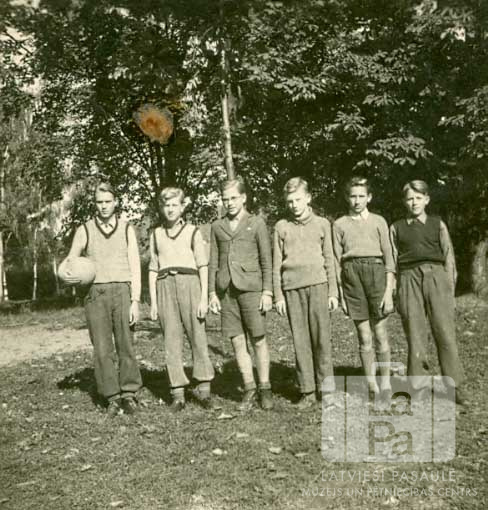
A primary school offered language, mathematics and religious instruction. Volleyball, basketball and table tennis gave young people organised recreation; scouting brought excursions and camping trips. The museum photograph of school volleyball players preserves this part of the camp’s social life. A second collection dates a group photograph to summer 1948, securely placing the young people at Camp Mack then.
Sources for this section
Skill on display
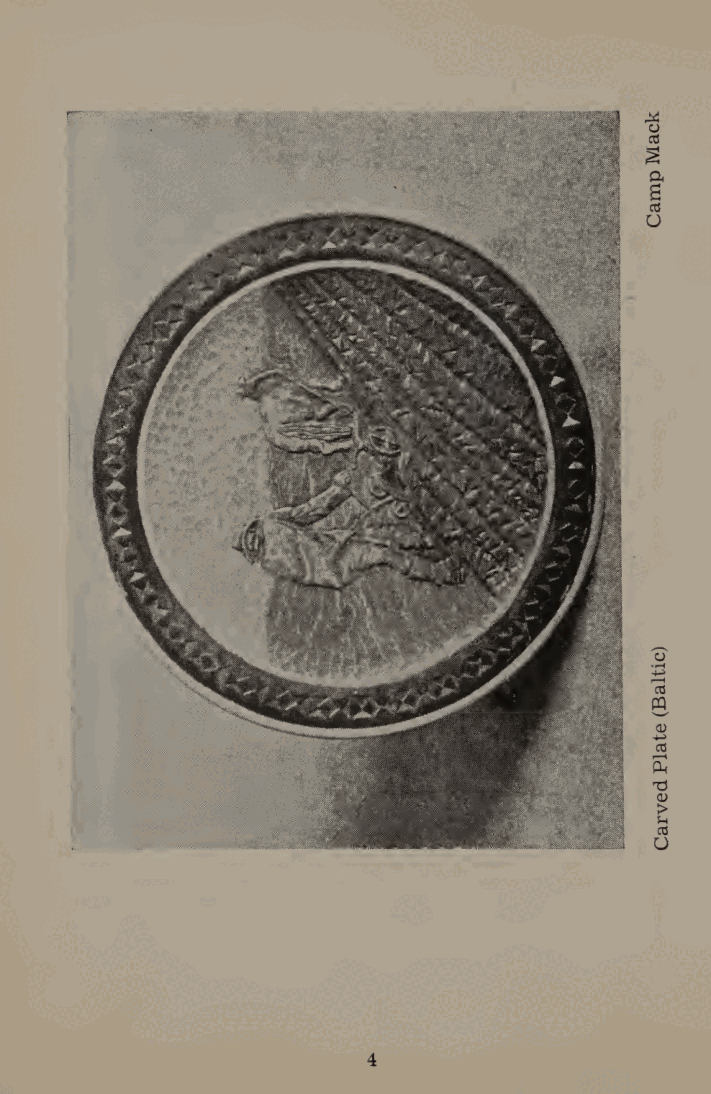
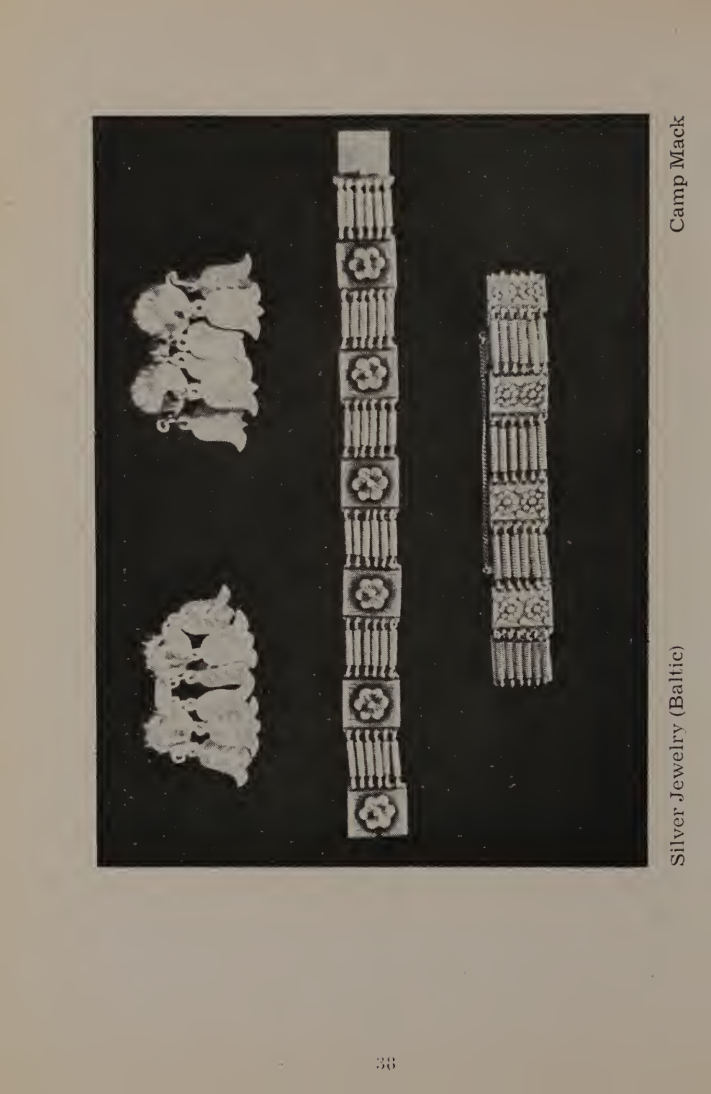
The original Bayreuth exhibition catalogue is unusually precise about where objects were made. Plates attributed to Camp Mack show painted and carved wooden dishes, boxes, candleholders, silver ornaments, dolls and wooden sandals. Several captions distinguish Latvian, Lithuanian or Estonian work within the broader Baltic category. The photographs make these surviving records useful beyond the names of organisations and administrators.
The regional exhibition presented creative work from several camps to challenge the idea that displaced people lived passively on relief. Its introduction discusses scarce supplies and the use of recovered materials and homemade tools across the participating camps. That is the exhibition’s regional context; the individual captions provide the direct evidence for Camp Mack’s contributions. Ukrainian embroidery and carvings illustrated elsewhere in the same volume came from Leopold-Kaserne.
Objects attributed to Camp Mack
| Catalogue plate | Object |
|---|---|
| 3 | Painted Lithuanian and Latvian plates |
| 19 | Estonian carved box |
| 24 | Wooden stein and bowl |
| 37-38 | Silver clasps and jewellery |
| 39-42, 44, 46-47 | Dolls |
| 54 | Wooden sandals |
Sources for this section
Leaving Bayreuth
Clinical work resumed on the site in the autumn of 1947 with about a hundred patients, and the district bought the grounds back from the Bavarian state in 1951. The camp and the returning hospital therefore overlapped, although no source retrieved here explains how the buildings were shared.
The museum collections preserve two onward journeys. One account records departure for Indiana in 1949; another describes transfer to Memmingen before emigration to the United States. Leaving Camp Mack could therefore mean another German camp before the ocean crossing. The camp’s final year was 1949, although the inventory and a later recollection differ over the month of closure.
Sources
- DP camp inventory: Camp Mack, entry 796
Arolsen Archives · 26 October 2023
AC 92-279 / OMF 318, Team 186. Capacity 820 dated 31 October 1947; catalogue nationalities include Polish-Ukrainian. Original underlying returns not independently retrieved.
- Handicrafts of Displaced Persons and Refugees
Area 3 Subheadquarters, Bayreuth / Diasporiana · PCIRO period
Complete 93-page original exhibition catalogue inspected. Camp Mack identified on individual object plates; Ukrainian exhibits are assigned separately to Leopold-Kaserne.
- Primary-school volleyball players
National Library of Latvia / Latvians Abroad Museum · Postwar photograph; catalogue 2021
Photograph and donor account identify Camp Mack in a former psychiatric institution; Latvian, Lithuanian and Estonian residents; departure for Indiana in 1949.
- Four young men in suits: photograph and camp recollections
National Library of Latvia / Latvians Abroad Museum · Summer 1948 photograph; later recollection
Full donor account read: Wendelhöfen premises, divided rooms, kitchen, school, sport, scouting and departures. Recollection contains a mistaken claim about Wagner’s birthplace, omitted. Closure recalled as end 1949 differs from inventory July; exact month not asserted.
- 150 Jahre Bezirkskrankenhaus: von der Kreisirrenanstalt zum Bezirkskrankenhaus 1870–2020
Stadtarchiv Bayreuth · Accessed 13 September 2026
Institutional history read in full 13 September 2026, illustrated from Stadtarchiv holdings. Asylum opened 16 May 1870 at Wendelhoefen for 250 patients, later 567 beds; dissolved 1 October 1940, 523 of 651 patients moved to Erlangen, Ansbach and Kutzenberg and from there taken to killing centres under Aktion T4; evacuation home for 420 girls from 26 October 1940; air raid of 11 April 1945; the American military government set up Lager Wendelhoefen for arrested Nazi functionaries and then for up to 1,400 DPs from Poland, Ukraine and above all the Baltic; clinic reopened autumn 1947; site bought back 1951. The 1,400 is a maximum for the whole camp, not a Ukrainian count.
- DP camp inventory: Wendelhoefen, entry 1600
Arolsen Archives · Catalogue dated 26 October 2023
Second catalogue row using the Mack name: ‘DP-Camp Mack Wendelhoefen’, Wendelhoefen (Kreis Bayreuth), nationality ‘ukrainisch’, AC 93-401, opened 30 January 1946, closed between 15 April and 20 May 1947, Team 186 Bayreuth, ITS Dok-ID 82040283-82040311. This project’s reconciliation of the row concluded it should be kept distinct from the Bayreuth entry until the archival records settle the relationship. Underlying returns not retrieved.
- Ukrainians in the Displaced Persons Camps of Austria and Germany, Table 8
Ihor Stebelsky, Ukrainskyi istoryk 1986 · Accessed 13 September 2026
Table 8, printed page 54 (headings and source notes on printed page 53), read from the PDF with column positions checked. Bayreuth is a heading with three lines: Leopold Kaserne 2,170 / 1,301 / 1,432 / 2,610; Other units - / 583 / 13 / -; St Georgen Hospital - / 7 / 82 / 68, at 1946–47, August 1946, May 1947 and December 1947. Camp Mack is not listed by name anywhere in the table.
- Latvian camps in Germany, Mūsu Pagasts, Nr. 1-2
Mūsu Pagasts, reproduced in facsimile by latvians.com · 1 May 1946
Facsimile sheet 1 of 6 read: a numbered list of Latvian camps in Germany, entry No. 15, “Bayreith 13a. Wendelsnofen, DP. Camp Mack Oberfranken”. Establishes a contemporary press record of the camp at Wendelhoefen, Bayreuth, among Latvian camps. The list was compiled by an unnamed editor.
Last researched 13 September 2026