Campo Limpo
Arrival and settlement
Campo Limpo Paulista, São Paulo · Brazil · 1947–1951
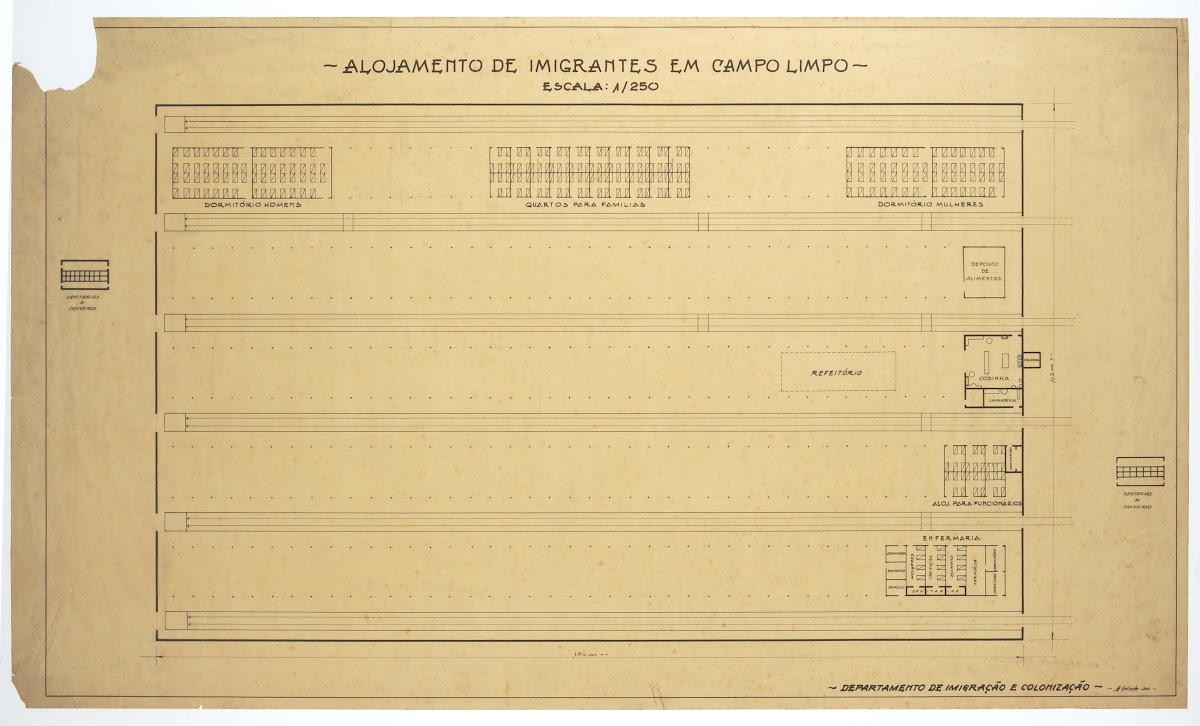
Disused coffee warehouses beside the railway at Campo Limpo Paulista were fitted out as São Paulo state’s reception hostel for postwar refugees while the Brás building was an aviation school. Ukrainians were the second largest group registered there, 1,386 entries in three years, before the newcomers moved on to work in and around the city.
Introduction
Campo Limpo’s immigrant hostel received refugees and displaced people in São Paulo state from 1947 to 1951. Former coffee warehouses became temporary accommodation while the better-known Brás immigrant hostel was occupied by an aviation school. Ukrainians were a substantial part of the arrivals: the registration table for 1947–1949 records 1,386 Ukrainian entries.
The substitution was not accidental. Brazil entered the war on 22 August 1942 and formed a partnership with the Embry-Riddle School; with migration at a standstill the state handed the Brás building to the air ministry, and from 1943 it housed the Escola Técnica de Aviação. When Brazil undertook from 1947 to receive people the International Refugee Organisation could not repatriate, another site had to be found.
A history in dates
- 1941Millions of sacks of coffee are burnt at the Campo Limpo depots under federal export policy; the sheds fall into disuse.
- 1943The Brás immigrant hostel in São Paulo becomes the Escola Técnica de Aviação.
- 1947The provisional hostel begins receiving postwar displaced people; 2,579 registrations, 439 of them Ukrainian.
- 1948Annual registrations include 517 Ukrainians.
- 1949Annual registrations reach 4,891 people across all recorded groups.
- 1951Brás resumes immigrant reception and Campo Limpo’s temporary role ends.
- 2024New museum research highlights refugee documents bearing Campo Limpo stamps.
Coffee warehouses become a reception hostel
The buildings belonged to the railway and coffee-trading landscape of Campo Limpo Paulista. A local history describes the former coffee depots being adapted for newcomers and preserves a childhood recollection of a Russian family staying there in 1948. Its photographs place those warehouses within the history of the station and the district’s later industrial development.
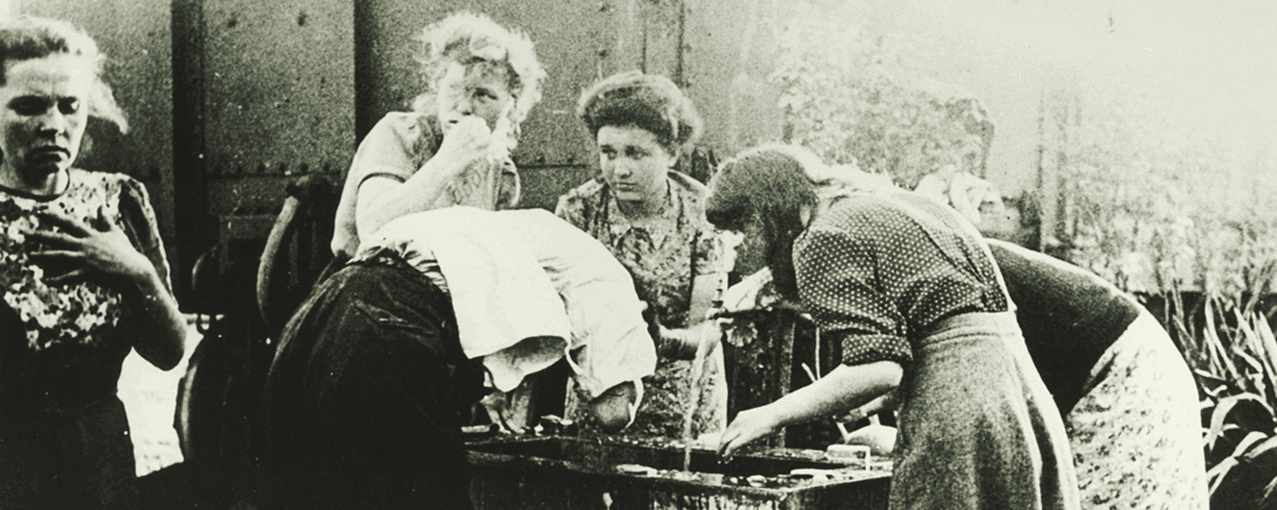
These were depots of the national coffee department. Millions of sacks were burnt there in 1941 under the federal export policy, and older residents remembered the smell reaching the centre of Jundiaí eleven kilometres away. The sheds then stood almost abandoned until the war ended. One of the people who passed through, a Russian who was two years old in 1948, later researched the place and observed that for want of publicity the hostel at Campo Limpo station does not appear in the history of the last migrations and survives only in the testimony of those who were there.
This was accommodation after the ocean crossing to Brazil, rather than a European displaced-persons camp. Research on refugee reception describes arrivals through Rio de Janeiro and the Ilha das Flores hostel before transfer to Campo Limpo when São Paulo was their initial destination. The hostel was an intermediate place between international resettlement and employment in Brazil.
Who passed through Campo Limpo
The annual totals grew from 2,579 registrations in 1947 to 4,891 in 1949. Ukrainians represented 12.27% of the three-year total. These figures count people registered over time; they do not measure how many slept in the warehouses on a particular night. The table records nationality as classified in the contemporary administration.
Poles were the largest group at 28.60%, Ukrainians the second at 12.27%, followed by Balts, Hungarians, stateless people, Russians, Yugoslavs and Czechs. The Ukrainian share fell across the three years, from 17.02% of the 1947 registrations to 8.79% of those in 1949, while Hungarian and Yugoslav numbers rose sharply. Nearly eight per cent of all those registered were recorded as stateless, a classification the museum illustrates with an identity booklet describing its holder as belonging to no state.
Recorded arrivals, 1947–1949
| Year | All registrations | Ukrainian registrations | Ukrainian share |
|---|---|---|---|
| 1947 | 2,579 | 439 | 17.02% |
| 1948 | 3,817 | 517 | 13.54% |
| 1949 | 4,891 | 430 | 8.79% |
| Total | 11,287 | 1,386 | 12.27% |
Registrations by nationality, 1947 to 1949 combined
| Nationality as recorded | Registrations | Share |
|---|---|---|
| Poles | 3,229 | 28.60% |
| Ukrainians | 1,386 | 12.27% |
| Balts | 1,017 | 9.01% |
| Hungarians | 873 | 7.73% |
| Stateless | 867 | 7.68% |
| Russians | 855 | 7.57% |
| Yugoslavs | 798 | 7.07% |
| Czechs | 273 | 2.41% |
| Other | 1,767 | 15.65% |
| Not recorded | 222 | 1.96% |
| Total | 11,287 | 100% |
From temporary accommodation to work
Many arrivals brought industrial skills. The museum identifies mechanics, electricians, metalworkers, cabinetmakers and welders among the declared occupations. This contrasted with earlier immigration streams associated chiefly with agricultural labour.
Employers recruiting the newcomers were concentrated in metropolitan São Paulo, especially the city itself. Brazilian recruitment sought both agricultural labour and skills for modernising industry, while encouraging family migration. Temporary reception therefore led into a labour market with several kinds of work, rather than one uniform destination for every household.
Firms put their requirements to the authorities and to the hostel itself, so that a good part of the newcomers arrived with a contract already made. Salles names medium and large employers: meat works, building and engineering firms, motor-vehicle and components plants, food, textile and printing works, leather and mining companies, among them Swift, Armour, General Motors and Firestone as well as immigrant-owned businesses such as Indústrias Reunidas F. Matarazzo.
Salles’s sample of the Campo Limpo disembarkation lists gives 52 Ukrainians in first employment, 49 of them as skilled workers, one as a technician or professional and two in unskilled service work. Ukrainian employers were most concentrated at São Caetano and in the eastern zone of the city, and Ukrainian households settled mainly in the eastern, western and southern zones, with none recorded in the centre. Declared qualifications did not always match the first job obtained: across all nationalities the proportion classed as skilled workers rose from 71% on the passport to almost 80% in the first job.
Ukrainians in the first-employment sample
| Category of first job | Ukrainians |
|---|---|
| Skilled workers | 49 |
| Technical and professional | 1 |
| Unskilled service | 2 |
| Total in sample | 52 |
Community and the idea of return
The hostel fed into an older Ukrainian settlement. Salles cites research on the Sociedade Ucrânia Livre at São Caetano, whose statute showed that its organisers were less concerned with gathering the Ukrainian community in Brazil than with political events in Ukraine, their stated aim being a sovereign, democratic and republican country. The earlier Ukrainian migration to São Caetano is described as made up of former officers of the Ukrainian army and of workers who had left their land because of hard conditions.
Among the surprises of the oral testimony Salles gathered is how persistent the idea of return remained. For a good part of these communities the question was not only rebuilding a life in Brazil but preparing to go back, and she notes that what she says of the Ukrainians holds for a significant part of the Russians as well.
Sources for this section
The documents that travelled with people
Surviving papers make the journey visible in another way. The museum’s research for a 2024 exhibition brought together temporary identity documents issued by the International Refugee Organisation, travel permits, vaccination records and later identity papers. Some bear the stamp of the provisional hostel at Campo Limpo Paulista. Photographs, physical descriptions and successive stamps record the administrative steps accompanying a family’s search for a new home.
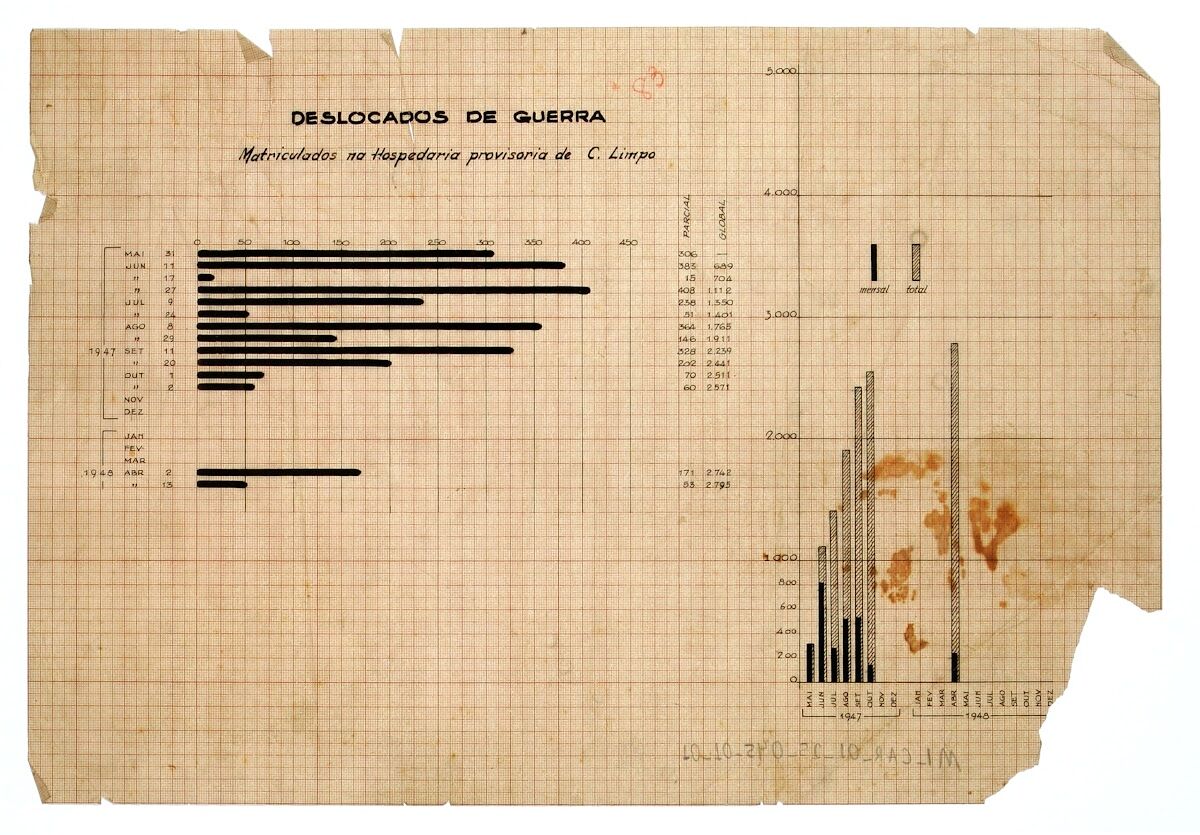
The resulting virtual exhibition shows identity certificates and laissez-passer issued in the late 1940s, an IRO certificate serving in place of a passport until a permanent travel document could be issued, and a chart of registrations at the provisional hostel. Its caption dates the hostel 1947 to 1952, where the museum’s own earlier article and Salles both give 1947 to 1951.
Sources for this section
Return to the Brás hostel
In 1951 the Brás building returned to its immigration function and Campo Limpo’s temporary role ended; the IRO was succeeded by the intergovernmental committee for European migration, which agreed with Brazil that the movement would continue. The registers of those who passed through Campo Limpo are held at the state public archive of São Paulo, and the warehouse site later became the Krupp works.
Sources for this section
Sources
- A Hospedaria de Imigrantes de Campo Limpo
Museu da Imigração · 6 May 2019
Museum history identifies the converted coffee warehouses, the Brás aviation school, the operating period, nationality shares, occupations and an authentic hostel photograph, and notes that the registers are held at the state public archive.
- Território e experiência imigratória: os refugiados em São Paulo no pós-Segunda Guerra Mundial
Maria do Rosário Rolfsen Salles, Cadernos Metrópole 20 · 2008
Original study read. Table 1, p. 183, reproduces the December 1950 immigration bulletin’s registration totals. Tables 2, 4 and 5 are samples from the Campo Limpo disembarkation lists held at the Memorial do Imigrante, covering first employment, employers and residence by zone.
- O estrangeiro ideal: políticas e práticas de hospitalidade na cidade de São Paulo
Sênia Regina Bastos, ANPUH symposium · 2013
Study describes the route through Rio de Janeiro and Ilha das Flores to temporary accommodation at Campo Limpo and employment around São Paulo.
- Campo Limpo Paulista: das origens ao terceiro milênio
Paulo Luiz Martinelli and Edoardo Coen; municipal council digital library · Undated
Pages 19–20 identify the buildings as depots of the national coffee department, describe the 1941 burning of the stocks, record a resident’s recollection of staying there in 1948, and note that the site later held the Krupp works. The local history’s shorter date range is not used as a complete hostel chronology.
- O tema da nova exposição virtual do Museu da Imigração
Gabriela Araújo, Museu da Imigração · 29 January 2024
Museum research describes preserved refugee documentation, including Campo Limpo hostel stamps.
- O Refúgio no Acervo do Museu da Imigração
Museu da Imigração on Google Arts & Culture · Accessed September 2026
Virtual exhibition of identity certificates, laissez-passer and vaccination records, with a chart of registrations at the provisional hostel. Its caption dates the hostel 1947 to 1952, against 1947 to 1951 in the museum’s own 2019 article and in Salles.
- Alojamento de imigrantes em Campo Limpo (1947/1952)
Museu da Imigração do Estado de São Paulo, shown in the online exhibition ‘O refúgio no acervo do Museu da Imigração’ · 1947–1952
Scale drawing at 1:250 titled ‘Alojamento de imigrantes em Campo Limpo’, drawn by the Departamento de Imigração e Colonização. It sets out the interior of the converted warehouse in bays, with a men’s dormitory (dormitório homens), rooms for families (quartos para famílias) and a women’s dormitory (dormitório mulheres) across the top, and a refectory (refeitório), staff quarters and an infirmary (enfermaria) along the right-hand side. The museum asserts no open reuse licence.
- Gráfico de deslocados de guerra matriculados na Hospedaria provisória de Campo Limpo (1947/1952)
Museu da Imigração do Estado de São Paulo, shown in the online exhibition ‘O refúgio no acervo do Museu da Imigração’ · 1947–1952
Hand-drawn chart on graph paper headed ‘Deslocados de guerra matriculados na hospedaria provisória de C. Limpo’ — displaced persons registered at the provisional Campo Limpo hostel. Horizontal bars give the monthly registrations from May 1947 to April 1948 with columns of monthly and running totals beside them, and a bar diagram at the right repeats the series month by month against a scale running to 5,000. The sheet is water-stained and torn at the right edge. The museum asserts no open reuse licence.
Last researched 13 September 2026