Chullora Railway Camp
Arrival and settlement
Greenacre, Sydney, New South Wales, Australia · 1948–1964 (institutional listing)
A New South Wales railway workers’ camp beside the Chullora workshops became an accommodation centre for displaced families, with a rent of a pound a week and huts built for single men. Ukrainian residents ran a Saturday school there from 1950 until 1961.
Introduction
At Chullora in Sydney, railway accommodation became a home for Ukrainian migrants and a centre for community life. Railway employment brought residents to the camp; a hall and Saturday school gave families a place to gather and teach their children. The camp housed railway workers as well as migrants, and its Ukrainian school continued into 1961.
A history in dates
- 1926New railway workshops are under construction at Chullora on 485 acres, employing more than a thousand men.
- 1948A railway workers’ camp is established near the corner of the Hume Highway and Brunker Road, with about twenty chalets on 18 hectares.
- 1948–1949A Lithuanian community history records Lithuanians on two-year government work contracts housed at the Chullora railway workers’ camp.
- 1949Lydia Mamtschak’s father moved to Chullora after the family’s stay at Bathurst.
- 1949St Frances Cabrini church is built at the camp for Catholic residents.
- Early 1950The Ukrainian Saturday school opened in a building arranged by Claudius Bilinsky.
- 1951The place is known as the Chullora Accommodation Centre for Migrants.
- 1957The Sydney Morning Herald publishes ‘A Shanty Town that makes the Railways Ashamed’.
- 1961The Ukrainian school’s final year, recorded in the 1966 community history.
- 1964End of the period recorded for the camp in the federal institutional listing.
- 1965St Frances Cabrini church at the camp closes.
Sources for this section
- ‘CHULLORA. GREAT WORKSHOPS, Making Electric Trains’, The Sydney Morning Herald, 8 November 1926, page 12
- Chullora Railway and Migrant Camp
- Sydney Lithuanian communities: a glance into the past
- Lydia Mamtschak, Family reunion, Seniors’ Stories 2015, volume 2
- Союз Українок Австралії ім. княгині Ольги, Melbourne–Sydney, 2001, ISBN 0957977700
- Artefact Heritage, 2 Hume Highway, Chullora: Heritage and Archaeological Impact Assessment, October 2015
- Ukrainians in Australia, volume 1, Melbourne 1966
- Australian Government National Redress Scheme, Chullora Railway & Migrant Camp
The workshops that made the camp
The camp existed because of the railway works beside it. In 1926 the Sydney Morning Herald described huge new workshops rising at Chullora on 485 acres, eleven miles from Central Station, already employing more than a thousand men and intended to replace Eveleigh. During the Second World War the workshops built Beaufort bombers.
After the war the New South Wales railways expanded again, employing some 60,000 workers by 1948, and that growth pressed hard on housing near the workshops. A camp for railway workers was established near the corner of the Hume Highway and Brunker Road in 1948, covering 18 hectares, with about twenty huts, called chalets, at first. Smaller huts housed single men and larger ones railway staff such as drivers, firemen, guards and conductors.
Railway housing in Sydney
The Australian Government’s institutional listing records Chullora Railway & Migrant Camp for 1948–1964 at the corner of Brunker Road and Hume Highway, Greenacre. A heritage assessment places the accommodation southwest of its separate 2 Hume Highway study area.
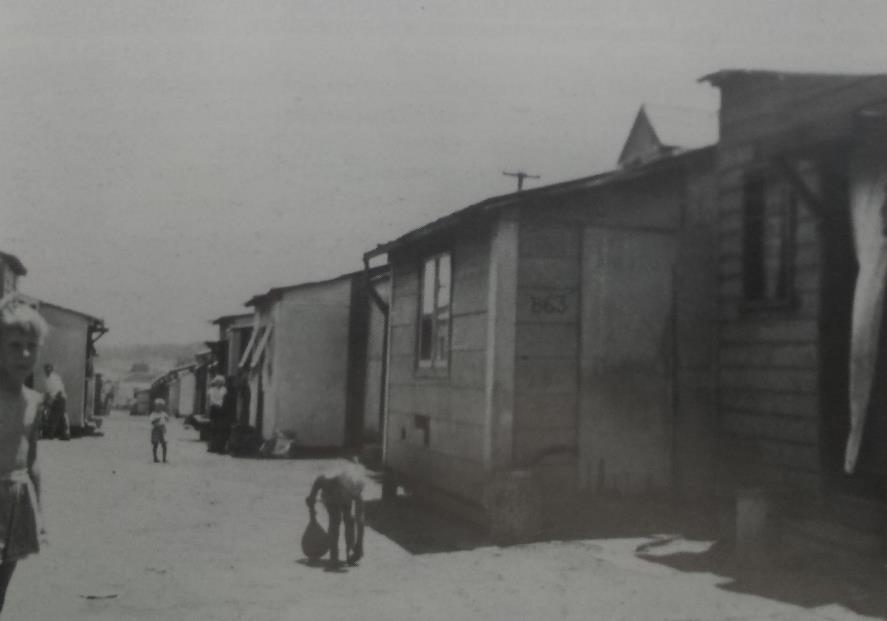
Intended as temporary, the camp continued after the war and became a migrant accommodation centre. Families occupied housing designed for single men. Drawing on Sue Rosen’s history of Bankstown, the assessment describes limited running water and sewerage, and its historical photograph shows rows of modest huts facing an unpaved lane.
The same assessment states that the centre came to house 2,047 migrants in 640 huts and 136 chalets. It gives no date and no source for those totals, so they describe the eventual size of the migrant section rather than a population return for any particular year.
Rent, rations of space and everyday comfort
A local history account reproduced by the Australian Federation of Ukrainian Organisations, drawing on the recollections of a resident named K. T. Groves, sets out the terms of living there. Rent was a pound a week, electricity included, for two ceiling lights and two power points. A hand-fired coal boiler shared between several chalets supplied the only hot water and worked badly. Two families shared a laundry with a concrete tub and an ironing board, and the chalets were hot in summer and cold in winter.
The camp had an Australian section and a migrant section. The account describes the migrants as mostly eastern European displaced people, with Poles the largest group, and families living in cramped quarters. A Polish family ran the general store. Rent in the migrant section was also a pound a week, with ten shillings more for a chalet with a sleep-out. By 1951 the place was known as the Chullora Accommodation Centre for Migrants.
The account quotes a 1957 Sydney Morning Herald article, ‘A Shanty Town that makes the Railways Ashamed’, describing fifteen hundred men, women and children in substandard huts. In the smaller huts one room served as kitchen, bedroom, living room and bathroom. Cooking was done in a galvanised iron shack over an open coke and coal fire burning under two lengths of railway track, and there was no running water in the smaller huts unless tenants pushed a garden hose through a window. Tenants added vegetable gardens, kitchenettes, carports and fences.
Lithuanians lived at the camp as well. A retrospective history of the Sydney Lithuanian communities records that in 1948 and 1949 many Lithuanians completing two-year work contracts with the Australian government were housed near Bankstown, in what it calls the railway workers tent “city” at Chullora and in the water reticulation workers camp at Regents Park. It gives no numbers for them and does not say how long they stayed.
Figures recorded for the camp
| Figure | Recorded detail | Source and scope |
|---|---|---|
| 1948 | Railway workers’ camp established near Hume Highway and Brunker Road | Local history account reproduced by the AFUO |
| 18 hectares | Area the camp covered | Same account; no surveyed boundary has been traced |
| About 20 chalets | Number built initially | Same account |
| £1 a week | Rent, including electricity for two lights and two power points; ten shillings more for a sleep-out | Same account; the migrant section paid the same rent |
| 1,500 people | Men, women and children in substandard huts | Figure quoted by that account from a 1957 Sydney Morning Herald article that has not been read in the original |
| 2,047 migrants, 640 huts, 136 chalets | Size the accommodation centre eventually reached | 2015 heritage assessment, which gives no date and no source for the totals |
| 120 children | Pupils at the Sisters of Charity infants school | Local history account; a Catholic school, not the Ukrainian Saturday school |
| 80 and 122 cottages | Housing Commission cottages built at Chester Hill and Lidcombe on railway land before the scheme stopped | Local history account; these were off-site replacements, not camp buildings |
Sources for this section
The camp’s changing names
The Ukrainian Women’s Association’s 2001 history records a sequence of names: Railway Camp Chullora, Chullora Park, and Accommodation Centre Chullora. The account credits resident supervisor Claudius Bilinsky, a Ukrainian immigrant, with helping establish a place for community activity.
Names recorded for the railway community
| Sequence | Name |
|---|---|
| First | Railway Camp Chullora |
| Later | Chullora Park |
| Finally in the account | Accommodation Centre Chullora |
Sources for this section
A hall becomes a Saturday school
Early in 1950, a Ukrainian Saturday school opened at the camp. Bilinsky arranged a large transportable building that could serve as both community hall and school. Lidia Hayevska-Denes of the Ukrainian Women’s Association helped run it. The association’s history places the initiative among Sydney’s earliest Ukrainian Saturday schools.
The 1966 community history records that teaching continued until 1961. It names L. Haievska as an early teacher, followed by the Shkurupii couple. The school’s eleven-year history shows community education continuing as residents rebuilt their lives in Australia.
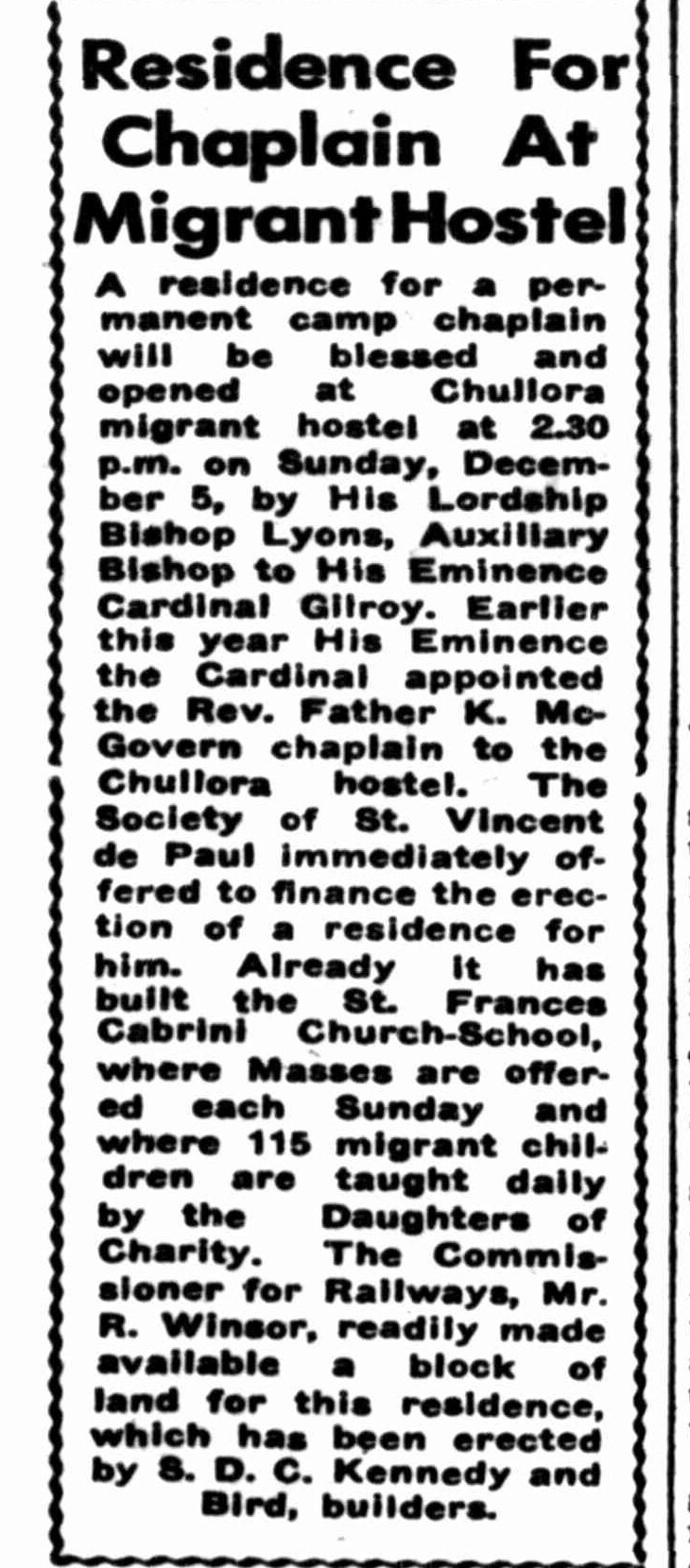
The Ukrainian school was one of several religious and welfare provisions. The local history account records that the Catholic Church built St Frances Cabrini at the camp in 1949 and that it closed in 1965, that the Sisters of Charity opened an infants school for 120 children because many mothers worked, and that Sister Brendan ran a club for young girls. Weekends brought the pictures at Bankstown and Punchbowl and Sunday afternoon soccer, which the account says the migrants particularly enjoyed.
One family, two camps
Lydia Mamtschak recalls arriving in Sydney with her parents on 6 June 1949, after childhood displacement from Lviv to Austria. They travelled to Bathurst, where they stayed together for two weeks. Then Lydia and her mother were sent to Greta in the Hunter Valley, while her father went to Chullora.
Her father repaired damaged seats at Redfern Railway Yards. Although he held a doctorate in law and spoke several languages, he could not find the legal or interpreting work he had hoped for. Her mother’s teaching qualifications were also unrecognised. Mamtschak’s account connects railway accommodation with the separation and changes of occupation experienced by one Ukrainian family.
A family’s route through New South Wales
| Time | Place | Experience recalled by Lydia Mamtschak |
|---|---|---|
| 6 June 1949 | Sydney | Arrival by ship |
| Following two weeks | Bathurst | Family accommodated together |
| After Bathurst | Greta and Chullora | Mother and daughter to Greta; father to Chullora |
| During father’s Chullora residence | Redfern Railway Yards | Repairing train seats |
Sources for this section
Leaving the camp
The Department of Railways always regarded Chullora as temporary. A Housing Commission scheme put up 80 cottages at Chester Hill and 122 at Lidcombe on railway land, but it stopped for lack of money, and many railway workers instead bought land in the district. Land opposite the workshops sold for £100 in 1950, hard to save for on £8 a week; the resident quoted in the local history bought a block at Greenacre in 1955 for £500 after years of overtime.
The federal listing closes the camp’s recorded period in 1964, and the workshops declined from the late 1950s as land was sold into private ownership. No surveyed boundary for the camp itself has been traced, and no record of its final closure has been read.
Sources
- Союз Українок Австралії ім. княгині Ольги, Melbourne–Sydney, 2001, ISBN 0957977700
Ukrainian Women’s Association of Australia · 2001
Relevant original page images visually checked; text extraction compared. Printed pp. 11–12; PDF pages 20–21. Naming sequence is undated and credited in a footnote to Bilinsky.
- Lydia Mamtschak, Family reunion, Seniors’ Stories 2015, volume 2
NSW Government · 2015
Relevant original page images visually checked; text extraction compared. Published memoir, pp. 103–104.
- Australian Government National Redress Scheme, Chullora Railway & Migrant Camp
Australian Government
Full live institutional listing read; names used in 1948–1964 and location at the corner of Brunker Road and Hume Highway, Greenacre. Administrative listing dates were not independently checked against camp opening and closure records.
- Artefact Heritage, 2 Hume Highway, Chullora: Heritage and Archaeological Impact Assessment, October 2015
Artefact Heritage · October 2015
Printed pp 12–13 (PDF 19–20) text and Figure 11 visually inspected. Planning assessment for a different study parcel northeast of camp; historical section draws on Rosen 1996 and newspapers, not original camp survey.
- Ukrainians in Australia, volume 1, Melbourne 1966
Ukrainians in Australia, volume 1 · 1966
Parent visually read NSW education paragraph on original scanned page. Retrospective history; school duration distinct from camp duration. Printed and scan page 712. School endpoint is not a camp closure date.
- ‘CHULLORA. GREAT WORKSHOPS, Making Electric Trains’, The Sydney Morning Herald, 8 November 1926, page 12
The Sydney Morning Herald (NSW : 1842 - 1954) · 8 November 1926
Full digitised article read 13 September 2026 through an Internet Archive snapshot of the Trove article page, because Trove’s live site is behind a bot-detection challenge. Establishes the workshops site before the camp; says nothing about migrant accommodation.
- Chullora Railway and Migrant Camp
Australian Federation of Ukrainian Organisations · Undated
Full page read 13 September 2026. The page states its own source as ‘Canterbury - Bankstown’, author and publisher unknown, so it is a local history text of unstated authorship reproduced by the federation; it quotes a resident, K. T. Groves, and a 1957 Sydney Morning Herald article that has not been read in the original. The page’s garbled hut dimensions were not used, and its spelling ‘St. Francis Cabpini’ is treated as St Frances Cabrini.
- Residence for chaplain at migrant hostel
Catholic Weekly (Sydney), page 2 · 25 November 1954
Notice that a residence for a permanent camp chaplain would be blessed and opened at Chullora migrant hostel at 2.30 p.m. on Sunday 5 December 1954 by Bishop Lyons, auxiliary bishop to Cardinal Gilroy; that the Rev. Father K. McGovern had been appointed chaplain to the Chullora hostel earlier that year; that the Society of St Vincent de Paul financed the residence and had already built the St Frances Cabrini Church-School at the hostel, where Mass was offered each Sunday and 115 migrant children were taught daily by the Daughters of Charity; and that the Commissioner for Railways, Mr R. Winsor, made a block of land available for the residence, which was erected by S. D. C. Kennedy and Bird, builders. Digitised by the National Library of Australia; Australian material published before 1955 is out of copyright.
- Sydney Lithuanian communities: a glance into the past
Sydney Lithuanian Community; Jonas Zinkus, translated by Ramutis Zakarevičius · Undated; read 14 September 2026
Community retrospective. The section on the Bankstown Lithuanian community was read in full; its first paragraph places Lithuanians on two-year government work contracts at Chullora in 1948 and 1949. The page cites no primary sources and gives no date of composition.
Last researched 13 September 2026