Colegio Santiago Apóstol
Arrival and settlement
Madrid · Spain · 1946–1969
A Madrid university residence gave displaced Ukrainian students a route from wartime captivity to higher education. Its residents built a choir, a student organisation and a Ukrainian parish in Spain while preparing for professional lives there or overseas.
Introduction
Colegio Mayor Santiago Apóstol was a university residence for refugees from Eastern Europe. In Madrid, displaced Ukrainians could resume interrupted studies with accommodation and financial support. The project combined Catholic assistance with the Franco government’s anticommunist international ambitions. Its university setting made it a different stage of displacement from the camps and military detention facilities many students had left.
The response was organised by two bodies founded by Spanish Catholics, the Obra Católica de Asistencia Universitaria and a parallel refugee organisation known as OCARE, which existed to help students and intellectuals from central and eastern Europe whose countries were under communist rule. The founding decree of 6 December 1946 spoke of Polish, Lithuanian, Croatian, Ukrainian and other university students seeking in Spanish hospitality the means to rebuild broken lives and finish their studies.
A history in dates
- 20 June to 6 July 1946The nineteenth Pax Romana congress in Salamanca and El Escorial takes up the problem of refugee students; Spain undertakes to finance 150 scholarships.
- November 1946The first students supported by the OCAU, twenty-five Poles and seventeen of other nationalities, reach Spain; two further groups of Poles and Ukrainians follow the next month.
- 6 December 1946A decree creates the college for displaced university students, graduates and teachers from Eastern Europe and gives its direction provisionally to OCAU.
- 23 December 1946Eighteen Ukrainian students leave Genoa aboard the Spanish ship Valencia.
- 25 December 1946They reach Barcelona and continue to Madrid.
- February 1947Seven further Ukrainian students arrive, bringing the initial Ukrainian group to twenty-five.
- 2 May 1947The residence at Donoso Cortés 63 is inaugurated.
- 1947The Spanish branch of Obnova is formed with twenty-six members.
- 1947The first 120 students make a pilgrimage to Santiago de Compostela.
- 1948 to 1949The college receives about 1,500 applications.
- 1948 to 1949Alfredo Sánchez Bella serves as director of the college before being replaced by Josef Cieker.
- Mid-1950Father Segundo Benito Galindo arrives as chaplain.
- April 1951Ukrainian broadcasting begins on Spanish national radio and continues until 1973.
- June 1952General Władysław Anders visits the college.
- 1954 and 1956The Ukrainian choir sings at Fátima during the Pax Romana congresses.
- 1959A newspaper survey counts 423 students of nineteen nationalities in the first ten years, sixty-five of them Ukrainian.
- 1962Obnova in Spain ceases to exist.
- 1 April 1969Decree 530/1969 ends the college’s special refugee mission and OCAU administration.
Sources for this section
- Breve historia de la organización estudiantil y de la colonia ucraniana en España, 1946–1996
- Maroš Timko, Czechoslovak-Spanish relations (1918–1977)
- Maroš Timko, ‘Czech and Slovak Exiles in Francoist Madrid and their Cold War (Im)mobilities’
- Decreto 530/1969, de 27 de marzo
- El exilio anticomunista centroeuropeo en la España de Franco
- Spain (entry on Ukrainians in Spain)
- José Luis Orella, ‘Treinta años de libertad para Polonia’
- A Catholic safe haven: University students from Eastern Europe in Spain during Francoism
- José Luis Orella, ‘The Ostpolitik of Francoist Spain’
From Italy to Madrid
The first group of eighteen Ukrainian students reached Barcelona by sea on Christmas Day 1946 and continued to Madrid. Seven more arrived from Italy in February 1947. Their route began among students held in the Rimini prisoner-of-war camp. The community’s later history describes scholarship opportunities emerging from the 1946 Pax Romana congress, which addressed the predicament of displaced university students.
The community’s own history sets the decision at the nineteenth Pax Romana congress, held in Salamanca and El Escorial from 20 June to 6 July 1946 at the initiative of Joaquín Ruiz Giménez. A Ukrainian delegation attended on behalf of Archbishop Ivan Buchko, apostolic visitor for Ukrainians in western Europe, headed by Father Maksym Hermaniuk, later archbishop of the Ukrainian church in Canada. According to that account no other delegation offered help, and the Spanish representation alone undertook to finance 150 scholarships for eastern European students. Buchko remained the students’ principal patron in obtaining Spanish scholarships.
The first group left Genoa on 23 December 1946 aboard the Spanish ship Valencia and entered Barcelona two days later. With the seven who followed in February 1947, the initial Ukrainian contingent in Spain came to twenty-five.
Ukrainians were not the first students the scheme brought in. A study of Czechoslovak-Spanish relations records that the first students supported by the OCAU, twenty-five Poles and seventeen of various other nationalities, arrived in Spain as early as November 1946, followed the next month by two further groups consisting of Poles and Ukrainians.
Sources for this section
A new home near the university
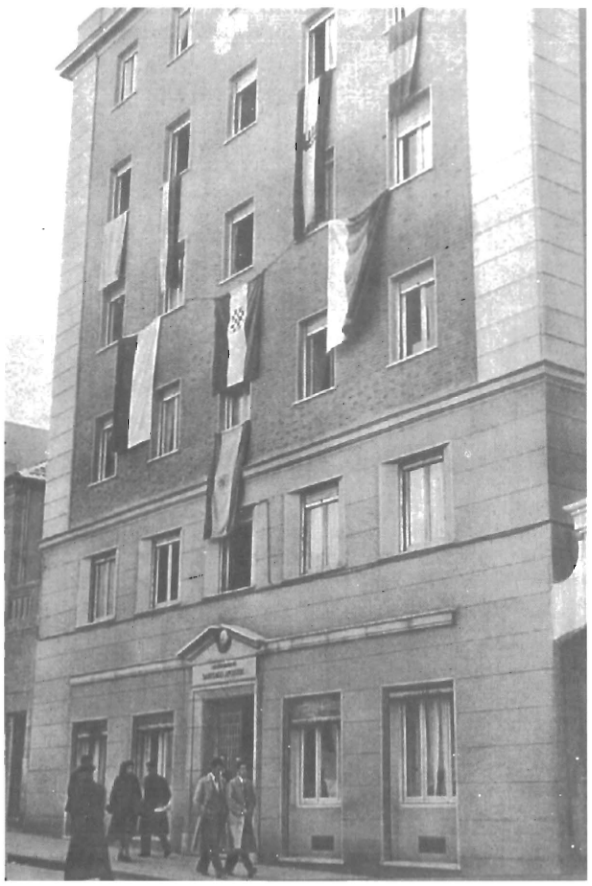
The five-storey residence at Donoso Cortés 63 was inaugurated on 2 May 1947. It was administered by the Obra Católica de Asistencia Universitaria, usually abbreviated OCAU. The building’s reported capacity was 118 residents. Financial support came from Spanish public funding and Catholic donations. Academic arrangements recognised previous study, while graduates who wanted to practise in Spain faced further recognition requirements.
The first months were improvised. Students arrived within two weeks of the December decree, while the building was still under construction, and were lodged in boarding houses and private homes until the inauguration. Sources differ on the size of the finished building: the OCAU report of 1946 to 1948 gives a capacity of 110 residents, and the later monograph 118. Either way the college was overcrowded almost at once, with 141 residents in 1949 to 1950 and 136 in 1952 to 1953, besides about a dozen Spanish students whom the reports do not count. It was an all-male hall. Plans announced in 1951 for a larger building for 200 students and a second residence in Barcelona were never carried out.
Inside there were a chapel where the chaplain said mass daily, a library, and a resident doctor, dentist and barber. Funding was a recurring difficulty, and a recent study describes the college’s insufficient funding and permanent debts as its main problem. One of the first contributions came from Catholic students in the United States, and OCAU turned repeatedly to the Spanish church hierarchy, which organised special collections, and to donations from individuals, banks and companies. The Cardinal of Toledo, Enrique Plá y Deniel, and the archbishop of Madrid-Alcalá, Casimiro Morcillo, involved themselves personally, Morcillo sitting on the OCAU board. Its president throughout was José María Otero Navascués, and the college’s director was Josef Cieker, formerly Slovak minister in Madrid.
The inauguration was a ministerial as well as a Catholic undertaking: Orella describes the college as the fruit of collaboration between the foreign minister, Alberto Martín Artajo, and the minister of national education, José Ibáñez Martín. The same author gives the college a first director before Cieker, recording Alfredo Sánchez Bella in the post from 1948 to 1949, when he was replaced by Josef Cieker, who held it until 1969.
Sources for this section
- Breve historia de la organización estudiantil y de la colonia ucraniana en España, 1946–1996
- El exilio anticomunista centroeuropeo en la España de Franco
- A Catholic safe haven: University students from Eastern Europe in Spain during Francoism
- Maroš Timko, ‘Czech and Slovak Exiles in Francoist Madrid and their Cold War (Im)mobilities’
- José Luis Orella, ‘The Ostpolitik of Francoist Spain’
- José Luis Orella, ‘Treinta años de libertad para Polonia’
Getting a place
Demand was far beyond the building. The first annual report describes an early admission process that valued rescue over academic record, stretching the budget to take in as many young Catholic students as possible from refugee and prisoner-of-war camps. From the academic year 1947 to 1948 admission became more orderly, weighted towards academic merit and with stricter age limits. The college received about 1,500 applications in 1948 to 1949 and 500 in 1950 to 1951, and officials expected more once the International Refugee Organisation closed.
Selection was delegated. The exile student organisations chose their own nationals, an arrangement first agreed with Polish Catholic Action in exile and kept in the long term, which made those bodies the gatekeepers of the residence. For the Ukrainians that body was Obnova. Several of these organisations moved their headquarters to the college, Obnova doing so when one of the Ukrainian residents became its president.
That arrangement ran through the house as a whole. Timko describes the college’s internal self-administration as based on a national rather than a state principle, and Orella calls the residence the epicentre of the exiles’ political, cultural and religious activities up to 1969.
Study and everyday life
Students received Spanish lessons and help entering the university system. Life in the residence also included lectures, student-led study groups, an English course, concerts and art exhibitions. Football, volleyball, basketball and chess connected residents with other Madrid colleges. Catholic teaching and pilgrimages were central to the institution’s programme, alongside its academic work.
Much of the programme was made by the residents themselves. They gave lectures in the house, one of them taught an English course, and they curated art exhibitions inside the college and at outside venues such as the Círculo Medina. Summer holidays were spent together and weddings were celebrated, alongside friendships and national rivalries.
The religious and public programme reached beyond the house. Orella lists among the college’s activities the participation of the first 120 students in a pilgrimage to Santiago de Compostela in 1947, the celebration of the national feast day, and a visit from General Władysław Anders in June 1952.
Ukrainian community life
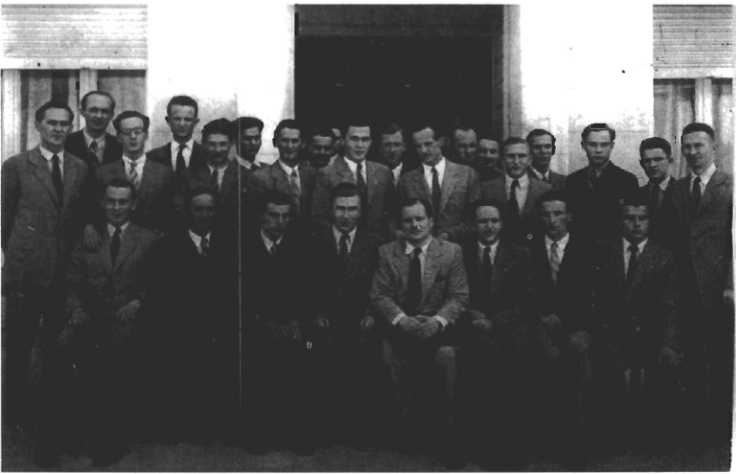
The students joined Obnova, the society of Ukrainian Catholic students, whose seat was in West Germany and which belonged to Pax Romana. The Spanish branch was formed in 1947 with twenty-six members. Obnova represented the whole Ukrainian student group before the OCAU board and, because Ukrainians had no legation in Madrid when Poles, Hungarians and the Baltic states did, it took on unofficially the task of representing the Ukrainian case in Spain. Members lectured to clubs and circles and worked on journalists, academics and friends in the faculties, against a general Spanish assumption that Ukraine was simply a Soviet republic or a province of Russia. Obnova continued until 1962, and a Ukrainian Student Hromada followed in 1956.
Its most public work was musical. Obnova organised a choir and a Ukrainian folk-dance group, later enlarged by young Spanish women, performing in national costume at university faculties, schools and institutes, on the radio and in theatres. The community history counts forty-one concerts in Spain and two prizes at international festivals held there. The choir gave two concerts at Fátima in Portugal during the Pax Romana congresses of 1954 and 1956 and sang two Byzantine-rite masses there. In Madrid it became known for singing at solemn masses on religious and national feast days and during visits by senior Ukrainian churchmen.
Most of the Ukrainian residents were Byzantine-rite Catholics and a few were Orthodox. As there were no Ukrainian priests in Spain, a Spanish bi-ritual priest, Father Santiago Morillo, first looked after them, and from the middle of 1950 a new chaplain, Father Segundo Benito Galindo, took up the work and stayed with the Ukrainian group for more than forty years; the Orthodox attended his liturgies as well. Archbishop Buchko created a personal Ukrainian parish for the whole of Spain in the late 1940s. Ukrainian broadcasting on Spanish national radio began in April 1951, three times a week at first and later daily, and ran until 1973, and a Ukrainian section was set up at the Centro de Estudios Orientales in 1952.
Graduation and onward journeys
More than seventy Ukrainian students passed through the college, and the community history states that ninety per cent of them completed their degrees. Spanish recognition of prior study, particularly from technical engineering schools, was agreed at the outset, but a graduate who wanted to practise in Spain had to pass a further qualifying examination; a special decree of 6 October 1954 gave a permit valid for ten years and renewable for ten more. Most left for the United States and Canada once qualified. About fifteen stayed, married Spanish women and formed the first Ukrainian colony in Spain.
The Ukrainians were one group among many. A survey published in ABC in 1959 counted 423 students of nineteen nationalities in the college’s first ten years, of whom sixty-five were Ukrainians, the second largest group after the Poles. Numbers grew to more than eight hundred residents over the following decade.
Orella puts the total higher than any national breakdown, writing that over two decades more than one and a half thousand university students from central and eastern Europe were able to finish their degrees in Spain. Many of those graduates, he records, worked at the universities and collaborated in the broadcasts that Radio Nacional de España made for twenty years in their respective languages, Ukrainian among Russian, Hungarian, Polish, Romanian, Slovak, Lithuanian, Czech and Croatian. In Timko’s account most of the college’s students left Spain once they had finished their studies.
Arrivals, accommodation and later settlement
| Measure | Figure | Scope |
|---|---|---|
| First Ukrainian arrival group | 18 | Left Genoa 23 December 1946, Barcelona 25 December |
| Second Ukrainian arrival group | 7 | February 1947 |
| Initial Ukrainian group in Spain | 25 | Sum of the two arrivals |
| Reported residence capacity | 110 or 118 | OCAU report 1946 to 1948, and the 2024 monograph |
| Residents, 1949 to 1950 | 141 | People actually living in the building |
| Residents, 1952 to 1953 | 136 | People actually living in the building |
| Ukrainian students over time | More than 70 | Cumulative participation |
| Ukrainian former students remaining in Spain | About 15 | Later settlement |
Students in the college’s first ten years, by nationality
| Nationality | Students |
|---|---|
| Poles | 85 |
| Ukrainians | 65 |
| Croats | 55 |
| Slovenes | 48 |
| Hungarians | 42 |
| Chinese | 29 |
| Slovaks | 21 |
| Romanians | 21 |
| Czechs | 12 |
| Latvians | 9 |
| Georgians | 8 |
| Belarusians | 6 |
| Estonians | 5 |
| Serbs | 5 |
| Russians | 4 |
| Lithuanians | 3 |
| Albanians | 2 |
| Bulgarians | 2 |
| Palestinian | 1 |
Sources for this section
- Breve historia de la organización estudiantil y de la colonia ucraniana en España, 1946–1996
- El exilio anticomunista centroeuropeo en la España de Franco
- A Catholic safe haven: University students from Eastern Europe in Spain during Francoism
- José Luis Orella, ‘The Ostpolitik of Francoist Spain’
- Maroš Timko, ‘Czech and Slovak Exiles in Francoist Madrid and their Cold War (Im)mobilities’
The end of the special mission
The residence’s founding purpose was formally changed on 1 April 1969. Decree 530/1969 recited the decree of 6 December 1946, stated that the needs it had been meant to answer had lost their social importance, repealed the articles that gave the college its special character and placed it under the Ministry of Education and Science. It became an ordinary university college.
The transfer cost the college its records. The 2024 monograph states that the documentation disappeared when OCAU handed the direction of the college to the University of Madrid, and that the present authorities have no information about the period. What survives are the academic files that students sent to the education ministry to have their previous studies recognised, now in the Archivo General de la Administración. The names of most of those who lived there are therefore not recoverable from the college’s own papers.
Orella sets the ending alongside other closures of the same year, recording that the Polish broadcasts on Radio Nacional de España, the magazine Polonia, the Santiago Apóstol College and the diplomatic representation of the Polish government in exile in London were all silenced and closed in 1969. Timko names the college’s insufficient funding and permanent debts as one of the causes of its eventual closure.
Sources
- Breve historia de la organización estudiantil y de la colonia ucraniana en España, 1946–1996
Ukrainian student-community history, Philadelphia–Madrid, 1997
Original memoir volume re-read, Spanish summary, printed pages 184 to 190; building photograph page 39 and student group page 65. Supplies the Pax Romana congress and the 150 scholarships, the Genoa to Barcelona voyage, the OCAU board, the five-storey building, Obnova’s role and its choir and dance group, the chaplains and the Ukrainian parish, the radio broadcasts and the later outcomes. Source photographs cropped without identifying captions.
- A Catholic safe haven: University students from Eastern Europe in Spain during Francoism
Sarah Lemmen, Culture & History Digital Journal, 2024
Full original scholarly article read, including its use of the OCAU annual reports, the college’s 1949 Reglamento and resident memoirs. Supplies the improvised first months, the capacity of 110, resident numbers, application figures, the change in admission criteria, the exile organisations as gatekeepers, the abandoned expansion plans and the facilities inside the building.
- El exilio anticomunista centroeuropeo en la España de Franco
José Luis Orella, Universidad Carlos III de Madrid / Dykinson, 2024
Original monograph re-read, printed pages 61 to 76: Pax Romana 1946 and the Ukrainian delegates, the foundation of OCAU and OCARE, the text of the founding decree, the address, opening and capacity of 118, the ministers and churchmen involved, the director Josef Cieker, degree recognition and the 1954 decree, the Ukrainian journeys and later migration, the 1959 breakdown of 423 students by nationality and the loss of the college’s records. The 800 figure is not used as simultaneous residence capacity. The footnote reference to BOE nº 348 page 8736 for the founding decree could not be confirmed against the BOE page images.
- Decreto 530/1969, de 27 de marzo
Boletín Oficial del Estado, 1 April 1969
Original decree, printed page 4763. Recites founding decree of 6 December 1946 and ends OCAU administration and the special refugee-student mission in 1969.
- Spain (entry on Ukrainians in Spain)
Internet Encyclopedia of Ukraine, Canadian Institute of Ukrainian Studies · retrieved 13 September 2026
Institutional reference entry. Supplies the 1947 founding of Obnova in Spain with twenty-six members and its end in 1962, the Ukrainian Student Hromada of 1956, the number of OCAU-supported Ukrainian students, the priests who served the community, the radio schedule of three broadcasts a week from 1951 and later daily, and the Ukrainian section at the Centro de Estudios Orientales in 1952.
- Maroš Timko, Czechoslovak-Spanish relations (1918–1977)
Charles University, Faculty of Arts, Centre for Ibero-American Studies (dissertation) · 2022
Printed pages 55 to 59 read: the first OCAU-supported arrivals of November 1946 and the groups of Poles and Ukrainians that followed in December, more than seventy Ukrainian students within the college, and about 800 students from sixteen countries with communist regimes across its existence.
- José Luis Orella, ‘The Ostpolitik of Francoist Spain’
Przegląd Europejski, number 4 (46) · 2017
Pages 100 to 101 and 109 read: Alfredo Sánchez Bella as first director from 1948 to 1949 and Josef Cieker until 1969, the college as the centre of exile political, cultural and religious activity, graduates working on Radio Nacional de España broadcasts, more than 1,500 students finishing degrees over two decades, and the closures of 1969.
- José Luis Orella, ‘Treinta años de libertad para Polonia’
Revista de Estudios Europeos, Universidad de Valladolid, number 76 · July to December 2020
Printed pages 112 to 113, section 3.1, read in Spanish: the inauguration of 2 May 1947 as a collaboration between the ministers Martín Artajo and Ibáñez Martín, the pilgrimage of the first 120 students to Santiago de Compostela in 1947, and the visit of General Anders in June 1952.
- Maroš Timko, ‘Czech and Slovak Exiles in Francoist Madrid and their Cold War (Im)mobilities’
Střed | Centre, number 2 · 2023
Pages 69 to 71 read: the November 1946 arrivals and the December groups of Poles and Ukrainians, the college’s internal self-administration on a national rather than a state principle, its insufficient funding and permanent debts, and the departure of most students from Spain after their studies.
Last researched 13 September 2026