Colmslie
Arrival and settlement
Morningside · Brisbane · Australia · 1949–1963; brief reuse around 1965
A First World War munitions factory beside the Brisbane River, later a naval base, became a workers’ hostel in 1949 and took its first residents from among the Baltic and eastern European displaced persons. Ukrainians were among the newcomers who passed through Colmslie on their way into Queensland work and neighbourhoods.
Introduction
Colmslie migrant hostel reused a former Commonwealth factory at 82 Colmslie Road, Morningside. It belonged to Brisbane’s postwar accommodation network. Ukrainian migration history identifies Colmslie, Enoggera and Wacol as initial homes for Ukrainians arriving in Queensland from European displaced-person camps between 1949 and 1952.

A history in dates
- 1917 to 1920The Commonwealth Acetate of Lime Factory was built to Auguste deBavay’s design.
- 1918Production began with thirty employees; it ceased early in 1922.
- November 1942The Royal Australian Navy took over most of the complex for the Fairmile naval base.
- December 1948The Department of Labour and National Service asked the navy for the buildings for Baltic displaced persons.
- 12 April 1949Colmslie appears among the hostels in operation in the Commonwealth programme.
- June 1949A workers’ hostel at Colmslie was reported with a projected capacity of five hundred.
- December 1949The name Colmslie Migrant Hostel came into official use.
- 27 December 1949The Courier-Mail reported migrants working for the army at Colmslie and taking English classes.
- January 1952Commonwealth Hostels Limited took over the management.
- January 1963The hostel held thirty families and had a capacity of 270.
- 31 March 1963The hostel closed; residents could move to Wacol.
- Around 1965The site briefly returned to migrant use before closing permanently.
- 1966The waterfront strip passed to the Queensland Fish Board.
- 7 December 2007The former factory was entered in the Queensland Heritage Register as place 602465.
The munitions factory
The buildings were put up between 1917 and 1920 as the Commonwealth Acetate of Lime Factory, part of the Australian Commonwealth Arsenal’s defence factory programme and the only one of its kind in Australia. The bacteriologist and chemist Auguste J. F. deBavay designed a process for fermenting and distilling Queensland molasses, and the factory was built to his specifications at a cost of about £120,000. Production began in 1918 with thirty employees and ceased early in 1922, by which time about a thousand tonnes of acetate of lime had been made and sent to Maribyrnong for conversion into acetone for cordite.
The plant made power alcohol from August 1924 to June 1926, then went onto reserve status under a caretaker. Its machinery was removed to Melbourne in 1935 and the site passed to the Department of the Interior in January 1936. The Postmaster-General’s wireless experimental section moved into several buildings from 1937, an advance party of the RAAF arrived on 23 May 1939, and army units followed. From November 1942 the Royal Australian Navy took over most of the complex as part of the Fairmile naval base, known by 1948 as HMAS Moreton, Colmslie.
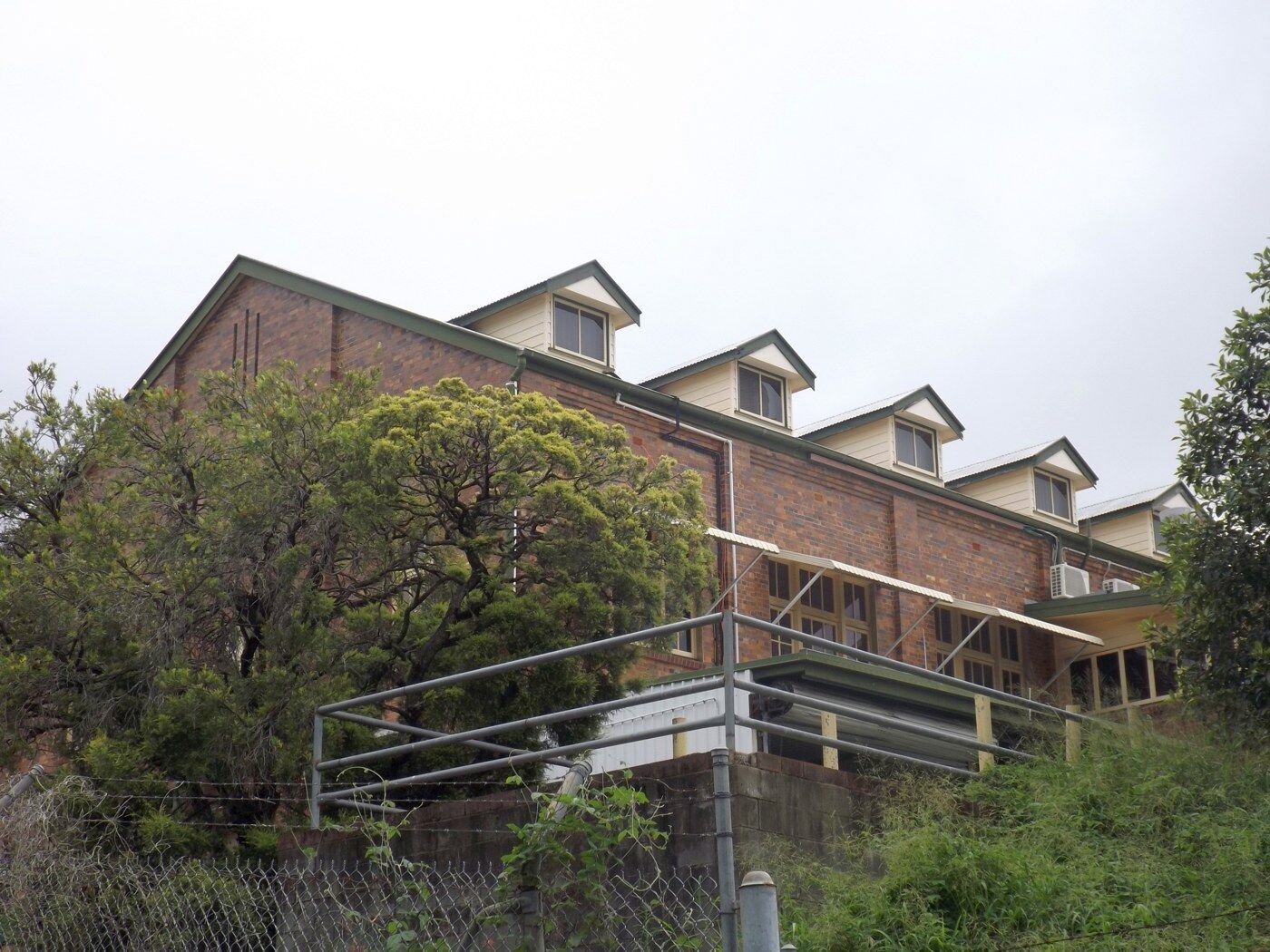
Sources for this section
A hostel for displaced persons
The Director of Migrant Hostels inspected the old factory, then serving as naval barracks, in mid-1948. In December 1948 the Department of Labour and National Service asked the navy for the buildings for Baltic displaced persons, and the site was transferred from the Department of the Interior. In June 1949 a workers’ hostel at Colmslie was reported with a projected capacity of five hundred. The existing factory buildings supplied the accommodation, and timber huts were added; they appear on an April 1949 works map but not on a 1948 site plan. Two of them, used as six-room sleeping blocks, still stood when the site was assessed for the heritage register. By December 1949 the name Colmslie Migrant Hostel was in use in official correspondence.
The distinction mattered in practice. Holding centres, run by the Department of Immigration, took dependants while the family breadwinner worked nearby; workers’ hostels, run by the Department of Labour and National Service, took the worker, and a family could stay together if there was room. Colmslie was a workers’ hostel, and the Commonwealth programme table of 12 April 1949 lists it among the hostels then in operation. A later table of 1951 records it as fully available for displaced-person workers while other Queensland hostels for British families were still being built.
A factory becomes a home
Before migration use, the factory complex formed part of a naval base. Existing buildings were adapted and timber sleeping blocks added around 1949. Commonwealth Hostels Limited assumed management in January 1952.
The conversion placed domestic life inside an industrial layout. Former production buildings provided sleeping rooms, recreation space, shared washing and meals. Rather than a newly designed residential neighbourhood, the hostel was an adaptation of available Commonwealth property.
Factory buildings adapted for daily life
| Former building | Hostel use |
|---|---|
| Acidifier House | Accommodation, dining room and kitchen |
| Evaporator House | Accommodation, ablutions and recreation |
| Alcohol Still House | Accommodation |
| Engine Room | Accommodation and recreation |
| Boiler House | Laundry |
| Engineer’s Office and Fitter’s Shop | Baggage store and assistant manager’s quarters |
| Winch House | Tool room |
| Lime Slacking Store | Office |
| Excise Office, Fertiliser House and Painter’s Shop | Store |
| Two added timber huts | Six-room sleeping blocks |
Sources for this section
From arrival to Queensland settlement
The Ukrainian diaspora encyclopedia describes a relatively small postwar Ukrainian migration to Queensland, initially concentrated in the Brisbane camps. Contract employment took men into northern sugar-cane work, factories and transport. Most later settled in Brisbane, including its southern and southwestern suburbs.
Those regional patterns do not imply that every worker passed through Colmslie. They explain the hostel’s place within a larger movement from temporary accommodation to jobs and independent homes. The same history records smaller Ukrainian groups remaining in regional centres such as Toowoomba, Townsville, Cairns and Mount Isa.
Sources for this section
Work around the hostel
The Courier-Mail reported on 27 December 1949 that eighty Queensland teachers were giving English classes to 1,240 foreign migrants in their spare time, and that three hundred of those migrants were working for the army at Gaythorne, Wallangarra, Cooper’s Plains, Indooroopilly, Bulimba and Colmslie. Foreign migrants were entitled to a year’s free tuition in English, and the classes for the army and air force workers were to continue through the school holidays. The report describes the labour and language arrangements around the site rather than the hostel’s own population.
A survey of Ukrainian education in Australia names Colmslie among the Queensland facilities, with Cairns, Enoggera, Stuart and Wacol, in which Ukrainians were first housed. It sets out the same two-year contract system: men worked where the government directed, and only after completing the contract could they move with their families. It also records that as the camps closed few Ukrainians stayed near them, and that by the mid-1950s only about six per cent of Ukrainians in Australia were in Queensland.
Later residents and closure
Commonwealth Hostels Limited took over the management in January 1952. Although policy directed assisted British migrants to hostels of this kind, non-British residents were still there at the end of the decade: a woman who lived at Colmslie between 1959 and 1962 recalled Germans, Finns, Danes, Yugoslavs and Russians among her neighbours. The manager, Mr Flood, lived in a bungalow surrounded by palms and hibiscus that had been the factory manager’s office and laboratory. After the Nest Egg Scheme of June 1959 allowed British migrants with £500 in savings to come without an accommodation sponsor, Colmslie and the depot at Yungaba were the first places earmarked for the emergency accommodation this created.
In January 1963 the hostel had a capacity of 270 and thirty families in residence. It closed on 31 March 1963, and residents who could not find other accommodation were allowed to move to Wacol. The site appears to have been briefly reactivated in 1965 before closing for good. The waterfront strip, with the naval workshops and slipway, went to the Queensland Fish Board in 1966 and is now the Brisbane fish markets, and Hans Continental Smallgoods occupied the rest of the site in the early 1970s. The heritage assessment notes that the two surviving demountable huts may be among the last examples still standing in Queensland of the temporary accommodation provided for postwar migrants on military property.
Recorded capacity and occupancy
| Date | Figure |
|---|---|
| June 1949 | Projected capacity of 500 persons |
| January 1963 | Capacity 270, with 30 families in residence |
Sources for this section
Sources
- Commonwealth Acetate of Lime Factory (former), Queensland Heritage Register 602465
Queensland Heritage Register, Queensland Government · Entered 7 December 2007; entry last updated 20 January 2016
The official register entry read in full: significance, history and description. The current register site has moved to qhr.detsi.qld.gov.au and the old detail address now returns a not-found page, so the entry was read from the Internet Archive capture of 21 May 2022. Supplies the factory chronology, the 1948 and 1949 transfer to migrant use, the projected capacity of five hundred, the building-by-building hostel uses, the January 1963 figures and the closure.
- Encyclopedia of Ukrainian Diaspora, volume 4: Queensland
Shevchenko Scientific Society · Undated
The Queensland entry names Colmslie and describes Ukrainian employment and settlement across the state.
- Commonwealth Government Hostels
Migration Heritage Project · 2022
The report transcribes archival programme tables, including Colmslie’s entry among the hostels operating on 12 April 1949.
- Commonwealth Acetate of Lime Factory
Shiftchange / Wikimedia Commons · 8 January 2015
Photographer’s own work, released under Creative Commons Zero. Original 3264 by 2448 pixels, taken 8 January 2015, showing surviving brick factory buildings at the site.
- Roman Chamula, Ukrainian Education in Australia
Teoriia i praktyka vykladannia ukrainskoi movy yak inozemnoi, issue 13, Ivan Franko National University of Lviv · 2017
Printed pages 29 and 30 read. Names Colmslie with Cairns, Enoggera, Stuart and Wacol among the Queensland facilities in which Ukrainians were first housed; sets out the two-year contract system; records that few Ukrainians remained near the camps after they closed and that about six per cent of Ukrainians in Australia were in Queensland by the mid-1950s. No Ukrainian population figure for Colmslie itself.
- Migrants go to school, The Courier-Mail (Brisbane), 27 December 1949, p. 3
The Courier-Mail, Brisbane · 27 December 1949
Trove text rendition transcribed verbatim into this project on 12 September 2026 by an earlier worker who read it in a browser. Trove could not be reached again on 13 September 2026 because it is served behind a bot challenge, so the transcript in the project file is what has been relied on. Names Colmslie among the places where migrants worked for the army and describes the English classes provided.
Last researched 12 September 2026