Cornberg
Displacement in Europe
Cornberg, Hesse, Germany · 1945–1949
A mining settlement became a home for displaced Ukrainians. Schools, a driving course, congregations and family life grew among Cornberg’s sandstone houses before residents moved on to new lives overseas.
Introduction
Cornberg’s displaced-persons camp occupied a settlement built for copper-shale miners in Hesse. From late 1945 to June 1949, its rows of sandstone houses accommodated a community that included many Ukrainians displaced by war and forced labour. Families married and raised children here, while schools, congregations and vocational teaching gave structure to everyday life.
The settlement was known as Camp 566 and was associated with UNRRA Area Team 1023. It remained an important centre of Ukrainian life: the United Ukrainian American Relief Committee included Cornberg among the principal camps in the American zone in its June 1948 report.
Sources for this section
- Gemeinde Cornberg: history of Cornberg
- Ukrainians in the UNRRA or IRO Camps of the United States Zone of Germany
- Cornberg DP Camp: Hrynenko family photographs, church history and cemetery images
- UNRRA Camp Cornberg / Historie
- Report of the United Ukrainian American Relief Committee, Inc.: History, Accomplishments, Statistics and Plans
- Cornberg Displaced Persons Camp: family account and transcribed employment certificate
A history in dates
- 1938–1941The sandstone mining settlement is built.
- November 1945The settlement is requisitioned for displaced-person accommodation; earlier residents move to neighbouring villages.
- Christmas 1945An emergency chapel opens following cooperation between Hasenau and Hryhorij Onufrij.
- 1946Olexa Harbuziuk becomes pastor of the Ukrainian Baptist congregation.
- 25 October 1946Anna Maria Zinkewycz and Michael Hrynenko marry at Cornberg.
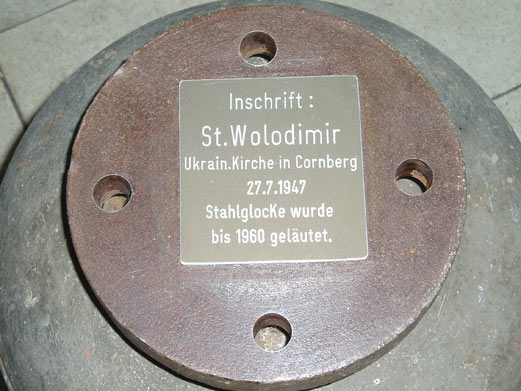
- 27 July 1947The date associated with St. Volodymyr’s Ukrainian Church appears on its surviving bell-identification plaque.
- 4 April 1948Cornberg’s choir sings at a baptismal service in Korbach.
- June 1949Camp use ends and the settlement is released again.
- 1954Cornberg becomes an independent municipality.
- Summer 1956The barracks church burns down.
- November 1960The 1947 steel bell ceases regular use in the new Catholic church.
- 1987The cemetery is redesigned and some original gravestones are preserved elsewhere.
Sources for this section
- Gemeinde Cornberg: history of Cornberg
- Geschichte der Ukrainisch-Katholischen Kirche in Deutschland vom Zweiten Weltkrieg bis 1956
- UNRRA Camp Cornberg / Historie
- Alex Harbuziuk: biography of Olexa Harbuziuk
- Cornberg DP Camp: Hrynenko family photographs, church history and cemetery images
- Alex Harbuziuk: Life in Germany
From mining settlement to displaced-persons camp
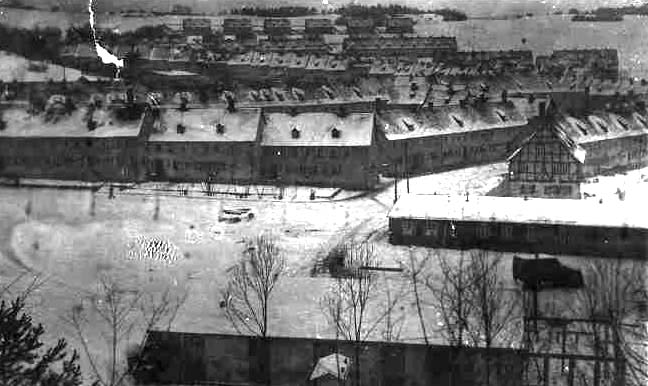
Cornberg was built between 1938 and 1941 for workers in the Kurhessische copper-shale industry. Planners chose local sandstone rather than the half-timbered construction common in neighbouring villages. Bright rows of houses followed the hillside. Wartime conditions curtailed the much larger settlement originally planned, leaving communal facilities unfinished.
Establishing the camp displaced the settlement’s earlier residents. They had to move to neighbouring villages. A local recollection describes leaving furniture in the houses and taking only personal possessions and household necessities; armed American soldiers searched departing carts at a checkpoint.
The municipality dates the requisition to 1 November 1945. The local account and a priest’s later report give 9 November. The precise relationship between these two dates remains unclear, but both place the transition in November 1945.
Homes and a changing population
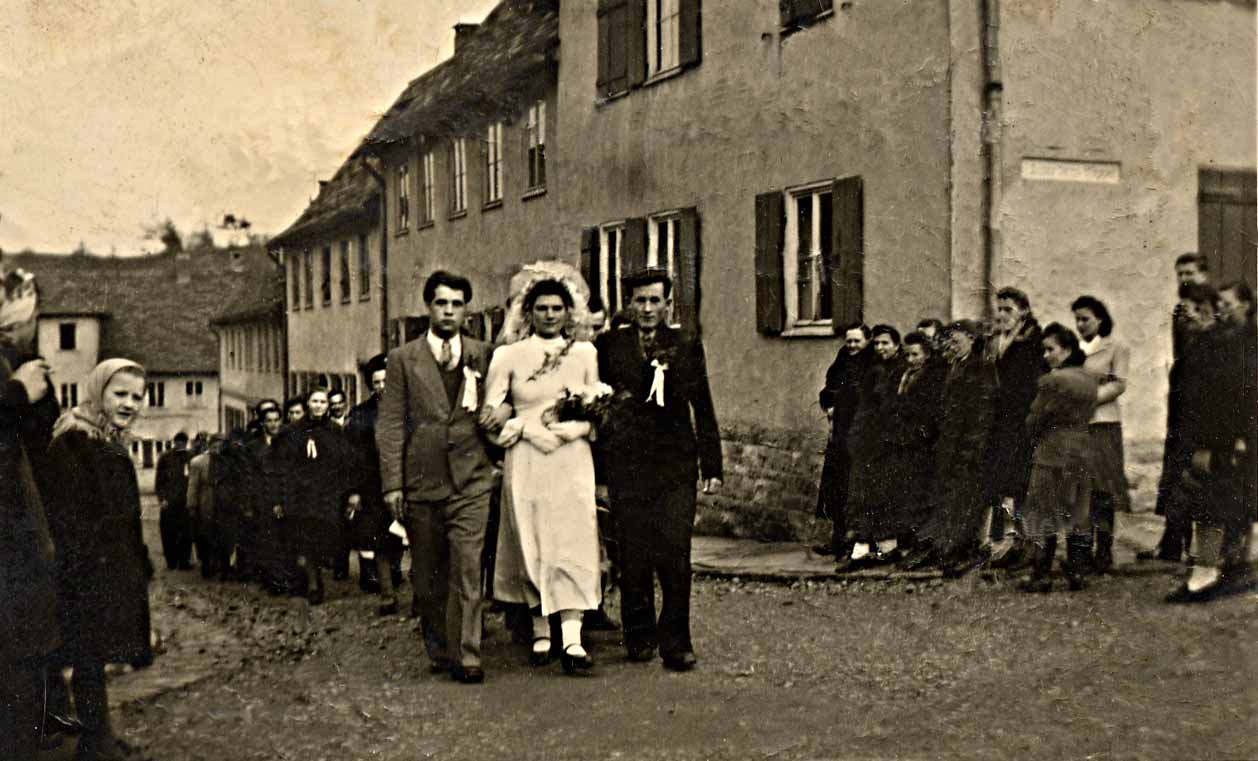
The settlement’s existing houses became the setting for camp life. A winter photograph shows long rows of homes following the slope, with open ground between them. In a 1946 wedding photograph, neighbours watch the bridal party pass along a street beside the houses.
Ihor Stebelsky’s comparative table records 2,481 Ukrainians in August 1946, 1,999 in May 1947 and 2,098 in December 1947. His separate figure of 2,338 comes from questionnaire returns collected during 1946–1947. The municipal description of an initial refuge for about 4,000 eastern Europeans has a broader scope and no precise census date.
Ukrainians recorded at Cornberg
| Reporting period | People | Basis |
|---|---|---|
| August 1946 | 2481 | UNRRA report |
| May 1947 | 1999 | UNRRA report |
| December 1947 | 2098 | PCIRO report |
| 1946–1947, date unspecified | 2338 | Questionnaire returns |
Learning practical skills
Cornberg had an elementary school, a secondary school and a trade school, alongside community organisations. These institutions served a population rebuilding its education and working life after displacement.
One instructor can be named. Wolodymyr Szafranowycz taught at the driving school at Camp 566 from November 1945 through December 1946. A certificate dated 21 January 1947, preserved in transcription by his family, identifies his work, welfare officer D. Davies and UNRRA Area Team 1023.
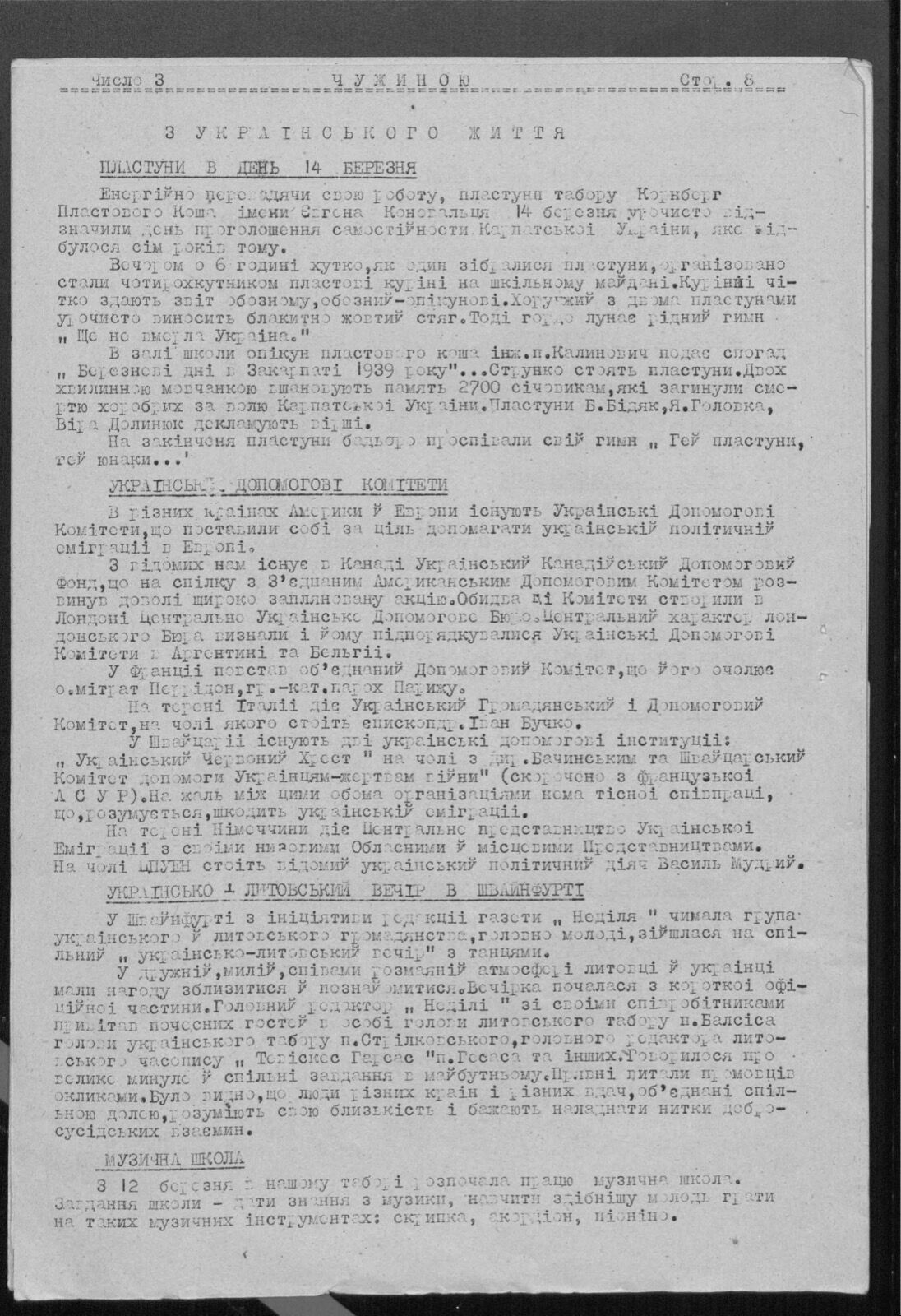
Teaching in the camp was not confined to trades. The same issue of Chuzhynoiu records that a music school began work in the camp on 12 March 1946, its task being to give a grounding in music and to teach the more able young people to play the violin, the accordion and the piano.
Churches, a pastor and a visiting choir
German priest Hasenau and Ukrainian priest Hryhorij Onufrij cooperated in establishing an emergency chapel. In Hasenau’s account, he provided financial help while Onufrij supplied workers. The chapel opened for Christmas 1945. A separate account describes Catholic Christians beginning the barracks church in 1945 and Ukrainians completing it in 1945–1946.
Olexa Harbuziuk became pastor of Cornberg’s Ukrainian Baptist congregation in 1946. According to his son Alex’s biography, he also edited the monthly magazine Doroha Pravdy, meaning The Way of Truth. Stebelsky’s list of two parishes is therefore not a complete inventory of every form of religious life represented in the camp.
Music connected the community with Ukrainians elsewhere. The Harbuziuk family collection identifies the Cornberg choir singing at a baptismal service in Korbach on 4 April 1948. The service took place in Korbach, while the singers came from Cornberg.
The camp’s own paper, Chuzhynoiu, describes how the Plast troop of the Cornberg camp, the Yevhen Konovalets Plast Kish, marked 14 March 1946, the seventh anniversary of the proclamation of the independence of Carpatho-Ukraine. At six in the evening the scouts gathered quickly as one and formed up in a square by troops on the school ground; the troop leaders reported to the camp marshal and he to their guardian, the standard-bearer and two scouts carried out the blue and yellow flag, and the anthem “Shche ne vmerla Ukraina” was sung. In the school hall the troop’s guardian, the engineer Mr Kalynovych, gave a recollection titled “March days in Transcarpathia, 1939”; two minutes’ silence was kept for the 2,700 Sich riflemen who had died a brave death for the freedom of Carpatho-Ukraine; the scouts B. Bidiak, Ya. Holovka and Vira Dolyniuk recited poems; and the meeting closed with the scouts’ own anthem, “Hei plastuny”.
Sources for this section
- Geschichte der Ukrainisch-Katholischen Kirche in Deutschland vom Zweiten Weltkrieg bis 1956
- Cornberg DP Camp: Hrynenko family photographs, church history and cemetery images
- Ukrainians in the UNRRA or IRO Camps of the United States Zone of Germany
- Alex Harbuziuk: biography of Olexa Harbuziuk
- Alex Harbuziuk: Life in Germany
- Chuzhynoiu (Чужиною), number 3, page 8: “Пластуни в день 14 березня”, 1946
The Hrynenko family
Anna Maria Zinkewycz and Michael Hrynenko married at Cornberg on 25 October 1946. Their family’s photograph shows the bride and two accompanying men walking beside the settlement’s houses as other residents look on. The family identifies Anna Maria as coming from Lubaczow and Michael from Rozdol in the Lviv region.
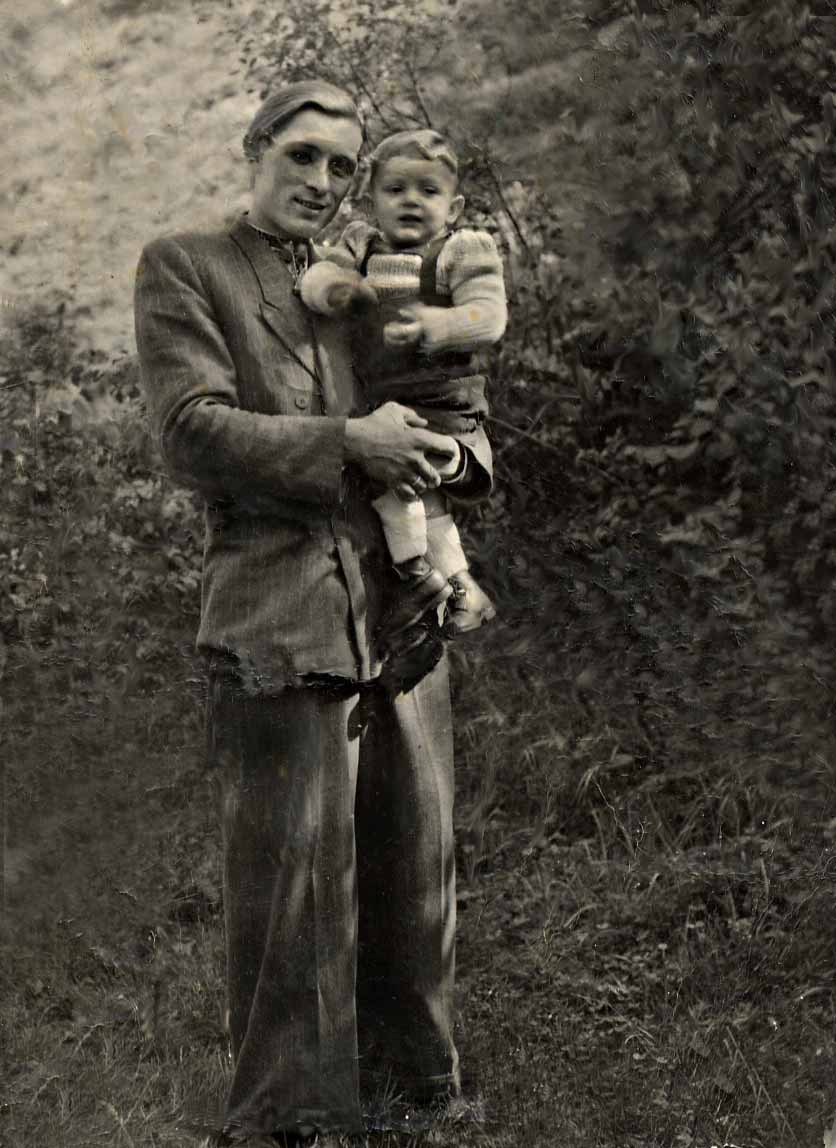
A second family photograph shows Michael holding their two-year-old son Roman at Cornberg in 1949. The family dates it to the period just before their journey to Manitoba, Canada. Marriage and childhood in the camp became part of a family history that continued across the Atlantic.
Sources for this section
Leaving Cornberg
In April 1949, Hasenau expected the Ukrainian community to depart on 29 April. The letter records an intended departure, not a confirmed date for everyone’s removal. The municipality gives 1 June 1949 as the date the settlement was released again; the local history also places the end of camp use in June. That administrative release does not establish when each former household actually returned.
Cornberg became an independent municipality in 1954. Objects from the Ukrainian church continued in use beyond the camp years. The church account describes a memorial stone commemorating 350 years of union between the Ukrainian Church and Rome, with Ukrainian, German and English inscriptions. It associates St. Volodymyr’s Ukrainian Church with the date 27 July 1947.
The barracks church burned down in summer 1956. Its 1947 steel bell continued to ring in the new Catholic church until November 1960, according to the local church account reproduced in the family collection. The surviving identification plaque names St. Wolodimir’s Ukrainian Church in Cornberg and gives 27 July 1947 and 1960.
Graves and memories
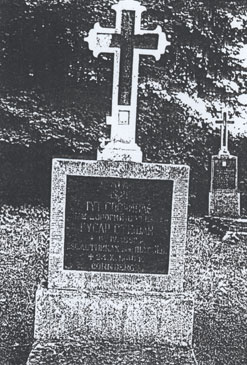
Not every resident lived to leave Cornberg. The local history records the deaths of 45 adults and 22 children during the camp years and their burial in its cemetery. It describes a redesign in 1987 as the old stones deteriorated, with some Cyrillic-inscribed stones preserved behind the cemetery chapel and in the sandstone museum.
Personal accounts also preserve the camp’s history. The Shevchenko Scientific Society Archives catalogues a collection assembled by Juchym Charczenko, a former head of Cornberg’s camp administration. Its description lists memoirs, photographs, correspondence and later writings through 1990—a record of remembering the community long after the camp closed.
Sources
- Gemeinde Cornberg: history of Cornberg
Gemeinde Cornberg · Undated
Municipal historical account; retrieved historical text read.
- Ukrainians in the UNRRA or IRO Camps of the United States Zone of Germany
Ihor Stebelsky / Ukrainian historical publication · 1986
Table 8, printed page 53; community-institution discussion on printed page 47. Page image and source footnotes checked.
- Alex Harbuziuk: biography of Olexa Harbuziuk
Rev. Harbuziuk Legacy · Undated
Family-authored biographical text containing attributed testimony from Olexa Harbuziuk’s son Alex.
- Alex Harbuziuk: Life in Germany
Rev. Harbuziuk Legacy · Undated
Family-history text and captions; images and original scans were not visually reviewed.
- Report of the United Ukrainian American Relief Committee, Inc.: History, Accomplishments, Statistics and Plans
United Ukrainian American Relief Committee, Inc. · 30 June 1948
Contemporary organisational report; principal-camps list on printed page 18 is selective.
- Cornberg Displaced Persons Camp: family account and transcribed employment certificate
Peter Shafron/Szafranowycz and Michigan Family History Network · Undated
Family account and transcribed employment certificate dated 21 January 1947. The original certificate is not claimed as image-verified.
- Geschichte der Ukrainisch-Katholischen Kirche in Deutschland vom Zweiten Weltkrieg bis 1956
Bernadetta Wojtowicz · 2000
Printed page 162, notes 517–518; PDF page 163. Relevant pages checked; quoted original letter not independently inspected.
- Cornberg DP Camp: Hrynenko family photographs, church history and cemetery images
Hrynenko family history collection / Michigan Family History Network · Undated
Full source-page text read. Five supplied images visually inspected. Family identities and dates are attributed to the captions. Image 4 is a bell-identification plaque, not the memorial stone. Photographers and reproduction licences are not established.
- Juchym Charczenko collection on the Displaced Persons camp in Cornberg, Germany
Shevchenko Scientific Society Archives · 1945–1990
Collection 001, Box 00686. Catalogue description and dates 1945–1990 only; unprocessed placeholder record, physical contents not inspected.
- UNRRA Camp Cornberg / Historie
Local Cornberg historical website · Undated
Local retrospective account of the camp period, population, cemetery, cemetery redesign and 9 November 1945 clearance; text read, complete image collection not visually inspected.
- Chuzhynoiu (Чужиною), number 3, page 8: “Пластуни в день 14 березня”, 1946
Ukrainian Museum-Archives of Cleveland, DP Camp Periodicals Collection, via the Internet Archive · 1946
Marked in the collection as public domain or an orphan work and offered under CC BY-NC-ND 4.0. Chuzhynoiu (Чужиною) was published by the educational department of the Cornberg camp. Under the standing head “З українського життя” the page reports the camp’s Plast troop on 14 March 1946, the Ukrainian relief committees abroad, a Ukrainian and Lithuanian evening at Schweinfurt, and the opening of a music school in the camp.
Last researched 12 September 2026