Damloup-Kaserne
Displacement in Europe
Rheine, North Rhine-Westphalia, Germany · Postwar displaced-persons camp; Ukrainian residents documented 1949
Former barracks in Rheine became a temporary home for Ukrainians after the war. Contemporary notices, a report of a public demonstration and Westphalian labour records show residents searching for relatives, working outside the town and making their experiences heard beyond the camp.
Introduction
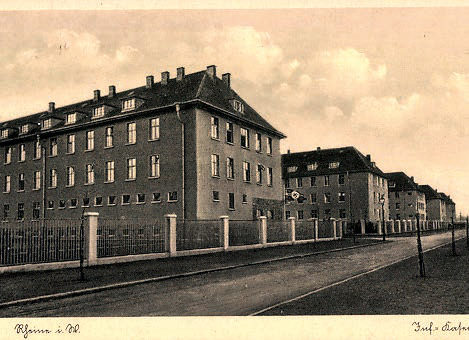
Damloup-Kaserne stood on Mittelstraße in Rheine’s Dorenkamp district. Built for the German army, it was used after the war as a transit camp for displaced people. Ukrainians were among its residents: their addresses appear in a Ukrainian periodical, and a contemporary report describes hundreds of Ukrainian men and women living there.
A history in dates
- October 1936An infantry battalion occupies the barracks.
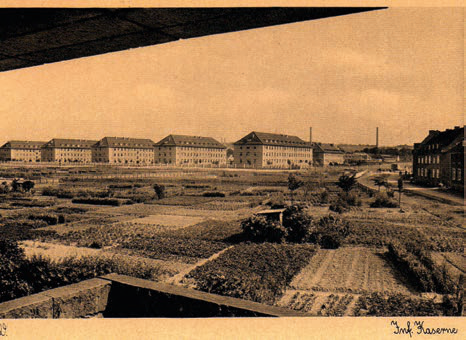
- From 1946The adjoining hutted Lager A is gradually cleared; a sports ground opens on the parade square in 1948.
- 16 January 1947A labour-office return records about 250 Ukrainians and Poles from a camp near Rheine clearing rubble in Münster.
- After 1945The site is used for displaced-persons transit accommodation.
- February 1949Hromada prints Damloup camp correspondence addresses.
- 6 November 1949Ukrainian residents demonstrate in Rheine’s market square.
- 1955The barracks accommodate refugees from the Soviet zone.
- 1958The Bundeswehr location administration moves into Damloup.
- Early 1959The first Bundeswehr recruits arrive in Rheine.
- 2014Military use ends.
- January 2022Rheine purchases the former barracks site.
Sources for this section
- Zur Geschichte des Stadtteils bis zum Wiederaufbau nach dem Zweiten Weltkrieg
- Trümmerräumung durch Displaced Persons
- Hromada, no 3–4 (27–28), February 1949
- ABN im Spiegel der deutschen Presse
- Vierzig Jahre Standort Rheine
- Städtebauliche Fallstudie für einen energieautarken Stadtumbau am Beispiel der Damloup Kaserne in Rheine
- Stadt Rheine übernimmt offiziell die Damloup-Kaserne
From military barracks to temporary home
Rheine became a garrison town in 1936. The town handed the military authorities a six-hectare site on Mittelstraße, and in October 1936 the third battalion of Infantry Regiment 79 moved into the newly built Damloup-Kaserne, named after a village near Verdun that had been bitterly fought over in the First World War. Because the permanent buildings were not enough, the barracks were extended by a hutted camp known as Lager A, between Mittelstraße, Darbrookstraße, Bühnertstraße and Im Sundern, where units of the Reich Labour Service and later the Wehrmacht were stationed.
After 1945, the military buildings were put to civilian use. Damloup first accommodated displaced people and later German expellees and refugees from the Soviet occupation zone. These successive uses explain why sources describe different kinds of residents at the same address.
Sources for this section
Ukrainian residents and family tracing
The Paris-based periodical Hromada printed notices from people trying to find relatives and acquaintances scattered by the war. Its February 1949 issue includes correspondence addresses at the Rheine DP camp in Damloup-Kaserne. This is direct contemporary evidence of the camp’s place within Ukrainian networks of communication.
A camp address could connect a person in Germany with readers living elsewhere in Europe. The notices show that recovery after displacement involved more than finding shelter: it also meant discovering who had survived and where family members had gone. They do not establish that the missing people themselves lived at Damloup.
Organised Ukrainian life at Rheine left a trace outside the town as well. A study of the Lintorf camp near Düsseldorf records that the Ukrainian church choir from Rheine and Lingen performed there on 1 December 1952. The choir is described by town rather than by camp, and by that date the Ukrainian population recorded at Rheine had already fallen a long way from its 1946 level.
Work beyond the camp
Displaced people accommodated at Rheine were sent out to work elsewhere in Westphalia. A labour-office return of 16 January 1947, held in the Staatsarchiv Münster, records about 250 Ukrainians and Poles from a camp near Rheine employed as male labour on the rubble clearance in Münster; a study of that work notes that January 1947 is the only month for which the origin of the workers can be established with certainty. The return says a camp near Rheine, not Damloup-Kaserne, and the town had more than one place of accommodation.
Numbers on the clearance fluctuated sharply. In February 1947 some 300 displaced people were at work, 600 to 700 after the March frosts and only 62 by May, when 500 were withdrawn altogether. The study attributes much of this to British priorities, since from 1947 the occupation authorities were offering resettlement or work in Britain to exactly the fit young men the German administration wanted for the rubble.
Displaced-persons labour on the Münster rubble clearance, 1947
| Date | Reported number at work | Note |
|---|---|---|
| 16 January 1947 | About 250 | Ukrainians and Poles from a camp near Rheine, male labour |
| February 1947 | 300 | All displaced people on the clearance |
| After the March frosts | 600–700 | All displaced people on the clearance |
| May 1947 | 62 | 500 having been withdrawn |
Sources for this section
Speaking beyond the camp
On 6 November 1949, Ukrainian residents gathered in Rheine’s market square for an anti-Soviet demonstration. A local newspaper report, reprinted the following month in ABN-Korrespondenz, described hundreds of men and women from Damloup-Kaserne, blue-and-yellow flags, speeches in German and a concluding Ukrainian song.
The report shows residents addressing the town around them rather than remaining invisible behind a camp address. Because it was reproduced by the anti-Bolshevik movement, it is best read as evidence of this public event and its organisers’ message, not as proof that every resident shared the same politics.
Sources for this section
Rheine in the population returns
Ukrainian relief statistics and UNRRA and IRO returns list Rheine across six reporting dates. The figures below describe the published Rheine entry. They are not a verified census of Damloup alone: a compiled camp directory records two camps at Rheine in the British zone under the numbers 3157 and 31/157, with Poles, Ukrainians and others, and the town also contained Gellendorf and Barackenlager B.
The figures document a declining Ukrainian population across the reporting period. They cannot tell us how much of that change came from overseas emigration, transfers between camps or movement into ordinary housing.
Ukrainians recorded under Rheine
| Date | Ukrainians |
|---|---|
| 1946–47 | 1,911 |
| May 1947 | 1,892 |
| December 1947 | 1,881 |
| July 1949 | 1,108 |
| December 1950 | 736 |
| August 1951 | 439 |
A changing site
The hutted Lager A beside the barracks was wound up from 1946 onwards. A local sports club laid out a new ground on the former parade square and began playing there in 1948; work on a new municipal school started on the rest of the land in 1953, although the last huts survived until 1979. The permanent barracks followed a different course: military administration returned in 1958, the first recruits arrived at the start of 1959, and Rheine grew into the second-largest Bundeswehr garrison in North Rhine-Westphalia.
By 1955, Damloup was a transit centre for roughly 1,500–2,000 refugees from the Soviet zone. A separate 400–600 displaced people lived at Barackenlager B on Schorlemerstraße. These totals concern different sites and populations. The new Bundeswehr location administration was established in 1958 and occupied rooms at Damloup.
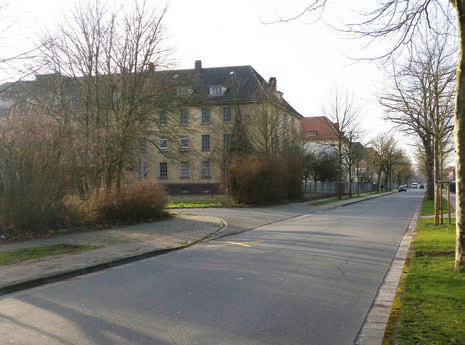
Military use finally ended in 2014. Temporary refugee reception resumed in 2015, decades after the Ukrainian DP period. In January 2022, Rheine bought the former barracks site for redevelopment as the Europa-Viertel am Waldhügel. The 1936 photographs and later street view preserve the physical setting through these changes.
Sources
- Zur Geschichte des Stadtteils bis zum Wiederaufbau nach dem Zweiten Weltkrieg
IG Dutum-Dorenkamp · Accessed September 2026
Local history with references: Damloup at Mittelstraße, 1936 military occupation, DP transit use, subsequent German refugees and 1958 military administration.
- Hromada, no 3–4 (27–28), February 1949
Hromada, Paris; digitised by Diasporiana · Accessed September 2026
Original issue cover visually checked. Family-tracing notices give DP Camp Rheine, Damloup-Kaserne addresses. No personal names or tracing-page image reproduced.
- ABN im Spiegel der deutschen Presse
ABN-Korrespondenz, December 1949, no 4, p 7 · Accessed September 2026
Original page visually checked. Reprints Rheiner und Steinfurter Nachrichten, 8 November 1949, about 6 November rally by Ukrainian Damloup residents. Partisan publication and reprinted report identified.
- Ukrainians in the Displaced Persons Camps of Austria and Germany, Table 7
Ihor Stebelsky, The Ukrainian Historian (Ukrainskyi Istoryk) 23, nos 3–4 (1986), pp 50–52 · Accessed September 2026
Original table and heading visually checked. Table 7 covers the British zone; Rheine locality counts of 1,911, 1,892, 1,881, 1,108, 736 and 439 across 1946–1951; not assigned exclusively to Damloup.
- Vierzig Jahre Standort Rheine
Traditionsverband Logistik Rheine · Accessed September 2026
Garrison history, pages 3–4: in 1955 Damloup was a transit camp for German refugees, distinct from the DP accommodation at Barackenlager B. Military administration established 15 October 1958.
- Städtebauliche Fallstudie für einen energieautarken Stadtumbau am Beispiel der Damloup Kaserne in Rheine
EWG Rheine; WoltersPartner and project partners, May 2018 · Accessed September 2026
Original page 61: historic 1936 and modern photographs; source 53 is Archiv des photohistorischen Arbeitskreises Rheine. Military use ended in 2014; temporary refugee reception resumed in 2015.
- Stadt Rheine übernimmt offiziell die Damloup-Kaserne
Bundesanstalt für Immobilienaufgaben · Accessed September 2026
Official 2022 property transfer report: January 2022 purchase, ten-hectare redevelopment as Europa-Viertel.
- Menschen am falschen Ort: Displaced Persons in der Damloup-Kaserne 1945–1952
Angelika Pries, Rheine–gestern heute morgen 2/2025; bibliographic notice by Westfälischer Heimatbund · Accessed September 2026
Relevant 2025 article identified in an institutional bibliography; full text not accessed and not used to substantiate narrative claims.
- Trümmerräumung durch Displaced Persons
Stefan Schröder, Westfälische Zeitschrift 147 (1997) · 1997
Printed pages 225 and 230 read. Footnote 20 cites Staatsarchiv Münster, Arbeitsämter Nr 2073, return of 16 January 1947: about 250 Ukrainians and Poles from a camp near Rheine on the Münster rubble clearance. Monthly totals of DP labour and the effect of British resettlement offers from 1947. The source says a camp near Rheine and does not name Damloup.
- Displaced Persons Camps – Germany R (Rheine entry)
dpcamps.org · Accessed September 2026
Compiled directory read in full: two camps at Rheine, British-zone numbers 3157 and 31/157, mostly Poles and Ukrainians. Used only to show that Rheine had more than one camp; not used for dates, capacities or population figures.
- Das Lager Lintorf
Ruth Braun, Die Quecke 65 (1995), p 60 · 1995
Records the performance of the Ukrainian church choir from Rheine and Lingen at the Lintorf camp on 1 December 1952. Evidence of organised Ukrainian church life at Rheine; the choir is identified by town, not by camp.
Last researched 13 September 2026