Luitpold-Kaserne
Displacement in Europe
Dillingen an der Donau, Germany · 1945–1950/1951
Schools, worship, workshops and a camp currency shared the Luitpold barracks, first as a Polish centre and then as one of the larger Ukrainian communities in Swabia. A resident’s 1949 watercolour and a plaque in the Studienkirche preserve the Ukrainian part of that history.
Introduction
Luitpold-Kaserne housed a substantial Ukrainian displaced-persons community in Dillingen an der Donau. It also appears in earlier records as the Polish D.P. Center Luitpold. Both descriptions belong to its history. The nearby Ludwig-Kaserne was a separate camp, especially associated with Lithuanian residents; its figures and institutions cannot simply be assigned to Luitpold.
A history in dates
- Summer 1945The Polish D.P. Center is established at Luitpold-Kaserne under UNRRA Team 308.
- June 19452,551 Polish residents are recorded, including more than 300 children.
- November 1945School lessons and vocational training begin for about 700 pupils.
- June 1946A UNRRA letter records a points system for canteen and amenity supplies operating across the Dillingen district; the scheme reached the Nördlingen camp in the same month.
- 22 August 1946UNRRA reports 200 Polish Ukrainians screened at Dillingen under Team 308.
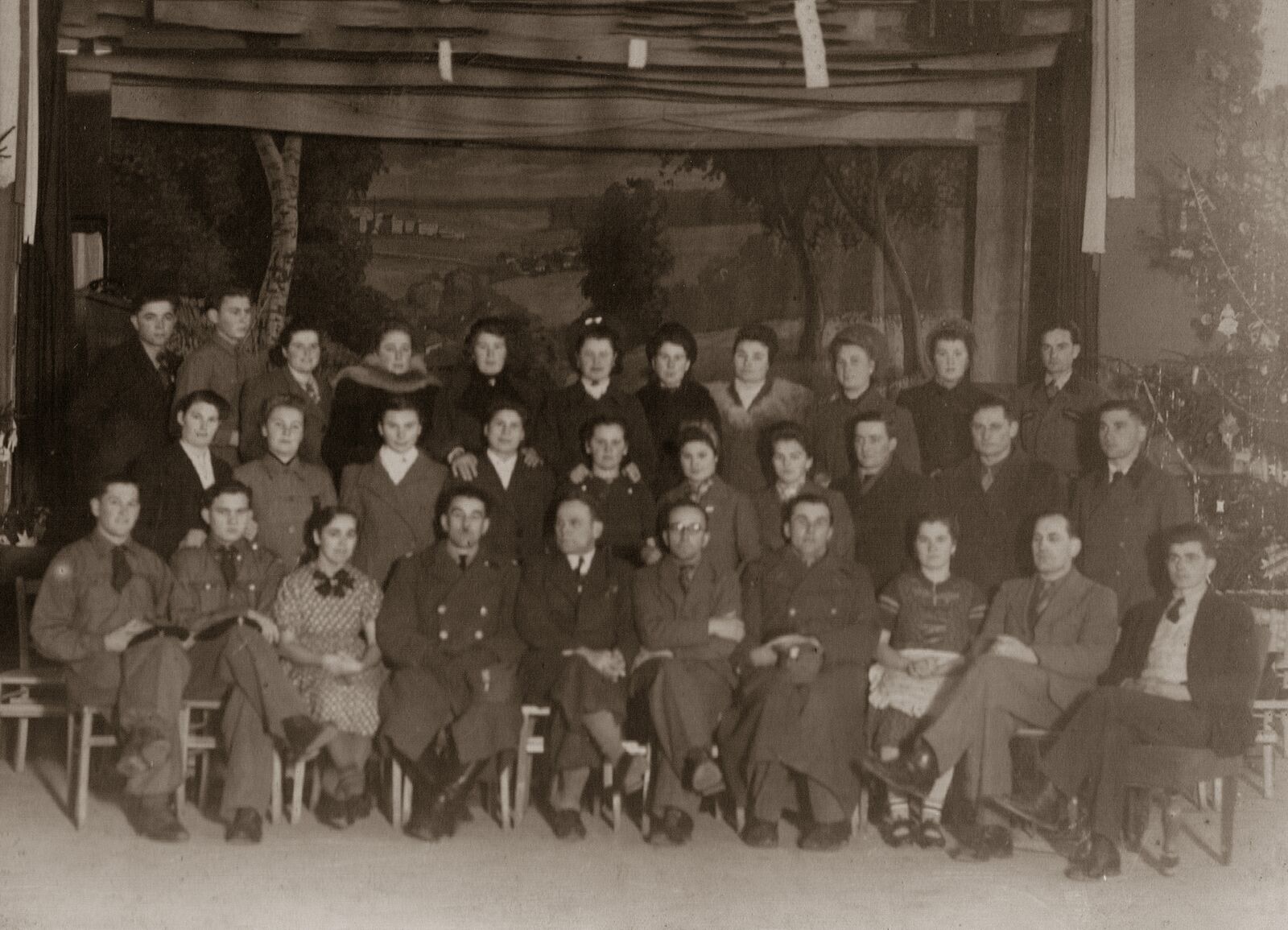
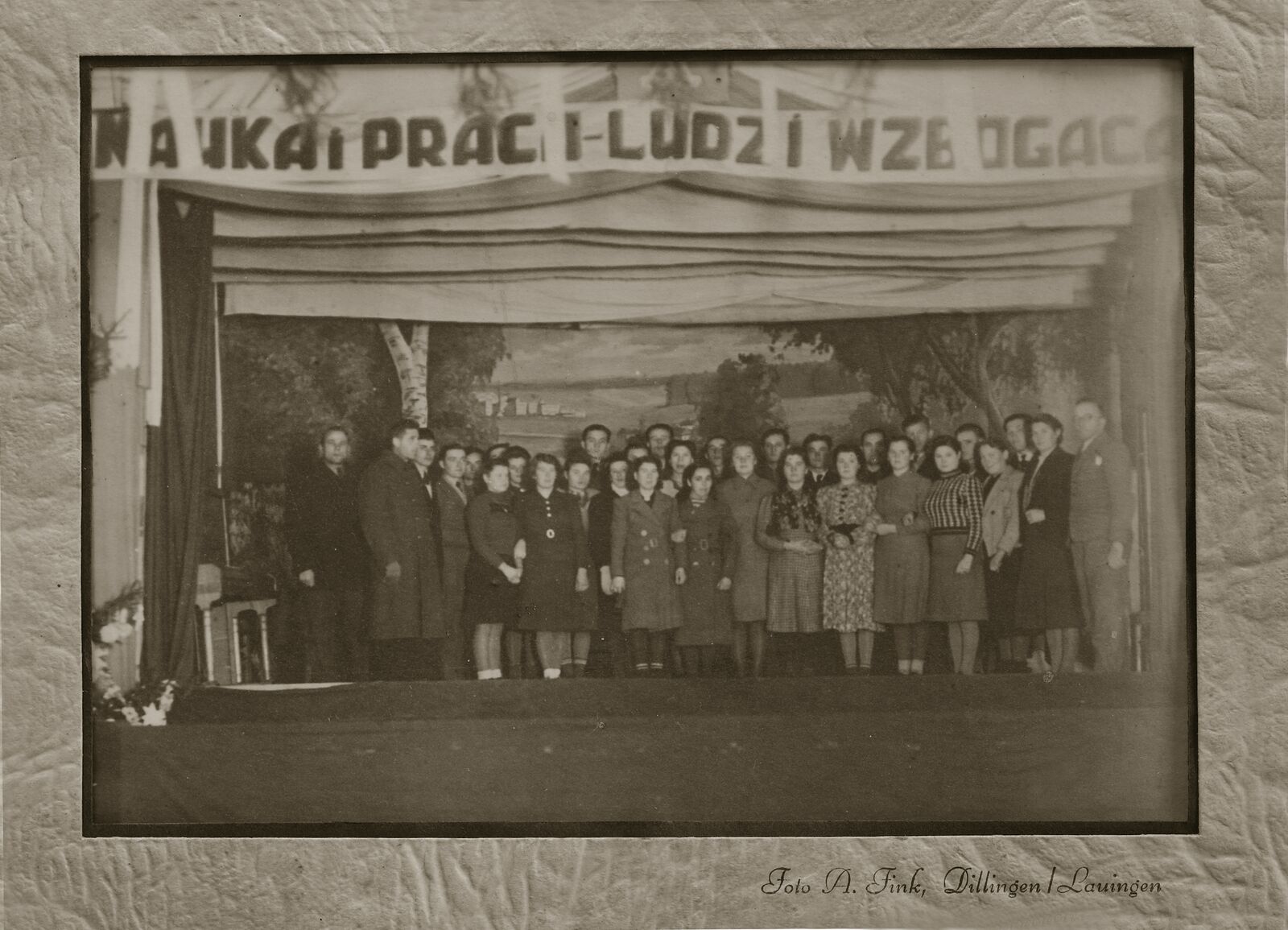
- Christmas 1946430 small children receive presents; the Polish church choir is photographed.
- May 1947A published return records 1,655 Ukrainians.
- July 1947The International Refugee Organisation begins taking over from UNRRA.
- 1 October 1947Strength reports for the Luitpoldkaserne and Ludwigskaserne camps are issued; the recorded names are entered into the Central Name Index.
- 30 June 1948Luitpoldkaserne appears in the Ukrainian relief committee’s main-camp list.
- 1949A resident watercolour documents Ukrainian school, church and living quarters.
- 30 September 1950 – 31 March 1951Closure interval recorded in the administrative inventory.
- Early 1960sThe barrack buildings are demolished.
Sources for this section
- Alte–Neue Heimat Dillingen: Das DP-Lager Dillingen
- Lithuanian camps in postwar Germany issued their own money
- Report on the screening of Ukrainian displaced persons, 22 August 1946
- The Refugee Experience: Table 7
- Strength reports of the Luitpold and Ludwig barracks DP camps, Dillingen an der Donau
- Report of the United Ukrainian American Relief Committee
- Denysenko Drawings: PJRC update no.10
- DP camp inventory: Dillingen entries 862–863
The first postwar community
The municipal archive describes a Polish DP centre established in summer 1945 under UNRRA Team 308, among the largest displaced-persons camps in Swabia. As early as June 1945 it held 2,551 Polish residents: 1,118 men, 687 women and more than 300 children in over 300 families. People slept in improvised dormitories of stacked beds, in former factory halls roughly converted into quarters. The neighbouring camp at Lauingen, with about 1,375 Polish residents, belonged to the same pastoral district, as did six American guard companies. From July 1947 the International Refugee Organisation took over from UNRRA by stages.
Redemptorist priests sent by the Polish military chaplaincy served the camp. One took up work in Augsburg on 8 June 1945 and was sent to Dillingen a month later to replace an injured colleague; with a third priest he cared for the Polish faithful at Dillingen and Lauingen, and by October 1945 they had blessed 107 marriages at Dillingen and 80 at Lauingen. Sunday services took place in the town’s Studienkirche, while weekday services used a camp chapel fitted out in a former cinema hall with a plain movable altar and a wooden cross. When one of the priests was killed in a car accident in June 1946, about 3,000 people attended the burial with more than 80 banners.
From November 1945 the camp ran school lessons and vocational training for about 700 pupils, with scout groups for boys and girls and a choir that sang at services. At Christmas 1946, 430 small children were given presents donated by UNRRA and the American Red Cross, and children from Lithuanian, Latvian and Estonian families took part; choirs from neighbouring camps sang together. Camp photographs preserve that organised communal life, including a Polish church choir at Christmas 1946 and a women’s choir at a vocational graduation. These are images of the Polish community, not photographs identified as Ukrainian performances.
Sources for this section
Ukrainian life in the barracks
Ukrainians appear in the camp record from 1946 onwards. The UNRRA liaison office at Augsburg reported on 22 August 1946 that 200 Polish Ukrainians had been screened at Dillingen under Team 308; the same report warns that no accurate breakdown of Ukrainians was possible, because screening teams reported unevenly and military authorities were still unsure how to classify Ukrainians by citizenship and nationality.
The Ukrainian American relief committee’s report of 30 June 1948 lists Dillingen’s Luitpoldkaserne among its main American-zone camps. Published Ukrainian population returns give 1,655 residents in May 1947 and 1,362 in December 1947, against 300 in August 1946 and 1,656 in the questionnaire returns collected during 1946 and 1947. The camp was therefore part of the Ukrainian institutional network even while administrative records kept a Polish or Polish-Ukrainian label.
A watercolour dated 1949 depicts a building containing family accommodation, a Ukrainian Orthodox church and a Ukrainian school. The church entrance had a small porch topped by a cross, with a bell beside it. The university library that holds the drawing describes how these different uses occupied adjoining parts of the same building. Services in the Studienkirche were held in Polish and in Ukrainian, and a plaque there commemorates the Ukrainian services today.
Recorded figures for the Luitpold camp
| Date or period | Measure | Figure |
|---|---|---|
| June 1945 | Polish residents | 2,551 |
| 1946–7 | Ukrainians, questionnaire returns | 1,656 |
| August 1946 | Ukrainians | 300 |
| 22 August 1946 | Polish Ukrainians screened at Dillingen, Team 308 | 200 |
| May 1947 | Ukrainians | 1,655 |
| December 1947 | Ukrainians | 1,362 |
| 31 October 1947 | Recorded capacity | 1,900 |
Camp money and daily needs
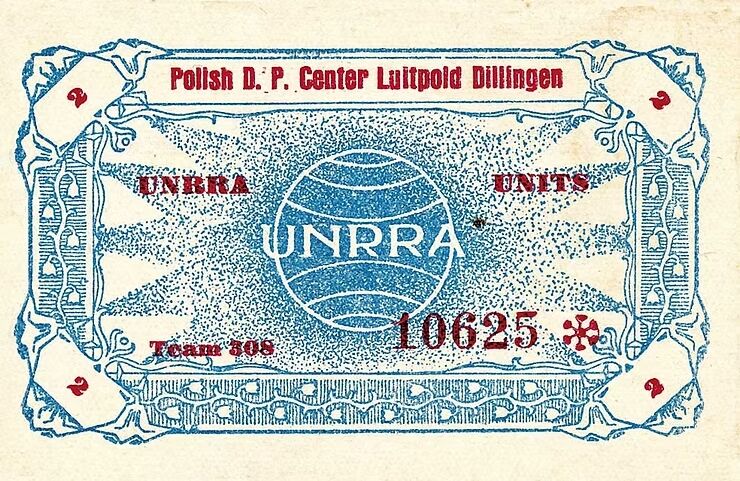
Surviving paper money carries the name Polish D.P. Center Luitpold and UNRRA Team 308, in denominations from 1 to 50 units. The notes replaced a Reichsmark that had lost its value and were used inside the camp, in the canteen and the workshops. They were designed by a Lithuanian artist who had fled his country in 1944 and who ran an art studio at the Lithuanian gymnasium in Dillingen from 1946 to 1948; his initials appear in the border ornament.
The camp money belonged to a wider district scheme. A Lithuanian numismatic account quotes a UNRRA letter of 17 June 1946 recording that Team 308 had “a Point system operating for P.X. and amenity supplies”, whose object was “to allow a fair distribution of supplies to all camp dwellers, with special facilities offered to the various working groups”. The same account places the Lithuanian camp at Ludwig in that district, with money issued in two printings, the first on white paper and the second on light-violet paper, and states that UNRRA officials used the same basic design for the Polish money issued at Luitpold. The system reached the camp at Nördlingen, fifty-five kilometres away, which held 500 Latvian and Lithuanian residents and whose notes began to circulate in June 1946.
Denominations of Luitpold camp money
| Issue | Units |
|---|---|
| UNRRA Team 308 | 1, 2, 5, 10, 20, 50 |
Following the camp into 1949 and beyond
The 1949 watercolour is important evidence that the Ukrainian community continued after 1948. The administrative inventory places closure between 30 September 1950 and 31 March 1951, and an earlier endpoint given in a recent local account cannot describe the full Ukrainian camp phase. Remaining residents were moved to other institutions, the site passed to German authorities, the buildings were demolished in the early 1960s, and a modern barracks area now stands on the ground.
In the records, nationality labels, administrative numbers and dates changed while people moved between institutions. Reading those records alongside a contemporary relief directory and images of school and church life produces a fuller history than treating Luitpold as exclusively Polish or exclusively Ukrainian throughout its existence.
The Dillingen municipal holdings include a file of strength reports for the Luitpoldkaserne and Ludwigskaserne camps issued on 1 October 1947, twelve inventoried pages preserved as thirteen digital reproductions. The archival description records that the names in these reports have been entered into the Central Name Index. It gives no breakdown by nationality and does not separate the two camps.
Three Dillingen facilities kept apart
| Facility | Identifier | Recorded description |
|---|---|---|
| Luitpold-Kaserne | AC 94-272; S 514 | Polish-Ukrainian and stateless; capacity 1,900 |
| Ludwig-Kaserne | AC 94-273; S 513 | Lithuanian, Estonian and Polish-Ukrainian; capacity 1,100 |
| Dillingen D.P. Hospital | Listed only in the population table | 36 Ukrainians in May 1947 |
Sources
- DP camp inventory: Dillingen entries 862–863
Arolsen Archives · 26 October 2023
Record 863, Polish-DP-Camp / Luitpold-Kaserne, Dillingen an der Donau: opening 24 January 1946 in the inventory’s own reckoning, closing between 30 September 1950 and 31 March 1951, AC 94-272 and later S 514, UNRRA Teams 308 Dillingen and 165 Leipheim, nationalities Polish-Ukrainian and stateless, capacity 1,900 at 31 October 1947. Record 862 is the separate Ludwig-Kaserne. Capacity is an accommodation figure, not a census.
- Report of the United Ukrainian American Relief Committee
United Ukrainian American Relief Committee · 30 June 1948
Printed p. 18.
- The Refugee Experience: Table 7
Canadian Institute of Ukrainian Studies · 1992
Printed pp. 47–48, Table 7. Columns 1946–7, August 1946, May 1947 and December 1947, assigned by position in the scan: Luitpold Camp 1,656, 300, 1,655 and 1,362. The Dillingen D.P. Hospital is a separate row with 36 in May 1947.
- Alte–Neue Heimat Dillingen: Das DP-Lager Dillingen
Stadtarchiv Dillingen · 12 March 2026
Original post and captioned images read in full. Establishment and June 1945 figures, UNRRA Team 308 and the IRO handover, Redemptorist chaplaincy, the cinema chapel and Studienkirche, schooling from November 1945, Christmas 1946, the camp currency and its Lithuanian designer, demolition in the early 1960s and the plaque for Ukrainian services. Its “until about 1948” closure is not adopted; its demographic breakdown is for the Polish community of June 1945.
- Denysenko Drawings: PJRC update no.10
Petro Jacyk Resource Centre, University of Toronto · Fall 2017
Indexed description on original page 7 read; the old direct PDF link now redirects. No unpublished personal names reproduced.
- Report on the screening of Ukrainian displaced persons, 22 August 1946
UNRRA Liaison Office, 9th Infantry Division Headquarters, Augsburg; reproduced in Yury Boshyk (ed.), Ukraine during World War II (CIUS, 1986) · 22 August 1946
Document 16, printed pp. 223–224; UN Archives PAG-4/3.0.11.0, 1.4:2. “Dillingen, Team 308, had 200 Polish Ukrainians screened”. The report names the town and team only, without separating Luitpold-Kaserne from Ludwig-Kaserne.
- Strength reports of the Luitpold and Ludwig barracks DP camps, Dillingen an der Donau
Kreisstadt Dillingen, described through the EHRI portal · Records dated 1 October 1947; description 22 April 1996
Archival unit description read in full. It covers strength reports of the Luitpoldkaserne and Ludwigskaserne displaced-persons camps issued on 1 October 1947, twelve inventoried pages held as thirteen digital reproductions, with the recorded names entered into the Central Name Index. No nationality breakdown is given.
- Lithuanian camps in postwar Germany issued their own money
VilNews, article by Frank Passic; reference material credited to the Balzekas Museum of Lithuanian Culture, Chicago · 2012
Sections headed Ludwig and Nordlingen read in full. They place the Lithuanian camp at Ludwig in the Dillingen UNRRA district under Team 308, describe its two paper issues, quote a UNRRA letter of 17 June 1946 on the district points system, and record the extension of that system to Nordlingen in June 1946.
Last researched 13 September 2026