Oberst-Drausnick-Kaserne
Displacement in Europe
Erlangen · Germany · Registered 24 January 1946, closed 15 September 1949
Erlangen’s former infantry barracks housed a Baltic-led displaced-persons community registered for 1,950 people that also included Polish, Jewish and Ukrainian residents. Lithuanian schools, a parish and student associations grew inside it, and its address appeared in international refugee publishing before the buildings returned to civilian use in 1950.
Introduction
The Oberst-Drausnick-Kaserne became one of Erlangen’s postwar homes for displaced people. Known administratively as the Baltic DP Camp, it accommodated Latvians, Lithuanians and Estonians alongside Polish, Jewish and Ukrainian residents. The inventory’s spelling “Brausnick” refers to the barracks named Drausnick in contemporary newspapers and the official heritage register.
The barracks camp should not be confused with the organised Jewish DP community of Erlangen, which had its own address in the town at Bohlenplatz 18, with a prayer room, a vocational school and a students’ union at the university, and which numbered between 34 and 80 members between 1946 and 1949. The inventory’s Jewish category for the barracks and that town community are separate records.
A history in dates
- 1890–1893The infantry barracks are built.
- 16 April 1945Erlangen surrenders to American troops.
- 1946A district of the Lithuanian exiles’ community is founded at Erlangen, with a parish, a Red Cross branch and a primary school.
- Autumn 1946The Streitberg centre under Team 549 closes.
- 24 January 1946The inventory records the Baltic camp as opening under UNRRA Team 549.
- 1947About 200 Lithuanians live in the camp, and 97 Lithuanian students are enrolled at the university.
- Late summer 1947The Forchheim centre under Team 549 closes.
- 31 October 1947The recorded camp capacity is 1,950.
- December 1947The published Ukrainian table counts 776 Ukrainians at Erlangen as a locality.
- 1948Correspondence courses in radio engineering are organised in the camp.
- After 1949Most of the Lithuanians leave Erlangen, chiefly for the United States.
- 30 July 1949Latvija’s masthead identifies its publisher at the camp address.
- 15 September 1949The camp inventory records closure.
- 8 November 1949The Bavarian parliament debates new uses for the released barracks.
- March 1950The barracks are released for housing and commercial conversion.
- 1 August 1950A tavern licence is issued for the former gatehouse canteen.
Sources for this section
- Erlangen listed buildings, D-5-62-000-1294
- Gaststätte Torwache
- Erlangen
- DP camp inventory: the Erlangen officers and the other Team 549 camps
- DP camp inventory, record 900: Baltic-DP-Camp / Oberst-Brausnick-Kaserne
- Ukrainian DP population table, Table 7
- Latvija, 30 July 1949, no 78(302)
- Bavarian Landtag, 8 November 1949, p 95
- Wohnungsnot und Wohnungsbau in Erlangen
The former infantry barracks
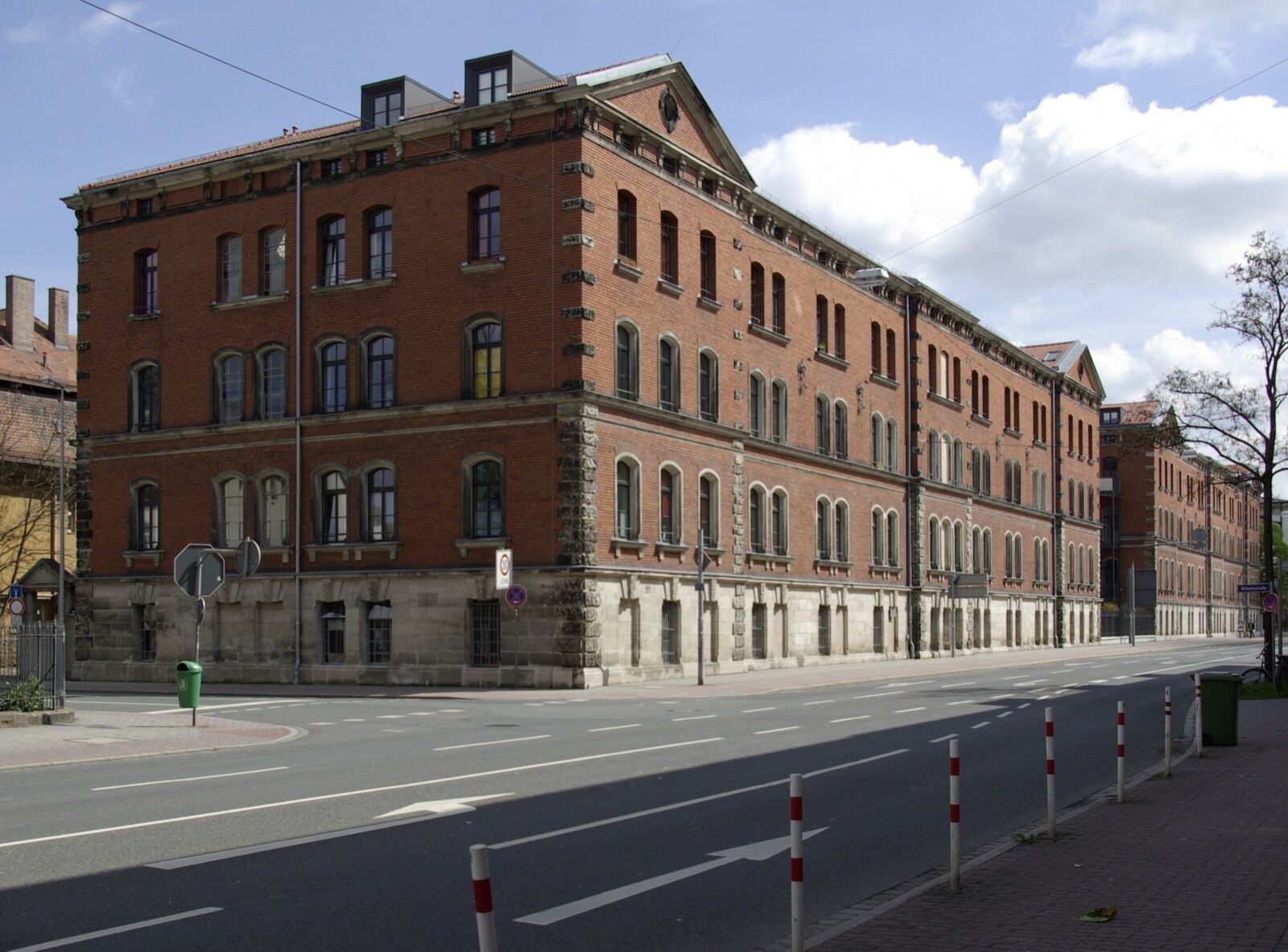
The complex was built between 1890 and 1893 for the 19th Bavarian Infantry Regiment, with later additions in 1912 and 1935 to 1936. Barracks buildings stretched around the present Drausnickstraße, Wilhelmstraße and adjoining streets. Erlangen surrendered to American troops on 16 April 1945, and after military use ended, former soldiers’ quarters accommodated displaced people and other refugees.
Sources for this section
The camp in the register
The inventory carries the site as Baltic-DP-Camp / Oberst-Brausnick-Kaserne at Erlangen in the American zone, opened on 24 January 1946 and closed on 15 September 1949. Its assembly-centre number was AC 92-252, later OMF 325, and supervision came from UNRRA Team 549 at Erlangen. Capacity was 1,950 on 31 October 1947, one of the larger figures in Middle Franconia. The record’s own archive reference is to monthly returns for Erlangen among the papers of the International Tracing Service, Dok-ID 81977317 to 81977465; a separate Arolsen catalogue entry covers Erlangen DP camp records for 21 August 1945 to 6 August 1946.
The same record names the officers. Schoier was the team director and Bramorel the field supervisor, and the camp is entered against three successive area teams — AT 1042 at Nürnberg, AT 1042 at Lauf and AT 1041 at Ansbach — within Area A 3, Würzburg. Team 549 was responsible for more than the barracks: the inventory also carries it against a centre at Forchheim in the journeymen’s house of the paper mill, closed in the late summer of 1947, and one at Streitberg in the Ebermannstadt district, closed in the autumn of 1946.
The camp in the register
| Record | Detail |
|---|---|
| Name in the register | Baltic-DP-Camp / Oberst-Brausnick-Kaserne |
| Opening | 24 January 1946 |
| Closing | 15 September 1949 |
| Capacity | 1,950 on 31 October 1947 |
| Assembly centre | AC 92-252; later OMF 325 |
| UNRRA team | T 549 Erlangen |
| Population categories | Latvian, Lithuanian, Estonian, Polish, Jewish, Ukrainian |
| Team director | Schoier |
| Field supervisor | Bramorel |
| Area teams | AT 1042 Nürnberg; AT 1042 Lauf; AT 1041 Ansbach |
| Area | A 3 Würzburg |
Community life in the camp
The Lithuanian encyclopedia’s account of Erlangen describes the institutions that grew inside a camp of this kind. A district of the Lithuanian exiles’ community was founded in 1946, under A. Geležėlė and then J. Visbaras. There was a Lithuanian parish served in turn by the priests V. Martinkus, V. Šalaviejus and S. Lisauskas, a branch of the Lithuanian Red Cross under S. Šalkauskas and Dr J. Varnas, and a primary school taught by E. Kvintufelytė and E. Vegnerienė.
About 200 Lithuanians were living in the camp in 1947. In the same year 97 Lithuanian students were enrolled at the Friedrich-Alexander University in the town, with J. Kedys as chairman of their association; correspondence courses in radio engineering were organised in 1948. A scout troop and a branch of the ateitininkai were active. After 1949 most of the Lithuanians left Erlangen, chiefly for the United States.
The 200 Lithuanians of 1947 are a small share of a camp registered for 1,950 people, and the published Ukrainian figures for the locality are larger still. The camp held several national communities at once, each with its own organisations, and no one of these counts describes the whole.
A publishing address beyond the camp
The July 1949 masthead of Latvija gave its publisher’s address as DP Camp Erlangen, Oberst-Drausnick-Straße 1. The newspaper appeared twice weekly and declared a circulation of 14,000. Its editorial office was in Esslingen and its printer in Ludwigsburg: Erlangen was part of a dispersed publishing network, not the sole place where the paper was produced. The circulation figure measures newspaper copies, not camp residents.
That masthead is dated seven weeks before the inventory’s closing date, which shows that the camp was still functioning as an institutional address in its final summer.
Residents and accommodation
The inventory records a camp capacity of 1,950 in October 1947. Stebelsky’s published table gives figures for Erlangen as a locality: 810 Ukrainians in the questionnaire returns collected in 1946 and 1947, no figure in the UNRRA return of 24 August 1946, 537 in the return of 31 May 1947 and 776 in the return compiled for December 1947. These show a substantial Ukrainian presence in the town, but the table has one Erlangen row and does not allocate every person to the Drausnick barracks.
For scale, the town’s reconstruction record counts 4,500 German outsiders and refugees in Erlangen in 1945 and 8,239 expellees among 50,011 inhabitants on 13 September 1950. Those are German categories and a different population from the displaced persons in the barracks.
Different measures of the community
| Record | Figure | Scope |
|---|---|---|
| Camp capacity, October 1947 | 1,950 | Drausnick camp, all nationalities |
| Ukrainians, survey 1946 to 1947 | 810 | Erlangen locality |
| Ukrainians, August 1946 | No figure | Erlangen locality |
| Ukrainians, May 1947 | 537 | Erlangen locality |
| Ukrainians, December 1947 | 776 | Erlangen locality |
| Lithuanians in the camp, 1947 | About 200 | Drausnick camp |
| Jewish DP community, January 1948 | 80 | Bohlenplatz 18, in the town |

The contested transition to civilian use
The inventory records the camp’s closure on 15 September 1949. In November, the Bavarian parliament debated proposals to use recently released barracks space for new Czech refugees while other displaced groups and students faced a severe housing shortage. These debates concerned what should happen next; they do not establish that the former Baltic camp continued unchanged, and they do not say where its residents went.
What survived
The state archives’ housing history dates the American release of the barracks for housing and commercial conversion to March 1950. A former gatehouse canteen became a licensed public tavern that August. Surviving accommodation blocks and the former officers’ building remain identifiable in the heritage register, with later residential, office and educational uses.
Sources
- DP camp inventory, record 900: Baltic-DP-Camp / Oberst-Brausnick-Kaserne
Arolsen Archives
Catalogue row read in full: Erlangen, US zone; categories Latvian, Lithuanian, Estonian, Polish, Jewish and Ukrainian; opening 24 January 1946; closing 15 September 1949; AC 92-252, later OMF 325; Team 549 Erlangen; capacity 1,950 on 31 October 1947; archive reference to ITS monthly returns for Erlangen, Dok-ID 81977317 to 81977465.
- Erlangen listed buildings, D-5-62-000-1294
Bavarian State Office for Monument Protection
Oberst-Drausnick complex built 1890 to 1893, with later additions; surviving barracks buildings and uses.
- Latvija, 30 July 1949, no 78(302)
Latvian Central Committee / Latvian National Library
Original newspaper masthead gives the publisher at DP Camp Erlangen, Oberst-Drausnick-Straße 1; twice weekly, circulation 14,000; editorial office in Esslingen and printer in Ludwigsburg.
- Wohnungsnot und Wohnungsbau in Erlangen
Bavarian State Archives
Pages 57 and 71: former DP barracks released in March 1950 and converted for housing and businesses.
- Bavarian Landtag, 8 November 1949, p 95
Bavarian Parliament
Contemporary debate over proposed new Czech-refugee use of the recently released Drausnick barracks; political remarks treated as debate, not as a neutral account of camp conditions.
- Ukrainian DP population table, Table 7
Ihor Stebelsky, in The Refugee Experience, 1992
Printed page 49, Bavaria section, row Erlangen: 810 in the questionnaire returns of 1946 to 1947, no figure in the UNRRA return of 24 August 1946, 537 on 31 May 1947 and 776 for December 1947. One locality row, with no allocation to a particular camp. Page rendered from the PDF at 300 dpi and read visually to check the column assignment.
- Gaststätte Torwache
Erlanger.de, January 2008
Barracks refugee use in 1946 to 1949, a late-1940s canteen in the gatehouse, a licence dated 1 August 1950, and the later building history. Also records the surrender of Erlangen on 16 April 1945 and the American use of the eastern barracks.
- Erlangen DP camp records, 21 August 1945 to 6 August 1946
Arolsen Archives
Catalogue dates support an early DP presence at Erlangen; personal records not reproduced.
- Erlangen, Jüdische DP-Gemeinde
after-the-shoah.org, citing Stadtarchiv Erlangen and USHMM
Register entry read to keep the sites apart: the organised Jewish DP community of Erlangen was at Bohlenplatz 18 in the town, not in a barracks, with 70 members in March 1946, 34 in January 1947, 70 in September 1947, 80 in January 1948 and 60 in February 1949, a prayer room, a vocational school and a Jewish students’ union at the university.
- Wiederaufbauatlas: Erlangen
Haus der Bayerischen Geschichte
City entry read: 4,500 German outsiders and refugees in 1945; 8,239 expellees in a population of 50,011 on 13 September 1950; the GEWOBAU housing company founded in 1950. These are German refugee and expellee categories, not displaced persons, and the entry names no camp.
- Former other ranks’ buildings of the Neue Infanteriekaserne, Drausnickstraße 1/1a, Erlangen
Janericloebe, via Wikimedia Commons · April 2012
Photograph licensed CC BY 3.0. Shows surviving accommodation blocks of the barracks in Drausnickstraße that housed the Baltic DP camp.
- DP camp inventory: the Erlangen officers and the other Team 549 camps
Arolsen Archives · 26 October 2023
Spreadsheet queried directly. Record 900 also names the team director as Schoier and the field supervisor as Bramorel, gives the area teams as AT 1042 Nürnberg, AT 1042 Lauf and AT 1041 Ansbach, and places the camp in Area A 3 Würzburg. Team 549 Erlangen is entered against two further camps: Forchheim, DP-Center I & II in the journeymen’s house of the paper mill, AC 92-269, opened 24 January 1946 and closed between 25 August and 20 September 1947; and Streitberg in the Ebermannstadt district, AC 92-310, opened 24 January 1946 and closed between 20 August and 19 October 1946. Serial dates converted from the Excel epoch.
- Erlangen
Visuotinė lietuvių enciklopedija, Lithuanian National Library · Published 2018, revised 2024
Full published entry read in Lithuanian: a refugee camp set up at Erlangen in 1945 after the German capitulation; a district of the Lithuanian exiles’ community founded in 1946; a Lithuanian parish, a branch of the Lithuanian Red Cross and a primary school; about 200 Lithuanians in the camp in 1947; 97 Lithuanian students at the university that year; correspondence courses in radio engineering in 1948; scout and ateitininkai groups; and departure of most of the Lithuanians after 1949, chiefly to the United States.
Last researched 13 September 2026