Jägerkaserne
Displacement in Europe
Eichstätt · Germany · 1945–1949
Eichstätt’s Jägerkaserne was built as an infantry barracks in the 1890s, held Allied officer prisoners as Oflag VII-B from 1939 to 1945, and then housed successive displaced-persons communities until 1949. Its early mixed population included Ukrainians; from late 1946 it was the principal home of a Jewish DP community.
Introduction
Eichstätt’s Jägerkaserne housed successive displaced-persons communities after the war. The camp inventory records an opening on 22 December 1945 and lists Latvian, Lithuanian, Estonian, Ukrainian, Jewish and stateless people among the groups associated with the facility; from late 1946 the barracks became the principal home of a Jewish DP community. Schools, a synagogue and sports clubs made the former military compound a place of communal life while residents waited for opportunities to leave Germany.
A history in dates
- 1897Work begins on the new infantry barracks by the Ochsenkeller.
- 1939The site becomes Oflag VII-B, a prisoner-of-war camp for officers.
- April 1945The officers’ camp is dissolved and its prisoners are marched towards Moosburg.
- 26 April 1945American troops enter Eichstätt, which is undamaged by bombing.
- 22 December 1945The camp inventory records the opening of the assembly centre.
- 6 February 1946A Latvian newspaper records the exact Jägerkaserne camp address.
- August 1946A comparative table records 436 Ukrainians at Eichstätt.
- Late November 1946550 Jewish DPs arrive from Bamberg’s Ulanenkaserne.
- April 1947The Jewish community figure reaches 1,341.
- October 1949University research dates the closure of the Jewish camp to this month.
- 1952The Bavarian Bereitschaftspolizei moves into the Jägerkaserne.
Sources for this section
- Geschichtstafel der Stadt Eichstätt
- Oflag VIIb, P.O.W. Camp, Gefangenenlager Jägerkaserne
- DP camp inventory: Jägerkaserne, entry 884
- Latviešu Vēstnesis
- The Refugee Experience: Ukrainian Displaced Persons after World War II
- Eichstätt: Jewish community and displaced-persons camp
- Between flight and new beginnings: the Eichstätt DP camp
The barracks before 1945
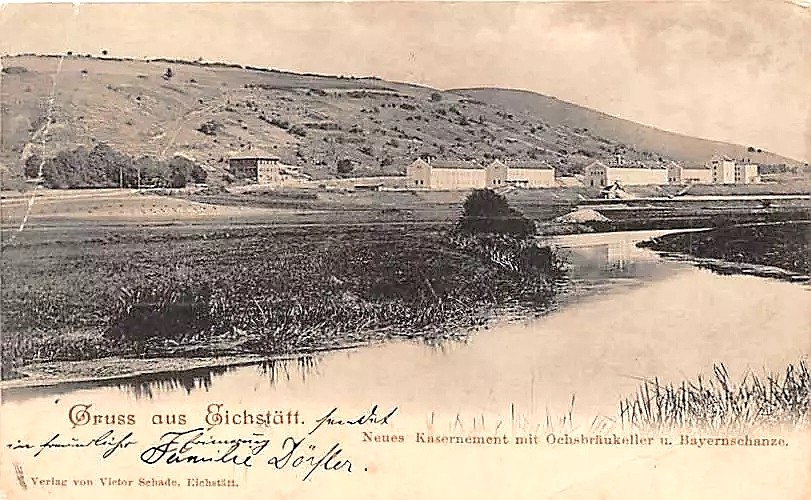
Work on a new infantry barracks by the Ochsenkeller began in 1897, on the slope above the Altmühl meadows that a postcard of 1898 shows still half open ground. The complex is the one that later carried the name Jägerkaserne and that now houses the Bavarian Bereitschaftspolizei.
From 1939 to 1945 the site was Oflag VII-B, a prisoner-of-war camp for officers. Polish officers were held there after the Polish campaign of 1939 and moved on a year later; French, Belgian and British officers taken in 1940 replaced them, New Zealanders and Australians captured in Greece and on Crete arrived in 1941, South African and British officers from the African campaign in 1942 and American officers taken in Tunisia in 1943. The camp was dissolved in April 1945 and its prisoners ordered to Moosburg.
American troops entered Eichstätt on 26 April 1945. The town came through the war without bomb damage, and its role as a large prisoner-of-war and hospital centre left it with buildings that could be used at once for the displaced.
The main camp and its neighbours
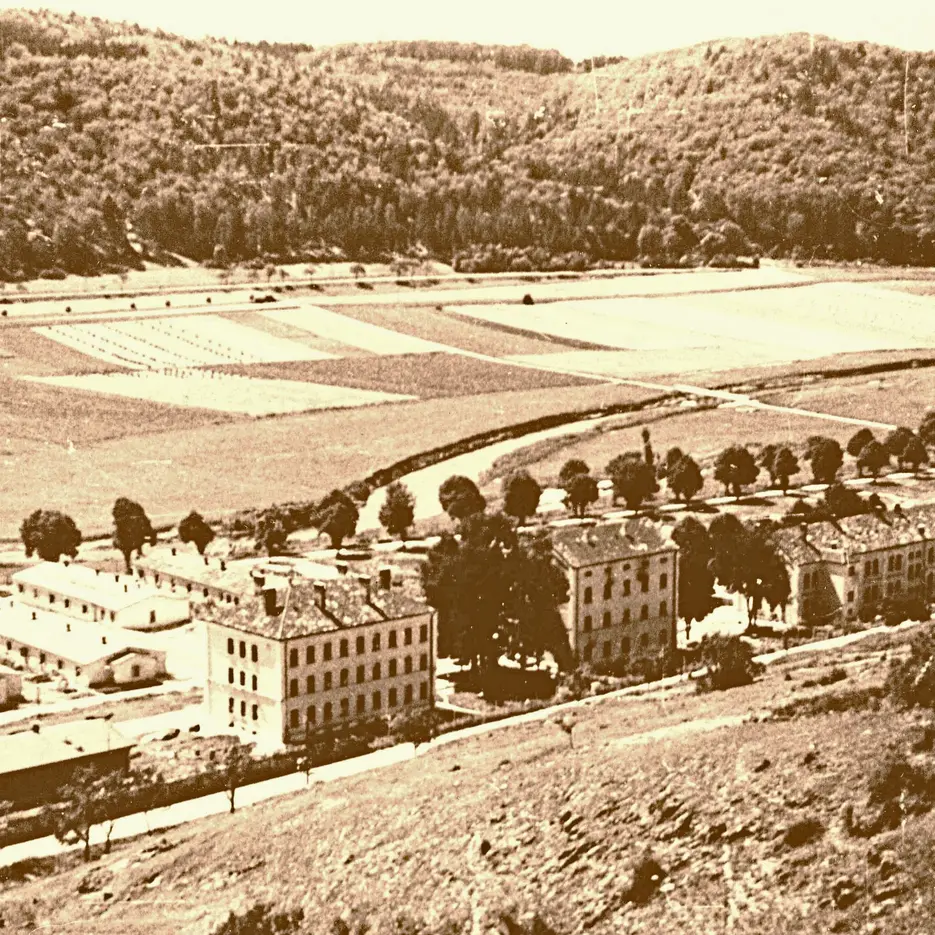
The barracks stood on Kipfenberger Straße. Surviving photographs show substantial masonry buildings alongside wooden huts, with fields and wooded slopes beyond. The site was the main residential camp, but several services and groups occupied other buildings around Eichstätt. A hospital used the building that later became the youth hostel. An orthodox Jewish group lived separately in the former agricultural school on Gemmingenstraße.
The inventory identifies the barracks as Assembly Center 92-277 and later OMF 343, administered by UNRRA Team 555. It is a separate site from Rebdorf and the agricultural-school accommodation. Treating every reference to Eichstätt as a reference to one barrack compound would obscure the different communities and uses.
Distinct places in the Eichstätt community
Changing communities
The first postwar reception camp accommodated liberated displaced people of several nationalities. A Latvian newspaper dated 6 February 1946 uses the exact Jägerkaserne address in a family-tracing notice. The inventory also lists Ukrainians among the groups associated with the facility, though the retrieved sources do not provide a separate Ukrainian census or a date for their departure.
One dated Ukrainian figure does exist. The comparative table of Ukrainians in the camps of the American zone records 436 at Eichstätt in the UNRRA return of August 1946, with no entry in the questionnaire collection or in the returns of May and December 1947. The row carries only the town name, so it cannot be assigned to the barracks alone: Eichstätt also had the agricultural-school accommodation, the area hospital and the separate site at Rebdorf.
At the end of November 1946, 550 Jewish displaced people came from the crowded Ulanenkaserne in Bamberg. They included survivors of Nazi persecution and people who had endured wartime deportation to the Soviet Union, returned to Poland and then fled renewed antisemitic violence. By April 1947 the published community figure was 1,341. These numbers describe the later Jewish phase, not an exclusively Ukrainian camp.
A further use of the barracks is recorded in the memoir of a Czechoslovak airman published by the Free Czechoslovak Air Force Associates. He writes that after his escape from Communist Czechoslovakia he and his companions “were sent to a Military Czechoslovak Refugee Camp, at Eichstätt – Jägerkaserne, under a command of a certain Czechoslovak Major Bruner”. The memoir gives no dates or figures for that camp and does not say how it stood in relation to the assembly centre.
Dated figures
| Date | Measure | Number |
|---|---|---|
| August 1946 | Ukrainians recorded at Eichstätt | 436 |
| Late November 1946 | Jewish arrivals from Bamberg | 550 |
| April 1947 | Jewish community population | 1,341 |
| 31 October 1947 | Inventory capacity for Jägerkaserne | 1,610 |
Sources for this section
Education and religious life
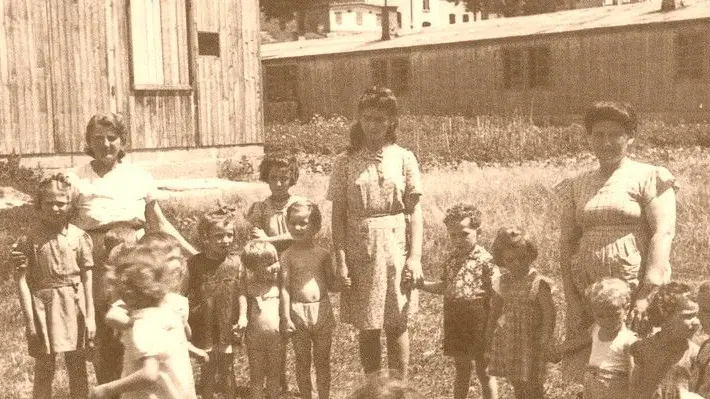
Residents organised a kindergarten and primary schooling, alongside a synagogue and sporting activities. Two clubs, Hapoel/Makabi and Elizur, offered organised sport. A small elected committee and camp police handled internal affairs, with international relief supplying material support. The kindergarten photograph preserved with the university’s research offers a direct view of children and carers among the huts.
Religious education was especially important in the separate orthodox accommodation. Its study institutions and ritual bath were located at the agricultural school, rather than automatically inside the barracks. Vocational training offered through ORT also formed part of the wider Eichstätt community, preparing people for new work after emigration. The precise location of that training changed or remains uncertain in the published account.
Departure and the surviving buildings
Emigration reduced the camp population, particularly after the foundation of Israel in 1948. The Haus der Bayerischen Geschichte states that from May 1948 so few remained that the camp was cleared by the end of September 1948, although its own heading for the section reads 1945 to 1949. The university’s research places the Jewish camp’s closure in October 1949, while the camp inventory records only an interval, between 30 September 1949 and 30 September 1950.
The Bavarian Bereitschaftspolizei was founded at Rebdorf in 1951 and moved into the Jägerkaserne in 1952; the rebuilding of its quarters, begun in 1978, was completed in 1991. The surviving buildings enabled researchers and returning families to revisit the setting during the 2019 symposium and later film work.
Sources for this section
Sources
- Between flight and new beginnings: the Eichstätt DP camp
Catholic University of Eichstätt-Ingolstadt · 29 July 2019
University research: main camp in Jägerkaserne, Jewish phase autumn 1946–October 1949, schools, sport, hospital and original photographs.
- Eichstätt: Jewish community and displaced-persons camp
Haus der Bayerischen Geschichte · Accessed September 2026
Full PDF read. Initial mixed camp, 550 arrivals from Bamberg late 1946, 1,341 in April 1947. Separate orthodox agricultural-school annex. Closure wording conflicts with KU; use KU 2019 research for final camp period.
- DP camp inventory: Jägerkaserne, entry 884
Arolsen Archives · 26 October 2023
AC 92-277, OMF 343, UNRRA 555; Latvian, Lithuanian, Estonian, Ukrainian, Jewish, stateless categories across the catalogue record. Capacity 1610 not census.
- Latviešu Vēstnesis
National Library of Latvia · 6 February 1946
Original newspaper searchable text gives Team 555 / DP Camp 5 / Jägerkaserne, Eichstätt in family-tracing address. Names not reproduced.
- History of the Bavarian Bereitschaftspolizei 1951–2025
Bavarian Police · February 2025
Official police institutional history describes preparation of former Jägerkaserne for police after the DP period.
- Former camp sites become a subject of film research
Catholic University of Eichstätt-Ingolstadt · 2020
Research team visits Jägerkaserne and Area Hospital, confirming distinction between separate premises.
- Oflag VIIb, P.O.W. Camp, Gefangenenlager Jägerkaserne
City of Eichstätt · Accessed September 2026
Municipal account of the officers’ prisoner-of-war camp on the site of today’s Bereitschaftspolizei, 1939–1945, with the successive national groups held there and the dissolution of April 1945.
- Geschichtstafel der Stadt Eichstätt
City of Eichstätt · Accessed September 2026
Official town chronology: 1897 start of work on the new infantry barracks by the Ochsenkeller, now the Bereitschaftspolizei quarters; American entry on 26 April 1945; police move to the Jägerkaserne in 1952; rebuilding completed 1991.
- Postcard: Gruss aus Eichstätt, Neues Kasernement mit Ochsbräukeller und Bayernschanze, 1898
Wikimedia Commons · 1898
Public domain; publisher Victor Schade, Eichstätt. Cropped to the picture side before publication so that the postal side, which carries a private addressee, is not reproduced.
- The Refugee Experience: Ukrainian Displaced Persons after World War II
Canadian Institute of Ukrainian Studies Press · 1992
Ihor Stebelsky chapter, table 7, printed pp. 47–51. The Eichstätt row gives 436 Ukrainians in the August 1946 UNRRA return and is blank in the other three columns; it carries the town name only and names no barracks.
- Vladimír Palička – escape from Communist Czechoslovakia
Free Czechoslovak Air Force Associates ltd · 15 February 2026
First-person memoir, section ‘Return to the Royal Air Force’, read for the passage placing the author in a Military Czechoslovak Refugee Camp at Eichstätt–Jägerkaserne under a Czechoslovak Major Bruner. The memoir gives no dates or figures for that camp.
Last researched 13 September 2026