Eisden–Lanklaar Camp
Displacement in Europe
Lanklaar, Eisden mining district · Belgium · 1942–1965
About twenty wooden huts were built beside the Zuid-Willemsvaart in 1942 to hold forced workers for the Eisden colliery, among them people the mine called Ukrainians. The same huts later held German prisoners and then became 263 emergency dwellings for migrant families, until the camp was closed in 1965.
Introduction
The camp remembered locally as the Russisch Kamp stood in Lanklaar, immediately west of the Zuid-Willemsvaart, and served Eisden’s coal mine. Its history crossed several distinct phases: forced labour, prisoner-of-war confinement and housing for postwar migrant workers. The site was later absorbed into an industrial estate.
A book-length study of the Limburg mining camps, published in 1998 by the Eisden heritage foundation and based on military and civil archives, on colliery archives that have since disappeared and on interviews with witnesses, takes the Eisden camp as its thread. It sets out the succession that gave the huts their popular names: the Russisch Kamp, the Baltenkamp, Klein Italië, or simply Het Kamp.
A history in dates
- Spring 1942About twenty huts are built north of the mine on the left bank of the Zuid-Willemsvaart.
- July 1942289 eastern European forced workers are assigned to Eisden; on 21 July twenty-one judged unfit are sent back towards Germany.
- September and October 1942The civilians are moved on and replaced by Soviet prisoners of war, with a further 500 men added in October.
- August 1944The recorded camp strength is 1,658, the largest of the seven Limburg camps.
- 1 to 3 September 1944The Germans clear the camp and march the inmates out towards the German border.
- 21 May 1945The first German prisoner convoy arrives at Eisden.
- After 1947Barracks become emergency homes for migrant workers and families.
- 1958257 families and 971 single men are still living in converted barracks at Genk, Lanklaar and Houthalen.
- 1965The camp closes after public criticism of its housing conditions.
- 2008The Bekaert Steelcord works, which had occupied the site, closes.
Workers brought from the east
In 1942 German authorities brought civilian forced workers from Ukraine and Belarus to the Limburg mines. Research on Eisden records 289 in its allocation. Later that year these workers were transferred to Waterschei and replaced by Soviet prisoners of war. The 289 is a combined group figure, not a count of Ukrainians alone.
The camp itself was built in the spring of 1942, north of the mine site on the left bank of the Zuid-Willemsvaart, on the road running from the colliery to the As–Lanklaar highway and its canal bridge. About twenty wooden huts stood inside a barbed-wire fence two metres high, each hut intended for a hundred men, with a wash hall, a dining hall and a lockable cupboard for each worker. Administratively the ground lay in the then municipality of Lanklaar.
The mine had considered using the old administration building, De Oude Burelen, for Eastern European forced workers. A separate camp was built instead. That decision matters when locating this history: the former offices, which retained other community uses, were not the Russisch Kamp.
The people who arrived in July 1942 were called Fremdarbeiter or russische Bergarbeiter in the German paperwork, but at Eisden they were spoken of as Ukrainians. Most were farmers, barely two per cent were miners and more than half were under twenty. On 21 July a first convoy of those judged unfit was sent back towards Germany, twenty-one of them from Eisden. From September 1942 they were replaced by prisoners of war selected from a collection camp in Saxony, and the Eisden contingent was made up in October with a further five hundred men. Between eighty and a hundred German soldiers guarded the camp, while Russians worked inside it as cobblers, barbers, nurses and kitchen hands, fetching bread from the colliery bakery in the Eisden garden suburb and milk from the mine tram stop.
Eisden became the largest of the seven Limburg camps. Jean Put’s tables record 1,042 men at the end of 1942, 1,268 a year later and 1,658 in August 1944; his list of deaths by camp gives twenty-nine for Eisden. Two of the men buried in the plot of honour at Genk died at Eisden, one of them born at Kryvyi Rih.
The Germans began clearing the camp on 1 September 1944, and on 3 September the inmates were marched off in columns by way of Lanklaar and Stokkem to the ferry at Meeswijk and on towards the German border. Some men had hidden underground with the help of free miners and waited for the liberation in the Eisden garden suburb.
From prison camp to emergency housing
The first convoy of German prisoners reached Eisden on 21 May 1945. They were confined in the barracks while working for the mine, and repatriated in 1947. The postwar coal drive then brought new contracted workers to Belgium, including displaced people from eastern Europe and migrants from Italy.
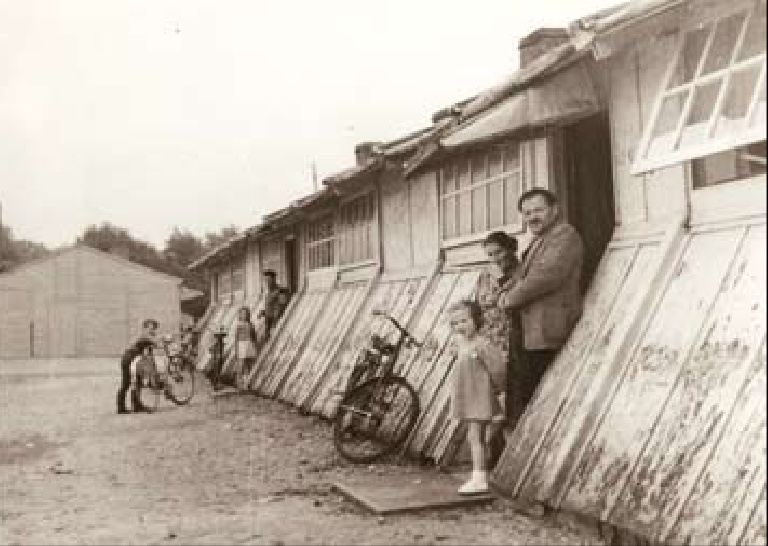
The barracks were converted into 263 emergency dwellings. A school, chapel, canteen and shop made the camp a place where families conducted everyday life. Many later residents of Eisden’s garden suburb had grown up there. The local heritage exhibition’s photograph shows the altered huts as homes, with doors, windows and a domestic scene outside.
This was a regional arrangement rather than a local improvisation. A mining heritage account records that from 1947 the prisoner-of-war barracks built by the Germans were used across the coalfield to house immigrants and their families, some 225 huts of timber and asphalt paper, to be demolished as other accommodation became available. They lasted far longer than intended: in 1958 there were still 257 families and 971 single men living in converted barracks at Genk, Lanklaar and Houthalen together.
Two different measures of the camp’s history
| Date or phase | Figure | What it measures |
|---|---|---|
| July 1942 | 289 | Civilian workers allocated to Eisden; Ukrainian and Belarusian origins combined |
| 31 December 1942 | 1,042 | Prisoners of war recorded in the camp |
| August 1944 | 1,658 | Prisoners of war recorded in the camp, the largest of the seven Limburg camps |
| 1942 to 1945 | 29 | Prisoners of war and Ostarbeiter recorded as having died |
| Postwar conversion | 263 | Emergency dwellings, not people |
Housing shortages and closure
The camp continued to serve successive waves of labour migration. An archive-based study describes accommodation for displaced people, Italians, Spaniards and Greeks before the old barracks were used for newly recruited Turkish miners. Poor housing was therefore a lasting part of the site’s history, rather than a condition confined to the immediate aftermath of war.
Investigators preparing a report on foreign workers found serious insanitary conditions. The mine’s management sought to prevent publication, but the article appeared in La Revue nouvelle in January 1965. The company closed the camp later that year. Its long survival shows how temporary wartime buildings could remain in use through decades of industrial recruitment.
Sources for this section
A wider Ukrainian community
Ukrainian church history places Eisden within a network of postwar mining communities served by visiting clergy. At first priests came from the Netherlands; Eisden later remained one of three principal parish centres, alongside Waterschei-Genk and Zolder. This records community life in the mining district, without placing every parishioner inside the camp.
Sources for this section
The site afterwards
Nothing of the camp survives. The ground it stood on was occupied until 2008 by the Bekaert Steelcord works and is now industrial land in Dilsen-Stokkem, the municipality that absorbed Lanklaar. The colliery’s own records did not survive either: when the closure of the mine was first discussed in 1968 the archive, which had been hidden behind a false wall in the attic of the management offices, was burnt in the furnace of the power station.
Sources for this section
Sources
- Lanklaar: settlement history
Flemish Inventory of Immovable Heritage · Accessed 2026
Locates the former camp west of the canal and identifies its later migrant housing role.
- Language Contact in a Mining Community
Nantke Pecht, Maastricht University / LOT · 2021
Pages 25–26 distinguish the 1942 civilian workers, Soviet prisoners and 1945 German prisoner arrivals. Page 25: “the Germans took control over the mines, leading to the compulsory labor of numerous Ostarbeiter (‘workers from the East’), forced to move from Ukraine and Belorussia to the Kempen (a total of 289 in Eisden)”. Pages 25–26: “In 1945, the leadership of the mine closed a contract with the American and British military to accept German prisoners of war, with the first convoy arriving on May 21, 1945. These prisoners, who were repatriated in 1947, lived for the time being in the so-called ‘Russian barrack camps,’”.
- De Oude Burelen
Jan Kohlbacher, Stichting Erfgoed Eisden / Municipality of Maasmechelen · Accessed 2026
Explains why a separate camp was built instead of housing forced workers in the old mine offices.
- Russisch Kamp exhibition
De Citeeuw, issue 9, Eisden-Tuinwijk · August 2014
Local heritage exhibition account with a historical photograph and 263 emergency dwellings.
- The reception of Turkish workers in Belgium
Mazyar Khoojinian, Cahiers d’histoire du temps présent 17 · 2006
Page 85 discusses the Limburg-Maas camp’s later use, adverse housing investigation and closure in 1965.
- History of Ukrainian parishes in Limburg
Ukrainian Greek Catholic Church, Genk · Accessed 2026
Institutional community history; Eisden references concern the wider locality.
- Ostarbeiter en krijgsgevangenen
Jean Put · Undated
Table of camp strengths at 31 December 1942, 31 December 1943 and August 1944 for the seven Limburg camps.
- Begraven in vreemde bodem
Jean Put · Undated
Numbers of prisoners of war and Ostarbeiter who died, given per camp; Eisden 29.
- Herinnering / Pamyat’
Marc Bertrands / Comité II · 2018
Regional memorial study: camp construction north of the Eisden mine site, the July 1942 allocation and return convoy, the September 1942 transfers, and the roll of graves at Genk.
- Russisch kamp
Dutch Wikipedia, citing Jan Kohlbacher (1998) · Page last edited 19 July 2025
Framework summary of Kohlbacher’s book: site and fence, hut capacity, occupations, guards, the September 1944 clearance, the Bekaert Steelcord occupation of the site and the destruction of the colliery archive. Used as a secondary summary, not as independent evidence.
- Van ontdekking tot sluiting: wie waren de mijnwerkers?
Ons mijnverleden, Cosimo · Accessed 2026
Mining heritage account of housing during the coal drive; the 225 huts and the 1958 figures cover Genk, Lanklaar and Houthalen together.
- Het Russisch kamp: de kampen bij de Limburgse mijnen 1942–1965 (review notice)
Heemkunde Limburg, 1998, no. 2, pp. 9–10, on Jan Kohlbacher’s book for vzw Stichting Erfgoed Eisden · 1998
Describes the book’s sources and the succession of populations that gave the huts their popular names. Read from a scan held in the project source folder.
Last researched 13 September 2026