Enoggera
Arrival and settlement
Brisbane · Queensland · Australia · Opened 14 April 1950; closing date not established
A migrant holding centre opened in 1950 on the army ground at Frazer’s Paddock, taking the dependants of men working elsewhere while they saved for a home. Its school, its plays and its parade floats left the clearest record of the families who passed through.
Introduction
Enoggera was a postwar migrant holding centre at Frazer’s Paddock in Brisbane. It opened on army land on 14 April 1950, providing accommodation within the Commonwealth’s resettlement system. Ukrainian migrants were among the communities associated with Enoggera, alongside the other Queensland centres at Wacol, Stuart and Cairns.
A history in dates
- About 1914 to 1917Fraser’s Paddock at Enoggera served as an army camp and training ground.
- May and June 1940A reception depot at Frazers Paddock selected men for the 7th Division.
- June 1949The Department of Immigration planned four holding centres for Queensland.
- 14 April 1950The holding centre opens at Frazer’s Paddock on army land.
- 1952Standard capacity is recorded as 515 places.
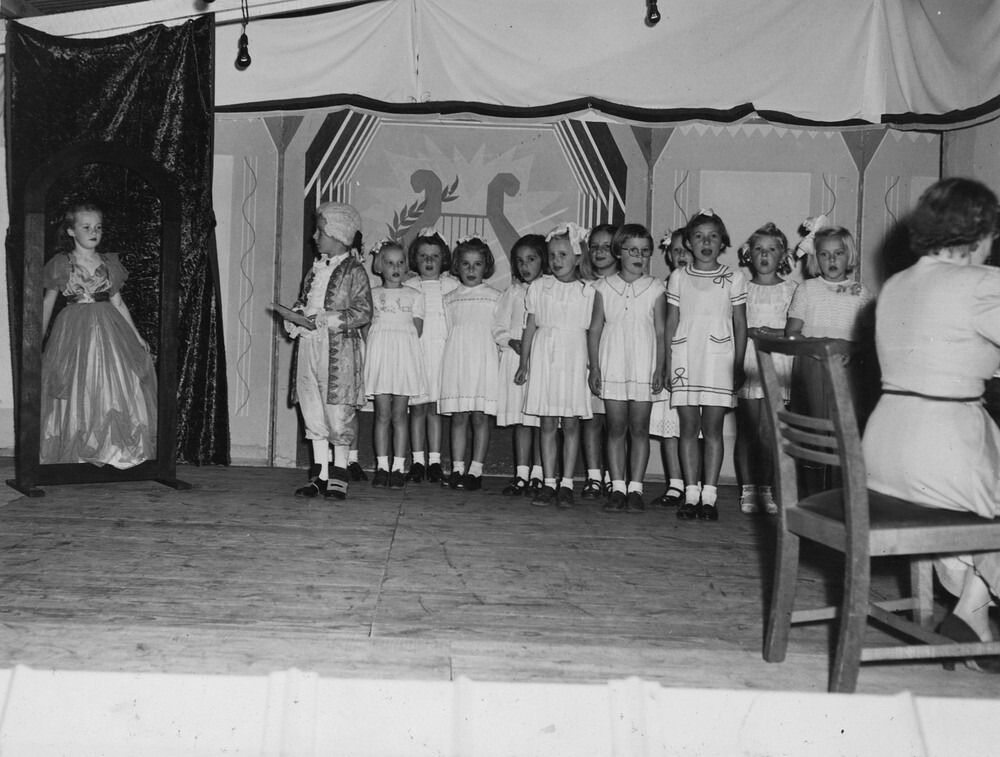
- 1953Children perform a play; coronation celebrations are also photographed at the centre.
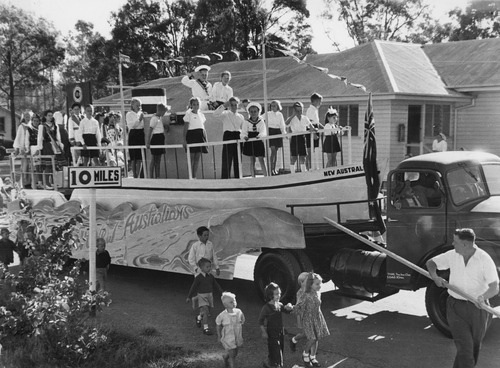
- Around 1955Children take part in a “New Australians” parade float.
- 1950 to 1956Enoggera Camp was a preaching point of the Brisbane South Lutheran parish.
- By April 1960Wacol is Queensland’s only remaining migrant holding centre.
Sources for this section
- State Library of Queensland catalogue records for Enoggera and Frazer’s Paddock
- Commonwealth Acetate of Lime Factory (former), Queensland Heritage Register 602465
- Children performing a play at Enoggera, 1953
- The Immigration Photographic Archive
- Migrant children on a ‘New Australians’ parade float at the Enoggera Immigration Holding Centre, Queensland, ca. 1955
- Index of Lutheran Parishes in Australia and New Zealand
Frazer’s Paddock before the centre
The ground was army land long before the migrants came. Photographs in the State Library of Queensland show soldiers sharing a meal in tents at Fraser’s Paddock, Enoggera Army Camp, about 1914, a large group of recruits there in 1916, and a training camp in 1917. In May and June 1940 the paddock held the reception depot from which Lieutenant-Colonel Radford selected men for units of the 7th Division. A 1920s subdivision plan filed under the same name places the paddock at Ashgrove, and the library catalogues the holding centre itself under that suburb.
Sources for this section
A home while families found their footing
The Department of Immigration’s holding centres were intended principally for dependants while working family members earned enough to secure housing outside. Enoggera was one of four Queensland centres planned in 1949. It had a standard capacity of 515 places in 1952, covering residents of all nationalities.
Families could move between centres after reaching Australia. A Polish family’s oral-history catalogue records residence at both Wacol and Enoggera following migration from a displaced-persons camp in Germany in 1949. Such movements connected the Brisbane centres, without making them a single facility.
One of four Queensland centres
In June 1949 the Department of Immigration was planning four holding centres for what it called New Australians in Queensland. Wacol opened on 9 November 1949 on army land; Stuart, on RAAF land south of Townsville, on 30 March 1950; Frazer’s Paddock at Enoggera on 14 April 1950, also on army land; and Cairns on 19 August 1950 on acquired land. Thirteen holding centres were still active across Australia in 1952, when the standard capacities of the Queensland four were listed. By April 1960 Wacol was the only one left in the state.
Enoggera in the Queensland holding-centre network
| Centre | Opened | Standard capacity, 1952 |
|---|---|---|
| Wacol | 9 November 1949, on army land | 1,465 |
| Stuart, south of Townsville | 30 March 1950, on RAAF land | 500 |
| Enoggera, Frazer’s Paddock | 14 April 1950, on army land | 515 |
| Cairns | 19 August 1950, on acquired land | 370 |
Sources for this section
Children, school and celebrations
A photograph taken in 1953 shows children presenting a play at the centre. Costumes, a painted backdrop and a gathered group of performers give a glimpse of activities organised within the migrant community. The image belongs to a collection of migrant-school photographs preserved by the State Library of Queensland.
Another photograph, dated around 1955, shows children on a parade float bearing the words “New Australians”. These public performances formed part of children’s lives alongside the practical work of settling into unfamiliar surroundings. The collection also records school activities at Wacol and elsewhere in Brisbane.
The National Archives holds a separate photographic record of coronation celebrations at Enoggera in 1953. Together, these images document the centre as a place of organised social activity as well as temporary accommodation.
The school photographs
The photographs of Enoggera come from a small collection assembled by Nancy Mossman, who taught at both the Enoggera and the Wacol immigration centres. The six prints show children welcoming the Queen Mother at the Exhibition grounds, planting trees at Ballymore Park with Mossman herself, performing a play at Enoggera, running a race, breaking up for the holidays at Wacol and riding the New Australians float at Enoggera. They are the closest thing to a record of school life at the centre that has been found.
The caption supplied with the running-race photograph names twenty-four children, among them Helena Prokopuk, Walentyna and Ludmilla Kwitnycka, Krystel and Edgar Nasarenko, Nicolai Kramarenko, and Paska and Walentyna Kuzewicz, which are Ukrainian surnames, alongside Latvian, Lithuanian, Polish, Hungarian and Italian ones. The library records that this photograph was possibly taken at either the Enoggera or the Wacol centre, so it cannot be assigned to Enoggera with certainty. It does show that children of Ukrainian families were in the Brisbane centres’ schools in the middle of the 1950s.
Sources for this section
Religious life
Enoggera Camp appears as a preaching point of the Brisbane South Lutheran parish between 1950 and 1956. This identifies one religious connection serving the camp’s diverse population; it does not describe a specifically Ukrainian congregation.
Sources for this section
How long it lasted
The centre’s closing date has not been established, and the three indications available do not agree. A local study by Desley Drevins, held by the State Library, is titled for the years 1949 to 1953. The Lutheran parish index lists Enoggera Camp as a preaching point of the Brisbane South parish from 1950 to 1956. The parade float photograph is dated to about 1955. What can be said is that the centre was working in 1953 and probably still in the middle of the decade, and that Wacol had absorbed the role by April 1960.
Sources for this section
- Commonwealth Acetate of Lime Factory (former), Queensland Heritage Register 602465
- Migrant children on a ‘New Australians’ parade float at the Enoggera Immigration Holding Centre, Queensland, ca. 1955
- Index of Lutheran Parishes in Australia and New Zealand
- State Library of Queensland catalogue records for Enoggera and Frazer’s Paddock
Leaving the holding centre
Enoggera’s role belonged to the early postwar network of holding centres. By April 1960 Wacol was the only such centre remaining in Queensland. Families leaving the system moved into the wider housing and employment landscape of their new country.
Sources for this section
Sources
- Commonwealth Acetate of Lime Factory (former), Queensland Heritage Register 602465
Queensland Heritage Register, Queensland Government · Entered 7 December 2007; entry last updated 20 January 2016
Corrected citation. The Queensland holding centre facts used on this page, the four centres planned in June 1949 with their opening dates, the 1952 standard capacities and the April 1960 statement that Wacol was the last in the state, come from the comparative passage in the history section of register entry 602465, which is the entry for the Colmslie factory. The address previously cited now returns a not-found page because the register has moved to qhr.detsi.qld.gov.au, so the entry was read from the Internet Archive capture of 21 May 2022.
- Ukrainian Education in Australia
Roman Chamula, Ivan Franko National University of Lviv · 2017
Original paper explicitly includes Enoggera among Ukrainian migrant centres; no Enoggera Ukrainian population count.
- Migrant Women Oral History: collection guide
State Library of Queensland · Interviews 1991–1992
Series 4 catalogue summary records a family’s Wacol and Enoggera residence. Full interview not reviewed; individual names omitted.
- Children performing a play at Enoggera, 1953
State Library of Queensland · 1953
Photograph by W. A. Jones and Company. State Library of Queensland catalogue image number 28509-0001-0002, record FL1364093, from collection 28509 Photographs of Migrant School Children. The catalogue records it as out of copyright and free to use with attribution to the State Library of Queensland.
- Migrant children on a ‘New Australians’ parade float at the Enoggera Immigration Holding Centre, Queensland, ca. 1955
John Oxley Library, State Library of Queensland · Original photograph about 1955; digitised 2012
Catalogue record read through the library OneSearch public interface on 13 September 2026. Image number 28509-0001-0005, record FL1364135, collection 28509. Rights: in copyright, Library Board of Queensland, licensed under Creative Commons Attribution 4.0. This replaces the earlier citation to a blog reproduction and establishes the licence.
- The Immigration Photographic Archive
National Archives of Australia · Undated
Identifies A12111, 53/17/22: Coronation celebrations, Enoggera Centre, Brisbane, 1953. Record listing read; image itself not reproduced.
- Index of Lutheran Parishes in Australia and New Zealand
Lutheran Archives · 20 September 2023
Brisbane South entry lists Enoggera Camp preaching point 1950–1956.
- State Library of Queensland catalogue records for Enoggera and Frazer’s Paddock
State Library of Queensland, OneSearch · Records read 13 September 2026
Catalogue records read through the library’s public search interface. Supply the army camp photographs at Fraser’s Paddock of about 1914, 1916 and 1917 and the 1940 reception depot; the 1920s subdivision plan placing the paddock at Ashgrove; and Desley M. Drevins, Enoggera Immigration Holding Centre: Ashgrove: 1949-1953, Keperra, 2005, a thirty-two leaf study with illustrations and maps, catalogued under the subject heading Enoggera Immigration Holding Centre.
- Collection 28509, Photographs of Migrant School Children, John Oxley Library
State Library of Queensland · Photographs 1953 to 1958; collection record read 13 September 2026
Collection and item records read. Creator Nancy Mossman, a school teacher at both the Enoggera and Wacol immigration centres; six photographs listed by subject; collection licensed Creative Commons Attribution. The running-race item, image number 28509-0001-0001, carries a caption naming twenty-four children and the note that it was possibly taken at either the Enoggera or Wacol centre.
Last researched 12 September 2026