Rheinland-Kaserne
Displacement in Europe
Ettlingen · Germany · 1945–1950
A Ukrainian camp community inside a former Prussian barracks at Ettlingen, with its own UNRRA team, its own camp post and a high school, whose last residents moved into towns and villages across North Baden in 1950.
Introduction
At the Rheinland barracks in Ettlingen, ten kilometres south of Karlsruhe, a large displaced-persons community lived inside a former military compound for five years. Contemporary German records generally called its people Polish; among them were some two thousand Ukrainians, who built schools and organisations there. Its final chapter led into towns and villages across North Baden: in autumn 1950 the remaining residents left the barracks for ordinary housing.
A history in dates
- From summer 1912The barracks are built as a Royal Prussian non-commissioned officers’ school.
- 1914–1920The compound serves as a reserve military hospital.
- From 1936Military use resumes; the compound houses an army NCO school of the 5th Infantry Regiment.
- 5 April 1945French troops occupy Ettlingen.
- May 1945The barracks accommodate around 2,400 displaced people awaiting repatriation.
- End of June 1945The town is handed over to the Americans; the zone boundary runs a few kilometres to the west.
- 24 January 1946The camp inventory records the opening of assembly centre AC 690 under UNRRA Team 94.
- 15 March 1946The camp leader is given permission by the UNRRA team director to issue camp stamps.
- 20 March 1946The first camp postage issue appears in four values.
- 1946–1947Population questionnaires record 2,147 Ukrainian residents.
- 20 July 1946A second camp postage issue appears.
- March 1947Members of the Polish camp committee leave on one of the last UNRRA transports.
- May 1947The camp’s Ukrainian population is recorded as 1,694.
- 31 October 1947The inventory records a capacity of 2,000.
- 1 July 1950The IRO camp becomes accommodation under German administration.
- 16 October 1950An IRO field welfare officer’s report records arrangements for transferring 300 displaced people into private billets.
- By 31 October 1950The last Ukrainian residents have moved to towns and villages in North Baden; the barracks return to occupation authority.
- 1950–1995The compound is used by American forces.
- 1997The site is divided between the town of Ettlingen and the federal government, and civilian reuse follows.
Sources for this section
- Rheinlandkaserne
- Ettlingen: Lagerpost — Post der DPs
- Zwangsarbeit in Karlsruhe 1939–1945
- DP camp inventory, record 910: Ettlingen, DP-Camp / Rheinländer-Kaserne
- The Refugee Experience: Ukrainian Displaced Persons after World War II
- Kaserne wieder bewacht
- Report on transfer from the Ettlingen Residual Center, item HT 36471
The barracks and the town
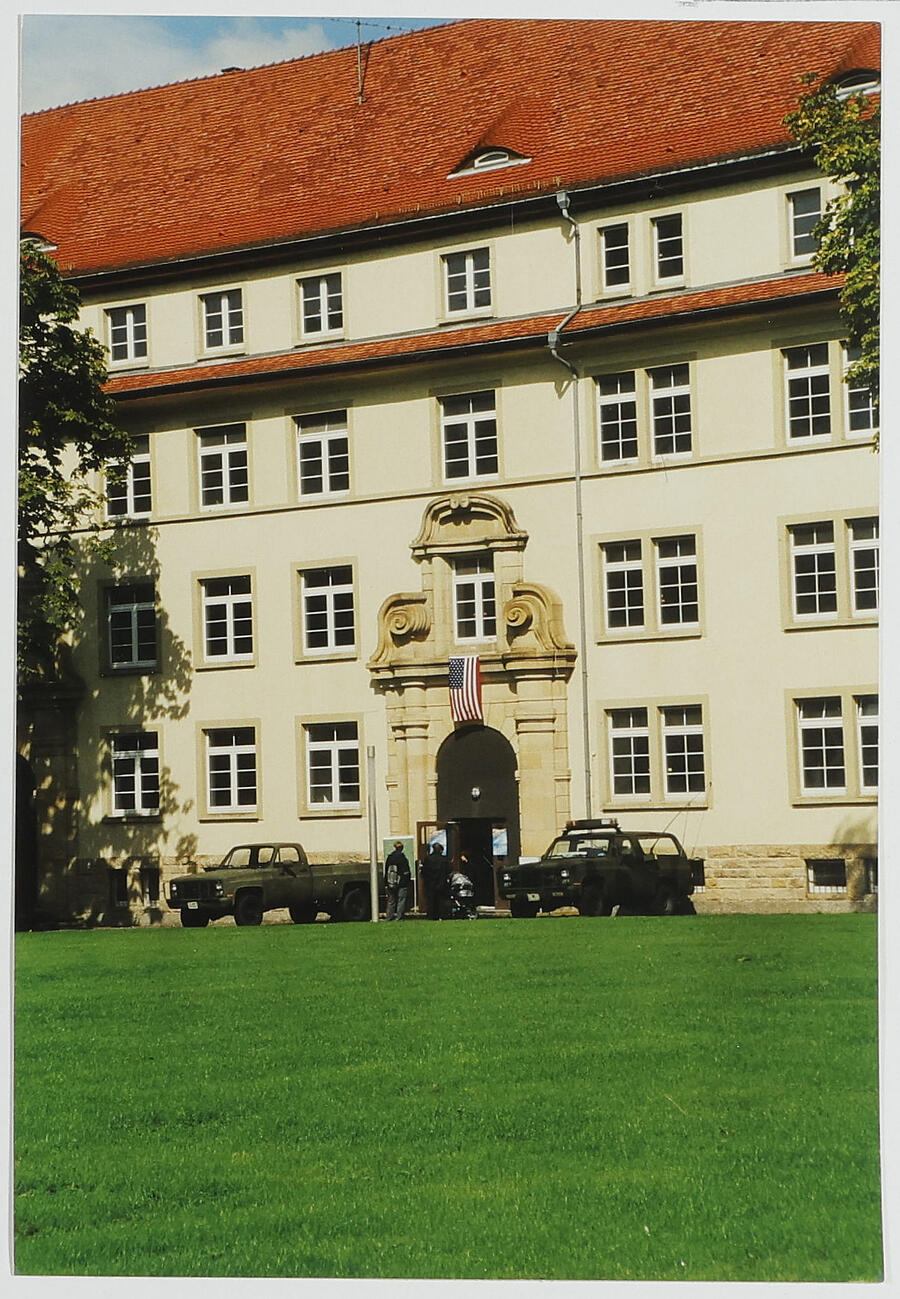
The barracks were begun in the summer of 1912 as a Royal Prussian non-commissioned officers’ school, the school having outgrown Ettlingen’s castle. The outbreak of war in 1914 stopped that use; from 1914 to 1920 the buildings served as a reserve military hospital, and under the Weimar Republic, when Ettlingen lay in the demilitarised zone, they were used for civilian purposes. Military use resumed from 1936, and until the end of the Second World War the compound housed an army NCO school of the 5th Infantry Regiment.
The compound stands at the northern edge of the town between Karlsruher Straße and Durlacher Straße. Ettlingen was a separate camp community from Karlsruhe, whose similarly named barracks appear on a different line in contemporary population statistics; the camp inventory records the Ettlingen building itself as ‘DP-Camp / Rheinländer-Kaserne’, so the two are easily confused.
By May 1945 approximately 2,400 displaced people were housed here while awaiting repatriation. Contemporary German records commonly labelled this population Polish; municipal historical research notes that the category included a considerable Ukrainian presence.
Which army governed them changed in the first months. French troops took Ettlingen on 5 April 1945 and handed the town to the Americans at the end of June. The new boundary between the American and French zones ran at Neu-Malsch and Bietigheim a few kilometres to the west and was closely guarded, so that the camp’s residents could scarcely visit the displaced-persons camp at Rastatt, only a short distance away in the French zone.
Finding enough clean water was an immediate problem. The municipal waterworks history places 2,000 displaced people in the barracks alongside a town population that had risen to roughly 20,000. Refugees, occupation personnel and renewed industrial demand put exceptional pressure on an already inadequate supply system.
How the camp was run
The camp inventory compiled from International Tracing Service records gives Ettlingen an opening date of 24 January 1946 and a capacity of 2,000 on 31 October 1947. It was assembly centre AC 690, renumbered BN 202 from September 1948, and its nationalities are listed as Polish, Baltic and various. Administration ran through UNRRA Team 94 under a director named Ettinger, with area teams at Mannheim and Darmstadt, in Area 2 at Ludwigsburg and later Nellingen, under a field supervisor named Nordby.
That structure is visible in the camp’s own paperwork. The report on the closure of the centre in October 1950 was written by an International Refugee Organization field welfare officer and addressed to the Area Welfare Officer, Area 2, Nellingen — the same area office the inventory names.
The surviving records are listed with the entry: a run of population and change returns for Ettlingen held by the International Tracing Service, and three files in the Stadtarchiv Ettlingen covering the foreigners’ camp of 1945 to 1948, the transfer of the displaced-persons camp into German administration, and miscellaneous single documents.
The camp in the DP camp inventory
| Field | Record |
|---|---|
| Location | Ettlingen (Kreis Karlsruhe), US zone, District 1 |
| Building | DP-Camp / Rheinländer-Kaserne |
| Opening | 24 January 1946 |
| Closing | Between 30 September 1949 and 30 September 1950 |
| Nationalities | Polish, Baltic, various |
| Capacity | 2,000 on 31 October 1947 |
| Assembly centre | AC 690; BN 202 from September 1948 |
| UNRRA team | Team 94, director Ettinger |
| Area teams | AT 1001 Mannheim; AT 1021 Darmstadt |
| Area | A 2 Ludwigsburg; A 2 Nellingen; field supervisor Nordby |
The camp’s own post
For a year the camp ran a postal service of its own. On 15 March 1946 the leader of the Polish camp received permission from Mr Ettinger, the director of UNRRA Team 94, to issue stamps for the camp’s needs. The first issue appeared on 20 March 1946 in four values, printed by the firm Prägedruck in Karlsruhe on white ungummed paper in sheets of twelve. It sold out within three months, and a second issue in four further values followed on 20 July 1946.
The stamps were used on letters inside the camp and above all to the neighbouring camps at Pforzheim and Knittlingen, carried about once a month by UNRRA’s own vehicle. The German post office would not accept them: letters franked with camp stamps alone were returned to the camp administration without comment, and where a letter carried both German and camp stamps the postal clerks cancelled the German ones with care and left the camp stamp untouched.
The second issue was sold out by the time the camp was wound up. The philatelic account records that some members of the Polish camp committee left on one of the last UNRRA transports in March 1947 and emigrated to Brazil, Argentina, Canada and the United States.
The camp post
| Date | Event |
|---|---|
| 15 March 1946 | Permission to issue stamps given by the UNRRA Team 94 director |
| 20 March 1946 | First issue, four values, printed in Karlsruhe in sheets of twelve |
| 20 July 1946 | Second issue, four values in different colours |
| 20 March 1947 | End of the camp post |
Sources for this section
Water, health and everyday life
A 1946 public-health assessment found that Ettlingen could supply only a little more than half the water needed per person each day. Bacterial contamination made the situation more serious. During the hot, dry summer of 1947, water wagons supplied higher parts of the town; by the end of the year residents had been ordered to boil tap water before drinking it.
These were town-wide conditions surrounding the camp, rather than a record of a specific outbreak inside it. They help explain why accommodation in a substantial barracks did not by itself guarantee comfortable living. Work on a new groundwater supply formed part of the wider postwar rebuilding of Ettlingen.
Sources for this section
Schools and community
Ettlingen was one of the Ukrainian centres in Württemberg-Baden with a broad network of organisations, including a high school. Its importance therefore extended beyond beds and relief distribution: young people could continue interrupted education within an organised Ukrainian community.
Religious affiliation crossed national boundaries. A study of the Ukrainian Autocephalous Orthodox Church, drawing on correspondence from late 1949 or early 1950, reports that Belarusians made up as much as 60 per cent of the Ettlingen Ukrainian Orthodox parish in 1949. A parish membership figure is consequently different from a count of Ukrainian camp residents.
Sources for this section
Population in the records
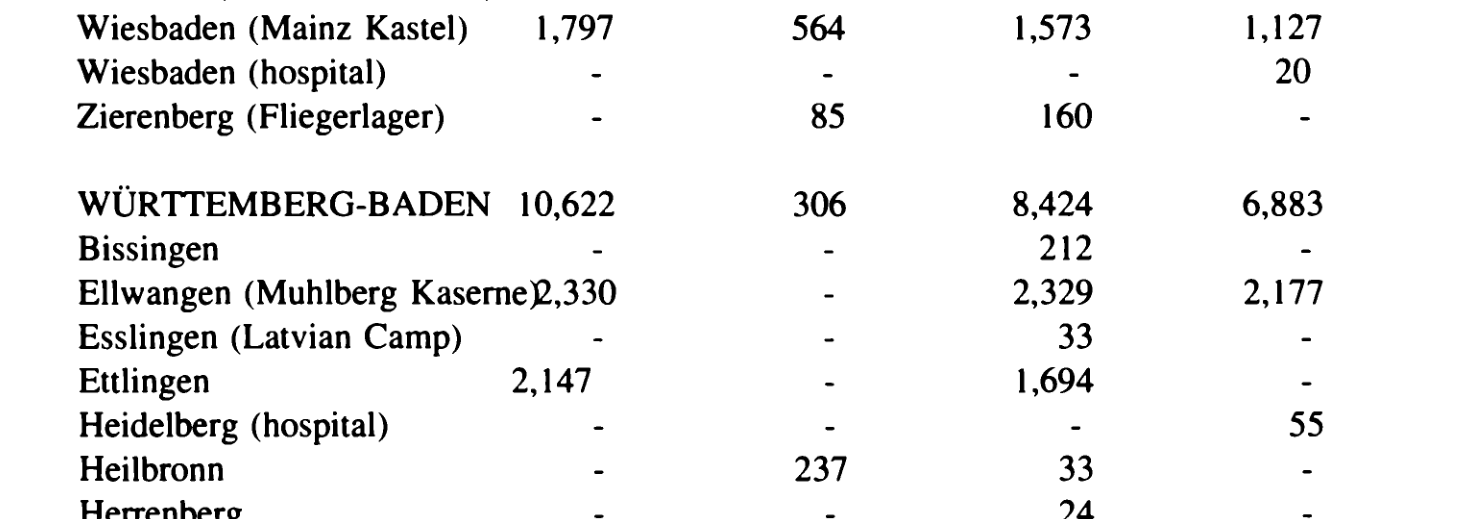
The surviving statistical series records 2,147 Ukrainians in the 1946–47 questionnaire material and 1,694 in May 1947. These are dated community counts, not the number of people who passed through the camp over its lifetime. The encyclopedia’s rounded figure of 2,150 belongs to the earlier period.
Ukrainian residents recorded at Ettlingen
| Date / series | Ukrainians |
|---|---|
| 1946–1947 questionnaires | 2,147 |
| May 1947 | 1,694 |
Leaving the camp
On 1 July 1950 the guarded IRO camp became accommodation under German administration. A four-page report dated 16 October, preserved by Museums Victoria in the papers of the Australian welfare officer Esma Banner, is headed ‘Transfer of Inhabitants from the Ettlingen, Residual Center to private billets in the German Economy’, and the museum describes it as covering the transfer of 300 displaced people. It documents the practical transition from collective accommodation to living among the wider population.
By 31 October the local newspaper reported that the last Ukrainians had left for housing in North Baden. It also described difficulties caused by inadequate preparation and prejudice in receiving communities. The vacated barracks were again guarded and under occupation authority. This was settlement within Germany, distinct from migration to an overseas reception camp.
The inventory’s own closing entry is looser than the newspaper’s: it places the end of the camp somewhere between 30 September 1949 and 30 September 1950. The dated report and the dated newspaper item fix it within that interval.
From camp accommodation to local settlement
The site afterwards
American soldiers occupied the compound from 1950, using it for the 77th US Engineer Battalion and a signals unit, until they left in 1995. In 1997 the site was divided: the town of Ettlingen bought the larger part from the federal property administration, while the federal government kept the area of the former research institute.
The buildings are still in use. The former barracks now accommodate the Fraunhofer Institute for Optronics, System Technologies and Image Exploitation, the Heisenberg-Gymnasium, doctors and therapists, a pharmacy, a restaurant and a cinema bistro; the old officers’ mess became a clubhouse for Ettlingen’s choral societies, and part of the staff building became a school.
Sources for this section
Sources
- Rheinland-Kaserne: reuse of former barracks
Landkreis Karlsruhe / Stadtarchiv Ettlingen · 2023 exhibition
Identifies DP occupation and subsequent military and civilian uses. Photograph Stadtarchiv Ettlingen 8-BS-6-37a-242_3.
- 150 years of water supply in Ettlingen
Stadtwerke Ettlingen · 2020
Printed pages 20–23: 2,000 DPs in Rheinland-Kaserne, water shortages, 1946 medical assessment, 1947 drought and postwar construction.
- The Refugee Experience: Ukrainian Displaced Persons after World War II
Canadian Institute of Ukrainian Studies Press · 1992
Ihor Stebelsky, printed pages 28 and 47, school/community network and table 7. Ukrainian Orthodox church chapter, printed page 181 note 75, Belarusian parish members in 1949.
- Kaserne wieder bewacht
Ettlinger Zeitung / Badische Landesbibliothek · 31 October 1950
Original issue, printed page 6, Heimat-Nachrichten: 1 July change of administration; final Ukrainian departures to housing in North Baden; barracks returned to occupation authorities.
- Report on transfer from the Ettlingen Residual Center, item HT 36471
Museums Victoria / Esma Banner collection · 16 October 1950
Catalogue entry read in full. A four-page typed report by Esma Banner, Field Welfare Officer of the International Refugee Organization, headed ‘SUBJECT: Transfer of Inhabitants from the Ettlingen, Residual Center to private billets in the German Economy’ and addressed ‘TO: The Area Welfare Officer, Area 2, Nellingen’. The museum’s summary describes it as covering the transfer of 300 displaced persons into private billets. The four original pages have not been inspected; the document’s American spelling of ‘Center’ is retained here because it is part of its title.
- Germany: Ukrainian displaced persons
Canadian Institute of Ukrainian Studies · Accessed September 2026
Identifies Ettlingen among major Ukrainian camps, approximately 2,150 in 1946–47; used as cross-check, not an independent census.
- Zwangsarbeit in Karlsruhe 1939–1945
Jürgen Schuhladen-Krämer / City of Karlsruhe, Stadtarchiv · 1997
Printed page 94: Ettlingen Rheinland-Kaserne occupied by approximately 2,400 DPs from May 1945; footnote clarifies Polish administrative designation included Ukrainians.
- DP camp inventory, record 910: Ettlingen, DP-Camp / Rheinländer-Kaserne
Arolsen Archives · Inventory of 26 October 2023
Catalogue row read in full from the spreadsheet. Ettlingen (Kreis Karlsruhe), US zone, District 1; opening date 24 January 1946; closing between 30 September 1949 and 30 September 1950; nationalities Polish, Baltic and various; capacity 2,000 on 31 October 1947; assembly centre AC 690, later BN 202; UNRRA Team 94 under director Ettinger; area teams AT 1001 Mannheim and AT 1021 Darmstadt; Area A 2 Ludwigsburg and A 2 Nellingen; field supervisor Nordby. The row also lists the surviving records: ITS Dok-ID 81978677–81979241, and three files in the Stadtarchiv Ettlingen.
- Rheinlandkaserne
Stadtwiki Karlsruhe · Version of 26 March 2022; read 14 September 2026
Full German entry read. Gives the barracks’ construction from summer 1912 as a Royal Prussian non-commissioned officers’ school, its use as a reserve military hospital from 1914 to 1920, civilian use under the Weimar Republic, renewed military use from 1936 as an army NCO school of the 5th Infantry Regiment, the housing of refugees and displaced people from 1945 to 1950, American use from 1950 to 1995, the division of the site in 1997 and the present occupants. A community wiki; used for the building’s chronology, not for camp administration.
- Ettlingen: Lagerpost — Post der DPs
Lagerpost.Info, after Manfred G. Heber, with Miczek and Perzynski · Read 14 September 2026
Full German entry read. Records the French occupation of Ettlingen on 5 April 1945 and its transfer to the Americans at the end of June 1945, the zone boundary west of the town, the barracks as the camp site, the permission given on 15 March 1946 by the director of UNRRA Team 94, Mr Ettinger, for the camp to issue its own stamps, the two issues of 20 March 1946 and 20 July 1946, the routes on which the stamps were used, and the dissolution of the camp with one of the last UNRRA transports in March 1947. A specialist philatelic compilation; its population figures are contradictory and are not used here.
Last researched 12 September 2026