Fallingbostel Camp
Displacement in Europe
Oerbke, Bad Fallingbostel, Lower Saxony, Germany · Displaced-persons camp 1945–1950
A displaced-persons camp on the ground of a former Wehrmacht troop camp at Oerbke, outside Fallingbostel, which held tens of thousands of people and became one of the British zone’s emigration and resettlement centres. Ukrainians were a minority within a largely Polish population, and their Orthodox parish left the fullest Ukrainian record of the place.
Introduction
Fallingbostel was a displaced-persons camp in the British zone of Germany, on the Lüneburg Heath between Hamburg and Hannover. It did not stand in the town itself but a few kilometres to the east, on the grounds of the former Truppenlager Fallingbostel at Oerbke, in the estate district of Osterheide. From February 1948 it worked as an emigration, transit and resettlement centre for displaced people about to leave Europe, so that for many Ukrainians arriving here marked the last stage of a journey that had begun in another German camp.
Three different institutions occupied the same stretch of heath in these years, and papers that name Fallingbostel can belong to any of them: the wartime prisoner-of-war camps around Oerbke, the displaced-persons camp, and the British internment camp for former National Socialists. The British also ran a separate displaced-persons camp on the neighbouring troop camp at Bergen, in the district of Lohheide, which is a different place again.
The camp accommodated several communities. Polish registration records, Ukrainian Orthodox parish papers and Mennonite photographs preserve different parts of its history. Their figures and experiences describe particular groups within Fallingbostel, rather than one exclusively Ukrainian settlement.
A history in dates
- 1 August 1938Ten villages of the Landkreis Fallingbostel, Oerbke and Hartem among them, have been cleared for the Bergen training area.
- 1939The workers’ camp at Fallingbostel is rebuilt as the prisoner-of-war camp Stalag XI B.
- 30 March 1945American prisoners of war arrive at Stalag XI B by boxcar after some 46 hours locked in the cars.
- 16 April 1945British troops liberate the camps on the training area, a day after Bergen-Belsen.
- 2 May 1945Soviet prisoners are evacuated from the Bergen-Belsen barracks to Fallingbostel: a Belsen relief chronology records 2,468, while Joanne Reilly gives 4,000 taken from Belsen’s Camp II.
- 8 and 22 May 1945A further 18 and then 501 Soviet prisoners are evacuated from Bergen-Belsen to Fallingbostel.
- 1945The internee camp at Fallingbostel holds 4,500 former Latvian soldiers, later transferred to Westerburg.
- July 1945An early surviving Polish registration card documents camp residence.
- 1 August 1945A British field regiment moves to Dushorn to police the camp, which its history puts at 28,000 people.
- August 1945Fallingbostel is given Assembly Centre number 2515.
- 27 September 1945Three thousand British troops search the camp room by room; a second search follows on 17 November.
- End of 1945Soviet displaced people held at the collection camp have been sent east; about 16,000 Poles and eastern European Jews remain at Fallingbostel and Oerbke.
- March 1946More than 22,600 Polish displaced people are registered.
- July 1947The camp is given DPACS number 9.
- February 1948Fallingbostel develops its emigration-centre role.
- May 1948A community birthday celebration includes 92 participants.
- May 1949The assembly-centre and DPACS numbers lapse.
- Around 1950The Ukrainian parish distributes World Council of Churches food aid.
- 14 July 1950The Orthodox community is counted by accommodation block.
- Middle of 1950The displaced-persons camp closes.
Sources for this section
- NLA HA Nds. 1241 Osterheide — Gemeindefreier Bezirk Osterheide, Sammlung Baumann
- Harold B. Farrar, World War II as I Remember It on the Fiftieth Anniversary
- Diary of events, liberation of Bergen-Belsen
- Joanne Reilly, Britain and Belsen
- Latvian soldiers in Germany
- Registration card: DP camp Fallingbostel
- 179 Field Regiment, Royal Artillery: regimental history, 1945–46
- Displaced Persons Camp Fallingbostel
- Fallingbostel Birthday Children
- Fallingbostel church papers and census
The heath before the camp
The Wehrmacht laid out the Bergen training area between Bergen and Fallingbostel in 1935 and 1936. Some 30,000 hectares were bought up and twenty-five parishes were dissolved. The district of Fallingbostel gave up 18,703 hectares, and ten of its villages — Wense, Untereinzingen, Obereinzingen, Hartem, Oberndorfmark, Oerbke, Böstlingen, Ettenbostel, Oberhode and Ostenholz — were cleared, their inhabitants resettled by 1 August 1938.
When war came in 1939 the workers’ camp at Fallingbostel was rebuilt as Stalag XI B, which grew into one of the largest prisoner-of-war camps in northern Germany. Stalag XI D (321) Oerbke, holding Soviet prisoners, stood in the same area from August 1941 until it was dissolved in June 1943; Stalag 357 Oerbke was established on its ground in 1944. Most of the prisoners registered to these camps in fact lived away from them, distributed among more than 1,100 working parties of thirty or forty men in the armaments industry at Hannover, Wolfsburg, Braunschweig and Salzgitter. British troops liberated the camps on the training area on 16 April 1945, the day after Bergen-Belsen. An American memoir of Stalag XI B puts 96,000 prisoners in the camp by mid-1944, and reports that more than 6,000 Soviet prisoners had died by mid-1942, mainly from typhus and under-nourishment, before Camp 321 was closed. These are a memoirist’s figures, not a camp register.
An American prisoner-of-war memoir describes the inside of Stalag XI B in its last weeks. Harold B. Farrar reached Fallingbostel about noon on 30 March 1945, after some 46 hours locked in a boxcar with sixty tired and sick prisoners, and was marched to the edge of town to what he calls a huge international prison camp housing thousands of captured soldiers, among them British, Canadian, Russian, Belgian, French, Dutch, Polish, Czech, New Zealand, Australian and Italian men and Americans taken in the Ardennes. His party marched out on 6 April, ten days before the British liberated the camp.
From repatriation to emigration centre
The British set up two distinct camps inside parts of the former troop camp. One was a collection camp, the Sammellager Fallingbostel, where Soviet displaced people waited to be sent home; they were moved east through the Soviet occupation zone before the end of 1945. Returning Soviet citizens were held first in filtration camps and screened by the security police, and those who failed the screening were often deported to Siberia — which is why so many people from the Soviet Union resisted repatriation. The other camp was the emigration camp, in which mainly Polish displaced people waited from the end of 1945 for permission to go abroad.
Once the Soviet transports had gone, the population at Fallingbostel and Oerbke consisted in the main of non-Jewish Poles and eastern European Jews, some 16,000 people in all. The Polish presence dominates the paperwork. Polish registration cards survive from July 1945, and by March 1946 more than 22,600 Polish displaced people were registered at Fallingbostel. Their cards recorded family composition, languages and accommodation alongside the standard UNRRA paperwork. These were records of presence and administration, not proof that every person eventually emigrated.
A British artillery regiment moved to Dushorn on 1 August 1945 to take over the policing of the camp area, and its published history puts the camp at 28,000 people of all nationalities, mostly Poles. It describes night patrols across the surrounding farmland, food taken from German farms and reprisals against Germans who had used forced labour. After a British soldier was shot at an outlying farm, 3,000 troops searched the camp room by room on 27 September 1945, looking for weapons and stolen goods, and repeated the search on 17 November. The account is a soldier’s view of the camp from outside its wire, not a description of life within it.
The administrative identifiers followed the same chronology. Fallingbostel held Assembly Centre number 2515 from August 1945 to May 1949 and DPACS number 9 from July 1947 to May 1949, with the compound numbering 9/68/72/107 in use between May 1948 and May 1949. Fallingbostel, Marx and Oldenburg were separate locations; a sequence of these names in a family’s papers can describe movements between camps.
Between the liberation and the opening of the displaced-persons administration, the site absorbed prisoners from Bergen-Belsen. A day-by-day chronology of the Belsen relief operation records 2,468 Soviet prisoners evacuated to Fallingbostel on 2 May 1945, a further 18 on 8 May and 501 on 22 May. Joanne Reilly gives a higher figure for the first of these movements, recording that on 2 May 4,000 Russians were taken from Camp II at Belsen to nearby Fallingbostel, where many of their compatriots were already housed. The two accounts do not agree on the number.
Fallingbostel also appears among the internee camps for captured soldiers. The Latvian State Historical Archives record 4,500 former Latvian soldiers in the internee camp at Fallingbostel immediately after the war, later at Westerburg; among the camps that source lists, only Putlos, with 9,735, held more.
The camp’s administrative identifiers
| Identifier | In use |
|---|---|
| Assembly Centre 2515 | August 1945 – May 1949 |
| DPACS 9 | July 1947 – May 1949 |
| DPACS 9/68/72/107 | May 1948 – May 1949 |
| Emigration, transit or resettlement centre | From February 1948 |
Sources for this section
- NLA HA Nds. 1241 Osterheide — Gemeindefreier Bezirk Osterheide, Sammlung Baumann
- Registration card: DP camp Fallingbostel
- 179 Field Regiment, Royal Artillery: regimental history, 1945–46
- Displaced Persons Camp Fallingbostel
- Diary of events, liberation of Bergen-Belsen
- Joanne Reilly, Britain and Belsen
- Latvian soldiers in Germany
The work of leaving
An International Refugee Organisation processing centre operated at Fallingbostel by May 1948. The Mennonite Central Committee maintained an office there, supporting a separate community within the wider refugee population. Its correspondence records contested eligibility decisions and the weight placed on interviews and accounts of wartime experience.
The camp’s own paperwork used the name to match the work. The Orthodox census of 1950 heads its lists with the Fallingbostel DP Resettlement Processing Center, the formal title of a place whose business by then was assembling people for departure.
The Ukrainian parish’s correspondence likewise includes emigrant lists and certificates. Alongside official selection procedures, families needed documentation of births and marriages. The church archive preserves affidavits as well as civil documents, showing how religious and administrative records became part of preparing to leave.
Civilian relief workers also passed through. A history of the Guide International Service names Fallingbostel among its postings and describes it as a staging camp, where its volunteers took over the welfare of one emigrant until he and his wife left for England.
Community life while waiting
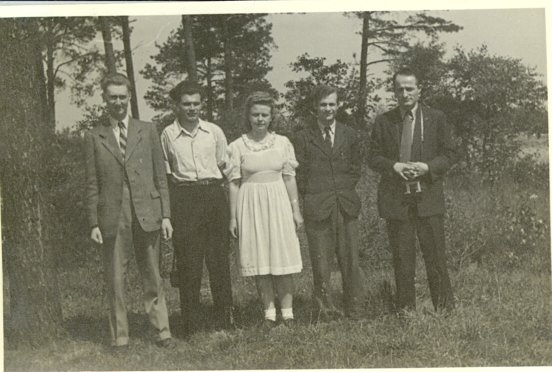
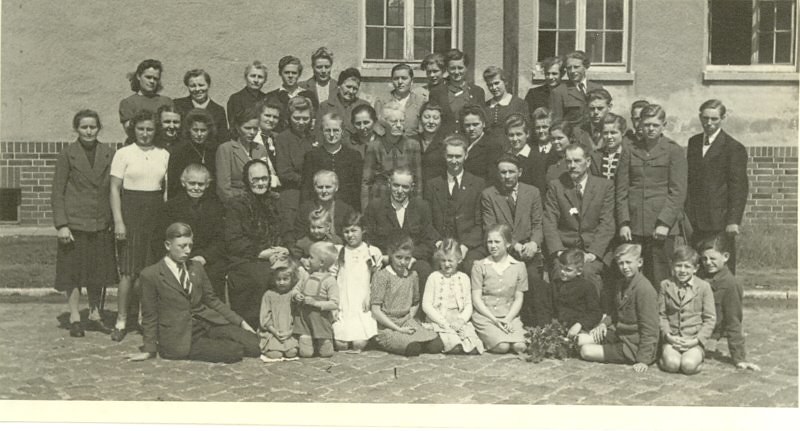
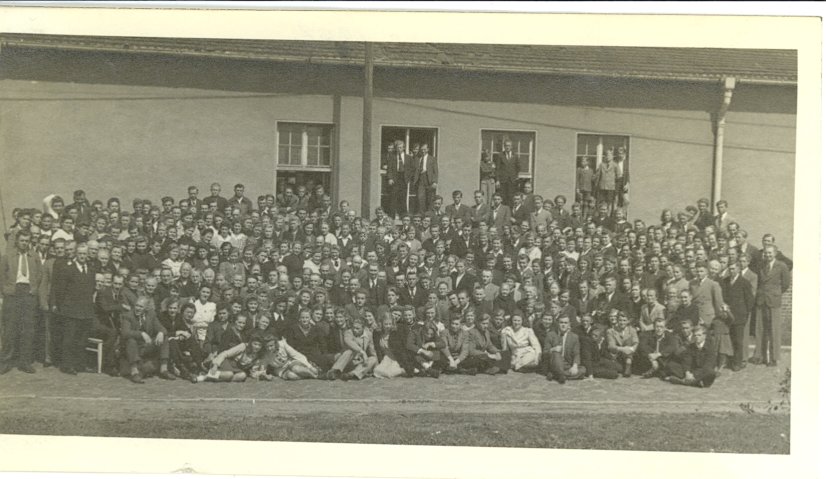
A May 1948 photograph records a shared birthday celebration for 92 people, ranging from one to 75 years old. It offers a glimpse of social life during the wait for resettlement: children, adults and older relatives participating in a community occasion. The photograph comes from the Mennonite collection and does not identify a Ukrainian gathering.
Children also continued their education. A University of Manitoba archival biography documents primary schooling across Munster-Lager and Fallingbostel during 1946–1950, followed by a family’s move to Canada. It is one recorded educational route through these camps, not a count of all pupils.
Sources for this section
The Ukrainian Orthodox congregation
The Ukrainian Autocephalous Orthodox parish at Fallingbostel was served by Fr Serhii Gerus, whose papers make up the surviving Ukrainian record of the camp. The same priest appears to have looked after the parish at Munster-Lager, a garrison town some forty kilometres away, which is why the two sets of records were kept and are held together.
The parish kept accounts for income, expenses, church publications and icons. Around 1950 it recorded the distribution of food supplied by the World Council of Churches. Religious life and practical relief were therefore closely connected.
On 14 July 1950 a census listed Orthodox residents by accommodation block, including their ages and nationalities, with each block leader signing the return. It describes the Orthodox population on that day; it is not a census of all Ukrainians or everyone in the camp.
Records of Ukrainian parish life
| Activity | Surviving material | Dates |
|---|---|---|
| Administration | Correspondence, certificates, emigrant lists | 1948–1950 |
| Finances | Income, expenses, publications and icons | 1948–1950 |
| Food relief | World Council of Churches distributions | Around 1950 |
| Community census | Orthodox residents, organised by block | 14 July 1950 |
Sources for this section
The cemetery at Hartemer Weg
The people who died in the camp were buried apart from the prisoner-of-war dead, in the Displaced Persons cemetery at Hartemer Weg in Osterheide. The Polish war graves index lists seventy-six burials there. Seventy-one of them carry both a year of birth and a year of death, and forty-eight of those died before their first birthday. The recorded deaths run from 1946 to 1950 and are heavily concentrated in 1946.
The names in the index are mostly Polish, with Ukrainian and other eastern European names among them. It is the plainest surviving measure of what the first postwar winters cost the families in the camp.
Recorded deaths at the Hartemer Weg cemetery
| Year of death | Burials indexed |
|---|---|
| 1946 | 45 |
| 1947 | 14 |
| 1948 | 7 |
| 1949 | 3 |
| 1950 | 2 |
Sources for this section
Closing, and what survives
Fallingbostel’s church register records baptisms and marriages for 1948–1950. The volume also contains earlier certificates and shares entries with Munster-Lager, a different camp about 40 kilometres away. Its earliest enclosed papers date from 1943; those papers do not establish that Fallingbostel’s postwar DP camp existed then.
Most of the remaining residents had either gone home or emigrated, above all to the United States, and on the account of the Lower Saxony State Archives the displaced-persons camp was finally closed in the middle of 1950. The Arolsen Archives’ guide to the Polish registration cards is more cautious, allowing that the camp may have continued into the middle of the decade. The latest securely dated material in the Ukrainian records is the census of July 1950.
The barracks at Oerbke did not disappear with the camp. The British Army kept the site as Camp Fallingbostel, and the Bergen training area beside it is still in military use.
Sources
- Fallingbostel and Munster-Lager DP Camp Church Records
Ukrainian History and Education Center · Finding aid 2012
Historical note and scope-and-content read in full: the camp as an emigration, transit and resettlement centre; Munster-Lager about 40 kilometres away; the two sets of records preserved together, possibly because a single priest served both communities. Extent 0.25 linear feet, dates 1943–1950 with the bulk 1948–1950.
- Registration card: DP camp Fallingbostel
Arolsen Archives e-Guide · Undated
Full explanatory text read; no personal card reproduced.
- Fallingbostel Birthday Children
Mennonite Church USA Archives · May 1948
Arthur Voth Photographs HM 4-387, box 1, folder 2, photo 22. Caption dated 30 May; programme on 20 May.
- Displaced Persons Camp Fallingbostel
DP Camps, Wolfgang Strobel contribution · Undated
Assembly Centre 2515 from August 1945 to May 1949; DPACS 9 from July 1947 to May 1949, with 9/68/72/107 between May 1948 and May 1949; emigration, transit or resettlement centre from February 1948; Land Niedersachsen, British zone, mostly Poles, Balts and Yugoslavs. Reply by Wolfgang Strobel read in full. Speculative wartime nationality claims and correspondents’ family enquiries excluded.
- MCC and National Socialism
Mennonite Central Committee, Intersections 9(4) · 2021
Original PDF 49:1948 processing-office photograph and contemporaneous correspondence discussed.
- Fallingbostel church papers and census
Ukrainian History and Education Center · 1948–1950
Container listing read in full: series 1, correspondence and records of Fr Serhii Gerus, 1948–1950, including circulars, receipts, birth and marriage affidavits, civil marriage certificates and emigrant lists; series 2, financial notebooks including the church elder’s records and the sale of church publications and icons; series 3, distribution of food aid from the World Council of Churches, about 1950; series 5, census of 14 July 1950, handwritten lists of all Orthodox residents of the Fallingbostel DP Resettlement Processing Center with ages and nationalities, arranged by block and signed by block leaders.
- Oleh Gerus fonds
University of Manitoba Archives · 2021 finding aid
PDF 3 biographical schooling chronology; identity not reproduced in article.
- Fallingbostel and Munster-Lager church register
Ukrainian History and Education Center · 1943–1950
Separates 1945–49 Munster parish entries from 1948–50 Fallingbostel entries and earlier inserted records.
- NLA HA Nds. 1241 Osterheide — Gemeindefreier Bezirk Osterheide, Sammlung Baumann
Niedersächsisches Landesarchiv, Abteilung Hannover, via Arcinsys · Finding aid, holdings 1934–2005
Full Geschichte des Bestandsbildners read in German: creation of the Bergen training area 1935–38 and the clearance of ten villages by 1 August 1938; Stalag XI B, Stalag XI D (321) Oerbke and Stalag 357; liberation on 16 April 1945; section 3, DP camps at Fallingbostel/Oerbke 1945–1950, with the Sammellager for Soviet DPs, the emigration camp for Polish DPs, about 16,000 remaining residents and closure in mid-1950; section 4, No. 3 Civilian Internment Camp. Individual files not consulted.
- 179 Field Regiment, Royal Artillery: regimental history, 1945–46
The Worcestershire Regiment · Regimental history, events of 1945
Occupation passages read in full: move to Dushorn on 1 August 1945 to police the Fallingbostel DP camp, described as holding 28,000 people of all nationalities, mostly Poles; night patrols; the searches of 27 September and 17 November 1945. Names of individual soldiers and the regiment’s own judgements of the residents are not reproduced.
- Displaced Persons Friedhof Hartemer Weg, Osterheide
Fundacja Polskie Groby · Index accessed September 2026
Burial index counted directly: 76 named or unnamed burials, of which 71 carry both a birth and a death year and 48 of those died within a year of birth; deaths 1946–1950, 45 of them in 1946. The site’s general description text on that page relates to the Soviet prisoner-of-war mass grave and is not used here.
- Fallingbostel Congregation
Mennonite Church USA Archives · 30 May 1948
Arthur Voth Photographs HM4-387, box 1, folder 2, photo 40. Released through Flickr Commons with no known copyright restrictions. The archive caption reads: “May 30, 1948. The congregation at Fallingbostel.”
- Fallingbostel Office Staff
Mennonite Church USA Archives · 9 June 1948
Arthur Voth Photographs HM4-387, box 1, folder 2, photo 48. Released through Flickr Commons with no known copyright restrictions. The archive caption names the office staff as A. V., Jacob Warkentin, Maria Brauer, Jacob Penner and Cornie, and records that Heinrich Hamm took over the other office.
- Diary of events, liberation of Bergen-Belsen
belsen.co.uk · Undated
Day-by-day chronology read for May 1945. Entries for 2, 8 and 22 May record Soviet prisoners evacuated from the Bergen-Belsen barracks to Fallingbostel. An unattributed community website, used only for those dated entries.
- Joanne Reilly, Britain and Belsen
University of Southampton PhD thesis, Department of History · December 1994
Printed page 136 consulted, recording the transfer of 4,000 Russians from Camp II at Belsen to Fallingbostel on 2 May 1945.
- Harold B. Farrar, World War II as I Remember It on the Fiftieth Anniversary
Memoir published by 465th.org · 1995
Printed pages 56 to 57 read in full: arrival at Fallingbostel by boxcar on 30 March 1945, the march to Stalag XI B, the author's figures for the camp complex, and departure on 6 April 1945 ten days before liberation. A personal memoir whose camp figures are the author's own.
- Latvian soldiers in Germany
Latvian State Historical Archives, virtual exhibition 'Baltic DPs in Germany' · Undated
Narrative text read in full. It lists the internee camps holding the largest numbers of former Latvian soldiers, with 4,500 at Fallingbostel, later at Westerburg.
- Guides Can Do Anything: the Guide International Service, 1942 to 1954
Guides Victoria, compiled by Nancy Eastick · About 1995
Printed pages 14 and 17 to 18 read. They name Fallingbostel among the service's postings and describe it as a staging camp where its volunteers took over the welfare of emigrants bound for England.
Last researched 12 September 2026