Flandern-Kaserne
Displacement in Europe
Stuttgart-Bad Cannstatt · Germany · 1945–1948
A former infantry barracks on the Burgholzhof housed a mixed displaced-persons camp whose inventory entry lists Polish-Ukrainian residents among others. It also held the emigration centre for northern Württemberg until that moved to Ludwigsburg in August 1948, after which the site became Robinson Barracks.
Introduction
Flandern-Kaserne housed a mixed displaced-persons community on Stuttgart’s Burgholzhof after the Second World War. Ukrainians were among the groups listed in its administrative record, which names Polish, Polish-Ukrainian, Baltic and other residents. The former infantry barracks later became Robinson Barracks, while the neighbouring Grenadier-Kaserne retained a separate name and history.
Sources for this section
A history in dates
- 1927Military use of the Burgholzhof begins with an army training ground.
- 1935–1936Flandern-Kaserne is built and opens as a German army post.
- 10 December 1945The command historian dates the beginning of relief use at Flandern.
- 25 April 1946The inventory opens a separate repatriation camp, 705 A, in the same barracks.
- 20 August 1946The inventory dates the opening of Assembly Centre 705 at Flandern.
- 31 October 1947Recorded capacity is 1,350 places.
- 2 January 1948A PCIRO return counts 360 Ukrainians in Bad Cannstatt as a whole.
- 11 June 1948The command historian dates the end of the relief period.
- 24 August 1948The northern Württemberg resettlement centre moves from Flandern to the Flak-Kaserne at Ludwigsburg-Ossweil.
- 1949–1950The U.S. Army takes over the post and renames it Robinson Barracks.
The former infantry barracks
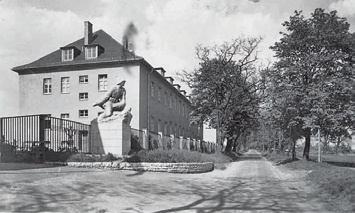
Military use of the Burgholzhof ridge began in 1927 with an army training ground. The German army acquired the land in 1934 and Flandern-Kaserne was built from 1935, opening in 1936; a district history and the American garrison history differ by a year on these dates. The neighbouring Grenadier installation followed, with the first battalion of Infantry Regiment 119 moving in during 1939. Building 111 at Flandern housed headquarters, and some later repurposed buildings had originally been stables for horse-drawn military equipment.
During the war, the garrison became a replacement training centre and accommodated signals and other troops. After fighting ended in May 1945, military compounds in this part of Stuttgart were put to several temporary uses, including internment and accommodation for displaced people.
Sources for this section
Relief accommodation
The U.S. Army’s command historian dates Flandern’s relief use from 10 December 1945 to 11 June 1948. The international agencies used existing military accommodation while residents’ longer-term futures were being resolved. The inventory identifies the facility as Assembly Centre 705 under UNRRA Team 52 at Stuttgart, with the later code WG 223, Area Teams 1003 Stuttgart and 1002 Ludwigsburg, and an entry that closes before 29 July 1948.
On 31 October 1947 its recorded capacity was 1,350. Polish, Polish-Ukrainian, Baltic and other groups appear in the inventory. This is a mixed camp, and the capacity must not be read as either a Ukrainian population total or an actual census of residents. The inventory carries a second entry for the same building, a repatriation camp numbered 705 A which ran from 25 April 1946 until some point between 20 September and 31 October 1947; the two functions therefore overlapped in the same barracks.
Stebelsky’s tabulation of Ukrainians in American-zone camps records 360 Ukrainians at Bad Cannstatt in the PCIRO return of 2 January 1948, with no figure for the three earlier returns. That row names the locality rather than a building, and Bad Cannstatt also contained the Funker-Kaserne, the Melbourne-Kaserne, a workers’ and students’ hotel and the Jewish camp at Stuttgart West, so it cannot be read as a count for Flandern.
The neighbouring Grenadier compound followed a different sequence. The garrison history gives it as an internment camp from September 1945 to January 1947 and then as a displaced-persons camp under International Refugee Organization control until late 1948, while the camp inventory records a capacity of 1,730 and a closing date in 1949 or 1950. Its dates and activities therefore belong to a separate institution, despite the close physical relationship between the two barracks.
Two neighbouring institutions
Flandern in the camp inventory
| Field | Record |
|---|---|
| Assembly Centre | 705, with a separate repatriation camp 705 A |
| Later code | WG 223 |
| UNRRA team | 52, Stuttgart |
| Area teams | 1003 Stuttgart and 1002 Ludwigsburg, from November 1946 |
| Opening and closing | 20 August 1946; entry closes before 29 July 1948 |
| Capacity, 31 October 1947 | 1,350 |
| National groups | Polish, Polish-Ukrainian, Baltic and others |
Other camps recorded at Bad Cannstatt
| Building | Nationality in the inventory | Assembly centre |
|---|---|---|
| Funker-Kaserne | Various | AC 670, WG 224 |
| Melbourne-Kaserne | Lithuanian | AC 706 and 712 A |
| Student’s and Worker’s Hotel | Estonian, Latvian, Lithuanian | AC 711 |
| Stuttgart West, Bismarckstrasse | Jewish | AC 664, WG 219 |
The emigration centre for northern Württemberg
Flandern had one function that reached far beyond Stuttgart. Ulrich Müller, working from IRO papers in the Archives Nationales in Paris, records that the resettlement centre which prepared displaced people from the whole of northern Württemberg for emigration overseas, and which housed the missions of the receiving countries, was originally in the Flandern-Kaserne in Stuttgart and was moved on 24 August 1948 to the Flak-Kaserne at Ludwigsburg-Ossweil. That move falls within weeks of the date at which the garrison historian ends Flandern’s relief period and at which the inventory entry closes.
A French archival inventory of records on political refugees and displaced persons identifies a file for Flandernkaserne, Stuttgart, covering April 1947 to June 1948. That is a locator for unread reports rather than a transcription of them, and it has not been used for any statement of fact here.
From camp to Robinson Barracks
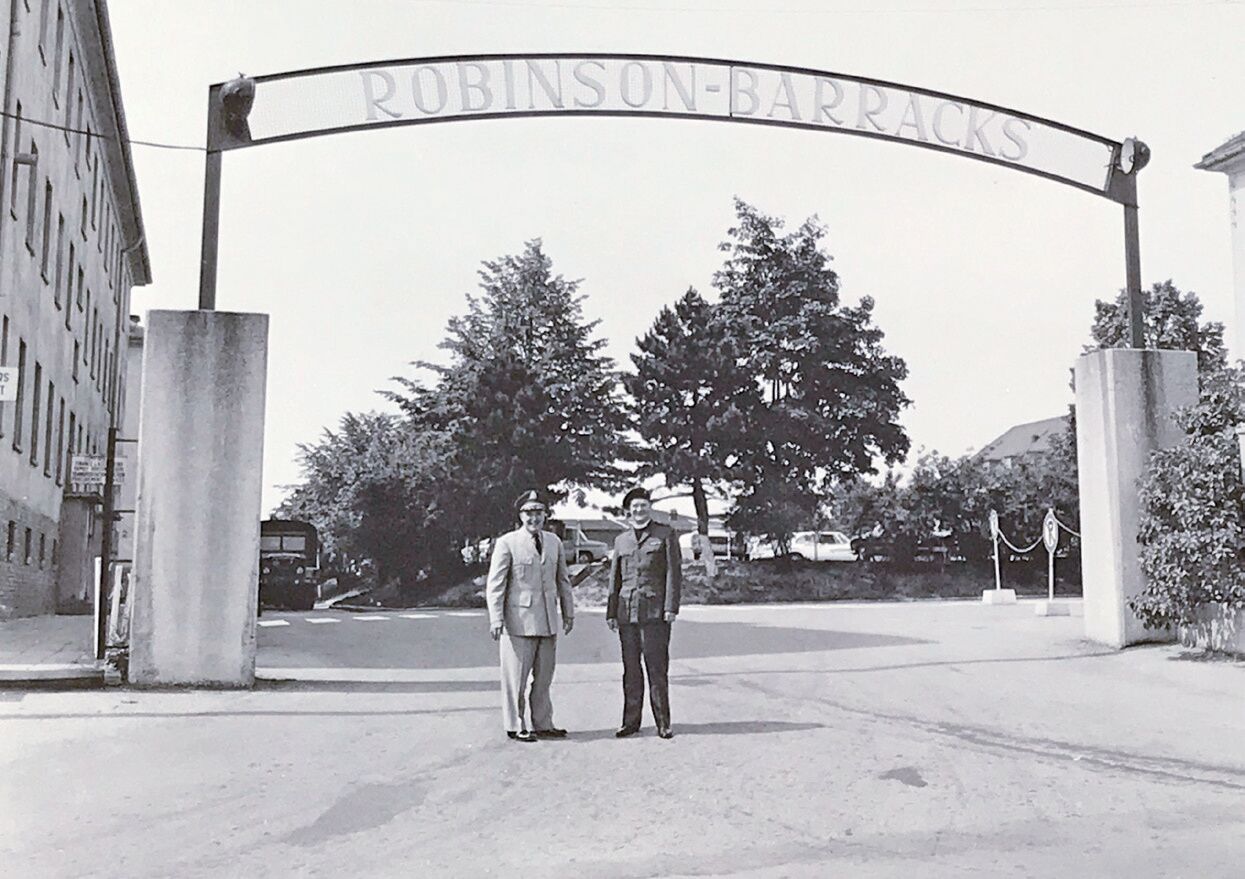
The U.S. Army took over both installations in 1949. Flandern received the name Robinson Barracks in 1950. Later military housing, schools and other facilities expanded across the area. A photograph of the Robinson entrance dated June 1965 records this subsequent military phase, rather than the displaced-person camp.
The original barracks buildings returned to German control by 1993. Parts of the area were subsequently redeveloped as Burgholzhof housing, while other sections continued to serve the American military community.
Sources for this section
Sources
- A brief history of Robinson Barracks
U.S. Army Garrison Stuttgart, EUCOM Command Historian · November 2021
The Citizen, page 16. Separately dates Flandern and Grenadier relief uses and reproduces U.S. Army photographs of the former barracks.
- DP camp inventory: Flandern-Kaserne, Bad Cannstatt
Arolsen Archives · 26 October 2023
Row 1491: AC 705, WG 223, UNRRA Team 52 Stuttgart, capacity 1,350 on 31 October 1947, opening 20 August 1946 and closing before 29 July 1948, nationalities Polish, Polish-Ukrainian, Baltic and various. Row 1492: Repatriation Camp Flandern-Kaserne, AC 705 A, 25 April 1946 to between 20 September and 31 October 1947. Row 1505 for the neighbouring Grenadier-Kaserne.
- Political Refugees and Displaced Persons: archival research report
Research report, archival inventory · Accessed September 2026
Printed page 33 identifies the French archival file for Flandernkaserne, Stuttgart, April 1947 to June 1948. This is a locator, not a transcription of the reports.
- Die Grenadierkaserne (1938/1939–2003)
Rainer Fiechtner, Stadtteilgeschichtliche Sammlungen Rot, Stuttgart · 22 May 2012
Dates the military development of the Burgholzhof from 1927 and the building of the Flandern-Kaserne from 1935, a year earlier than the garrison history.
- Ukrainians in the Displaced Persons Camps of Austria and Germany, Table 8
Ihor Stebelsky, Ukrainskyi Istoryk 3 · 1986
PDF page 56, printed page 54. Row "Bad Connstadt": 360 Ukrainians in the PCIRO return of 2 January 1948, blank in the three earlier columns. A locality row covering every camp in Bad Cannstatt.
- Displaced persons (DPs) in Ludwigsburger Kasernen 1945–1951
Ulrich Müller, Ludwigsburger Geschichtsblätter 43 · 1989
Printed page 137, note 60 citing Archives Nationales Paris AJ 43, 814: the northern Württemberg emigration camp was originally in the Flandernkaserne in Stuttgart and moved to the Flak-Kaserne at Ludwigsburg-Ossweil on 24 August 1948.
Last researched 13 September 2026