Forstner-Kaserne
Displacement in Europe
Karlsruhe · Germany · Registered 24 January 1946, closed between 30 September 1949 and 30 September 1950
A staging centre in a Karlsruhe barracks through which Poles, Balts, Yugoslavs and a small recorded Ukrainian community passed between 1946 and the end of the decade, before the site became Smiley Barracks.
Introduction
The Forstner-Kaserne sheltered displaced people after the Second World War in the area now known as Karlsruhe’s Nordstadt. Most residents were Polish, while the camp inventory also records Ukrainian, Lithuanian, Yugoslav, Latvian and Estonian communities. The buildings provided a temporary base for people displaced by forced labour and deportation.
The inventory calls the site a staging centre, and its Ukrainian numbers are consistent with that. Karlsruhe’s large Ukrainian community was housed elsewhere in the city, at the Rheinland barracks, which the published population table lists as a separate camp.
A history in dates
- 1936–1938The barracks are built beside the Hardtwald and occupied in April 1938.
- 1945The Allies establish accommodation for displaced people.
- 8 July 1945The Americans formally assume occupation authority in Karlsruhe.
- 24 January 1946The inventory records the staging centre as opening, under UNRRA Team 519 and director Ward.
- 31 October 1947The inventory records capacity for 1,400 people.
- December 1947The published Ukrainian table counts 123 Ukrainians at the Karlsruhe staging centre.
- 1947, the end of the 1940s, or about 1950The US Army takes the barracks over as Smiley Barracks; three local accounts give three datings.
- 1949–1950The DP camp closes within the interval recorded in the inventory.
- From 1954The Paul Revere Village housing estate is built near Smiley Barracks.
- 19 April 1995American forces formally leave Karlsruhe.
- 1997 onwardCivilian conversion creates housing and community facilities.
The barracks in the Hardtwald
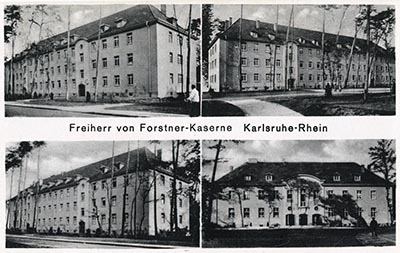
The military complex was built in the middle of the woodland at the Kanalweg between 1936 and 1938, as part of German rearmament, and was occupied in April 1938. It stood on the former Forstner-Straße, now Kanalweg. A surviving postcard shows the accommodation blocks shortly before the war. These buildings became the physical setting for the postwar camp.
The name belonged to a soldier of the previous generation: General der Infanterie Freiherr Ernst von Forstner, who lived from 1869 to 1950 and had commanded the 1st Baden Infantry Regiment. The compound appears in the records as General-Forstner-Kaserne and as Freiherr-von-Forstner-Kaserne, and the inventory of camps enters it simply as Forstner-Kaserne.
A centre for displaced people
After liberation, the Allies repurposed the barracks as a collection and repatriation centre. The site history published by the cooperative that now occupies the buildings identifies former forced labourers and prisoners of war among the people accommodated, and the district association’s account describes them as forced labourers deported during the war, mainly from Poland and the Soviet Union.
The administrative inventory records the site as Forstner-Kaserne / Staging-Center, opened on 24 January 1946 under UNRRA Team 519 at Karlsruhe, with assembly-centre numbers AC 619 and AC 691, later BN 203. Its recorded population categories were Polish, Lithuanian, Yugoslav, Latvian, Estonian and Ukrainian, in that order.
The same row places the staging centre in the wider relief structure. Its team director was named Ward; its area teams were at Mannheim, Ettlingen and Darmstadt, and it belonged to Area 2 at Ludwigsburg under a field supervisor named Nordby. The Ettlingen camp on the edge of the city, a much larger Ukrainian community, sat under the same area teams and the same field supervisor, so the two were administered from the same desks.
The records that survive from the camp are the monthly population and change returns filed for Karlsruhe with the International Tracing Service, catalogued as Dok-ID 81996521 to 81996853.
The camp in the register
| Record | Detail |
|---|---|
| Name in the register | Forstner-Kaserne / Staging-Center |
| Location | Karlsruhe, US zone, District 1 |
| Opening | 24 January 1946 |
| Closing | Between 30 September 1949 and 30 September 1950 |
| Capacity | 1,400 on 31 October 1947 |
| Assembly centre | AC 619; AC 691; later BN 203 |
| UNRRA team | T 519 Karlsruhe, director Ward |
| Area teams | AT 1001 Mannheim; AT 1001 Ettlingen; AT 1021 Darmstadt |
| Area | A 2 Ludwigsburg; field supervisor Nordby |
| Population categories | Polish, Lithuanian, Yugoslav, Latvian, Estonian, Ukrainian |
| Surviving records | ITS monthly returns for Karlsruhe, Dok-ID 81996521–81996853 |
The recorded population
Karlsruhe’s municipal history reports that as many as 1,700 people were housed here at times, and the district association gives the same figure. The inventory gives a capacity of 1,400 on 31 October 1947. The figures describe different records and dates; neither is a Ukrainian-only headcount.
For Ukrainians specifically there is one camp-level figure. Stebelsky’s published table lists Karlsruhe (Staging Centre) with no entry in the earlier returns and 123 people in the return compiled for December 1947. The same table lists Karlsruhe (Rheinlander K.) separately, with 1,300 in the questionnaire returns of 1946 and 1947, 1,344 in May 1947 and 1,633 in December 1947, and Ettlingen on a third line. A staging centre is a place people pass through, and a single late figure is what such a place tends to leave behind.
Accommodation figures
Ukrainians recorded in and around Karlsruhe
| Camp in the table | 1946 to 1947 | May 1947 | December 1947 |
|---|---|---|---|
| Karlsruhe (Staging Centre) | No figure | No figure | 123 |
| Karlsruhe (Rheinlander K.) | 1,300 | 1,344 | 1,633 |
| Ettlingen | 2,147 | 1,694 | No figure |
After the displaced-persons camp
The inventory places closure between 30 September 1949 and 30 September 1950. The local accounts of the American takeover do not agree: the district association says the US Army moved in during 1947 and renamed the site Smiley Barracks, while the cooperative’s history dates that to about 1950. The municipal Stadtlexikon offers a third reading, ‘the end of the 1940s’, which sits closer to the inventory’s closing interval. Since the staging centre still had residents in December 1947, either the two uses overlapped or the earliest of the three datings is wrong.
American authority over the city itself began earlier and lasted longer. The Americans formally assumed occupation authority in Karlsruhe on 8 July 1945, and the former Forstner barracks, by then Smiley Barracks, became the seat of the US District Command Karlsruhe. At its height the American presence in the city numbered about 14,000 soldiers and family members, and from 1954 the Paul Revere Village housing estate was built nearby.
Three datings of the American takeover
| Account | Date given |
|---|---|
| Bürgerverein Nordstadt, district history | 1947 |
| Stadtlexikon Karlsruhe | End of the 1940s |
| MiKa cooperative, site history | About 1950 |
| DP camp inventory, closing interval | Between 30 September 1949 and 30 September 1950 |
Homes and community buildings
The formal American departure came on 19 April 1995. The site then took on another civilian role: the MiKa cooperative, founded in 1997, converted former barracks into homes, and the wider redevelopment included health and social services, a kindergarten and community meeting spaces. The former military complex also became home to the American Library and the Mikado cultural centre.
Sources
- Freiherr-von-Forstner-Kaserne
Katja Förster, Stadtarchiv Karlsruhe, 2015
Municipal account of the 1936 to 1938 barracks, postwar DP use, accommodation for up to 1,700 people, US reuse and civilian conversion; postcard 8/PBS oXIVa 2591.
- From barracks to housing cooperative
MiKa housing cooperative
Current occupants’ institutional history: collection centre in 1945, Smiley Barracks in 1950, conversion in 1997 and Mikado in 2003.
- DP camp inventory, record 1093: Forstner-Kaserne / Staging-Center
Arolsen Archives
Catalogue row 1093 read in full from the spreadsheet: Karlsruhe, US zone, District 1; building ‘Forstner-Kaserne / Staging-Center’; categories Polish, Lithuanian, Yugoslav, Latvian, Estonian and Ukrainian, in that order; opening 24 January 1946; closing between 30 September 1949 and 30 September 1950; assembly centres AC 619 and AC 691, later BN 203; UNRRA Team 519 Karlsruhe under director Ward; area teams AT 1001 Mannheim, AT 1001 Ettlingen and AT 1021 Darmstadt; Area A 2 Ludwigsburg; field supervisor Nordby; capacity 1,400 on 31 October 1947; archive reference to ITS monthly returns for Karlsruhe, Dok-ID 81996521 to 81996853.
- Ukrainian DP population table, Table 7
Ihor Stebelsky, in The Refugee Experience, 1992
Table 7, “Ukrainians in UNRRA and IRO Camps of the American Zone of Germany”; printed page 47, Württemberg-Baden section; column notes printed p. 51. Karlsruhe (Staging Centre): no figure in the first three returns, 123 in the return compiled for December 1947. Karlsruhe (Rheinlander K.) is a separate row with 1,300, no figure, 1,344 and 1,633; Ettlingen is a third row. Page rendered from the PDF and read visually to check the column assignment. Stebelsky’s earlier 1986 printing of the same tables numbers them one higher, where this is Table 8.
- Geschichte des Stadtteils
Bürgerverein Karlsruhe Nordstadt
District history: the General-Forstner-Kaserne built in 1938 in the wood at the Kanalweg; after 1945 up to 1,700 forced labourers deported during the war, mainly from Poland and the Soviet Union; the US Army moving in during 1947 and renaming the site Smiley Barracks.
- Rheinkaserne (Pionierkaserne, Mudra-Kaserne)
Stadtlexikon Karlsruhe
Read only to keep the Karlsruhe sites apart. A different barracks, used to receive displaced persons from July 1945 and also, temporarily, refugees including Danube Swabians from Yugoslavia, with US forces occupying it from 24 January 1947.
- Surviving barracks boundary and pedestrian entrance, former Forstner-Kaserne, Karlsruhe
Kürschner, via Wikimedia Commons · 22 October 2022
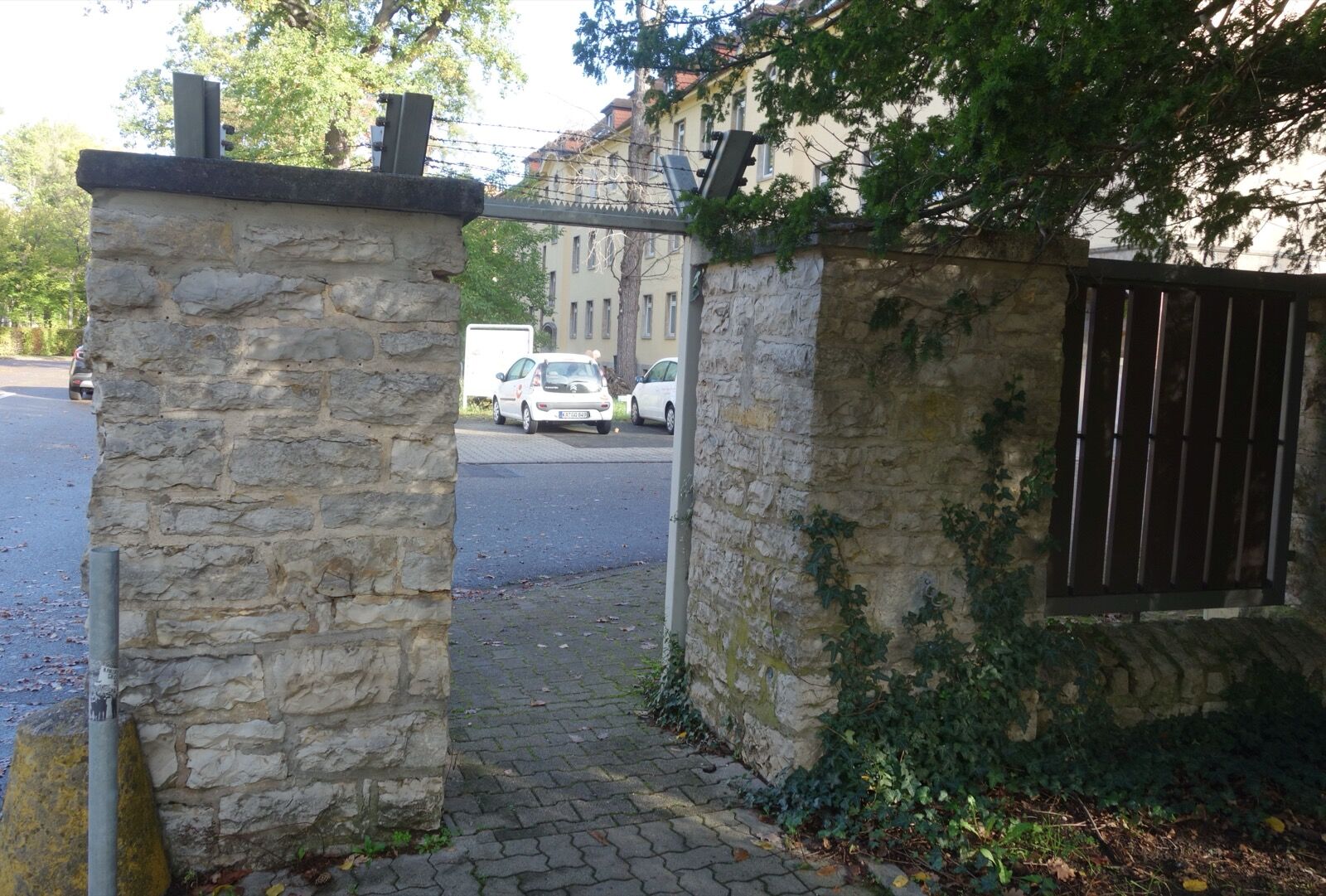
Photograph released under the Creative Commons CC0 public domain dedication. Shows the pedestrian entrance beside the original barrier gateway to the barracks, called Forstner-Kaserne before the American army renamed it Smiley Barracks.
- Forstner-Kaserne
Stadtwiki Karlsruhe · Read 14 September 2026
Entry read in full. Names the barracks after General der Infanterie Freiherr Ernst von Forstner (1869–1950), a former commander of the 1st Baden Infantry Regiment, and records the forms General-Forstner-Kaserne and Freiherr-von-Forstner-Kaserne, the American renaming as Smiley Barracks and the later civilian uses. A community wiki, used here only for the namesake and the variant names.
- Amerikanische Streitkräfte in Karlsruhe 1945–1995
Stadtarchiv Karlsruhe, Blick in die Geschichte 149 · Read 14 September 2026
City archive article read in full. Gives 8 July 1945 as the date the Americans formally assumed occupation authority in Karlsruhe, identifies the former Freiherr-von-Forstner-Kaserne, by then Smiley Barracks, as the seat of the US District Command Karlsruhe, notes the Paul Revere Village housing built nearby from 1954, gives a peak of about 14,000 soldiers and family members in the city, and dates the formal American departure to 19 April 1995.
Last researched 13 September 2026