Funk-Kaserne Transit Centre
Displacement in Europe
Munich · Germany · Transit and resettlement · documented 1946–1955
The former Munich air signals barracks became the largest resettlement centre in southern Germany, where arrivals were registered and people leaving Europe completed their medical and consular formalities. Ukrainian population returns and a firsthand family account place Ukrainians among those who passed through.
Introduction
Funk-Kaserne in northern Munich was a transit and resettlement facility for people preparing to leave postwar Germany. Ukrainian population returns and a firsthand family account establish its place in Ukrainian displacement history. For some families, the barracks were one of the final stops between a residential camp and emigration overseas.
Sources for this section
A history in dates
- 1936–1938The barracks are built as an air force signals barracks.
- 1945The former barracks become reception accommodation for displaced people, with an UNRRA team file for Funk Kaserne.
- January 1946Transit use is documented; 219 residents are recorded.
- May 1946962 people are recorded in transit and 378 in the emigration section.
- May 1947A return records 194 Ukrainians at Funk-Kaserne Transit.
- December 1947The recorded Ukrainian group reaches 487.
- March 1948Jewish residents are transferred to the Warner-Kaserne and the transit function moves to Freimann.
- April 1950The emigration camp recorded in the Jewish DP register is closed.
- September 1951A Ukrainian family transfers here for medical screening before departure to the United States.
- From 1952People who are not displaced persons also emigrate through the resettlement centre.
- September 1955Emigrants leaving the centre by train on 17 September board their ship on 21 September.
- 1959The latest departure date noted on a surviving registration card from the resettlement centre.
- 1956–1992The site serves as a Bundeswehr engineer barracks.
- 1990s onwardMilitary use gives way to civilian activities and, later, the Domagkpark development.
Sources for this section
- Funkkaserne
- Schwabing-Freimann cultural history trail
- UNRRA Germany Mission administrative history, box and folder list
- München Funkkaserne: transit and emigration camp
- Frankfurter Ring: Funkkaserne
- Ukrainians in Funk-Kaserne Transit
- A Ukrainian family’s move to Funk-Kaserne
- Registration card: Resettlement Center Munich-Freimann
- From barracks to city quarter: Funkkaserne
- Domagkpark
The former signals barracks
The site lay between today’s Domagkstraße and Frankfurter Ring. Built for military use during the Nazi period, it became reception accommodation for displaced people after the war. It was separate from Munich’s Freimann SS barracks, Luitpold-Kaserne and the residential community at Laim, all of which appear under different headings in the population returns.
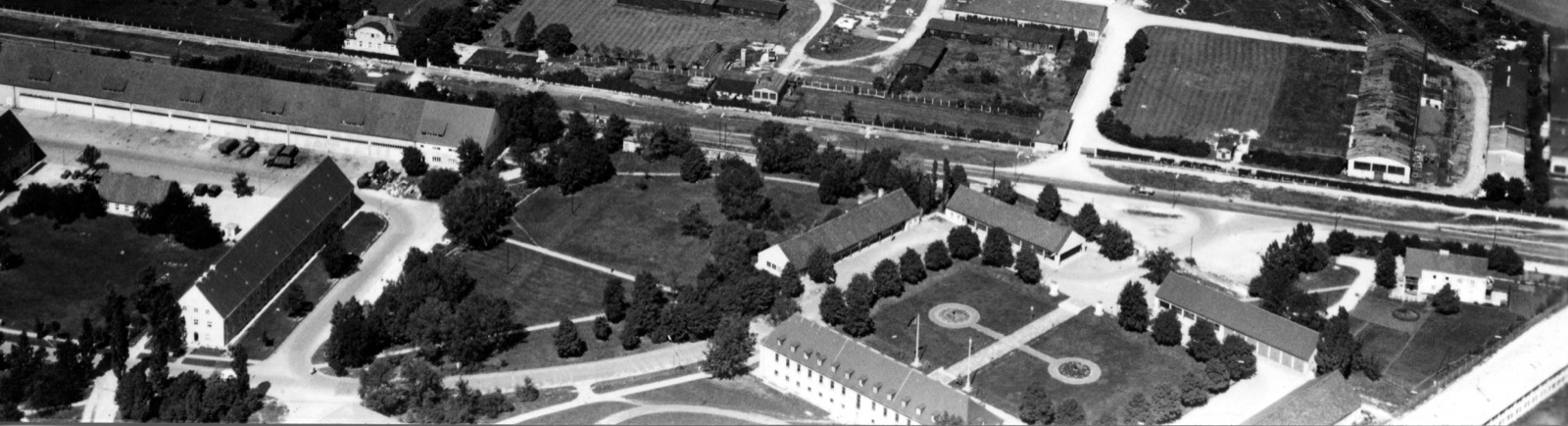
The barracks were built between 1936 and 1938 as an air force signals barracks during German rearmament, to designs by Albert Heichlinger, Lars Landschreiber and Max Dellefant, and came through the war largely undamaged. That is why they could be turned over so quickly: an intact compound of blocks, kitchens and offices on the northern edge of the city, close to the railway.
What the centre actually did
This was a processing place rather than a home. Displaced people arriving in the Munich area were registered here and then distributed among other camps, and those preparing to leave were advised on their emigration and billeted here while their medical examinations were carried out. The Jewish Museum Munich describes military accommodation used for displaced persons and as a transit centre probably from January 1946, and states that Jewish and non-Jewish displaced persons alike completed their last formalities here before departing by ship or aeroplane.
The premises were never big enough for the traffic. The stated maximum was 600 places, with up to 1,800 people housed at times, and the transit section is elsewhere given as having room for 650 while being severely overcrowded. All Jewish residents of the camp were transferred to the Warner-Kaserne, also known as the Ernst-von-Bergmann-Kaserne, in March 1948.
Sources for this section
Two functions, two sets of dates
The centre had a transit section and an emigration section, and they did not end together. The register of Jewish displaced-persons camps records occupancy at the Funkkaserne of 219 in January 1946, 962 in transit and 378 in emigration in May 1946, 1,700 in October 1946, 779 in February 1947, 574 in September 1947, 31 in October 1948 and 8 in March 1949. It gives 1948 as the closing date of the transit camp and April 1950 for the emigration camp, and records that all Jewish camp residents were moved to the Warner-Kaserne in March 1948. The transit function itself went to the former SS barracks in Freimann in 1948.
The UNRRA files in the United Nations Archives give the administrative identifiers: Assembly Centre 95-277, written in the catalogue as Funk Kaserne Transitent, Munich, with files for 1946 and 1947, and a Team 547 Funk Kaserne Munich file for 1945 and 1946. The separate Munich Resettlement Centre in the Ukrainian population table is not the same entry, and the two should not be merged.
Emigration work continued after the camp numbers were closed. The city’s cultural-history guide records that UNRRA set up a reception camp for displaced persons here in 1945 and that it lasted until 1955, and the Jewish Museum records that from 1952, once the IRO had ceased to act as a relief organisation, people who were not displaced persons also emigrated through the Funkkaserne resettlement centre. That explains how a Ukrainian family could be sent here for medical screening in September 1951, more than a year after the emigration camp recorded in the Jewish DP register had closed.
The Arolsen Archives hold registration cards from the resettlement centre that document its later phase. The cards were created from 1952 onward, after the displaced-persons camp closed and the IRO was disbanded, and one of the latest departure dates noted on a card is from 1959. A second Arolsen e-Guide entry records that the Funkkaserne went on being used as a resettlement centre after the dissolution of the IRO, which had been responsible for the displaced persons’ care and emigration until the end of 1951.
Recorded occupancy of the Funkkaserne centre
| Date | People recorded |
|---|---|
| January 1946 | 219 |
| May 1946 | 962 in transit and 378 in emigration |
| October 1946 | 1,700 |
| February 1947 | 779 |
| September 1947 | 574 |
| October 1948 | 31 |
| March 1949 | 8 |
Sources for this section
- München Funkkaserne: transit and emigration camp
- Frankfurter Ring: Funkkaserne
- Ukrainians in Funk-Kaserne Transit
- UNRRA Germany Mission administrative history, box and folder list
- Schwabing-Freimann cultural history trail
- A Ukrainian family’s move to Funk-Kaserne
- Registration card: Resettlement Center Munich-Freimann
- Funkkaserne resettlement centre
A practical stage before emigration
A firsthand account published by the American Friends Service Committee describes a Ukrainian family receiving authorisation in late September 1951 to move from Bad Aibling Children’s Village to Munich’s Funk-Kaserne. Their purpose was medical screening and final preparation for departure to the United States.
That account supplies a precise example of what the resettlement function meant for a family. Care and schooling at an earlier institution were followed by another move, with examinations and departure arrangements still ahead. The activities described at Bad Aibling belong to that children’s village; they are not evidence of equivalent facilities inside Funk-Kaserne.
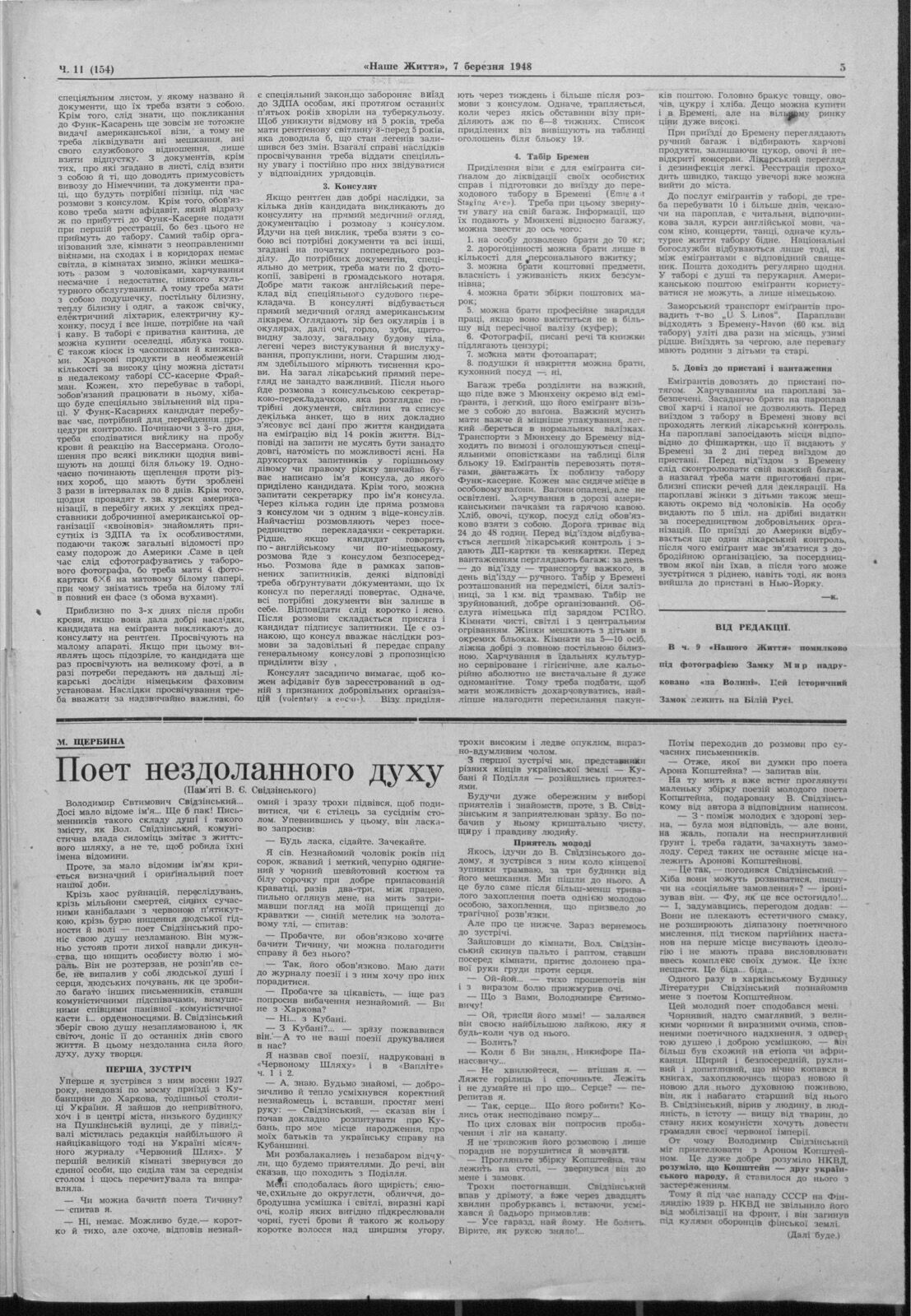
A practical guide for intending emigrants, printed in the Augsburg Ukrainian weekly Nashe zhyttia on 7 March 1948, describes the place as those passing through it found it. A summons to the Funk-Kaserne was not the same thing as the grant of an American visa, the paper warned, so nobody should give up a room or a job — only take leave. An affidavit had to be produced at first registration or the applicant would not be admitted. The camp itself the guide calls badly run: rooms with unmended windows, no light on the stairs or in the corridors, cold rooms, women housed together with men, food that was poor and insufficient, and nothing provided in the way of cultural life.
The guide accordingly told people what to bring: a pillow, bed linen, warm underclothes and clothing, a candle, an electric torch, an electric hotplate, crockery and everything else needed to make tea and coffee. There was a private canteen in the camp selling herring and apples, and a kiosk with newspapers and books; food in unlimited quantity could be had at a high price in the nearby SS-Kaserne camp at Freimann. Everyone staying in the camp was obliged to work in it unless specially released. A candidate remained at the Funk-Kaserne for as long as the screening took: from the third day he could expect to be called for a blood test and a Wassermann reaction, with notices of all such summonses posted daily on the board beside block 19, while inoculations against various diseases began at the same time, three of them at eight-day intervals, and so-called Americanisation courses ran every day.
The Arolsen e-Guide gives an example of how quickly the last stage could run. People who left the Funkkaserne resettlement centre by train on 17 September 1955 boarded their ship on 21 September. The port of embarkation is not named.
Ukrainians in the transit returns
The 1946–1947 questionnaire series lists 144 Ukrainians at Funk-Kaserne Transit. Later returns record 194 in May 1947 and 487 in December 1947. These are snapshots of one national group, rather than a count of everyone who passed through the facility.
The same table separately lists a Munich Resettlement Centre. Its figures are not silently combined with those for Funk-Kaserne: changes of administrative name and function require documentary evidence, even when later testimony explicitly calls Funk-Kaserne a resettlement centre.
Ukrainians at Funk-Kaserne Transit
| Return | People |
|---|---|
| 1946–1947 questionnaire series | 144 |
| May 1947 | 194 |
| December 1947 | 487 |
Sources for this section
The site after the displacement years
Municipal histories describe refugee accommodation continuing into the 1950s before the compound returned to military use. The documented family transfer in September 1951 is therefore important evidence against treating an earlier transit-section closure as the end of all refugee processing at the site.
From 1956 to 1992 the 62.6-hectare site was a Bundeswehr engineer barracks, with a final parade in March 1992. From 1993 the buildings held the Domagk studios, with up to 300 artists’ workspaces, and demolition began in 2010.
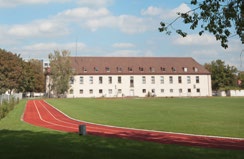
After military use ended, the buildings accommodated artists and other temporary civilian activities. Redevelopment created the Domagkpark district, with around 1,800 homes on the City of Munich’s account. Parts of the former complex remain in public use, including the building and sports ground shown here in the city’s conversion study.
Sources
- Schwabing-Freimann cultural history trail
Landeshauptstadt München · Municipal historical guide
Identifies former Funkkaserne and postwar reception use. The guide’s broad end date is not assigned to every distinct transit programme.
- Ukrainians in Funk-Kaserne Transit
Canadian Institute of Ukrainian Studies Press · 1992
Stebelsky table 7, printed page 49: 144 in 1946–1947 questionnaire series, 194 in May 1947, 487 in December 1947. Distinguishes Funk transit from Munich Resettlement Centre and Freimann.
- A Ukrainian family’s move to Funk-Kaserne
American Friends Service Committee, Peace Works · Public firsthand recollection
Family of former Ukrainian forced labourers authorised to transfer from Bad Aibling Children’s Village to Funk-Kaserne in late September 1951 for medical screening and departure to the United States. No resident names reproduced.
- From barracks to city quarter: Funkkaserne
Landeshauptstadt München · 2013
Printed pages 32–35: former barrack site, UN refugee use, later military and civilian phases. Photograph on page 33 shows surviving building and sports ground in modern use.
- Domagkpark
Landeshauptstadt München · Accessed September 2026
Current municipal account identifies the former Funkkaserne land as Domagkpark, with approximately 1,800 homes.
- Funkkaserne
German Wikipedia · retrieved 13 September 2026
Built 1936–38 as an air force signals barracks; displaced-persons use to 1955; Bundeswehr 1956–1992; Domagk studios; Domagkpark.
- München Funkkaserne: transit and emigration camp
after-the-shoah.org, register of Jewish DP camps and communities in West Germany · page updated 12 June 2017
Occupancy figures from January 1946 to March 1949; transit camp closed 1948, emigration camp April 1950; Jewish residents moved to the Warner-Kaserne in March 1948.
- Frankfurter Ring: Funkkaserne
Jüdisches Museum München, online exhibition Munich Displaced · retrieved 13 September 2026
Registration and distribution of arrivals, emigration advice, medical examinations, capacity 600 against up to 1,800 present, transit moved to Freimann in 1948, non-DP emigration from 1952.
- UNRRA Germany Mission administrative history, box and folder list
United Nations Archives, AG-018-039, via dpcamps.org · 1945–1949
Assembly Centre 95-277 Funk Kaserne Transitent, Munich, 1946–1947; Team 547 Funk Kaserne Munich 1945–1946.
- Aerial view of the former Funkkaserne, Munich, about 1950
Maurer SE, via Wikimedia Commons · photograph undated, about 1950
Detail of a company aerial photograph, licensed CC BY-SA 4.0. Shows the barracks compound from the air; the road along its front is the present Frankfurter Ring, then the Freimanner Straße.
- Shcho treba znaty emihrantam do SShA (What emigrants to the USA need to know), Nashe zhyttia, number 11 (154), 7 March 1948, page 5
Nashe zhyttia, Cultural and Educational Department of the Ukrainian camp, Augsburg · 7 March 1948
Digitised by the Ukrainian Museum-Archives of Cleveland with the United States Holocaust Memorial Museum in the Displaced Persons Camp Periodicals Collection; marked public domain or an orphan work and offered under Creative Commons Attribution-NonCommercial-NoDerivatives 4.0. A practical guide for intending emigrants describing conditions and procedure at the Funk-Kaserne.
- Registration card: Resettlement Center Munich-Freimann
Arolsen Archives, e-Guide · Undated; read 14 September 2026
e-Guide description page read in full. It dates the surviving Funkkaserne registration cards from 1952, after the displaced-persons camp closed and the IRO was disbanded, notes 1959 as one of the latest departure dates on a card, and gives the September 1955 train-to-ship example.
- Funkkaserne resettlement centre
Arolsen Archives, e-Guide · Undated; read 14 September 2026
Single e-Guide text passage on the former Wehrmacht radio barracks at Freimann, recording that the Funkkaserne went on being used as a resettlement centre after the dissolution of the IRO, which had been responsible for displaced persons’ care and emigration until the end of 1951.
Last researched 13 September 2026