Ganacker
Displacement in Europe
Ganacker · Germany · 1945–1949
A bombed-out Luftwaffe airfield in the Isar valley became one of the larger mixed relief camps of Lower Bavaria, with more than seven hundred Ukrainians recorded there in the questionnaire returns of 1946 and 1947. Its buildings passed to German expellees in 1949 and were cleared in 1962.
Introduction
Ganacker’s former airfield became a place of temporary refuge after the Second World War. Relief accommodation occupied the former military site from May 1945. The camp inventory records Polish, Jewish, Russian and Polish-Ukrainian residents. Published population returns place several hundred Ukrainians there across three separate counts, and Ganacker also appears in the history of Belarusian displacement, as one of the places from which people moved to Osterhofen.
A history in dates
- August 1936Nineteen farmers are told their land is required; levelling begins that autumn on 350 hectares.
- 20 or 21 February 1945A subcamp of Flossenbürg concentration camp is set up to build a concrete runway; it is evacuated on 24 April.
- 29 April 1945Units of the 71st US Infantry Division capture the former airfield.
- May 1945Relief accommodation is established in the former airbase.
- 8 January 1946The inventory record for AC 93-262 opens.
- 12 August 1946A marriage is recorded at the Ganacker displaced persons camp in the papers of a nurse who worked at the camp’s UNRRA hospital.
- Autumn 1946Ganacker is among the places contributing residents to the Belarusian community at Osterhofen.
- 31 May 1947The UNRRA summary records 553 Ukrainians.
- 31 October 1947The inventory records accommodation capacity of 900.
- 2 January 1948The PCIRO summary records 736 Ukrainians.
- 30 June 1949The inventory closes its record of the DP camp.
- 1949The site enters a new phase housing German expellees.
- October 1962The later camp is cleared and largely demolished.
Sources for this section
- Lecture on Ganacker airfield, reported in full
- KZ-Außenlager Ganacker
- Ganacker airfield: local historical research
- DP camp inventory: Ganacker, entry 978
- Wanda Zofia Ciecierska papers
- Piśmiennictwo białoruskie na emigracji na przykładzie pisma Marzec z lat 1947–1948
- Ukrainians in UNRRA and IRO camps of the American zone: Table 7
The airfield before 1945
In August 1936 nineteen farmers were told by an officer of the Munich air district that their land was needed for an airfield, and had no way of refusing the leases. Work on levelling a runway and putting up buildings began that autumn on an area of three hundred and fifty hectares. Flying school 112 began training pilots immediately, and the station held the status of an emergency airfield of the second and, from 1939, the first category. Fighter squadrons arrived from the spring of 1944.
From January 1945 Ganacker was part of Project Silber: the first Messerschmitt Me 262 jets were stationed there and a concrete runway was begun. That work was done by concentration camp prisoners. A subcamp of Flossenbürg existed from 20 or 21 February to 24 April 1945, holding about five hundred men, most of them Jewish, first at the airfield and later at Erlau near Wallersdorf; at least 138 of them died between 2 March and 23 April 1945. The subcamp and the relief camp that followed shared a location and nothing else, and the two must not be described in each other’s terms.
The Flossenbürg memorial’s account of the subcamp sets out who was held there: about five hundred mainly Jewish prisoners from Poland, Hungary, France and Greece, together with Russian, Polish, French, Belgian, Czech and German prisoners, and prisoners from seventeen nations in all.
The Bundesarchiv finding aid for Luftgaukommando VII preserves two further traces of the wartime station. A file of June 1936 to November 1938 on the fixing of workers’ wages and wage scales names Ganacker among the duty stations concerned, and a weather-service volume enumerates the stations Landsberg/Lech, Lechfeld, Kaufbeuren and Landau-Ganacker for the years 1937 to 1943. Neither entry says anything about the postwar camp.
From airfield to refuge
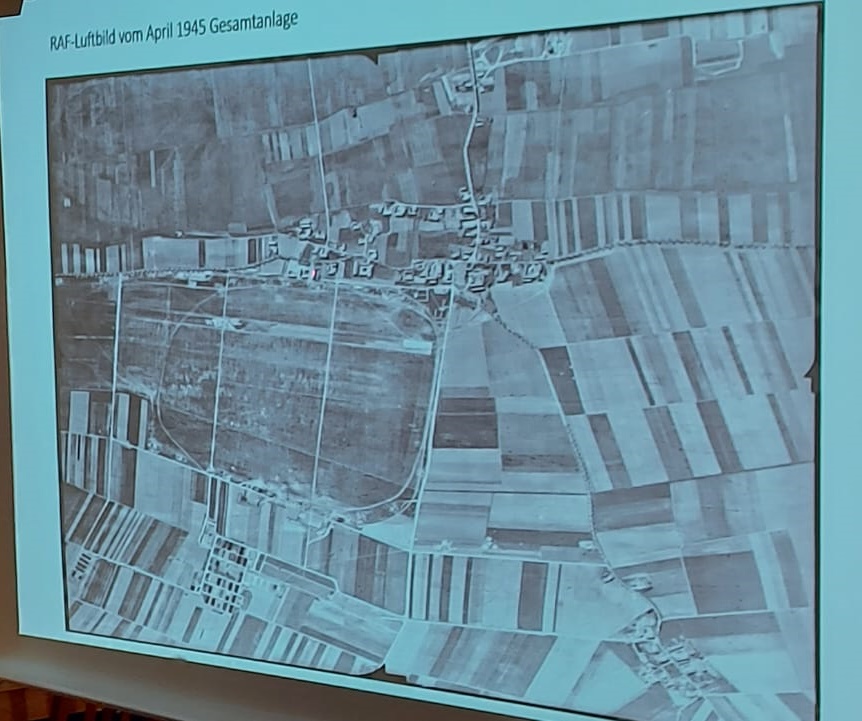
An American bombing raid in April 1945 left damage heavy enough to end all flying, and units of the 71st US Infantry Division took the station on 29 April. In May the Americans established an UNRRA camp in the former airbase to accommodate people uprooted by the war. A surviving aerial image shows the large compound and surrounding fields shortly before that change of use.
Wartime forced labour, the postwar DP camp and later accommodation for German expellees were distinct institutions.
An UNRRA hospital operated at Ganacker. The papers of a Polish nurse, Wanda Zofia Ciecierska, described by the United States Holocaust Memorial Museum, include certificates documenting her nursing work for the UNRRA hospital in Ganacker, and the same description records that she married at the Ganacker displaced persons camp on 12 August 1946. The description gives no date for the hospital’s opening and no measure of its size.
A camp within a relief network
Ganacker was recorded as Assembly Centre 93-262. The administrative network included UNRRA Team 542 at Dingolfing, then Area Team 1046 at Regensburg from November 1946, and Area 4 at Amberg. From September 1948 the inventory gives the identifier NBO 426. These changing references help connect records created by different offices.
The inventory gives 8 January 1946 as its opening entry, later than the May 1945 establishment described in local historical research. It lists a capacity of 900 on 31 October 1947. This was the accommodation figure recorded for the camp, rather than a count of Ukrainians or a dated census of everyone living there. Its archive reference points to holdings and change reports under document identifiers 81984854 to 81984889, which have not been read.
Camp identifiers
| Reference | Recorded detail |
|---|---|
| Assembly centre | AC 93-262 |
| Later identifier | NBO 426, from September 1948 |
| Relief team | Team 542, Dingolfing |
| Area team | 1046, Regensburg, from November 1946 |
| Recorded nationalities | Polish, Jewish, Russian, Polish-Ukrainian |
| Capacity | 900 on 31 October 1947 |
Sources for this section
How many Ukrainians
Ihor Stebelsky’s published table, which lists the place as Ganacher, records 707 Ukrainians in the questionnaire returns collected during 1946 and 1947, 553 in the UNRRA summary of 31 May 1947 and 736 in the PCIRO summary of 2 January 1948. These are counts of Ukrainians only, and each is smaller than the recorded capacity of 900, which is consistent with the inventory’s description of a camp of several nationalities. The rise between May 1947 and January 1948 suggests arrivals from elsewhere, but no source consulted says where from.
Ukrainians recorded at Ganacker
| Source and date | People |
|---|---|
| Questionnaire returns collected 1946–1947 | 707 |
| UNRRA summary, 24 August 1946 | not listed |
| UNRRA summary, 31 May 1947 | 553 |
| PCIRO summary, 2 January 1948 | 736 |
Moving between camps
Belarusian displaced people from Ganacker were among those who helped form the community at Osterhofen. Around 400 Belarusians gathered there from several places, including Dingolfing and Passau. A separate Belarusian camp developed in autumn 1946 and opened its educational institutions in February 1947. The number 400 describes that receiving community, not departures from Ganacker alone.
Sources for this section
The end of the DP phase
The inventory records 30 June 1949 as the end of Ganacker’s DP camp. Local historical research dates its conversion to accommodation for German expellees from the former German territories in the east to 1949. That later camp continued until October 1962, when it was cleared and largely demolished. Almost every building of the former airfield has since been removed; only a few of the former officers’ mess buildings beside the road towards Haidenkofen survive in workshop use.
Different uses of the same area
| Period | Institution |
|---|---|
| 1936–1945 | Luftwaffe airfield, flying school and, from 1944, fighter units |
| February–April 1945 | Subcamp of Flossenbürg concentration camp building the jet runway |
| May 1945–1949 | Displaced persons relief camp |
| 1949–October 1962 | Accommodation for German expellees |
Sources
- Ganacker airfield: local historical research
Reservistenverband / Walter Fritz research · 3 November 2022
Full article read: American capture 29 April 1945, May UNRRA conversion, 1949 expellee phase, October 1962 clearance.
- DP camp inventory: Ganacker, entry 978
Arolsen Archives · 26 October 2023
Exact Ganacker record. Nationalities Polish, Jewish, Russian and Polish-Ukrainian. Opening serial 16810 = 8 January 1946; closing 18079 = 30 June 1949. Capacity 900 on 31 October 1947, not a population census. ITS documents 81984854–81984889.
- Piśmiennictwo białoruskie na emigracji na przykładzie pisma Marzec z lat 1947–1948
Andriej Moskwin / University of Warsaw · 2017
Printed page 128 directly read: Belarusian community at Osterhofen included arrivals from Ganacker, Dingolfing and Passau.
- Ganacker airfield photograph gallery
Reservistenverband · 2022
Photograph of historical lecture slide, visually labelled RAF aerial photograph April 1945. Contemporary photograph of a historical aerial image, not a DP-era ground photograph.
- Lecture on Ganacker airfield, reported in full
W. Ruhstorfer for the Reservistenverband, reporting research by Walter Fritz · 3 November 2022
Verbatim passages transcribed: nineteen farmers informed in August 1936, 350 hectares, flying school 112, category II and from 1939 category I emergency airfield, Jagdgeschwader 54 from spring 1944, forced labourers and Flossenbürg prisoners housed in Finnish tents in the Pfarrholz near Wallersdorf, Project Silber and the Me 262 concrete runway from January 1945, the April 1945 bombing that ended flying, capture by the 71st US Infantry Division on 29 April, the UNRRA camp from May 1945, the expellee camp from 1949, clearance in October 1962 and the surviving officers’ mess buildings towards Haidenkofen.
- KZ-Außenlager Ganacker
Wikipedia · Retrieved 13 September 2026
Subcamp of Flossenbürg, 20 or 21 February to 24 April 1945; about 500 mostly Jewish male prisoners; runway construction for the Me 262; at least 138 deaths between 2 March and 23 April 1945; evacuation begun 23 April. Tertiary account, used only to keep the wartime camp distinct from the postwar relief camp. It says nothing about the site after 1945.
- Ukrainians in UNRRA and IRO camps of the American zone: Table 7
Ihor Stebelsky, in The Refugee Experience, Canadian Institute of Ukrainian Studies Press, 1992 · 1992
Table 7, printed pages 47–51, row spelled Ganacher: 707 in the questionnaire returns collected during 1946 and 1947, 553 in the UNRRA summary of 31 May 1947 and 736 in the PCIRO summary of 2 January 1948; no entry in the UNRRA summary of 24 August 1946. Column assignment checked against the x-positions of the digits in the PDF text layer. Ukrainians only, not total camp population.
- KZ-Gedenkstätte Ganacker, left memorial stone
Wikimedia Commons · Photographed September 2009
Photograph by the Wikipedia contributor Donaulustig, released under the Copyrighted free use terms. The stone records eighty-nine concentration camp prisoners from the Ganacker camp who died in April 1945 and were reburied in April 1957 at the Flossenbürg honour cemetery.
- Wanda Zofia Ciecierska papers
United States Holocaust Memorial Museum, via the EHRI Portal, accession 2003.385.1 · Collection covering circa 1934–1968
Biographical note and scope and content note read on the EHRI unit page: nursing work for the UNRRA hospital in Ganacker, certificates documenting that work held in the collection, and a marriage at the Ganacker displaced persons camp on 12 August 1946.
- Ganacker Subcamp
KZ-Gedenkstätte Flossenbürg · Undated web page
Memorial-site history entry read in full: subcamp dates of 20 February to 24 April 1945 and the composition of its prisoner population, about five hundred mainly Jewish prisoners from Poland, Hungary, France and Greece, with prisoners from seventeen nations in all.
- Luftgaukommando VII (München / Kloster Scheyern), 1925–1945 (Findbuch BArch RL 19-7)
Bundesarchiv, Abteilung Militärarchiv, Freiburg · 15 May 2023
Finding aid searched for Ganacker. It describes BArch RL 19-7/266, a file of June 1936 to November 1938 on the fixing of workers’ wages and wage scales that names Ganacker among the duty stations, and BArch RL 19-7/200, a weather-service volume for 1937 to 1943 covering the stations Landsberg/Lech, Lechfeld, Kaufbeuren and Landau-Ganacker. The files themselves have not been read.
Last researched 13 September 2026