Ganghofersiedlung
Displacement in Europe
Regensburg, Bavaria, Germany · 1945–1949
A Messerschmitt workers’ estate in southern Regensburg, built as the Göringheim, was requisitioned in the autumn of 1945 and became the largest Ukrainian displaced-persons settlement in Germany. Its residents called it Oselia and gave it parishes, schools, a technical institute, youth organisations, a theatre, workshops and its own newspapers before the camp was dissolved in September 1949.
Introduction
Ganghofersiedlung was a residential estate in southern Regensburg that became home to displaced people after the war. The Internet Encyclopedia of Ukraine describes it as the largest Ukrainian displaced-persons camp in Germany between 1945 and 1949, housing at its peak in 1947 almost 5,000 Ukrainian and 1,000 non-Ukrainian residents. University researcher Walter Koschmal identifies the Ukrainian community as Oselia and describes schools, theatre, a police service and a post office. A contemporary Ukrainian relief report names Ganghofersiedlung among the principal camps in the American zone in June 1948. The estate lies on the opposite side of the city from the Von-der-Tann-Kaserne camp, which is documented separately.
A study of postwar aerial photography records that the United States Army internment camp at Regensburg was separate from the UNRRA displaced persons camp in the Ganghofersiedlung, which it dates between 1945 and 1949.
A history in dates
- 1936–1938The Göringheim is built for Messerschmitt employees; the last flats are occupied in September 1938.
- Late summer 19413,182 people live in the 242 flats of the second construction phase.
- October 1945Sebta’s study records 4,723 residents in the settlement.
- 20 October 1945The settlement is fully evacuated by its German residents on the order of General Lucian Truscott.
- October–November 1945The estate is requisitioned and about 6,000 displaced people move into the vacated flats.
- 4 December 1945Berent F. Landstreet begins work as director of UNRRA Team 120, almost from the start of the DP settlement’s existence.
- 24 January 1946The Arolsen inventory dates the opening of assembly centre AC 93-259, later NBO 407.
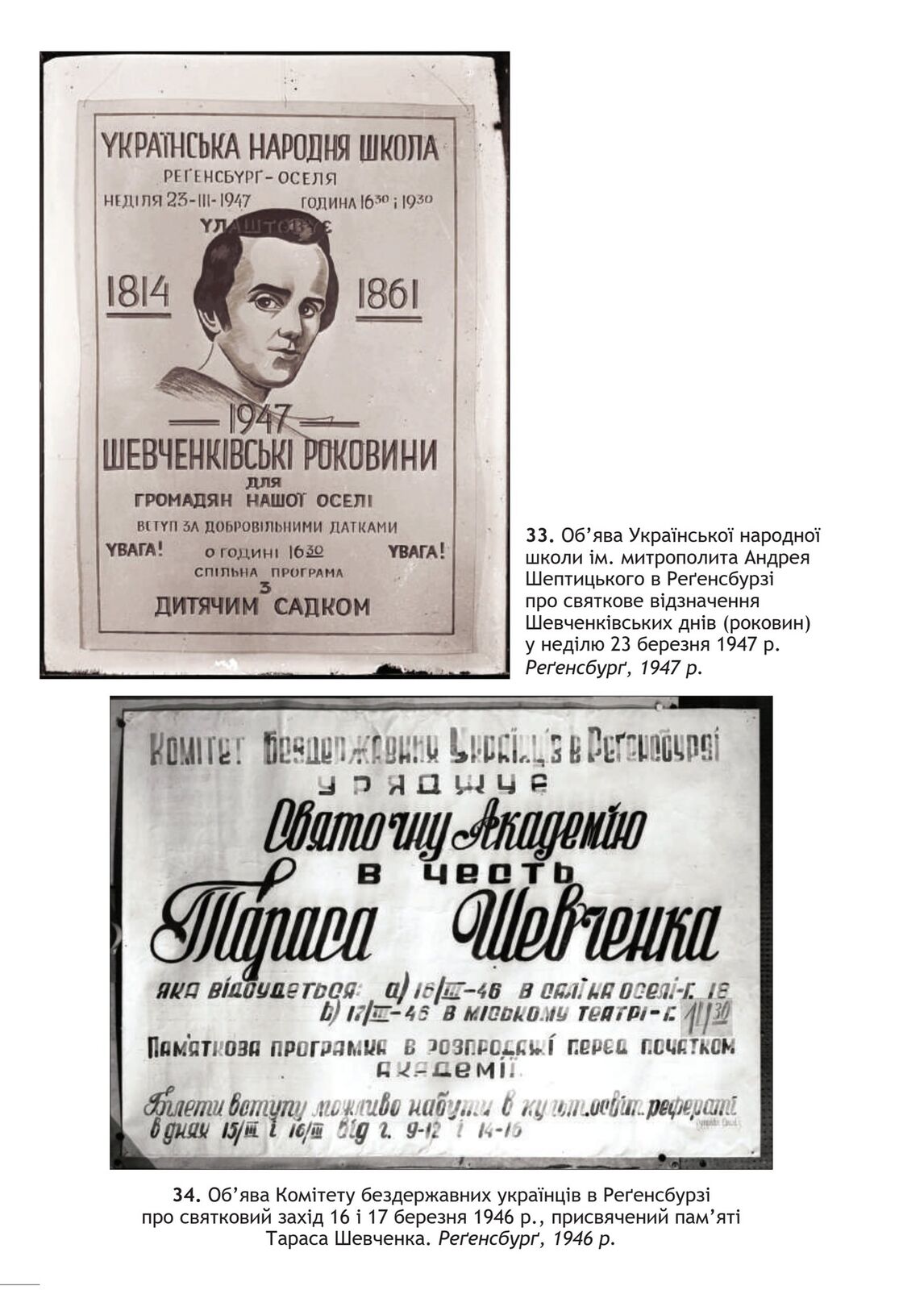
- 16–17 March 1946The Committee of Stateless Ukrainians in Regensburg announces a commemorative event for Taras Shevchenko; the printed notice survives as a negative in the Kurinnyi archive.
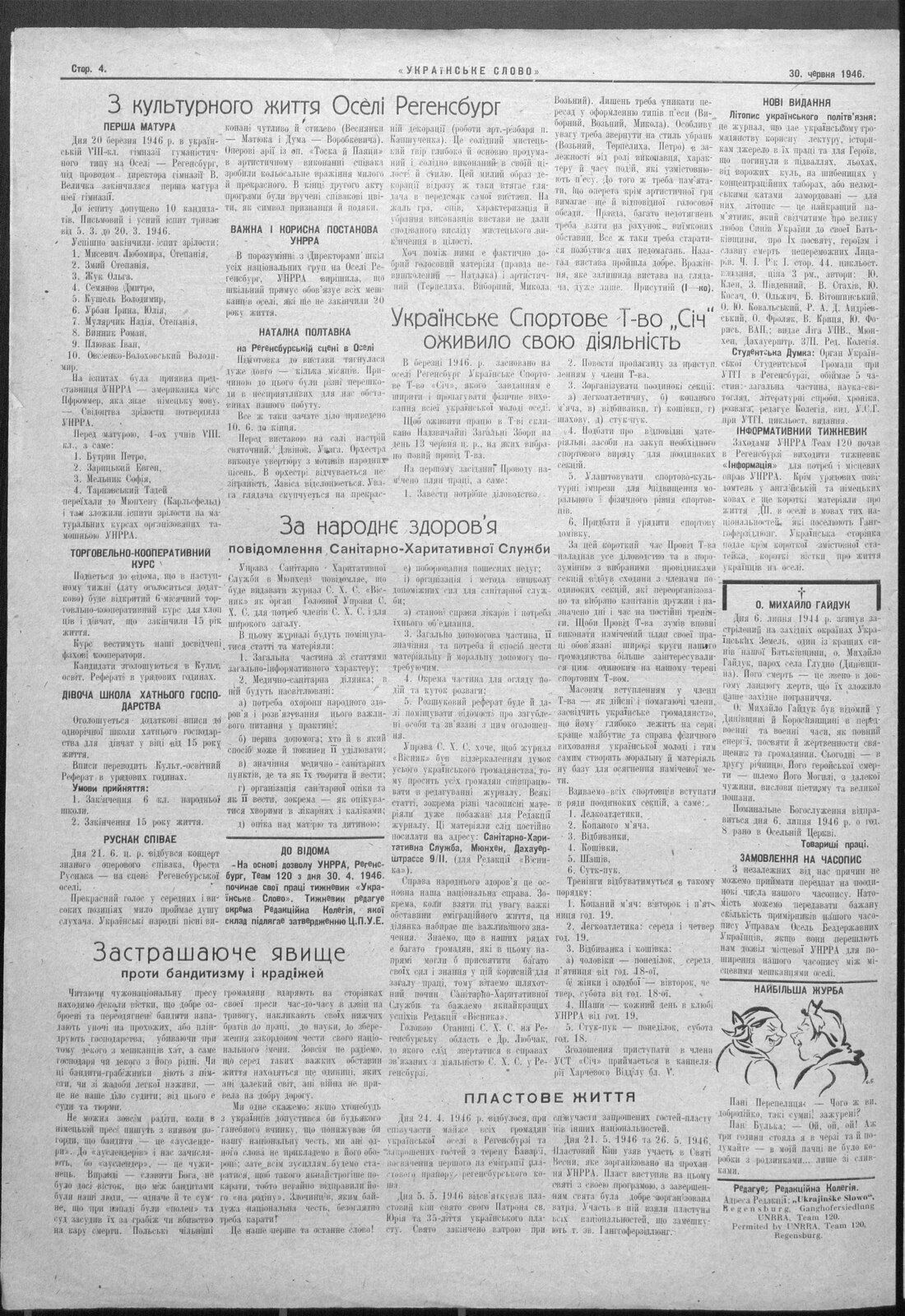
- 20 March 1946The first matura of the Ukrainian eighth-grade humanities gymnasium on the settlement is completed, under its director V. Velychka.
- 1 May 1946Wil Sadée describes shared houses, nationality schools and 1,200 incoming Polish residents.
- 21 May 1946The camp presents sport, folk dance, singing, scouts and exhibitions to invited Allied personnel.
- End of 1946About 1,200 Polish nationals have been repatriated; Ukrainians become the largest group.
- 1946/47 school yearClasses I A, I B and II B of the Ukrainian folk school are photographed with placards naming the school and the school year.
- July 1946Landstreet returns to Philadelphia; the paper reports that the American authorities have approved a temporary statute for the settlement’s DP court, with the American military court as court of appeal.
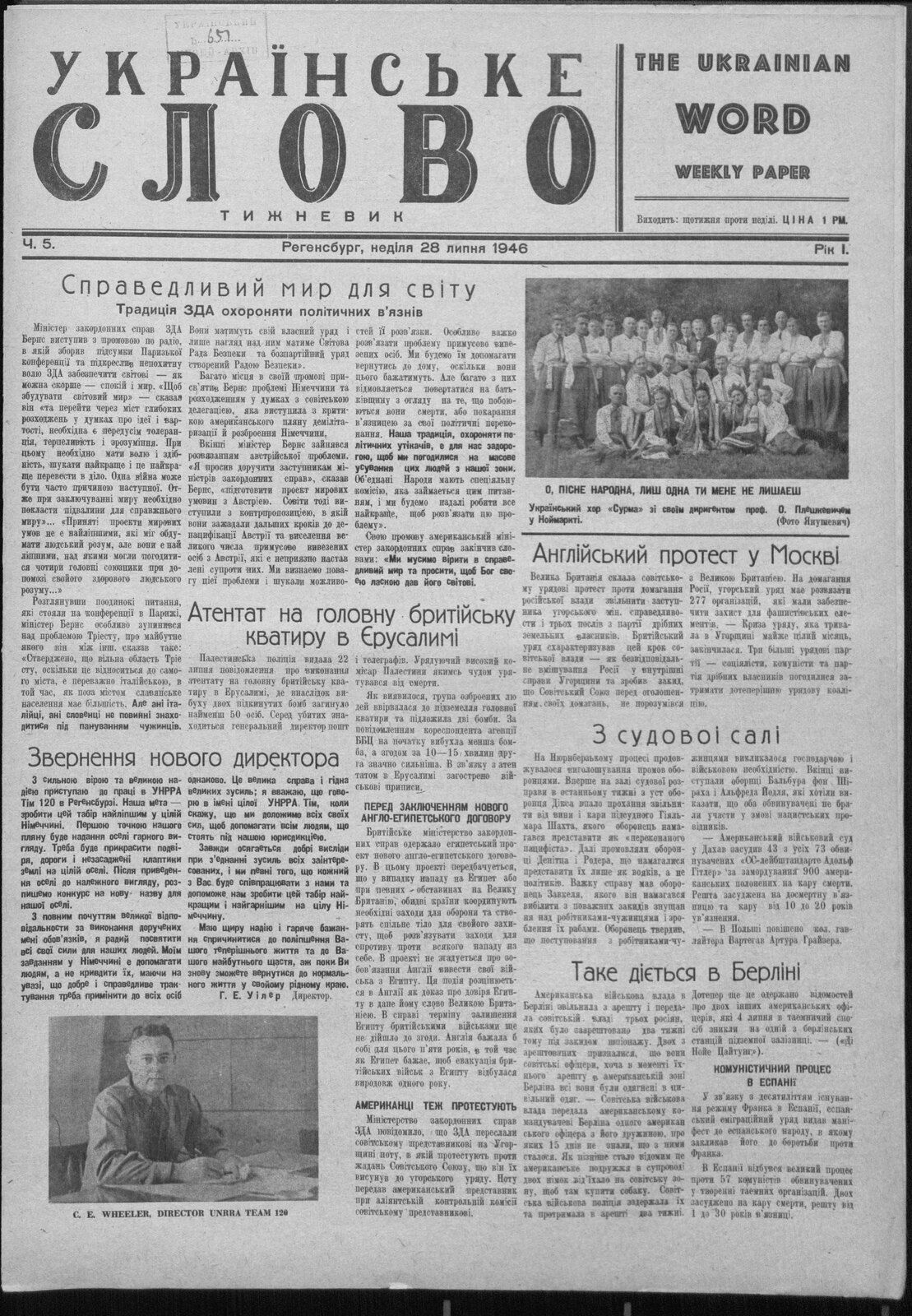
- 28 July 1946The new Team 120 director, C. E. Wheeler, addresses residents on the front page of Ukrainske slovo, promising to make the camp the best in Germany and to announce a competition for a new settlement name.
- 12–13 August 1946The UNRRA Team 120 health department calls registered foreigners in Regensburg and the surrounding district for lung X-ray photography.
- 20 August 1946Normal classes begin at the Ukrainian national school, Regensburg-Oselya.
- 26–27 October 1946The Shevchenko bandura choir under Mr Bozhyk gives concerts in the settlement’s gymnasium hall.
- 3 November 1946The Ukrainian settlement publicly welcomes resettlers from other camps in an announcement in Ukrainske slovo.
- 23 March 1947The Ukrainian folk school named after Metropolitan Andrei Sheptytskyi announces Shevchenko commemoration days.
- 1947Peak population of almost 5,000 Ukrainian and 1,000 non-Ukrainian residents; capacity recorded as 6,000 on 31 October.
- 1947–1949The Ensemble of Ukrainian Actors performs under Volodymyr Blavatsky.
- 30 June 1948A Ukrainian relief report lists Ganghofersiedlung among principal camps in the American zone.
- September–October 1949The camp is dissolved; residents transfer to Ulm, Ingolstadt and Amberg or have emigrated, and the estate returns to German use.
- 1950A “1-Ulm / D. 1” overprint on Ganghofersiedlung local stamps is issued for the Sedankaserne camp at Ulm, according to the Collectors Club of Chicago’s Philatelic Encyclopedia.
- 1984Malaniak donates Ukrainian and English versions of Striving for Dignity to The Ukrainian Museum, New York.
- 2015The University of Regensburg records the documentary’s rediscovery and public screenings.
Sources for this section
- Robert Werner, Die unbekannte Ukraine in der Ganghofer-Siedlung Regensburg
- Helmut Halter, Stadt unterm Hakenkreuz: Kommunalpolitik in Regensburg während der NS-Zeit
- Tetiana Sebta, «Архів Петра Курінного»: збірка фотодокументів Інституту рукопису НБУВ
- Wil Sadée’s 1946 letters, edited by Lucas van der Hoeven
- Ukrainske slovo: tyzhnevyk (The Ukrainian Word: weekly), Regensburg, issues 1–19, 30 June – 3 November 1946
- DP camp inventory: Ganghofer Siedlung, Regensburg
- Regensburg, Internet Encyclopedia of Ukraine
- United Ukrainian American Relief Committee report, 30 June 1948
- The Philatelic Encyclopedia, entry “1-Ulm / D. 1”
- Bohdan Z. Malaniak, More about DPs’ camp experiences, The Ukrainian Weekly, 19 March 1995, no 12, p 9
- University of Regensburg annual report 2015
The Göringheim before 1945
The estate was built for the Messerschmitt aircraft works, at its height Regensburg’s largest employer with up to 14,000 staff. Helmut Halter’s study of the city under National Socialism records that the first phase was built in a few months by 80 firms, 75 of them from Regensburg, that the last flats were occupied in September 1938, and that tenants were exclusively works employees. The name Göringheim was proposed by an SA brigade leader and approved by Göring; 16 of the 24 streets were named after dead SA men, the main axis is today’s Theodor-Storm-Straße, and the estate school was named after Horst Wessel. A second phase finished with 242 flats holding 3,182 people in late summer 1941, and by March 1942 the estate was described as extended to about 840 dwelling units. Barracks for forced labourers, most of them from Ukraine and other Soviet republics, stood nearer the works and were a separate installation.
Requisition, administration and scale
After the war the United Nations refugee organisation requisitioned the whole Göringheim, by then renamed Ganghofer-Siedlung. Halter records that its inhabitants had to leave in the autumn of 1945 and that Germans, the authorities included, were afterwards refused access. Robert Werner dates the American military government’s order to create a new foreigners’ quarter to October 1945; the editorial annex to the Sadée letters dates the full evacuation to 20 October 1945 on the order of the American general Lucian Truscott, and says the 925 vacated flats were allocated to about 6,000 displaced people from Ukraine, Poland, Lithuania, Belarus, the Basque country and the concentration camps.
The Arolsen Archives inventory records the assembly centre as AC 93-259, later NBO 407, under UNRRA Team 120, open from 24 January 1946 to 30 September 1949, with a capacity of 6,000 on 31 October 1947 and Polish, Ukrainian, stateless, Russian, Lithuanian and Latvian residents. That opening date belongs to the UNRRA centre; people were living in the requisitioned houses from the previous autumn. Sebta’s study of the Kurinnyi archive, citing Ukrainian sources, records 4,723 residents in October 1945 and approximately 4,560 in December 1947. Werner puts between 4,000 and 6,000 displaced people in about 880 houses in the by then fenced settlement, with an entrance gate on Theodor-Storm-Straße, and traces how the composition changed: most residents recorded as Russian were sent home, in part by force, during 1945, and about 1,200 Polish nationals followed by the end of 1946, after which Ukrainians became the largest group. Stebelsky’s published returns list Regensburg only as a city total and cannot be attributed to this camp alone.
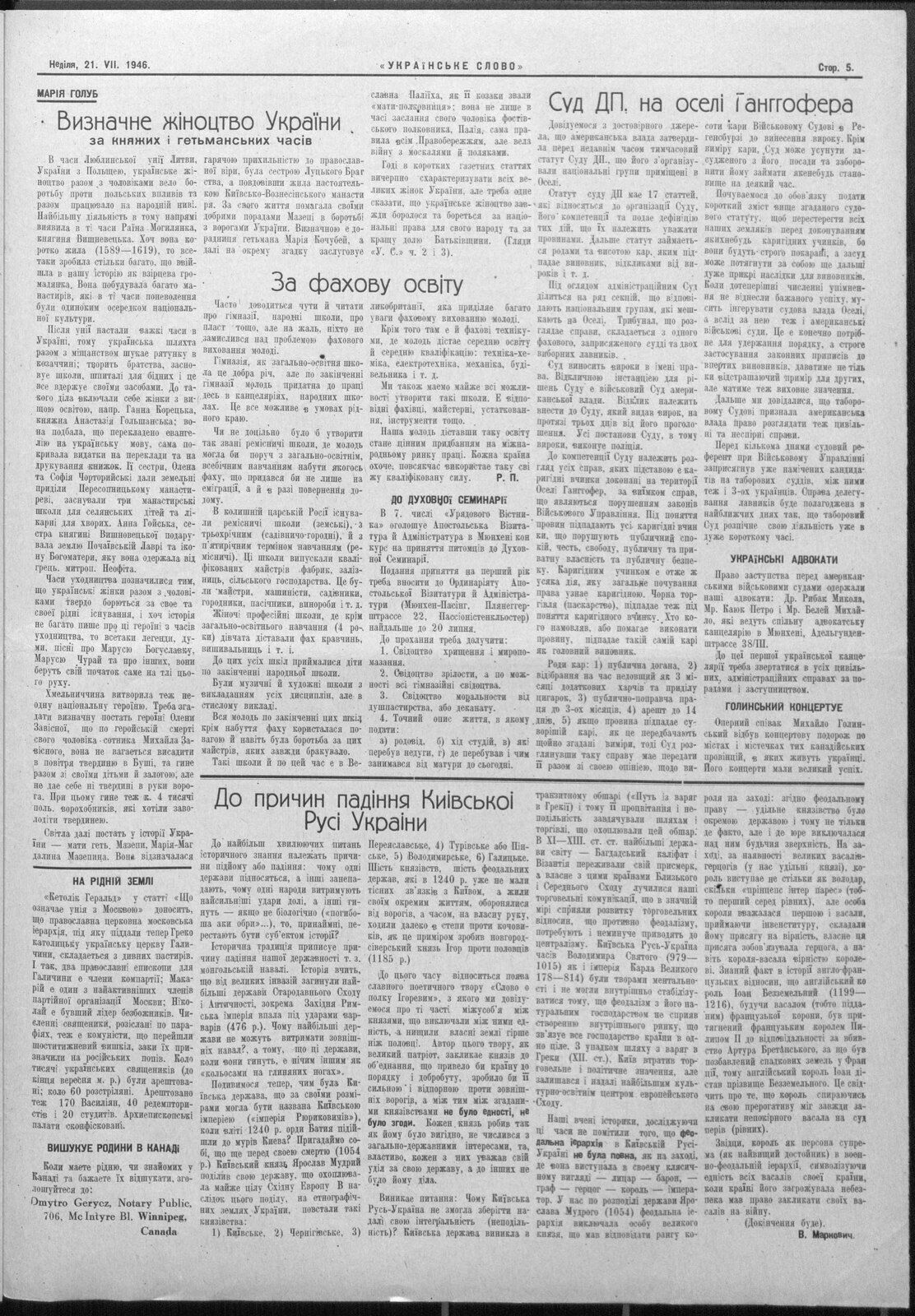
The paper names the UNRRA officers who ran the settlement in 1946. Berent F. Landstreet had worked as director of UNRRA Team 120 from 4 December 1945, “almost from the very beginning of the existence of the DP settlement on the Ganghofersiedlung”, and the issue of 21 July 1946 reported his return home to Philadelphia after seven months in the post. His successor, C. E. Wheeler, addressed residents on the front page of 28 July 1946: «Наша мета — зробити цей табір найліпшим у цілій Німеччині» — our aim is to make this camp the best in all Germany — and said that once the settlement had been brought into proper shape a competition would be announced for a new name for it.
The camp in the administrative record
| Field | Recorded value | Source and scope |
|---|---|---|
| Assembly centre number | AC 93-259, later NBO 407 | Arolsen inventory, record 1396 |
| Relief team | UNRRA Team 120, Regensburg | Arolsen inventory; the same team ran Von-der-Tann-Kaserne and Wolkering |
| Opening | 24 January 1946 | Arolsen inventory and the Sadée annex; the houses were requisitioned in October 1945 |
| Capacity | 6,000 on 31 October 1947 | Recorded accommodation capacity, not a census |
| Nationalities listed | Polish, Ukrainian, stateless, Russian, Lithuanian, Latvian | Order as printed in the inventory; no numbers given |
| Closure | 30 September 1949 | Arolsen inventory; Werner dates the dissolution to September 1949 |
| IRO file | Documents on the Ganghofersiedlung camp, 1949 | Archives Nationales, Paris, AJ 43 818/16, as listed by Boshyk and Balan; file not consulted |
Population and housing as reported by different sources
| Statement | Figure | Source and scope |
|---|---|---|
| Displaced people quartered over four years | Up to 6,000 at times | Halter, from municipal and press records; not a single-date census |
| Flats vacated in November 1945 | 925 | Editorial annex to the Sadée letters |
| Dwellings on the estate | 1,140 flats in 152 houses | Editorial annex to the Sadée letters; Halter’s 1942 note gives about 840 dwelling units |
| Houses occupied by DPs | About 880 | Werner, alongside a range of 4,000 to 6,000 residents |
| Residents at peak, 1947 | Almost 5,000 Ukrainian and 1,000 non-Ukrainian | Internet Encyclopedia of Ukraine |
| Ukrainians in the city of Regensburg, 1945–1949 | 6,149 in total | Editorial annex to the Sadée letters; a cumulative city figure, not a camp census |
| Transferred at dissolution, September 1949 | A good 3,000 | Werner, citing surviving name lists |
Ukrainians recorded at Regensburg in Stebelsky’s Table 7
| Return | Ukrainians recorded at Regensburg |
|---|---|
| 1946–47 (questionnaire returns) | 4,664 |
| August 1946 (UNRRA) | 1,985 |
| May 1947 (UNRRA) | 4,293 |
| December 1947 (PCIRO) | 4,560 |
Sources for this section
- Robert Werner, Die unbekannte Ukraine in der Ganghofer-Siedlung Regensburg
- Wil Sadée’s 1946 letters, edited by Lucas van der Hoeven
- Helmut Halter, Stadt unterm Hakenkreuz: Kommunalpolitik in Regensburg während der NS-Zeit
- Ihor Stebelsky, Ukrainian Population Migration after World War II, Table 7
- DP camp inventory: Ganghofer Siedlung, Regensburg
- Tetiana Sebta, «Архів Петра Курінного»: збірка фотодокументів Інституту рукопису НБУВ
- Ukrainske slovo: tyzhnevyk (The Ukrainian Word: weekly), Regensburg, issues 1–19, 30 June – 3 November 1946
Oselia: a Ukrainian community
The Internet Encyclopedia of Ukraine sets out the institutions the residents built. The camp’s governing bodies were elected and political blocs competed in camp elections; the administration was headed first by V. Zaiats, then by Ahenor Artymovych in 1946, Yakiv Serbyn from 1946 to 1948 and P. Balei from 1948. A Ukrainian Catholic parish was led by Rev O. Sharanevych and later Ye. Haidukevych, and a Ukrainian Orthodox parish by Rev V. Shevchuk. The school system ran from kindergarten through elementary and secondary schools to vocational courses in home economics, radio mechanics, driving and photography, and to the Ukrainian Technical and Husbandry Institute.
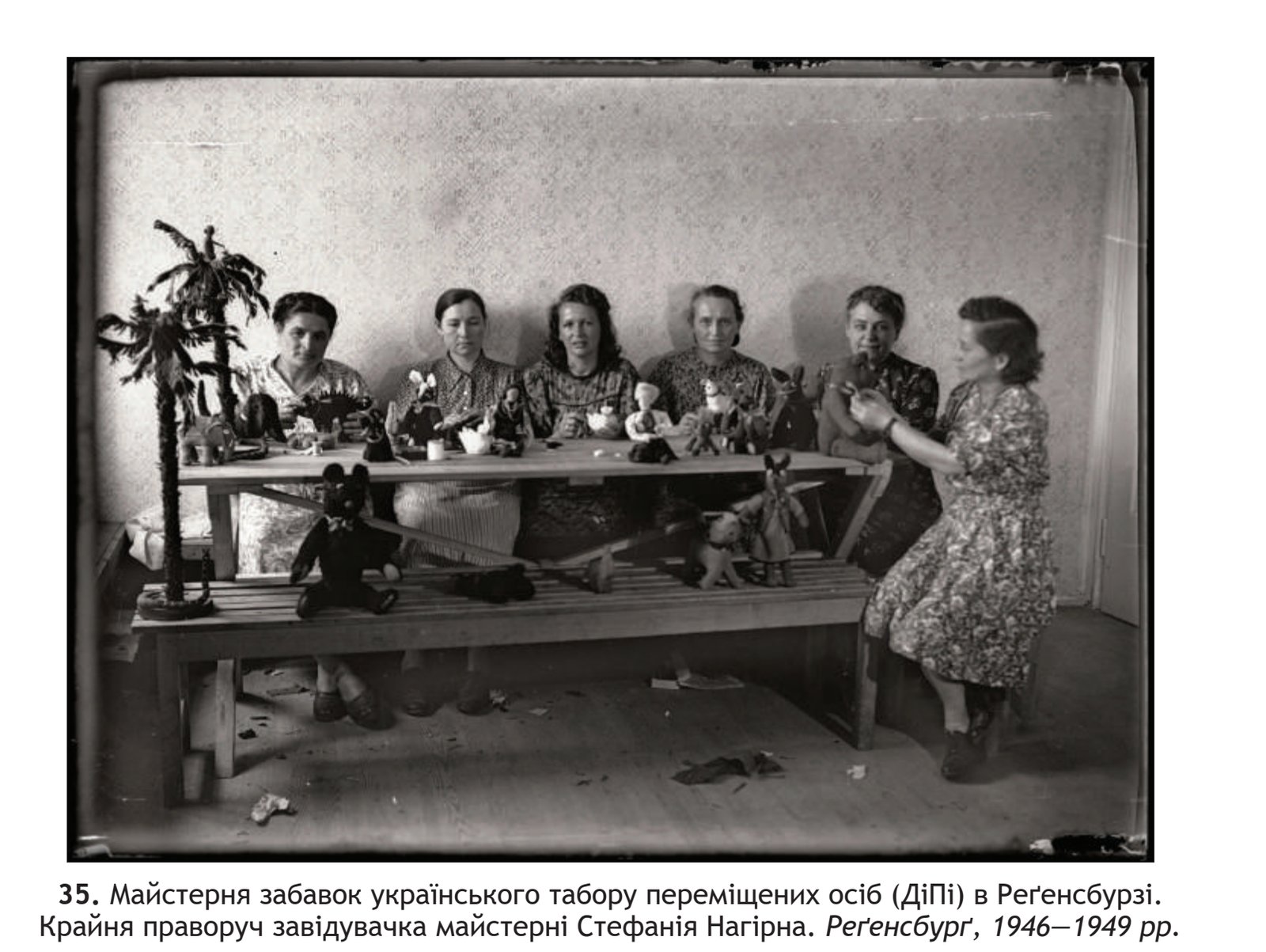
Youth and cultural life was equally organised: the Plast and SUM youth associations, the Sich sports club, a church choir conducted by I. Kurylenko, a drama group and orchestra led by I. Povaliachek, a music school, and from 1947 to 1949 the Ensemble of Ukrainian Actors directed by Volodymyr Blavatsky. There were medical and social services, camp workshops for tailoring, barbering, toys, leather, jewellery and ceramics, and the Ukrainske Mystetstvo co-operative. Several periodicals appeared: the weekly Slovo in 1945–46 under Spyrydon Dovhal, Ukrainske slovo in 1946–47 under Yuliian Tarnovych, Visnyk oseli from 1947 under I. Durbak, and a Weekly Information Bulletin in 1946. The Boshyk and Balan bibliography lists these Regensburg imprints with somewhat different runs, giving Slovo as a weekly from December 1945 to 1948 and Ukrainske slovo as a weekly from June to August 1946, and lists many further titles printed in the city, including manuals from the Technical and Husbandry Institute, without attributing every one of them to the camp.
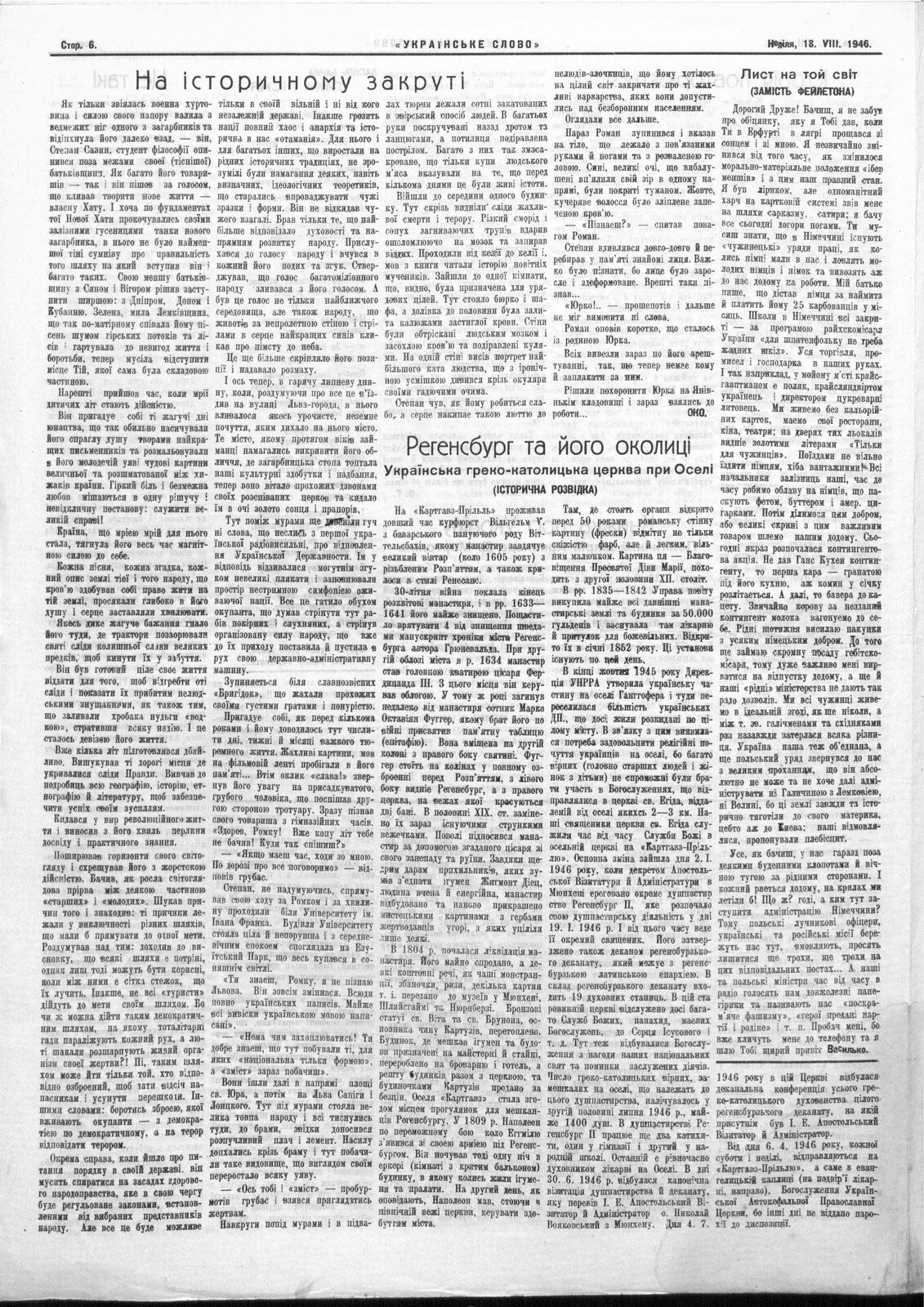
Ukrainske slovo was edited inside the settlement. Its imprint, printed at the foot of the paper through the run, gave the editorial address as «Адреса Редакції: „Ukrajinske Slowo“, Regensburg, Ganghofersiedlung UNRRA, Team 120. Permited by UNRRA, Team 120, Regensburg», and named the Mittelbayerische Zeitung of Regensburg as typesetter and printer. A historical sketch in the issue of 18 August 1946 records that at the end of October 1945 the UNRRA directorate formed a Ukrainian section at the Ganghofer settlement, and that most of the city’s Ukrainian displaced people, until then living scattered across Regensburg, moved there. The same sketch explains that a parish was then needed on the settlement, because many of the faithful, mainly older people and women with children, could not reach the church of St Giles some two to three kilometres away.
The paper also records a court and two parishes on the settlement. In July 1946 it reported that the American authorities had recently approved a temporary statute for a DP court organised by the national groups housed in the settlement: the statute had seventeen articles, the tribunal consisted of one professional sworn judge and two elected lay judges, and the American military court was the court of appeal. A notice in August 1946 reminded residents that the court chancellery took cases and gave information on Monday, Wednesday and Friday mornings in the building of the Polish settlement administration, on the second floor. The paper printed weekly service schedules for the Greek-Catholic pastoral ministry of Regensburg II (Oselya) and for the parish of the Ukrainian Autocephalous Orthodox Church in Regensburg, whose chapel stood by the settlement.
Sources for this section
Schools, work and the camp economy
In her letter of 1 May 1946 the Dutch UNRRA worker Wil Sadée described Team 120, fifteen people, caring for approximately 5,000 residents who included Belarusians, Ukrainians, Poles, Basques and Romanians, living about three families to a house, each nationality keeping its own school alongside recreation, scouts, a newspaper, religion and sport. Her work that week was at the railway station, where around 1,200 Polish arrivals from another camp had to be moved from goods wagons. By 15 May she had taken over education, supervising kindergarten, elementary school, gymnasium, trade school and sewing school, meeting the school directors every Thursday and helping Ukrainian groups who wanted to found a girls’ secondary school. Medical staff comprised one American doctor, two New Zealand nurses and about thirteen displaced-person doctors, with serious cases sent to the city hospital.
The annex to her letters describes the camp economy. UNRRA paid every resident a standard ration of 21 cigarettes a week and working residents could earn up to 100, while camp money was issued for a camp shop. Twelve workshops operated on the UNRRA site, among them a cobbler’s shop repairing some 250 pairs of shoes a week, and UNRRA employed 105 of its own police. The camp administration issued its own postage stamps to pay for camp infrastructure. On 21 May 1946 the whole settlement showed its national skills to invited Allied personnel with sport, folk dance, singing, scouts and exhibitions, and a straw poll on repatriation that month asked every resident to write whether they wished to return: most did not.
Health provision appears in the paper’s official notices. The UNRRA Team 120 health department at the Ganghofersiedlung called all foreigners registered with UNRRA who lived privately in Regensburg and the surrounding district to report for lung X-ray photography on Monday 12 August 1946, or at the latest on Tuesday 13 August; a further notice placed the examinations in the gymnasium hall at the Ganghofersiedlung. In September the department announced that displaced people X-rayed by the Swiss Red Cross could collect their cards at the hospital building on the settlement, “where milk is issued”. The schools are datable from the same columns: the first matura of the Ukrainian eighth-grade humanities gymnasium on the settlement was completed on 20 March 1946 under the gymnasium’s director, V. Velychka; the administration of the Ukrainian national school at Regensburg-Oselya announced that normal classes would begin on Tuesday 20 August 1946; and the school board published a twenty-eight-page report for the 1945–46 school year.
The Ukrainian Technical and Husbandry Institute gave its address in the paper as Ukrainisches Institut Regensburg, Ganghofer Siedlung, Paul-Heyse-Strasse 2, and was still enrolling new students in October 1946. The bandura choir named after Taras Shevchenko, under Mr Bozhyk, gave concerts in the gymnasium hall of the settlement on 26 and 27 October 1946, and a scout campfire brought together scouts of all the nationalities living in the settlement. In November 1946 the settlement advertised itself to displaced people elsewhere — «УКРАЇНСЬКА ОСЕЛЯ В РЕҐЕНСБУРЗІ ЩИРО ВІТАЄ В СЕБЕ ПЕРЕСЕЛЕНЦІВ З ІНШИХ ТАБОРІВ!», the Ukrainian settlement in Regensburg warmly welcomes resettlers from other camps — and the paper ran literary competitions for prose and for children’s writing, with entries to be sent to its Ganghofersiedlung address by 15 December 1946.
A welfare worker’s snapshot, 1 May 1946
| Measure | Reported number | Scope |
|---|---|---|
| Residents | Approximately 5,000 | Several nationalities; personal estimate |
| Team 120 personnel | 15 | Staff, not residents |
| Social workers | 5 | Included in team personnel |
| Polish arrivals | Approximately 1,200 | Recent arrivals from another camp, not total Polish population |
Preserved on film and in photographs
The settlement’s life survives on film in Striving for Dignity. Producer Bohdan Z. Malaniak wrote in 1995 that Ukrainian and English versions had been made and that he donated both to The Ukrainian Museum in New York in 1984; the university’s 2015 annual report recorded Walter Koschmal’s rediscovery of the documentary in a New York archive and screenings in Regensburg and Munich. A 2025 study published in Kyiv identifies postwar negatives from Regensburg–Oselia, also named Ganghofersiedlung, within the photographic holdings of the Vernadsky National Library of Ukraine, and reproduces selected images in a chapter on 1945–1949.
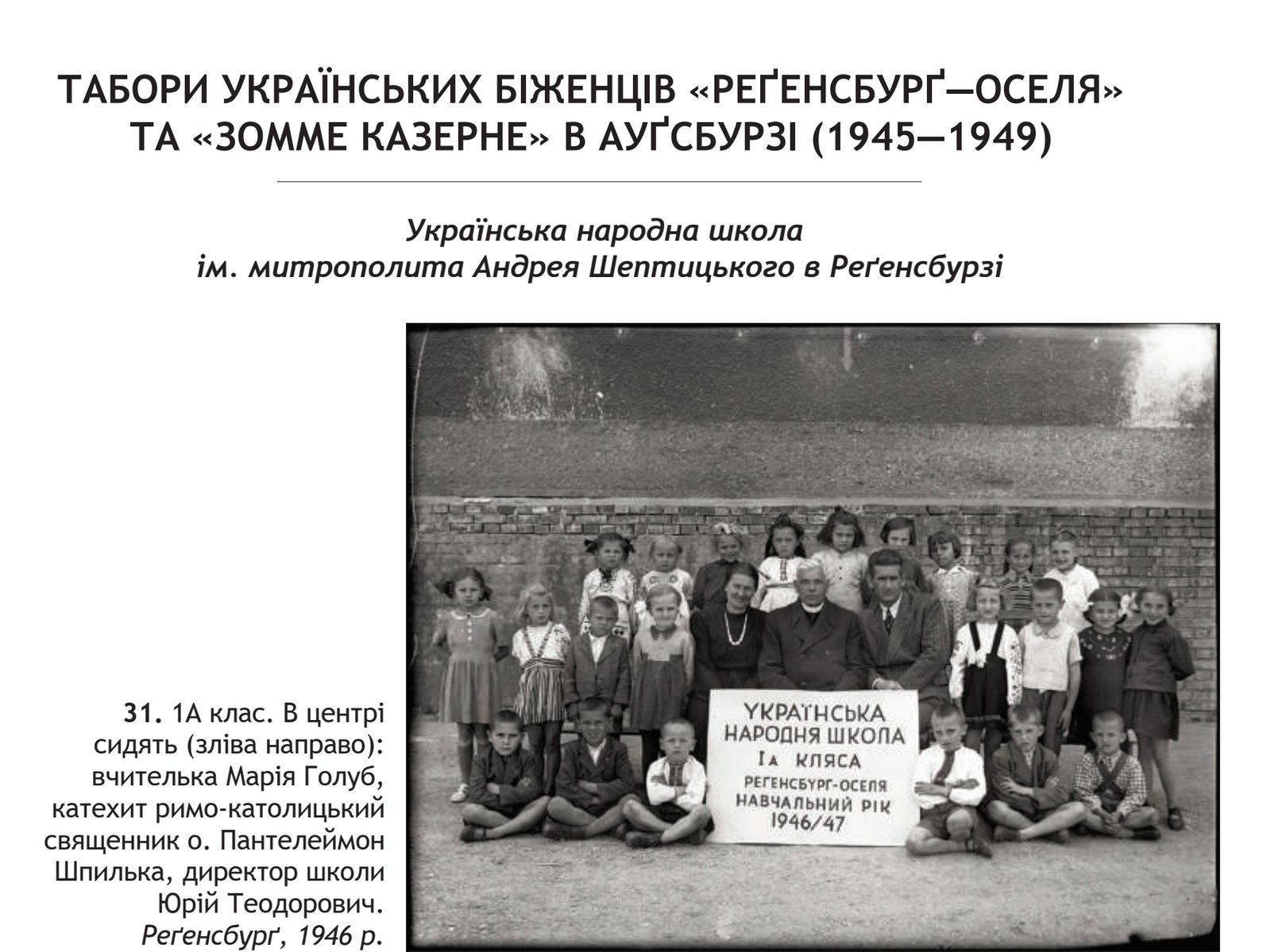
The full text of that study reports that six of the negatives in the collection were taken in the Regensburg–Oselia camp, while for 174 negatives the place of photography could not be determined. Three of them show school classes of the 1946/47 school year, each photographed with a placard reading «Українська народна школа. І А [І Б/ІІ Б] кляса. Реґенсбурґ—Оселя. Навчальний рік 1946/47» — Ukrainian folk school, class I A, I B or II B, Regensburg–Oselia, school year 1946/47.
The study’s captions name the camp’s elementary school as the Ukrainian folk school named after Metropolitan Andrei Sheptytskyi, and identify in a class photograph of 1946 the teacher Mariia Holub, the catechist Father Panteleimon Shpylka and the school director Yurii Teodorovych; a photograph dated 1946 to 1949 shows the camp’s toy workshop with its manager Stefania Nahirna. Two of the reproduced images are of printed notices: the school’s announcement of Shevchenko commemoration days for Sunday 23 March 1947, and an announcement by the Committee of Stateless Ukrainians in Regensburg of a commemorative event on 16 and 17 March 1946.
A neighbourhood of shared homes
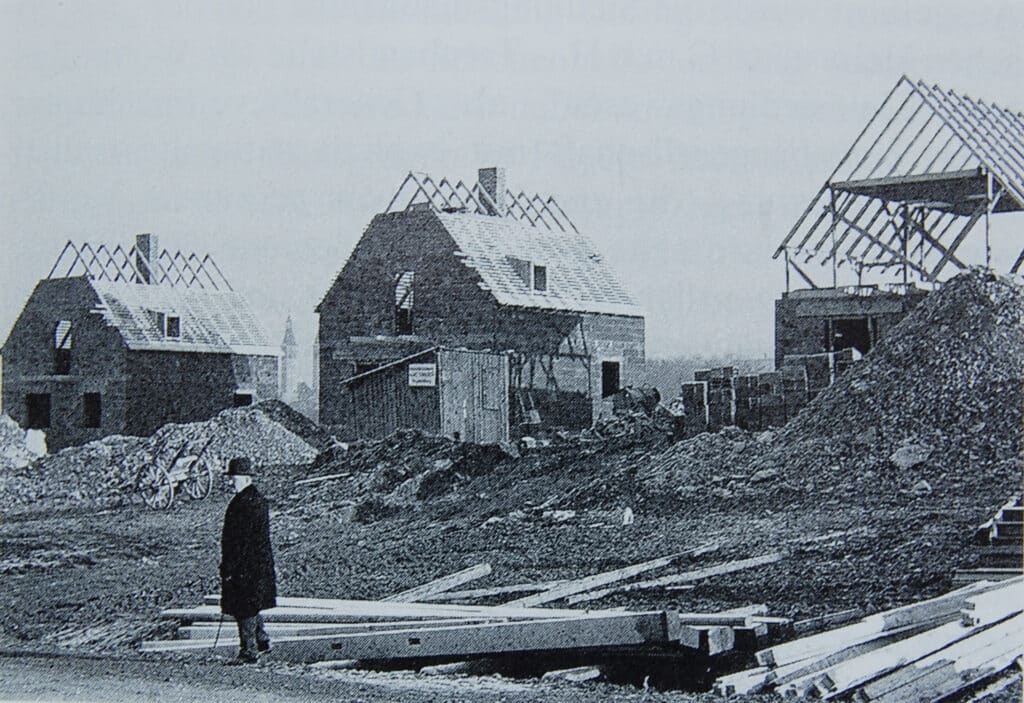
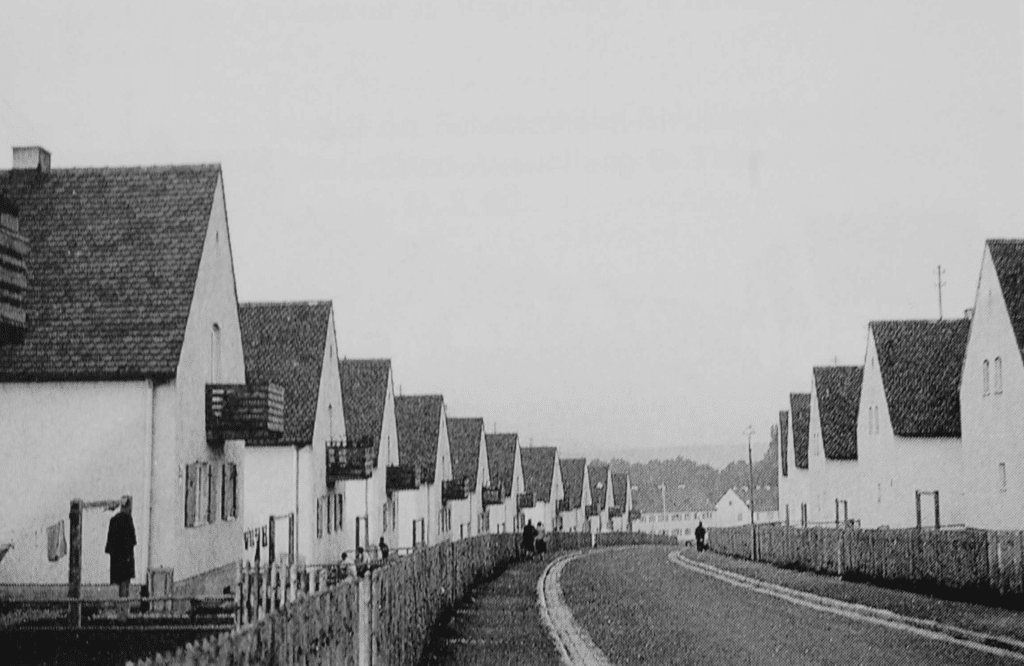
Historical photographs show rows of pitched-roof houses with small gardens and wooden balconies, the setting in which families shared houses while nationality groups maintained separate schools.
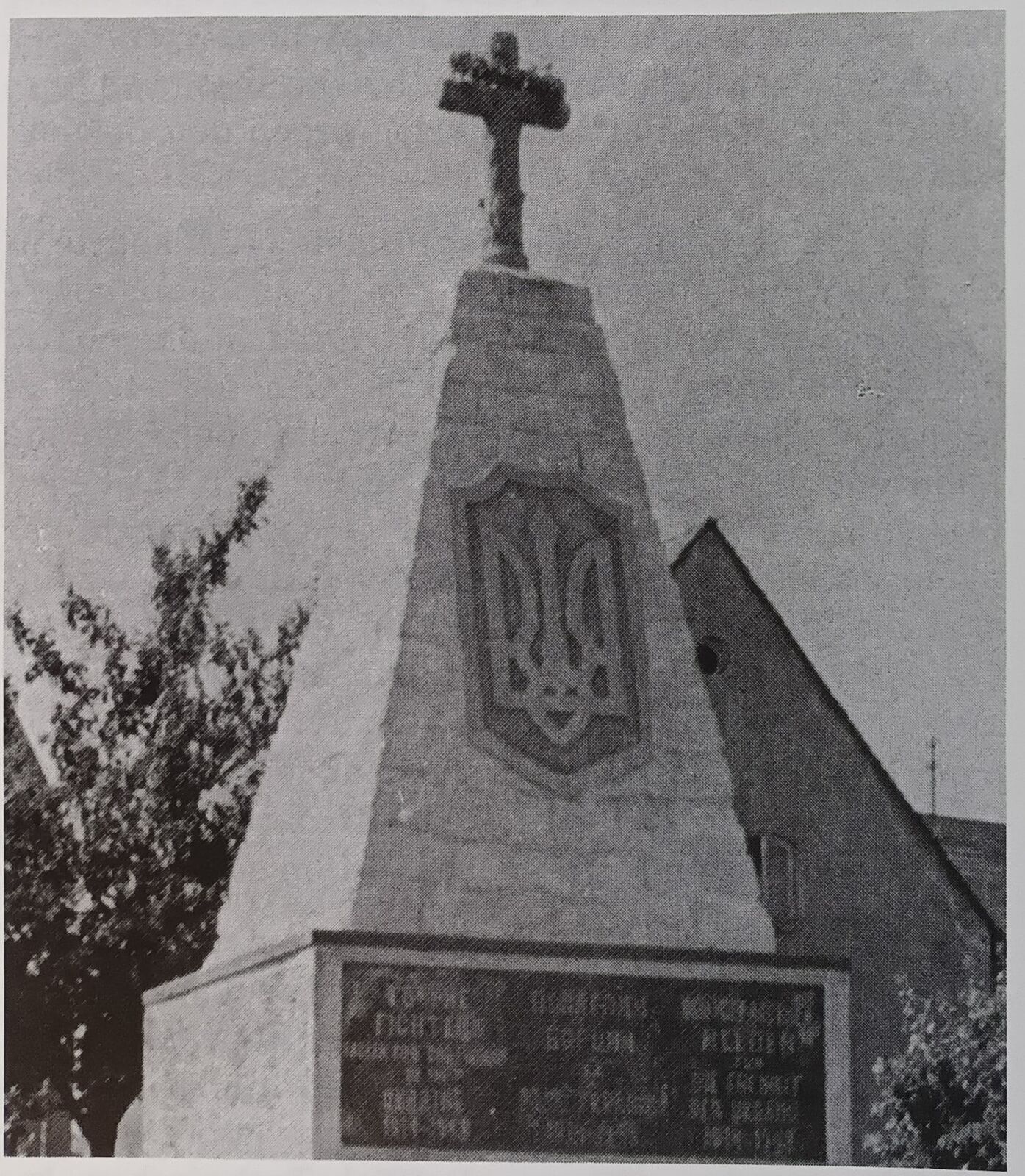
A Ukrainian commemorative monument also stood in the settlement, between Franz-von-Kobell-Straße and Wilhelm-Raabe-Straße, its cross and trident visible in a photograph reproduced from Völkl’s 1992 study. Werner’s account describes members of the Ukrainian nationalist movement and of the Ukrainian Insurgent Army becoming dominant in the settlement, with followers of Stepan Bandera in leading positions, and states that the monument was probably removed around 1958. These are claims made in a work of contemporary journalism, and they describe organised groups rather than every resident.
Dissolution and afterwards
The camp was dissolved in September 1949. Werner reports that the displaced people still there, mostly Ukrainians, were moved to camps at Ulm, Ingolstadt and Amberg, a good 3,000 of them according to surviving name lists, while others had already emigrated to the United States, Canada and Australia, and some to Belgium. The Sadée annex dates the return of the settlement to the German population to October 1949, and Halter records that the Free State of Bavaria later handed it back to the Heimbau housing company with its fabric unchanged. A file of IRO documents on the Ganghofersiedlung camp for 1949 survives in the Archives Nationales in Paris; neither it nor the transfer lists have been consulted here.
The camp’s local stamps outlived it. The Collectors Club of Chicago’s Philatelic Encyclopedia records an overprint, “1-Ulm / D. 1”, found on Ganghofersiedlung local stamps and issued, it says, by Ukrainian nationals in 1950 for the Sedankaserne displaced persons camp at Ulm, one of the places to which residents of the settlement had been transferred. The entry cites John Bulat’s Comprehensive Catalogue of Ukrainian Philately of 2003, which has not been consulted here.
Sources for this section
- Robert Werner, Die unbekannte Ukraine in der Ganghofer-Siedlung Regensburg
- Wil Sadée’s 1946 letters, edited by Lucas van der Hoeven
- Helmut Halter, Stadt unterm Hakenkreuz: Kommunalpolitik in Regensburg während der NS-Zeit
- Yury Boshyk and Boris Balan, Political Refugees and ‘Displaced Persons’, 1945–1954: A Selected Bibliography and Guide to Research
- The Philatelic Encyclopedia, entry “1-Ulm / D. 1”
Sources
- United Ukrainian American Relief Committee report, 30 June 1948
Undated
Printed page 18, PDF page 22; camp list visually reviewed in existing source review.
- University of Regensburg: Walter Koschmal
Undated
Research profile identifies Oselia, 1945–1949, and community institutions.
- University of Regensburg annual report 2015
Undated
Printed page 177: documentary discovery and screenings.
- Robert Werner, Die unbekannte Ukraine in der Ganghofer-Siedlung Regensburg
2025-12-19
Re-read 13 September 2026: 1936 construction for Messerschmitt as the Göring-Heim; October 1945 order for a new foreigners’ quarter; UNRRA Team T120; repatriations of Russian and about 1,200 Polish residents; 4,000-6,000 DPs in about 880 houses; OUN and UPA dominance and the freedom-fighters’ monument removed around 1958; dissolution in September 1949 with a good 3,000 transferred to Ulm, Ingolstadt and Amberg. Contemporary journalism; underlying records require follow-up. The comment thread below the article contains reader-supplied pre-publication material that is not used here.
- Wil Sadée’s 1946 letters, edited by Lucas van der Hoeven
2025-06
Letters of 1 and 15 May 1946 (PDF pp. 19-22) and editorial Annex I on the Ganghofer settlement (PDF pp. 59-64), all read 13 September 2026. Transcriptions and editorial annex read; the original manuscripts have not been inspected. The annex’s dwelling counts differ from other sources and are reported as attributed.
- Bohdan Z. Malaniak, More about DPs’ camp experiences, The Ukrainian Weekly, 19 March 1995, no 12, p 9
Undated
Publisher PDF text of full signed letter read; visual page fetch timed out. First-person producer account; film itself not inspected.
- Tetiana Sebta, «Архів Петра Курінного»: збірка фотодокументів Інституту рукопису НБУВ
Institute of Ukrainian Archaeography and Source Studies, NAS of Ukraine; Vernadsky National Library of Ukraine, Manuscript Institute · 2025
Open-access full text. Printed pages 34–38 read for the Regensburg—Oselia negatives (six identified as taken in the camp, 174 of undetermined location) and the camp’s institutions; illustration captions on printed pages 133–135 read for the school, its staff and the toy workshop. The camp-negative chapter begins at printed page 32 and the selected camp illustrations at page 133. The collection-wide total of 1,340 photographic documents is not a Regensburg count. Also catalogued, with abstract and contents, at https://resource.history.org.ua/item/0018915, the entry from which this study was previously cited here.
- Helmut Halter, Stadt unterm Hakenkreuz: Kommunalpolitik in Regensburg während der NS-Zeit
Universitätsverlag Regensburg, Regensburger Studien und Quellen zur Kulturgeschichte · 1994
Open-access edition; printed pages 321-327 read. Construction of the Göringheim, street naming, the second phase of 1939–41, about 840 dwelling units by 1942, requisition by the United Nations refugee organisation and eviction of German residents in autumn 1945, up to 6,000 displaced persons over four years, later return to the Heimbau company.
- Regensburg, Internet Encyclopedia of Ukraine
Canadian Institute of Ukrainian Studies; from Encyclopedia of Ukraine vol. 4 (1993) · 1993
Entry read in full: peak population of almost 5,000 Ukrainians and 1,000 others in 1947, elected governing bodies and named administrators, parishes, school system and Technical and Husbandry Institute, Plast, SUM and Sich, choir, drama group, orchestra, music school and Ensemble of Ukrainian Actors, workshops and co-operative, political blocs, and four periodicals with editors.
- Yury Boshyk and Boris Balan, Political Refugees and ‘Displaced Persons’, 1945–1954: A Selected Bibliography and Guide to Research
Canadian Institute of Ukrainian Studies, University of Alberta, Research Report No. 2 · 1982
IRO records in the Archives Nationales, Paris: AJ 43 818, sub-series 34/2, item 16, ‘Documents concernant le camp de Ganghofersiedlung a Regensburg, 1949’. Also the register of Ukrainian periodicals and books published at Regensburg. Files not consulted; imprints are attributed to the city, not necessarily to the camp.
- Ihor Stebelsky, Ukrainian Population Migration after World War II, Table 7
in The Refugee Experience, Canadian Institute of Ukrainian Studies Press · 1992
Printed pages 47–51. ‘Regensburg’ appears as one row: 4,664 (1946–47), 1,985 (August 1946), 4,293 (May 1947), 4,560 (December 1947). A city-level total covering all Regensburg assembly centres.
- DP camp inventory: Ganghofer Siedlung, Regensburg
Arolsen Archives · 2023-10-26
Record 1396: AC 93-259, later NBO 407, UNRRA Team 120 Regensburg, open 24 January 1946 to 30 September 1949, capacity 6,000 on 31 October 1947, nationalities Polish, Ukrainian, stateless, Russian, Lithuanian and Latvian. Archive reference: ITS documents for Regensburg and Staatsarchiv Amberg files 12278, 12281, 12282 and 12295.
- Post-War Internment Camp at Regensburg, Germany, 1945–1953
WWII Aerial Recon Studies · Accessed 14 September 2026
First paragraph read: the United States Army internment camp at Regensburg was separate from the UNRRA displaced persons camp in the Ganghofersiedlung, which the article dates between 1945 and 1949.
- The Philatelic Encyclopedia, entry “1-Ulm / D. 1”
Collectors Club of Chicago · Accessed 14 September 2026
Numerical and Symbol Designations section read: an overprint found on Ganghofersiedlung local stamps, issued by Ukrainian nationals in 1950 for the Sedankaserne displaced persons camp at Ulm, citing John Bulat, Comprehensive Catalogue of Ukrainian Philately (2003), which was not consulted. The entry spells the city “Regensberg”.
- Ukrainske slovo: tyzhnevyk (The Ukrainian Word: weekly), Regensburg, issues 1–19, 30 June – 3 November 1946
Ukrainian Museum-Archives, Cleveland, DP Camp Periodicals Collection; digitised by the Internet Archive · 1946
Issues 1–19, 30 June to 3 November 1946, read as page images across the 268-image Internet Archive item. Editorial imprint at issue 1 page 4 and repeated at the foot of the last page of later issues, naming the Ganghofersiedlung editorial address and the Mittelbayerische Zeitung as printer. Also read: the DP-court report and the UNRRA director's farewell at issue 4 pages 4–5; the incoming director's address at issue 5 page 1; the historical sketch of the Greek-Catholic parish at issue 8 page 6; UNRRA Team 120 health-department notices at issue 6 page 5 and issue 11 page 7; school notices at issue 8 page 3 and issue 17 page 6; Technical and Husbandry Institute enrolment notices at issue 16 page 6 and issue 22 September page 8; church service schedules at issue 10 page 7 and issue 17 page 8; and the settlement's own announcements, literary competitions and concert report at issues 18 and 19. Creative Commons BY-NC-ND 4.0.
Last researched 13 September 2026