Gersdorff-Kaserne
Displacement in Europe
Wiesbaden · Germany · 1945–1946
Camp 563 brought Polish, Baltic and Ukrainian displaced people into a large former barrack compound in today’s Europaviertel. It was one of the earliest and shortest-lived camps in the American zone, running from 1945 until the site was redesignated Camp Lindsey in November 1946.
Introduction
Gersdorff-Kaserne was one of Wiesbaden’s main places of refuge for displaced people after the Second World War. Former forced labourers and people uprooted from eastern Europe were accommodated in the large barrack compound on Schiersteiner Straße. Polish, Baltic and Ukrainian residents appear in its administrative record. The camp stood in today’s Europaviertel, separate from the Ukrainian camp at Mainz-Kastel.
A history in dates
- April 1897The von Gersdorff regiment moves into the first completed barrack buildings.
- 1907–1912Further building enlarges the compound on Schiersteiner Straße.
- April 1945The former military compound becomes accommodation for displaced people as Camp 563.
- April to November 1945Wiesbaden police records catalogue alleged offences by displaced people; a United States military film records police raids inside the compound.
- January 1946A documented Baltic family is registered at Gersdorff; Camp 563 appears in the inventory.
- 13 November 1946The site is designated Camp Lindsey, within the inventory’s closing interval of 19 October to 20 December 1946.
- 1990sAmerican withdrawal makes possible the development of the Europaviertel.
The compound on Schiersteiner Straße
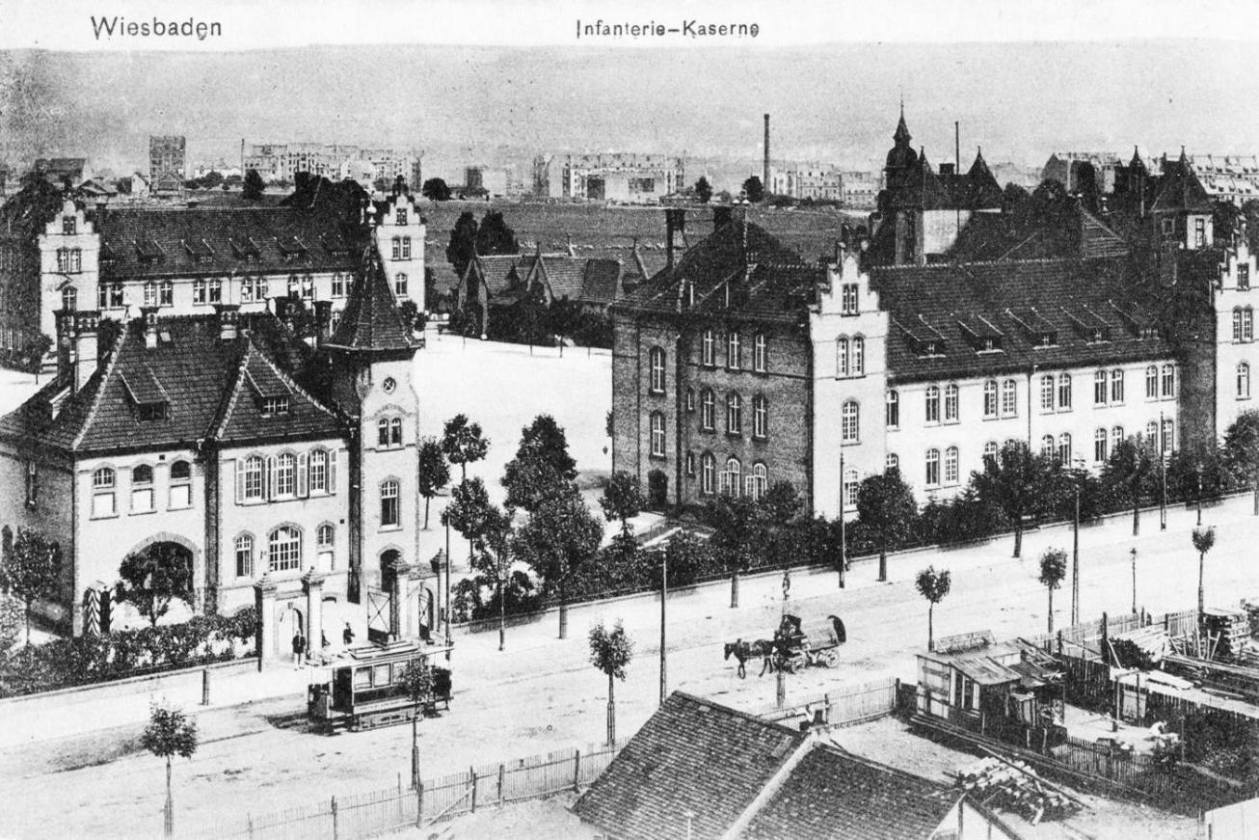
The first barrack buildings were completed in spring 1897. Further construction created a larger military complex with accommodation blocks, parade grounds and a garrison hospital. Before the Second World War, the area had also passed through French and British occupation and a period of civilian use.
Wiesbaden’s municipal lexicon dates the move of the von Gersdorff regiment into the new barracks to April 1897, with further building in 1907 to 1909 and 1909 to 1912, and further military hospital buildings alongside the accommodation.
The wider complex contained sections known as Ochamps, Oranien and Gersdorff. This history explains why different names appear in descriptions of the same neighbourhood, but it does not make every Wiesbaden barracks a part of Camp 563. The Von-der-Goltz compound in Kastel was elsewhere.
Names and places
| Name | Meaning |
|---|---|
| Gersdorff-Kaserne / Camp 563 | DP accommodation on Schiersteiner Straße |
| Lindsey Air Station | Later American military use of the wider compound |
| Europaviertel | Present-day district on the former barrack site |
| Von-der-Goltz-Kaserne, Mainz-Kastel | Separate camp location across the city |
Sources for this section
Camp 563 in the administrative record
The Arolsen Archives camp inventory records the facility as Gersdorf-Kaserne at Wiesbaden, assembly centre AC 563, with Polish, Baltic and Ukrainian residents, served by UNRRA Team 28 Wiesbaden under a team director named Bayer and a field supervisor named Westerman, with an area team in place from November 1946. Its closing is given as an interval between 19 October and 20 December 1946. No capacity is recorded.
The inventory’s opening field reads 24 January 1946, but the same date recurs in the opening and team-director fields of many unrelated entries in that spreadsheet, so it behaves like a reporting date rather than a verified start. A compiled history of the American installation instead dates the displaced-persons camp on Schiersteiner Straße from April 1945, which fits both the municipal account and the police records of April to November 1945 discussed below.
The camp inventory entry
| Field | Recorded value |
|---|---|
| Assembly centre | AC 563 |
| UNRRA team | T 28 Wiesbaden, director Bayer; area team from November 1946 |
| Field supervisor | Westerman |
| Nationalities | Polish, Baltic, Ukrainian |
| Capacity | Not recorded |
| Opening field | 24 January 1946, a date that recurs across unrelated entries |
| Closing | Between 19 October and 20 December 1946 |
| Archive reference | ITS Dok-ID 82040911–82041331; Stadtarchiv Wiesbaden WI/3 Nr. 2616 |
Sources for this section
Filmed at the gate
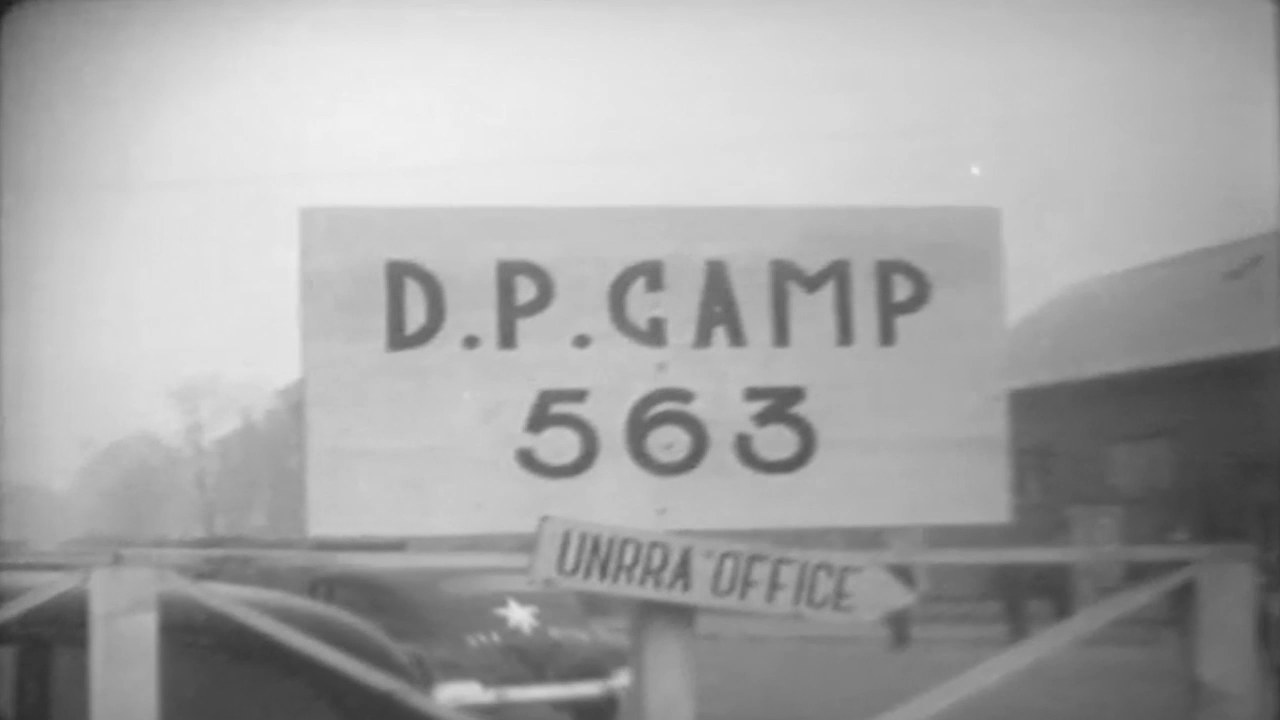
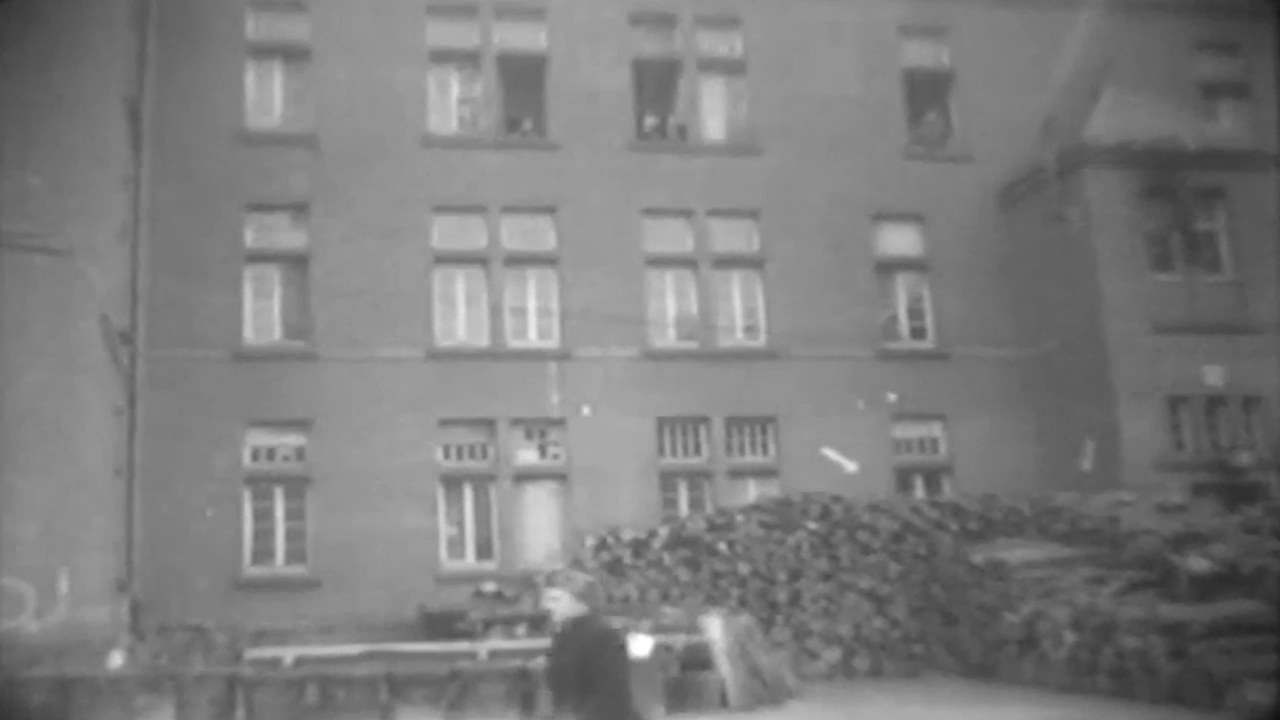
The clearest surviving picture of the camp is a United States Army Air Forces film held by the National Archives under the title Polish D.P. Raids. Its cameramen followed American military police into the compound and recorded the entrance board reading D.P. CAMP 563 with a hanging sign for the UNRRA office, the camp gate with its sentry box, buildings marked Gersdorff Kaserne, and the barrack blocks with firewood stacked along their fronts.
The same film records the camp’s own institutions in its signage: an office of the Polish camp administration in Wiesbaden, a Polish police post and a DP police bureau, alongside the UNRRA office and an American Red Cross field director’s room. It also records what the title means in practice, with military police searching rooms, pulling suitcases from the tops of cupboards and going through luggage, including a room where a bedridden man and a child in a cot were searched. The footage is a policing record, made by the policing authority, and it shows self-administration and suspicion side by side.
Sources for this section
Refuge after forced labour
The Volksbund’s research describes displaced people being housed mainly in Gersdorff-Kaserne, with accommodation organised by nationality. Its archival case study establishes a Lithuanian family’s registration in the camp by January 1946. The inventory additionally identifies Polish and Ukrainian residents and links the institution to UNRRA Team 28.
Providing shelter did not immediately restore health or security. A historical study of Wiesbaden describes severe difficulties in feeding, clothing and providing medical care for the displaced people assembled in the barracks. Former forced labourers had arrived after years of coercion, poor living conditions and deprivation.
That study puts the numbers gathered in the barracks at more than 7,000 and at times as many as 11,000 destitute people, drawn overwhelmingly from eastern European countries. This is a description of the compound at its fullest rather than a dated census, and it should not be read as a headcount for any one day or as a count of any one nationality.
The same study examines hostility outside the camp. Police records extensively catalogued alleged offences by foreigners, while overlooking how Nazi persecution, hunger and the collapse of ordinary supply had shaped the situation. These records require historical context: allegations and discriminatory labels cannot stand in for a balanced description of the people living at Gersdorff.
From Camp 563 to Lindsey
The transition back to military use was not described with a single consistent end date. The camp inventory places its administrative closure in late 1946, while Wiesbaden’s municipal history gives 1945–1947 for the compound’s collection-camp phase. The police site history describes renovation after refugees left in 1946. These accounts suggest that the wider site and the particular administrative camp record should be read separately.
A compiled installation history gives the sharpest date for the American takeover: the camp is described as operating under United Nations direction, and supporting the American Red Cross in Germany, from April 1945 through November 1946, with the designation Camp Lindsey applied on 13 November 1946. That falls inside the inventory’s closing interval of 19 October to 20 December 1946.
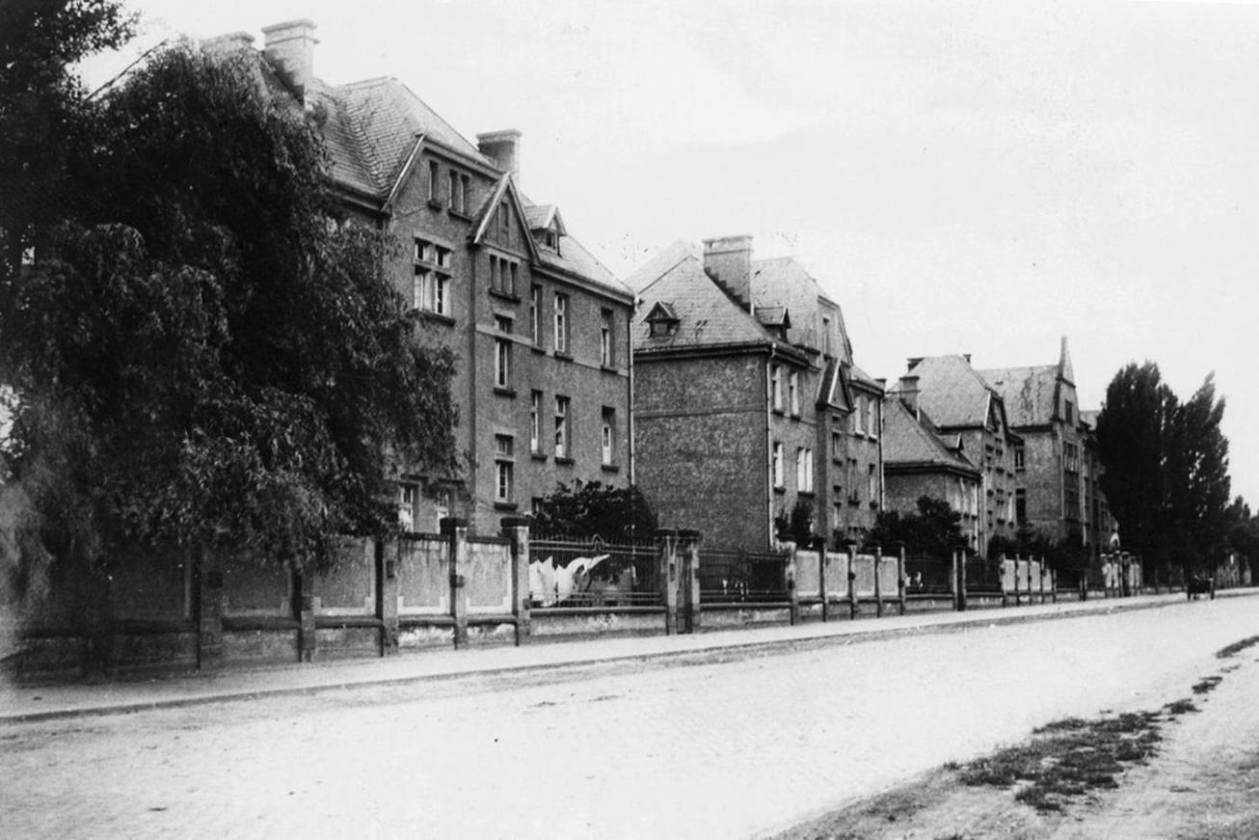
The compound subsequently became Lindsey Air Station. American military use continued into the early 1990s, after which the site was redeveloped as the Europaviertel. Surviving historical photographs show the substantial buildings that framed the camp years, although the views reproduced from the police album predate the displaced-persons community.
Dates given for the camp phase
| Source | Span given |
|---|---|
| Wiesbaden municipal lexicon | 1945 to 1947, United Nations collection camp |
| Compiled installation history | April 1945 to November 1946; Camp Lindsey from 13 November 1946 |
| Arolsen camp inventory | Closing between 19 October and 20 December 1946 |
| Polizei Hessen site history | Refugees until 1946, then renovation |
Sources
- Barracks in Wiesbaden
Landeshauptstadt Wiesbaden · Accessed September 2026
Municipal history identifies the Schiersteiner Straße compound, the three barrack sections and the military hospital buildings, a DP collection camp in 1945–1947, later Lindsey Air Station and today Europaviertel. The German path returns an error; the English import was read.
- From military grounds to police headquarters
Polizei Hessen · Accessed September 2026
Institutional site history: barracks completed in 1897, later expansion and occupation uses. On the interwar years: “Nun bezogen Einheiten der französischen Armee die Kaserne, die wiederum 1925 von der britischen Rheinarmee abgelöst wurde. … Nach einem halben Jahr zog Frankreich die Soldaten jedoch ab, und das Gelände wurde umgewidmet und für die zivile Nutzung freigegeben.” Describes refugees until 1946, followed by renovations. Dates concern different parts of a large compound.
- Historical photographs of Gersdorff-Kaserne
Polizei Hessen · Historical album published online
Pages 2 and 10: authentic views of the barracks before the DP period; page 10 dated to the 1920s.
- Displaced people at Gersdorff-Kaserne
Volksbund Deutsche Kriegsgräberfürsorge, Hessen · Accessed September 2026
Institutional research identifies accommodation separated by nationality and a Lithuanian family registered at Gersdorff by January 1946. Resident names omitted.
- Forced labourers and prisoners of war in Wiesbaden
GEW Hessen, HLZ / Hartmann Wunderer · March 2015
Printed pages 12–13 analyse the inadequate support for DPs at Gersdorff and hostile police representations. Approximate large population figures not treated as an exact facility census.
- DP camp inventory: Gersdorf-Kaserne
Arolsen Archives · 26 October 2023
Entry 1611 read from the spreadsheet on 13 September 2026: Camp AC 563, Team 28 Wiesbaden, team director Bayer, field supervisor Westerman, area team from November 1946; Polish, Baltic and Ukrainian residents; no capacity recorded. Administrative closing interval 19 October to 20 December 1946. Its opening field of 24 January 1946 recurs across unrelated rows and is treated as a reporting date. Archive reference ITS Dok-ID 82040911–82041331 and Stadtarchiv Wiesbaden WI/3 Nr. 2616, the latter unread.
- Polish D.P. Raids: United States Army Air Forces film of DP Camp 563, Gersdorff-Kaserne
National Archives and Records Administration, RG 18, Army Air Forces Combat Subjects; online copy Internet Archive · National Archives Identifier 5616, local identifier 18-CS-4651; undated in the catalogue, dated 1945 by the Internet Archive copy
Silent black-and-white film, Public Domain Mark 1.0. The NARA catalogue record and the full shot description were read, and the QuickTime master was opened and frames inspected on 13 September 2026. Signage recorded on screen: D.P. CAMP 563, UNRRA OFFICE, Gersdorff Kaserne, DP Police Bureau, Polska Policja, Zarząd Obozu Polskiego w Wiesbadenie, USAFE Military Police Headquarters.
- Kriminelles Gesindel: displaced persons in Wiesbaden
GEW Hessen / Hartmann Wunderer · Accessed 13 September 2026
Web version of the same study. Gives the numbers gathered in the former Gersdorff-Kaserne as more than 7,000 and at times 11,000 destitute people, and about 10,000 foreign forced labourers and prisoners of war in Wiesbaden during the war. Treated as a range for the compound at its fullest, not a camp census.
- Ihor Stebelsky, Table 8: Ukrainians in the UNRRA or IRO camps of the United States zone of Germany
Ukrainskyi Istoryk · 1986
Printed p. 53 rendered and read visually on 13 September 2026. The Land Hessen section lists Wiesbaden (Mainz Kastel) and Wiesbaden (hospital) and contains no Gersdorff row in any of the four returns. Cited here as negative evidence.
Last researched 13 September 2026