Gießen Ukrainian Workers’ Camp
Displacement in Europe
Gießen, Hesse, Germany · 1948–1949
Employment at an American army depot east of Gießen offered Ukrainians a route towards greater independence and overseas resettlement. Residents built much of the camp themselves, ran a club and a library, and argued with the relief authorities about rations and pay.
Introduction
Gießen’s Ukrainian workers’ camp joined accommodation to employment at the American army depot. Known in Ukrainian as Robitnycha Oselia, a home for workers, it was one of the labour camps that UNRRA and then the IRO set up from 1946 onwards to reduce the cost of maintaining displaced people. The relief committee in the United States negotiated the labour contract and presented the project as a way to improve living conditions for displaced Ukrainians.
The first Ukrainian residents arrived on 23 January 1948 from other camps in the American zone, among them Aschaffenburg, Cornberg, Mainz-Kastel and Korbach. The camp stood about eight kilometres east of the town centre and was administered by the Labor Service Company in the Licher Straße.
A history in dates
- December 1947Preparations for the camp are made; the organiser leaves the Lagarde barracks at Aschaffenburg.
- January 1948The Ukrainian workers’ camp opens.
- 23 January 1948The first Ukrainian residents arrive from Aschaffenburg, Cornberg, Mainz-Kastel and Korbach.
- April 1948217 people live in the camp; about 130 are still building it and ten work at the depot. The administration has eight departments.
- 13 May 1948The camp catalogue’s administrative entry for the workers’ camp begins.
- 30 June 1948The relief committee reports about 200 employed and 800 further jobs dependent on housing.
- Early 1949A supply officer’s memoir records depot work and camp administration.
- 30 June 1949The catalogue records the closure of the workers’ camp.
- End of 1949The camp is dissolved; most residents emigrate overseas and the rest move to Bavarian camps.
The depot and the huts
The American depot was laid out after the war on the site of the Gießen civil airport of 1929, at the eastern edge of the town, and grew to cover about 200 hectares. It later became the central goods distribution centre for American forces in Europe. That is the installation whose work the camp existed to serve.
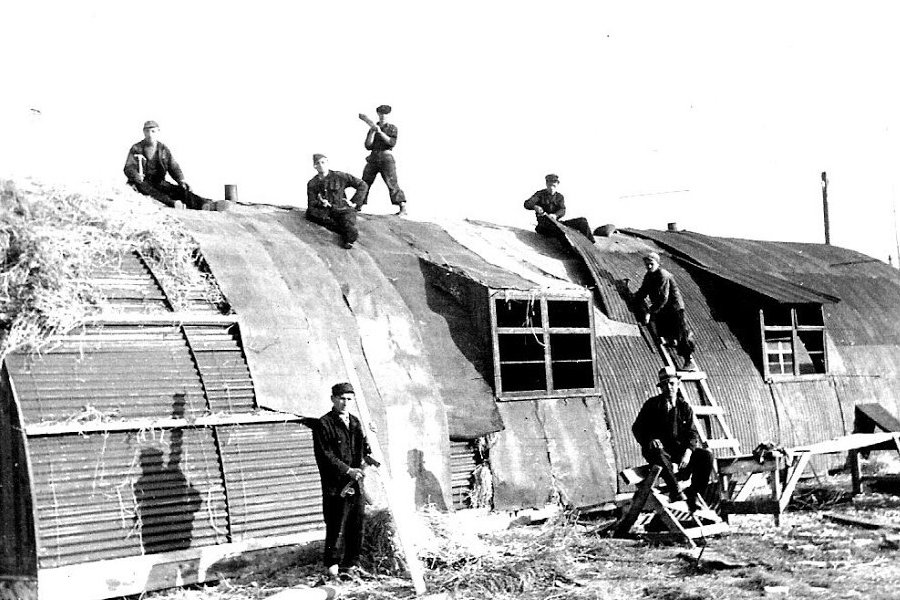
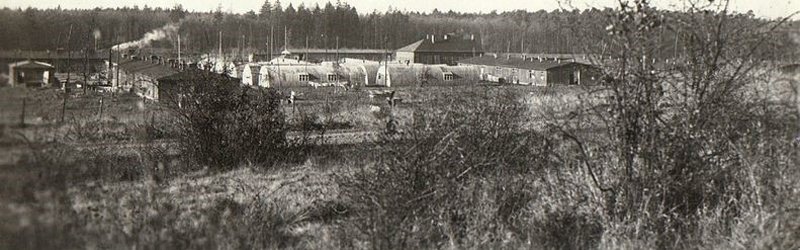
The camp itself was modest. Residents were housed in twenty English huts of the Nissen type and four wooden barracks. A metal hut held 28 people, mostly single men with a smaller number of women, while families lived in the wooden barracks. Those had 23 rooms each and were meant for about 40 people, but in practice held between 50 and 70. The first groups laid drainage, water and electricity within a few weeks and repaired some of the accommodation themselves.
Accommodation and rations
| Item | Recorded detail |
|---|---|
| Metal huts | 20 English huts of the Nissen type |
| Wooden barracks | 4, of 23 rooms each |
| People per metal hut | 28, mostly single men |
| People per wooden barrack | Intended for about 40; actually 50 to 70 |
| Daily ration, Ukrainian workers | About 2,500 kilocalories |
| Daily ration, Polish and Baltic DPs and German staff | About 3,200 kilocalories with the heavy-labour supplement |
| Hourly pay | 77 to 86 pfennigs, about 140 to 160 marks a month |
Sources for this section
Jobs promised, housing needed
The camp was organised by an officer of the Ukrainian central representation responsible for work placement, who had lived in the Lagarde barracks at Aschaffenburg until the end of December 1947. He formed a staff of five, appointed as the camp administration by the united Ukrainian American and Canadian committee at the IRO. By April 1948 the administration had eight departments and 217 people were living in the camp: about 130 were still building it and ten were already working in the depot.
The relief committee’s report of 30 June 1948 describes a scheme with the potential to employ more than a thousand Ukrainians. About 200 were then employed; the remaining 800 jobs depended on providing accommodation. The report records an ambition and a practical obstacle, rather than a completed thousand-person workforce, and its figures separate people already working from those whom the military authorities expected to employ once housing became available.
Later negotiations with the Americans committed the IRO to offering between 300 and 500 jobs at the depot, according to how many workers the Ukrainian representation could supply, together with better rations and a separate Ukrainian work group under its own leader. The camp catalogue records the unit only as a workers’ camp, opening on 13 May 1948 and closing on 30 June 1949, administrative dates that do not match the account drawn from the camp’s own correspondence.
The June 1948 employment plan
| Measure | People | Status in the report |
|---|---|---|
| Already employed | About 200 | Current employment |
| Additional jobs | 800 | Dependent on housing |
| Overall opportunity | More than 1,000 | Planned scale of the agreement |
The camp in April 1948
| Measure | People |
|---|---|
| Living in the camp | 217 |
| Still building the camp | About 130 |
| Employed at the American depot | 10 |
Life around the depot
A memoir written by a member of the camp’s supply staff describes the work performed in 1949: loading, packing, driving, operating handling equipment and repairs. Only ten Ukrainians were employed at the depot in April 1948, none qualified as mechanics or drivers, so they were given unskilled work and were often distributed among German gangs. The administration hoped to recruit skilled workers from other Ukrainian camps in order to take over a section of the depot outright.
Conditions were unequal. Ukrainian workers received the ordinary daily ration of about 2,500 kilocalories, while Polish and Baltic displaced people and German employees also received a heavy-labour supplement bringing them to roughly 3,200. Some Ukrainians registered as Balts and moved to the Baltic camps at Hanau, Frankfurt or Marburg for better conditions. Pay ran between 77 and 86 pfennigs an hour, roughly 140 to 160 marks a month, with department heads, interpreters and stenographers on 200 to 220. Supplies came mainly from the IRO administration at Fulda, and fuel, warm bedding and warm clothing were tightly rationed.
Employment also determined the right to stay. Only depot workers and the staff of the administration, camp police and housekeeping could live in the camp, and anyone dismissed from their job had to leave with their family at short notice. Unmarried men, and men whose families remained in other camps, were preferred for transfer to Gießen. The camp director was appointed by the American military administration.
Sources for this section
Culture and political discussion
Residents assembled a library and a workers’ club, bought radios and established a barber’s shop and a tailoring service. Concerts and theatre gave the camp a social life beyond depot shifts. The IRO refused to support a fortnightly travelling cinema on the ground that fewer than 200 people lived in the camp, and turned the request down even when the administration offered to pay double for the tickets.
Most of the workers belonged to the Orthodox or the Greek Catholic church, yet they were required to work on their own feast days while Catholic holidays were free. The supply officer’s memoir recalls a strong branch of the Ukrainian Revolutionary Democratic Party, and makes a careful distinction: despite the camp’s political reputation, most residents and staff were not party members.
The memoirist’s own route continued from Germany to Australia in 1949 and later to the United States in 1954, which illustrates how leaving a camp could begin several stages of migration rather than one direct journey.
Sources for this section
Work and the prospect of leaving
A later study places Gießen beside the Ukrainian workers’ camp at Hanau. Across the two, more than 600 Ukrainians obtained employment with American military installations. The combined figure belongs to both camps and cannot be assigned to Gießen alone.
Workers were offered priority in resettlement, and the camps existed in part to make the labour of mostly male Ukrainians useful enough to improve their chances under the IRO programme at a time when Canadian and Australian schemes preferred Baltic applicants. The workers’ camp was dissolved at the end of 1949: most residents emigrated overseas, while the sick, the disabled and the elderly were moved to camps in Bavaria. Both Ukrainian workers’ camps closed as overseas resettlement increased and American installations recruited more German workers.
A camp preserved in photographs
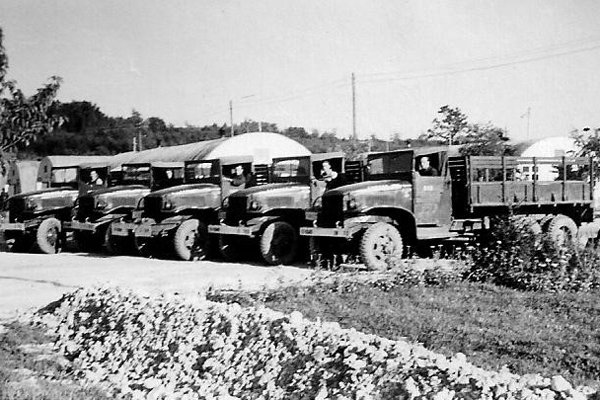
The photographs published with the research come from the family album of the camp’s cultural affairs officer. They show men repairing a curved hut roof, rows of metal and wooden buildings, and depot lorries with their Ukrainian drivers in 1948.
Keeping the Gießen camps apart
Gießen held more than one camp. The catalogue also records an Artillerie-Kaserne assembly centre in the town, opened on 1 February 1946 with a capacity of 780. Stebelsky’s Table 7 lists 500 Ukrainians at Gießen in the questionnaire survey collected during 1946 and 1947, with blanks in all three dated returns. That figure predates the workers’ camp and should not be attached to it.
Sources for this section
Sources
- Ukrainische Displaced Persons in Deutschland
Nazarii Gutsul and Sebastian Müller, Bundeszentrale für politische Bildung · 2014
Archival research using microfiche from the Staatsarchiv Darmstadt, files of the Ukrainian Free University in Munich and the Kurdydyk family album, presenting results of the 2012 student project “Displaced Persons in Mittelhessen 1945–60”. Original article read in full; underlying camp correspondence not separately accessed.
- Report: History, Accomplishments, Statistics and Plans
United Ukrainian American Relief Committee · 30 June 1948
Printed page 12, PDF page 16 visually inspected: Gießen labour contract, about 200 employed and 800 planned pending housing. These are employment figures, not resident counts.
- Na neokraianim kryli: Respubliky trybun
Volodymyr Biliaiv, 2003 memoir, Ukrainian Life in Sevastopol library · 2003
First-person account of supply work at Gießen in 1949, depot occupations, political organisation and later migration. No inmate names reproduced in the narrative.
- Economic Aspects of Camp Life, The Refugee Experience
The Refugee Experience, Canadian Institute of Ukrainian Studies Press · 1992
Printed page 75, PDF page 102 read. Combined Gießen/Hanau workforce, resettlement priority and late-1949 closure; not a Gießen-only population.
- US-Depot Gießen
German Wikipedia · Accessed 13 September 2026
The depot was laid out after the war on the site of the Gießen civil airport built in 1929, at the eastern edge of the town between the ring road and Rödgener Straße, covering about 200 hectares. The article says nothing about displaced persons.
- DP camp inventory: Gießen Workers-Camp and Artillerie-Kaserne
Arolsen Archives · 26 October 2023
Record 1000: Workers-Camp, opening 13 May 1948, closure 30 June 1949, later designation H 182, no capacity or nationality recorded. Record 999: Artillerie-Kaserne, opening 1 February 1946, capacity 780, later H 129, UNRRA Team 10 Gießen. The administrative dates differ from the published research and are given as they stand.
- The Refugee Experience, Table 7
Ihor Stebelsky, Canadian Institute of Ukrainian Studies Press · 1992
Table 7 “Ukrainians in UNRRA and IRO Camps of the American Zone of Germany”, printed pages 47–51. The Giessen row is in the Land Hessen section on printed page 47 and reads 500 in the 1946–7 questionnaire column, with blanks in the August 1946, May 1947 and December 1947 returns, so it cannot describe the workers’ camp of 1948.
Last researched 13 September 2026