Hallendorf Camp 25
Displacement in Europe
Hallendorf, Salzgitter, Lower Saxony, Germany · Ukrainian displaced-persons camp in the British zone, documented 1945–1949
Hallendorf’s Camp 25 grew inside a barrack camp built north of the village for the Reich Labour Service and then for the Hermann Goering ironworks. Its Ukrainian residents ran a secondary school, churches, a theatre and scouting, and the camp was one of the ten main Ukrainian centres listed in the British zone in 1948.
Introduction
Hallendorf’s Camp 25 was a Ukrainian displaced-persons community in Germany’s British occupation zone, in the industrial district that became the city of Salzgitter. Its residents established schools, Orthodox and Catholic churches, a theatre and scouting organisations. These institutions attracted the attention of neighbouring displaced communities seeking to organise their own lives after the war.
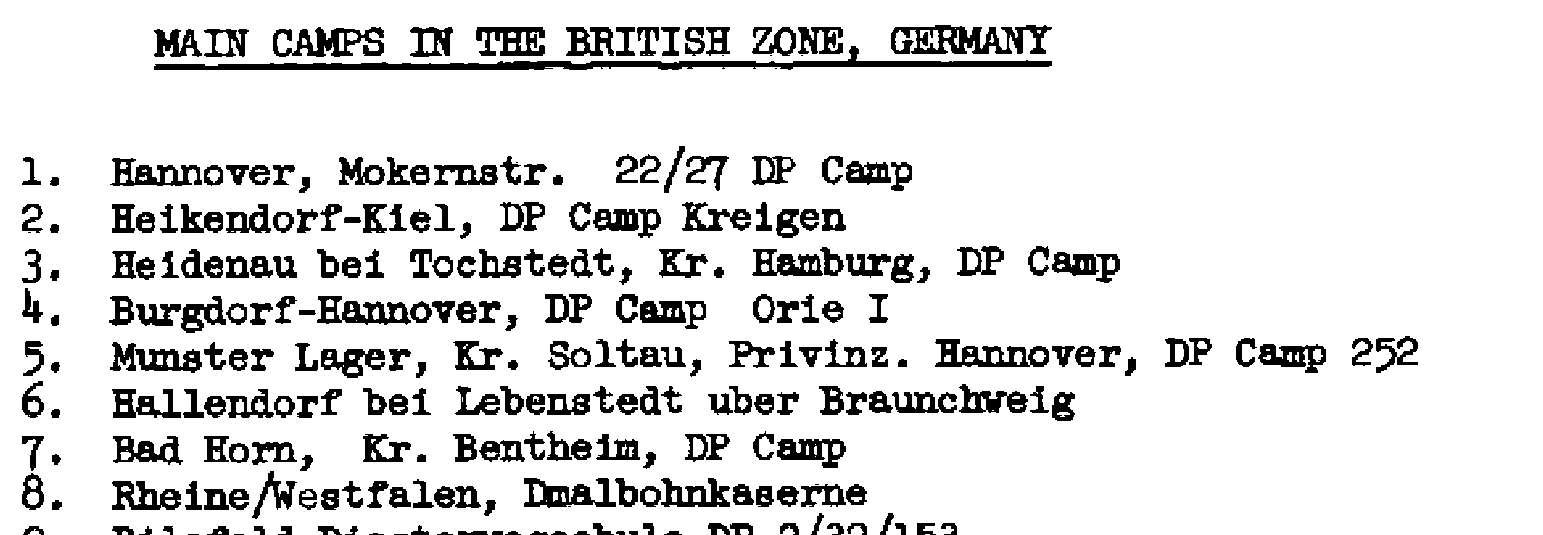
By the summer of 1948 the camp was substantial enough to appear among the ten main Ukrainian camps of the whole British zone in a relief agency’s published report, listed simply by its postal address at Hallendorf near Lebenstedt.
A history in dates
- Before 1939A Reich Labour Service camp stands north of Hallendorf on both sides of the Bleckenstedter Strasse.
- 1939The site passes to the Hermann Goering ironworks as Lager 25, with sub-camps 25A, 25B and 25C.
- 1945Some residents of Ukrainian Camp 25 join the newly established Belarusian community at nearby Watenstedt.
- 1 November 1945Former forced labourers from Ukraine dedicate a trilingual memorial plaque at the Westerholz cemetery.
- 30 June and 7 July 1946A fixture list enters UST Kalyna of Hallendorf against UST Dovbush of Braunschweig and UST Dnipro of Hannover.
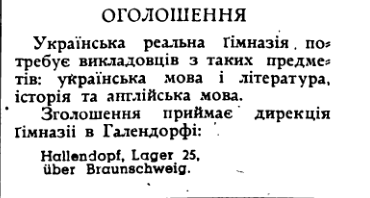
- 9 August 1946The camp’s Ukrainian secondary school advertises for teachers of Ukrainian language and literature, history and English.
- 1946–1947A historical population compilation records 1,420 Ukrainians at Hallendorf.
- 9 August 1946A Luna correspondent describes the camp’s single-domed Orthodox church, built from barrack material, and its active drama studio.
- 8 September 1946Luna reviews four guest performances given in the Heidenau camp by the Hallendorf camp theatre.
- 30 June 1948A relief committee report counts 1,646 Ukrainians at Hallendorf and lists the camp among the ten main camps of the British zone.
- 26 June 1949The camp newspaper Ukrainske slovo reports commemorations for Petliura and Konovalets at Hallendorf.
- From 1950Lager 25A is converted to housing as the area’s camps pass to German civil use.
- 1970sMetal plaques giving names and dates are set into the ground at some Westerholz graves, from an incomplete cemetery register.
- 22 February 1996A childhood photograph and recollection of receiving CARE supplies at Hallendorf are published.
Sources for this section
- Liste der Wohn- und Arbeitslager im Salzgittergebiet
- Belarusians in camps for displaced persons in West Germany in 1945–1952
- Salzgitter Hallendorf (war graves documentation)
- Salzgitter-Hallendorf, Ehrenfriedhof Westerholz
- Luna (Echo), the Heidenau camp newspaper, 1946 issues
- Luna, 9 August 1946 (Diasporiana bound-volume PDF, p 116): Ukrainian secondary-school recruitment notice
- Ukrainians in the Displaced Persons Camps of Austria and Germany, Table 7
- Report: history, accomplishments, statistics and plans, 30 June 1948
- The Nation in a Nutshell? Ukrainian Displaced Persons Camps in Postwar Germany
- Ukrainian Children’s Fund
The barracks before 1945
The camp buildings were not built for refugees. Lager 25 stood north of Hallendorf on both sides of the Bleckenstedter Strasse and began, before 1939, as a camp of the Reich Labour Service. In 1939 it passed to the ironworks of the Hermann Goering combine and became a workers’ camp, one of dozens laid out between 1938 and 1945 to house the labour that built the works and the surrounding company town.
Lager 25 had lettered sub-camps. Two of them, 25A and 25C, were wartime labour camps that also held forced labourers, and both were used for displaced persons after 1945; 25B was a police camp. The compiled list of the area’s camps records that Lager 25C is occasionally confused with Lager 21 in published accounts.
Lager 25 and its sub-camps in the Salzgitter camp list
| Camp | Built | Wartime use | After 1945 |
|---|---|---|---|
| Lager 25 | Before 1939, then 1939 | Reich Labour Service camp, then ironworks workers’ camp | Displaced persons; later merged with 25C |
| Lager 25A | 1939 | Forced-labour camp | Displaced persons; housing from 1950 |
| Lager 25B | 1939 | Police camp | No displaced-persons use recorded |
| Lager 25C | 1939 | Forced-labour camp | Displaced persons; occasionally confused with Lager 21 |
| Lager 21 | 1939 | Gestapo labour-education camp | A separate institution, not part of Lager 25 |
Sources for this section
A camp with a precise address
A notice printed in the Ukrainian newspaper Luna on 9 August 1946 gives an unusually direct link between the community and its location: applications for teaching posts were to be sent to the secondary school at Hallendorf, Lager 25, via Braunschweig. The number distinguishes this postwar Ukrainian camp from other facilities around Hallendorf.
One of those other sites was Lager 21, the Gestapo’s wartime labour-education camp near the Hallendorf to Bleckenstedt road. The memorial history of that institution belongs to a different numbered camp. The shared place name does not make the Ukrainian school a continuation of Lager 21.
Keeping education alive
The 1946 advertisement sought teachers of Ukrainian language and literature, history and English. It describes a Ukrainian realna himnaziia: a secondary school with an academically oriented curriculum. The request shows both the subjects the school wanted to sustain and its need to recruit qualified staff across the displaced Ukrainian community.
A later church biography independently records a religion-teaching appointment at Hallendorf’s secondary school in 1946. Together, the contemporary advertisement and the biographical record place both general education and religious instruction inside the camp’s daily life.
The same relief report that lists Hallendorf among the main camps counted, for the British zone as a whole, 33 grade schools with 1,869 pupils, 13 vocational schools, 25 kindergartens and eight colleges. Those are zone totals and cannot be divided between camps, but they show the network of schooling to which the Hallendorf secondary school belonged.
Churches, scouts and neighbouring communities
A Belarusian organiser’s recollections, examined in a 2022 University of Warsaw study, describe Camp 25’s churches, theatre, schools and scouts. Some Belarusians were living among the Ukrainians. When a separate Belarusian camp was established at nearby Watenstedt in July 1945, its first settlers included people who had left Ukrainian Camp 25.
This was a local transfer between neighbouring displaced-persons communities, rather than emigration from Germany. Watenstedt subsequently developed its own institutions; their history should be kept distinct from the institutions described at Hallendorf.
Political commemoration also had a place in camp life. Antons’s study of Ukrainian displaced persons in the British zone cites a June 1949 report in the camp newspaper Ukrainske slovo of ceremonies for Symon Petliura and Yevhen Konovalets held at Hallendorf and at Braunschweig. The detailed programme Antons describes, with morning services, requiems at symbolic graves and youth parades, is documented for Braunschweig rather than for Hallendorf.
A correspondent’s report in Luna on 9 August 1946 describes the camp under the heading Hallendorf. In the middle of the camp stood an autocephalous Orthodox church in the Ukrainian style, built from barrack material and carrying a single dome. A little further on was a theatre in which a drama studio worked actively, its amateurs, in the correspondent’s words, winning wide attention and general praise.
The camp theatre also performed away from home. A review in Luna on 8 September 1946 records four guest performances given in the Heidenau camp by the Hallendorf camp theatre under its artistic director, the artist M. Tahaiev, opening with Kvitka-Osnovianenko’s Svatannia na Honcharivtsi. The review reports Hrinchenko’s Stepovyi Hist as already in the theatre’s repertoire, with work under way on Tobilevych’s Suieta and on F. Meleshko’s drama Trioma Shliakhamy.
Hallendorf also fielded its own sports society. A fixture list printed in Luna on 7 July 1946 enters UST Kalyna of Hallendorf in the first round against UST Dovbush of Braunschweig on 30 June 1946, and against UST Dnipro of Hannover on 7 July.
Institutions documented in Camp 25
| Institution | Evidence |
|---|---|
| Ukrainian secondary school | Contemporary recruitment notice, 9 August 1946 |
| Orthodox and Catholic churches | Visitor’s recollection analysed in 2022 study |
| Theatre and scouting organisations | Same recollection of Ukrainian Camp 25 |
The memory of a relief parcel
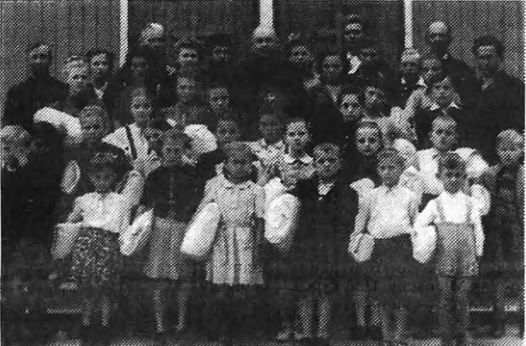
A photograph published in 1996 shows children receiving CARE supplies at Hallendorf. In the accompanying recollection, a former child resident remembered receiving a first parcel on Ukrainian Palm Sunday, aged seven. Decades later, that experience helped motivate relief work for children in Ukraine.
The photograph preserves a personal view of postwar relief: children gathered with supplies, rather than an administrative inventory. Its original caption identifies Hallendorf, but gives neither a year nor a numbered camp section.
Sources for this section
The recorded population
Two independent compilations give figures. The historical series assembled by Ihor Stebelsky records 1,420 Ukrainians under Hallendorf for the questionnaire returns of 1946 and 1947, and leaves the later columns blank, which means no return was filed for that camp at those dates rather than that nobody was left. The relief committee’s own district table records 1,646 Ukrainians at Hallendorf on 30 June 1948, all of them living in camps.
Both are figures for the Hallendorf reporting entry. Neither divides the total between Lager 25 and its lettered sub-camps. Stebelsky lists Salzgitter separately, with 409 Ukrainians in December 1947, so the wider industrial district and the Hallendorf entry were counted apart.
Ukrainians recorded at Hallendorf
| Date | Ukrainians | Source and scope |
|---|---|---|
| 1946–1947 | 1,420 | Stebelsky Table 7, Hallendorf entry, from 1946–47 questionnaire returns |
| May 1947 | no return | Stebelsky Table 7 cell blank, which is not a zero |
| December 1947 | no return | Stebelsky Table 7 cell blank; Salzgitter is listed separately with 409 |
| 30 June 1948 | 1,646 | Relief committee district table, Ukrainians in DP camps |
The Ukrainian memorial at Westerholz cemetery
Hallendorf’s dead lay outside the village. The old Hallendorf cemetery was closed during the construction of the Reichswerke ‘Hermann Göring’ and its ground handed over to the steelworks; the dead buried there were exhumed and reburied on a new site in nearby Westerholz.
In November 1945 former forced labourers from Ukraine commemorated their compatriots at this cemetery with a memorial plaque set directly on the ground to the left of the entrance, its inscription in Ukrainian, Russian and English. The German war graves commission records that the memorial stone was erected by Ukrainian survivors shortly after the Allied liberation of Salzgitter, and that for many years it was the only reference on the site to the victims of National Socialism buried there.
The English part of the inscription is dated 1 November 1945 and reads: ‘HERE, UNDER 806 BARROWS LIE SEVERAL HUNDRED ANONYMOUS MARTYRS OF VARIOUS NATIONALITIES. MAY THEM REST IN PEACE IN THIS HOSTILE GROUND! ETERNAL REMEMBRANCE AND GLORY! UKRAINIAN CEMETERY 1 NOVEMBER 1945’. The plaque commemorated dead of various nationalities while naming the ground a Ukrainian cemetery.
The war graves commission records that in the 1970s metal plaques giving names and dates of birth and death were set into the ground at some of the graves, on the basis of an incomplete cemetery register.
Sources for this section
After the camp
Hallendorf’s barracks did not stand empty. Lager 25A was turned over to housing from 1950, and the neighbouring Watenstedt camps became refugee transit camps and then flats for Germans expelled from the east.
Sources for this section
Sources
- Luna, 9 August 1946 (Diasporiana bound-volume PDF, p 116): Ukrainian secondary-school recruitment notice
Luna / Echo, Heidenau; original periodical · Accessed September 2026
PDF page 116 visually checked; school address explicitly Hallendorf, Lager 25. Issue date is 9 August 1946, not the bound volume’s first issue date.
- Belarusians in camps for displaced persons in West Germany in 1945–1952
Anastasiya Ilyina, Warsaw East European Review 12 (2022), p 104 · Accessed September 2026
Full indexed original p 104 checked: Ukrainian Camp 25, churches, theatre, schools, scouts and Belarusian departures to Watenstedt. Claims about later Watenstedt institutions not transferred to Hallendorf.
- Ukrainian Children’s Fund
Ukrainian Herald, supplement to Narodna Volya, 22 February 1996, p 7 · Accessed September 2026
Original page visually checked: Hallendorf childhood CARE recollection and photograph. Exact year/camp number not supplied; personal identification removed from published crop/caption.
- Ukrainians in the Displaced Persons Camps of Austria and Germany, Table 7
Ihor Stebelsky, The Ukrainian Historian (1986), pp 50–52 · Accessed September 2026
Original table/heading checked. Hallendorf 1946–47 count 1420; later blank cells not zero. Locality count not allocated to one numbered subsection.
- Archbishop Stephen, leader of Kyiv Patriarchate’s parishes in United States and Canada, dies at 89
The Ukrainian Weekly, 19 November 2006, p 1 · Accessed September 2026
Original PDF inspected: appointment as religion lecturer at Hallendorf secondary school 1946, move to Westphalia 1947. No resident names reproduced in prose.
- Das Arbeitserziehungslager
Gedenkstätte Salzgitter · Accessed September 2026
Institutional memorial explicitly identifies separate Gestapo camp as Lager 21 near Hallendorf-Bleckenstedt road.
- Liste der Wohn- und Arbeitslager im Salzgittergebiet
Wikipedia DE · Accessed 13 September 2026
Wikitext read in full. Lager 25 Hallendorf: built before 1939 by the RAD as an RAD-Lager, from 1939 a Huette workers’ camp, after 1945 displaced persons, north of Hallendorf on both sides of the Bleckenstedter Strasse. Sub-camps 25A and 25C labour camps then displaced persons, 25A housing from 1950; 25B a police camp. The entry for 25C warns that it is occasionally confused with Lager 21. Watenstedt camps 22 and 23 became refugee transit camps.
- Report: history, accomplishments, statistics and plans, 30 June 1948
United Ukrainian American Relief Committee · Accessed 13 September 2026
Scan has no text layer; PDF pages 30 and 31, printed 26 and 27, rendered at 190 dpi and read directly. Printed 26: Hallendorf 1,646 Ukrainians in DP camps. Printed 27: Hallendorf listed sixth among the main camps of the British zone as ‘Hallendorf bei Lebenstedt uber Braunchweig’, with zone totals for religion and schools.
- The Nation in a Nutshell? Ukrainian Displaced Persons Camps in Postwar Germany
Jan-Hinnerk Antons, Harvard Ukrainian Studies 37, nos 1–2 (2020), pp 177–211 · Accessed 13 September 2026
PDF read in full. Footnote 103 cites ‘Z zhyttia taboriv’, Ukrainske slovo, no. 60, 26 June 1949, for commemorations at Hallendorf and Braunschweig. The described programme belongs to the Braunschweig camp and is not transferred to Hallendorf here.
- Salzgitter Hallendorf (war graves documentation)
Porta Polonica · Undated; read 14 September 2026
Documentation page on the war cemetery, section ‘Salzgitter Hallendorf’ read in full. It records the memorial plaque set up by former forced labourers from Ukraine in November 1945 and quotes the English part of its trilingual inscription.
- Salzgitter-Hallendorf, Ehrenfriedhof Westerholz
Volksbund Deutsche Kriegsgräberfürsorge e.V. · Undated; read 14 September 2026
War cemetery information page; the sections ‘The site’ and ‘The memorial site’ were read. They record the closure of the old Hallendorf cemetery during construction of the Reichswerke ‘Hermann Göring’ and the reburial at Westerholz, the memorial stone erected by Ukrainian survivors, and the metal plaques added in the 1970s.
- Luna (Echo), the Heidenau camp newspaper, 1946 issues
Zahrava co-operative publishing house, Heidenau; Ukrainian Museum-Archives, Cleveland, DP Camp Periodicals Collection, digitised by the Internet Archive · 7 July – 8 September 1946
Digitised bound issues read as page images. Issue of 7 July 1946, page 6: British-zone fixture list entering UST Kalyna of Hallendorf. Issue of 9 August 1946, page 4: correspondent's report 'Zhyvemo, pratsiuiemo, tvorymo', section headed 'Hallendorf'. Issue of 8 September 1946, page 6: theatre review 'Na nashii stseni'.
Last researched 13 September 2026