Falkenberg Camp
Displacement in Europe
Falkenbergsweg, Hamburg-Neugraben, Germany · Barrack camp 1936–1976; Ukrainian displaced-persons population documented 1946–1951
Ukrainians who would not return to Soviet-ruled homelands moved into the barracks of a former Neuengamme annex at the Falkenbergsweg, and made a community there with an Orthodox church in a hut. Population returns trace their numbers falling from over 1,500 in 1947 to 229 in 1951, while the camp became an ordinary Hamburg residential barracks and was demolished in 1976.
Introduction
Falkenberg was a displaced-persons camp on the Falkenbergsweg in Hamburg-Neugraben. It was distinct from the nearby Fischbek camp on Rostweg. Ukrainians formed a substantial community here: contemporary population returns and a later childhood memoir document their presence.
A history in dates
- 1936A barrack camp is laid out at the Falkenbergsweg; during the Second World War it holds forced labourers.
- End of 1943The upper camp is rebuilt for 500 Italian military internees working on prefabricated housing.
- 13 September 1944 to 8 February 1945The Neugraben annex of Neuengamme operates in the upper camp with 500 Czech Jewish women.
- From 1945Ukrainians and Belarusians who will not return east stay on in the huts, alongside evacuated Hamburg families.
- 1 May 1946A Latvian displaced-persons newspaper’s camp list records “DP. Camp 515, Falkenberg” at Neugraben, Hamburg 24.
- May 1947The Ukrainian population return records 1,567 people at Falkenberg.
- 1948A later memoir records a Ukrainian family’s move from Fischbek to Falkenberg.
- 26 June 1949Ukrainske slovo reports an assault on an autonomous Orthodox priest at Falkenberg.
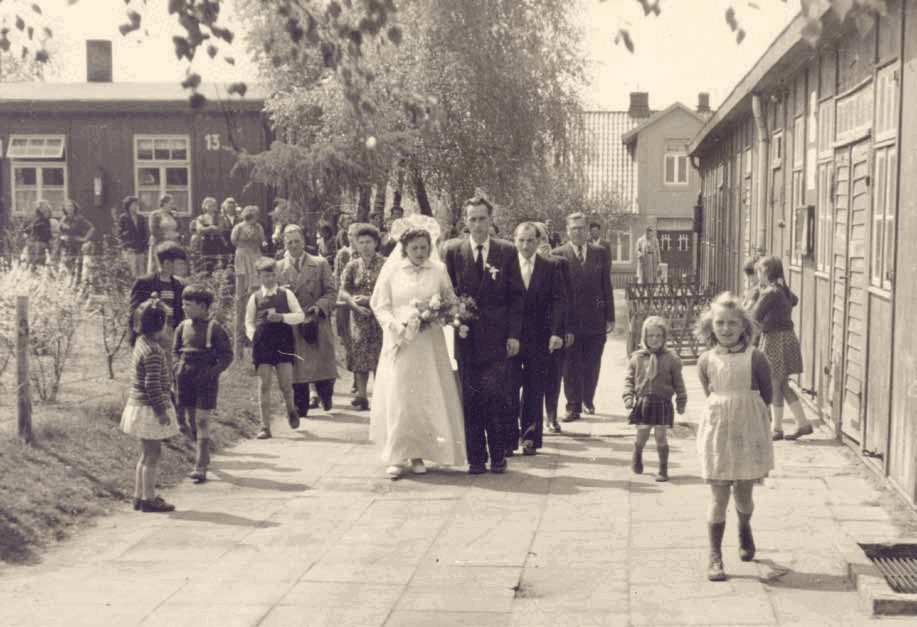
- Summer 1950Municipal administration takes over; a camp wedding is photographed.
- August 1951The Ukrainian population return records 229 people at Falkenberg.
- 1976The barracks of the Wohnunterkunft Falkenbergsweg are demolished.
- 2020Süderelbe Secondary School students erect an information panel and memorial column at Falkenbergsweg 71.
- 2023The City of Hamburg acquires the former camp site from the Federal Real Estate Agency.
- June 2025Local officials discuss the Denkort Falkenberg interpretation project.
Sources for this section
- KZ-Aussenlager Neugraben
- KZ-Außenlager für Behelfsheimbau und Baustoffgewinnung
- Latviešu nometnes Vācijā (Latvian camps in Germany), Mūsu Pagasts, numbers 1–2
- Ukrainians in the Displaced Persons Camps of Austria and Germany, Table 7
- Childhood memoir: Hamburg-Falkenberg and onward migration
- The Nation in a Nutshell? Ukrainian Displaced Persons Camps in Postwar Germany
- Vom DP-Camp zum Ausländerlager
- Fragmented Memories: The History of the Women’s Satellite Camps of the Neuengamme Concentration Camp in Hamburg, 1944–1945
- Regionalausschuss Süderelbe: meeting minutes 25 June 2025
A place with several histories
The barrack camp at the Falkenbergsweg existed from 1936 to 1976 and passed through several uses. Two wartime labour camps stood on the ground: a small camp on the rise, and a larger one at the foot of it for male forced labourers, many of them barely in their twenties and mostly from France, Belgium and the Netherlands. At the end of 1943 the upper camp was rebuilt for Italian military internees, and the contractor August Prien, which was building prefabricated emergency housing nearby, put five hundred of them into it.
The complex was cleared in the summer of 1944. From 13 September 1944 until 8 February 1945 the empty upper camp became the Neugraben annex of Neuengamme concentration camp, holding five hundred young Czech Jewish women deported through Theresienstadt and Auschwitz-Birkenau; the Hamburg memorials foundation records that they were transferred to Neugraben from the Veddel (Dessauer Ufer) satellite camp. They were made to build temporary housing and lay water mains and roads before transfer to Hamburg-Tiefstack and then to Bergen-Belsen.
An aerial photograph taken on 3 April 1946 records the former annex huts. The wartime prisoners and the later displaced-persons community are different populations on the same ground; their numbers must never be combined.
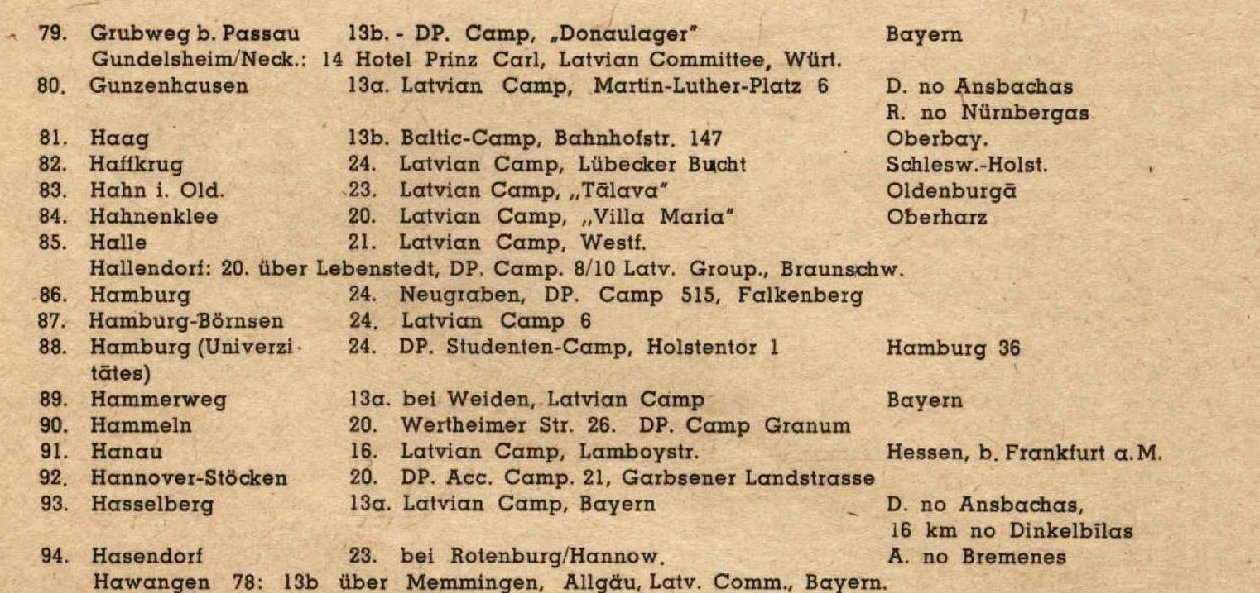
A list of camps in Germany printed in the Latvian displaced-persons newspaper Mūsu Pagasts on 1 May 1946 gives the site its British postal designation, recording “DP. Camp 515, Falkenberg” at Neugraben under Hamburg 24. The entry names the camp and nothing more: no population, and no nationality.
The same designation appears in the Ukrainian press with a street address attached. A tracing notice in the Regensburg weekly Ukrainske slovo of 15 September 1946 asked that replies be sent to “DP Camp 515, Falkenberg-Neugraben, Falkenbergsweg 1”. The notice records one reply address and nothing more about the camp.
Phases of the barrack camp at the Falkenbergsweg
| Period | Use |
|---|---|
| 1936 onwards | Barrack camp laid out; forced-labour camp from 1940 |
| End of 1943 to summer 1944 | Upper camp holds 500 Italian military internees |
| 13 September 1944 to 8 February 1945 | Neugraben women’s annex of Neuengamme, 500 Czech Jewish prisoners |
| 1945 to about 1950 | Displaced persons, including Ukrainians and Belarusians, with evacuated Hamburg families |
| From summer 1950 | Municipal residential barracks, Wohnunterkunft Falkenbergsweg |
| 1976 | Demolished |
Sources for this section
- KZ-Aussenlager Neugraben
- KZ-Außenlager für Behelfsheimbau und Baustoffgewinnung
- Fragmented Memories: The History of the Women’s Satellite Camps of the Neuengamme Concentration Camp in Hamburg, 1944–1945
- Latviešu nometnes Vācijā (Latvian camps in Germany), Mūsu Pagasts, numbers 1–2
- Rozshuky (Searches), Ukrainske slovo, 15 September 1946, page 6
Why Ukrainians stayed at the Falkenbergsweg
Northern and western European forced labourers went home after the war. Others who had lived in the camp during the war years now counted as displaced persons and simply stayed in the huts. The site’s published history states plainly that Ukrainians and Belarusians who had worked for the German war economy moved into the barracks as they fell empty, because they did not want to return to countries by then under Stalin’s control.
Hamburg families who had been evacuated during the bombing also moved in, because housing in the ruined city was scarce. From the start, then, the camp was shared between displaced foreigners and German residents rather than being a closed Ukrainian settlement.
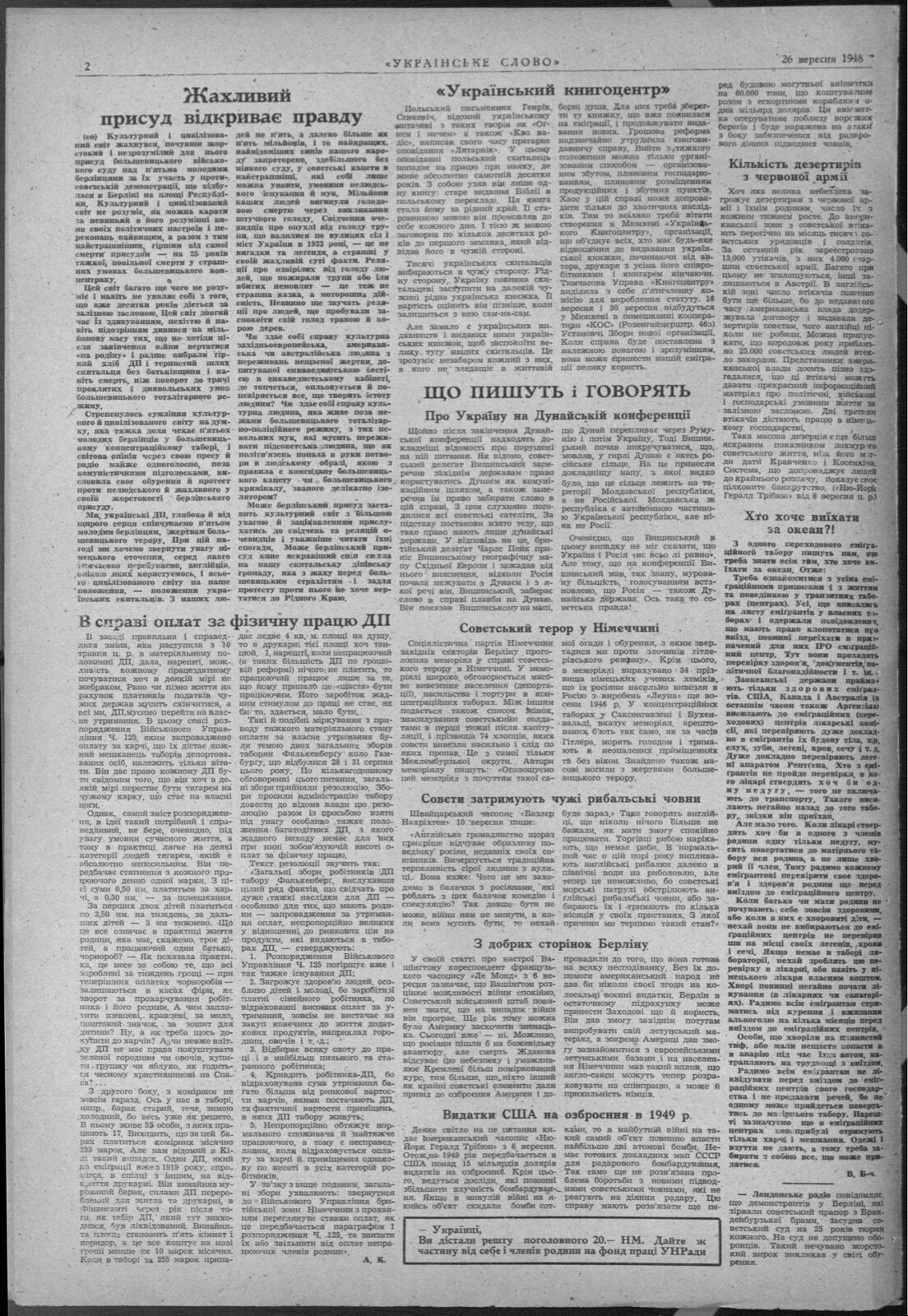
The same report prints the resolution passed at the camp. The general meeting of the DP workers of the Falkenberg camp, having heard a whole series of facts showing the very hard consequences for displaced people — especially for those with families — of charges for maintenance out of all proportion to the market prices of the goods issued in the DP camps, affirmed that Instruction No. 125 worsened an already hard existence; that it endangered health, above all that of children and the young, because after the high deductions a family worker’s wages did not suffice to buy the additional food, greens and vegetables needed to live; that it took away all appetite for work even from the most diligent worker; that it wronged the DP worker, because the sum deducted was far greater than the market value of the food supplied to displaced people and than the real value of the accommodation in which they lived; and that it fell disproportionately on the ordinary consumer doing the heaviest work, since the same rate for food and lodging was deducted from every category of worker. The meeting resolved to ask the Military Government of the British zone of Germany to review the rates, as paragraph 1 of Instruction No. 125 provided, and either to lower them or to exempt non-working members of a family.
Families and everyday life
A childhood memoir published in 2023 recalls a Ukrainian family moving from Fischbek to Falkenberg in 1948. Five families shared a room divided by blankets. An Orthodox church operated in a barrack. The recollection conveys the close quarters in which religious life and family routines continued.
A photograph from summer 1950 shows a wedding procession among the camp buildings. Hamburg’s memorial exhibition uses it to illustrate how displaced people married and founded families while waiting to leave or establish a more permanent home.
A report in Ukrainske Slovo of 26 September 1948 preserves the camp’s own reckoning of what work paid for. Military Government Instruction No. 125 required every working displaced person to pay one mark a day, half of it for food and half for accommodation, with 3.50 marks a week for each of the first two children and 3 marks a week for each child after that. The writer asked what that meant in practice for a family with, say, three children and one working father, a labourer: at the wages then paid for unskilled work the whole of the week’s earnings stayed in the firms’ cash offices as repayment for the keep of the worker and his family, and there was nothing left for the cobbler or the tailor, for soap, a postage stamp or an exercise book for a child. He gave an instance from the camp itself. One barrack there was old, leaked and was cold in winter, being by then like a sieve; fifty-two people lived in it, of whom seventeen worked, so that 255 marks a month were being paid in rent for that one hut.
A divided Orthodox community
Religious life was not always peaceable. Antons’s study of Ukrainian displaced persons in the British zone records that at Falkenberg a priest of the autonomous Orthodox jurisdiction was set upon with knives and knuckledusters, and that British military police had to intervene. The incident was reported in the Ukrainian camp newspaper Ukrainske slovo on 26 June 1949.
Antons notes that another historian places the same or a similar attack at the neighbouring Fischbek camp. The two Hamburg camps are frequently confused, and this account is recorded here with that caution attached.
Sources for this section
What the population records show
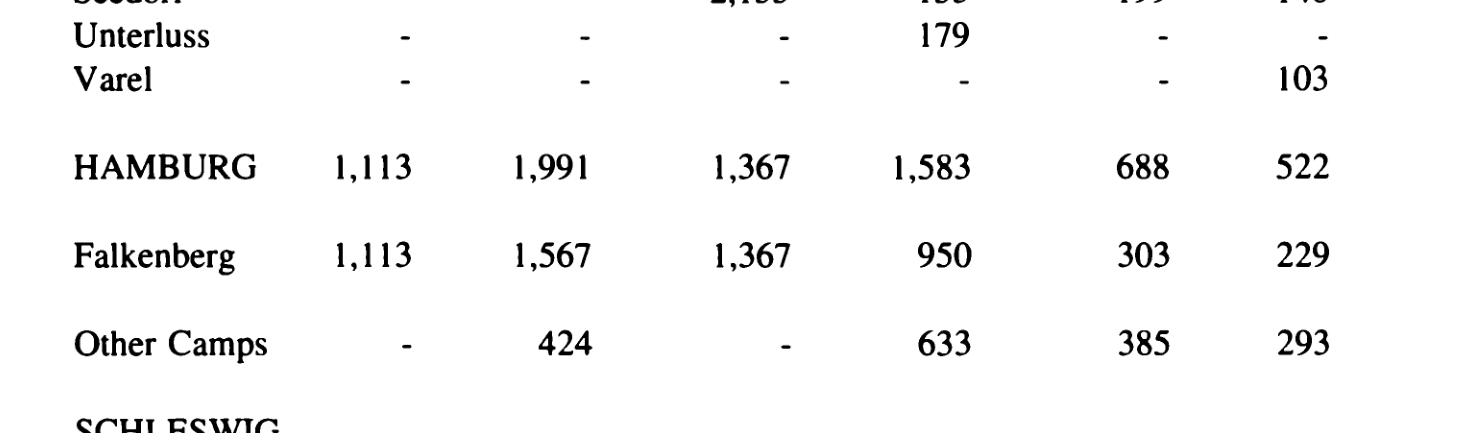
Falkenberg’s Ukrainian population rose between the 1946 and 1947 questionnaire returns and May 1947, then fell steadily. Stebelsky’s table gives 1,113, then 1,567, 1,367, 950, 303 and 229 at six dates between 1946 and August 1951. These counts concern Ukrainians specifically.
Other returns measure other things. In June 1948 a relief committee counted 2,253 Ukrainians in the Hamburg district as a whole, which is more than Falkenberg alone; Stebelsky separates Falkenberg from Hamburg’s other camps in the same way. A 1950 survey recorded 659 displaced people of all nationalities at Falkenberg, which is not a competing Ukrainian total.
Ukrainians at Falkenberg
| Date | Ukrainians |
|---|---|
| 1946–1947 | 1,113 |
| May 1947 | 1,567 |
| December 1947 | 1,367 |
| July 1949 | 950 |
| December 1950 | 303 |
| August 1951 | 229 |
Returns that measure something else
| Date | Figure | What it counts |
|---|---|---|
| 30 June 1948 | 2,253 | Ukrainians in DP camps in the whole Hamburg district |
| 1950 | 659 | Displaced persons of all nationalities at Falkenberg |
| 1960s | about 750 | Average residents of the Wohnunterkunft Falkenbergsweg, all nationalities including Germans |
Moving on, or remaining in Hamburg
The memoir follows one family’s onward journey: the father left for industrial work in France in 1949, while a child’s school record places her at Seedorf in 1949 and 1950 before reunion in France. This was an individual route through another German camp, rather than a transfer of the entire Falkenberg community.
In summer 1950, Hamburg’s social administration took over its remaining six DP camps. Residents began paying rent for their barrack accommodation, fences were removed, and some camps also housed homeless Germans. Institutional control changed even where residents remained in the same place.
Officially the site was now the Wohnunterkunft Falkenbergsweg, a municipal residential barracks. An average of about 750 people lived there through the 1960s, and the former SS hut in the upper camp was turned into a day nursery. The camp was demolished in 1976.
A site still being researched
A memorial stone stands where the women’s annex was. It was damaged repeatedly and its plaque removed several times, so in 1992 a further plaque was fixed at the Neugraben district office. Remains of the barrack foundations survive in the ground, although no barracks stand.
In June 2025, local proceedings discussed Denkort Falkenberg, an educational project combining the camp’s history with the surrounding nature reserve. Proposals included digital walks, interpretation panels and protection of buried foundations. The committee requested accessible, multilingual presentation.
An April 2026 announcement reported an archaeological survey undertaken in 2025 and a forthcoming presentation covering the site’s uses as forced-labour camp, concentration-camp annex, DP camp and residential camp. This continuing work can add detail to the physical history of the barracks.
Commemoration on the ground has continued. In 2020 students from the Süderelbe Secondary School erected an information panel and a memorial column at Falkenbergsweg 71, and in 2023 the City of Hamburg acquired the site from the Federal Real Estate Agency.
Sources
- Vom DP-Camp zum Ausländerlager
KZ-Gedenkstätte Neuengamme, exhibition panel 19 · Accessed September 2026
Original panel checked: Falkenbergsweg 73; 659 all-nationality DPs in 1950, municipal takeover and summer 1950 wedding photograph. Wentorf school/map not Falkenberg.
- Childhood memoir: Hamburg-Falkenberg and onward migration
Maidan Monitoring, 2023 · Accessed September 2026
First-person recollection checked: family registration at Falkenberg 1948, divided room, Orthodox church, father to France 1949 and child school record Seedorf 1949/50. Names not reproduced.
- KZ-Außenlager für Behelfsheimbau und Baustoffgewinnung
Neuengamme Memorial, Hamburg City Hall exhibition 2019, panel 25 · Accessed September 2026
Original panel checked: Neugraben satellite camp 13 September 1944–8 February 1945, 500 Czech Jewish women, five huts within the larger forced labour camp, actual site aerial 3 April 1946. Wartime camp distinct from postwar DP status.
- Ukrainians in the Displaced Persons Camps of Austria and Germany, Table 7
Ihor Stebelsky, Ukrainian Historical Review 1986, pp 50–52 · Accessed September 2026
Original table/header visually checked: Falkenberg 1,113; 1,567; 1,367; 950; 303; 229. Hamburg aggregate and Other Camps excluded.
- Regionalausschuss Süderelbe: meeting minutes 25 June 2025
Harburg district council proceedings · Accessed September 2026
Published minutes checked: Denkort Falkenberg proposal, digital walks, archaeology, protection of underground foundations and a request for accessible multilingual interpretation. The project is a proposal, not claimed to be finished.
- Archaeology of the former Falkenberg camp
Neuer Ruf Süderelbe, April 2026, week 15 · Accessed September 2026
Contemporary announcement quotes an Archaeological Museum Hamburg specialist leading the 2025 survey. The lecture covers the camp’s uses from the 1930s to the 1970s. Not used as an excavation results report.
- KZ-Aussenlager Neugraben
Wikipedia DE · Accessed 13 September 2026
Wikitext read in full. Gives the two wartime labour camps, the 500 Italian military internees placed by August Prien at the end of 1943, the women’s annex of 13 September 1944 to 8 February 1945, and the postwar section: Ukrainians and Belarusians moved into the vacated huts rather than return to Stalin-ruled countries, the site became the Wohnunterkunft Falkenbergsweg with about 750 residents in the 1960s, the SS hut became a day nursery and the camp was demolished in 1976. Cites Karl-Heinz Schultz, ‘Das Barackenlager am Falkenbergsweg 1936–1976’. Named former prisoners listed there are not reproduced.
- The Nation in a Nutshell? Ukrainian Displaced Persons Camps in Postwar Germany
Jan-Hinnerk Antons, Harvard Ukrainian Studies 37, nos 1-2 (2020), pp 177–211 · Accessed 13 September 2026
PDF read in full. Printed p 193 and footnote 64: an autonomous Orthodox priest attacked at Falkenberg with knives and knuckledusters until British military police intervened, from ‘Hanebnyi napad na sviashchenyka’, Ukrainske slovo, no. 60, 26 June 1949. Antons himself notes Heyer places the same or a similar incident at Fischbek.
- Report: history, accomplishments, statistics and plans, 30 June 1948
United Ukrainian American Relief Committee · Accessed 13 September 2026
Scan has no text layer; PDF page 30, printed page 26, rendered at 190 dpi and read directly. District table ‘Population in districts of the British zone, Germany’: Hamburg 2,253 Ukrainians in DP camps at 30 June 1948. This is the Hamburg district, covering all its camps, not Falkenberg alone.
- Ukrainian Population Migration after World War II, Table 6
Ihor Stebelsky, in The Refugee Experience, Canadian Institute of Ukrainian Studies Press · 1992
Scan published by diasporiana.org.ua; no reuse licence is stated by the holder. Page image rendered from the digitised volume and the camp’s row read visually.
- “В справі оплат за фізичну працю ДП”, Ukrainske Slovo (Українське Слово), 26 September 1948, page 2
Ukrainian Museum-Archives of Cleveland, DP Camp Periodicals Collection, via the Internet Archive · 26 September 1948
Marked in the collection as public domain or an orphan work and offered under CC BY-NC-ND 4.0. Ukrainske Slovo was published at Blomberg in Lippe by the Ukrainian Central Relief Committee for the British zone. The article, signed A. K., sets out the effect of Military Government Instruction No. 125 on working displaced people and prints in full the resolution of the general meeting of the DP workers of the Falkenberg camp near Hamburg.
- Latviešu nometnes Vācijā (Latvian camps in Germany), Mūsu Pagasts, numbers 1–2
Mūsu Pagasts, 1 May 1946; facsimile and English translation reproduced by latvians.com · 1 May 1946
List of camps in Germany read in facsimile and translation; items number 86 and number 188 both record “DP. Camp 515, Falkenberg” at Neugraben under the postal district Hamburg 24. The entries give the designation only, with no population or nationality.
- Fragmented Memories: The History of the Women’s Satellite Camps of the Neuengamme Concentration Camp in Hamburg, 1944–1945
Foundation of Hamburg Memorials and Learning Centres Commemorating the Victims of Nazi Crimes (SHGL) · 2025
Chapters “Hamburg-Neugraben 1944–1945” and the remembrance-culture page read: the 500 Jewish Czech women transferred to Neugraben from the Veddel (Dessauer Ufer) satellite camp on 13 September 1944, the camp standing beside a forced-labour camp on Falkenbergsweg; the information panel and memorial column erected by Süderelbe Secondary School students at Falkenbergsweg 71 in 2020; and the City of Hamburg’s acquisition of the site from the Federal Real Estate Agency in 2023.
- Rozshuky (Searches), Ukrainske slovo, 15 September 1946, page 6
Ukrainske slovo, Regensburg, Ganghofersiedlung, UNRRA Team 120; printed by Mittelbayerische Zeitung, Regensburg. Ukrainian Museum-Archives, Cleveland, DP Camp Periodicals Collection, digitised by the Internet Archive · 15 September 1946
Issue of 15 September 1946, printed page 6, read as page images. The 'Rozshuky' tracing column carries a notice asking for replies at 'DP Camp 515, Falkenberg-Neugraben, Falkenbergsweg 1'.
Last researched 13 September 2026