Hanau
Displacement in Europe
Hanau · Germany · 1945–1950
A large camp across the Lamboystraße barracks, which began as a repatriation centre for more than ten thousand people and ended as the last displaced-persons camp in Hesse, with a small Ukrainian community inside a mainly Baltic population.
Introduction
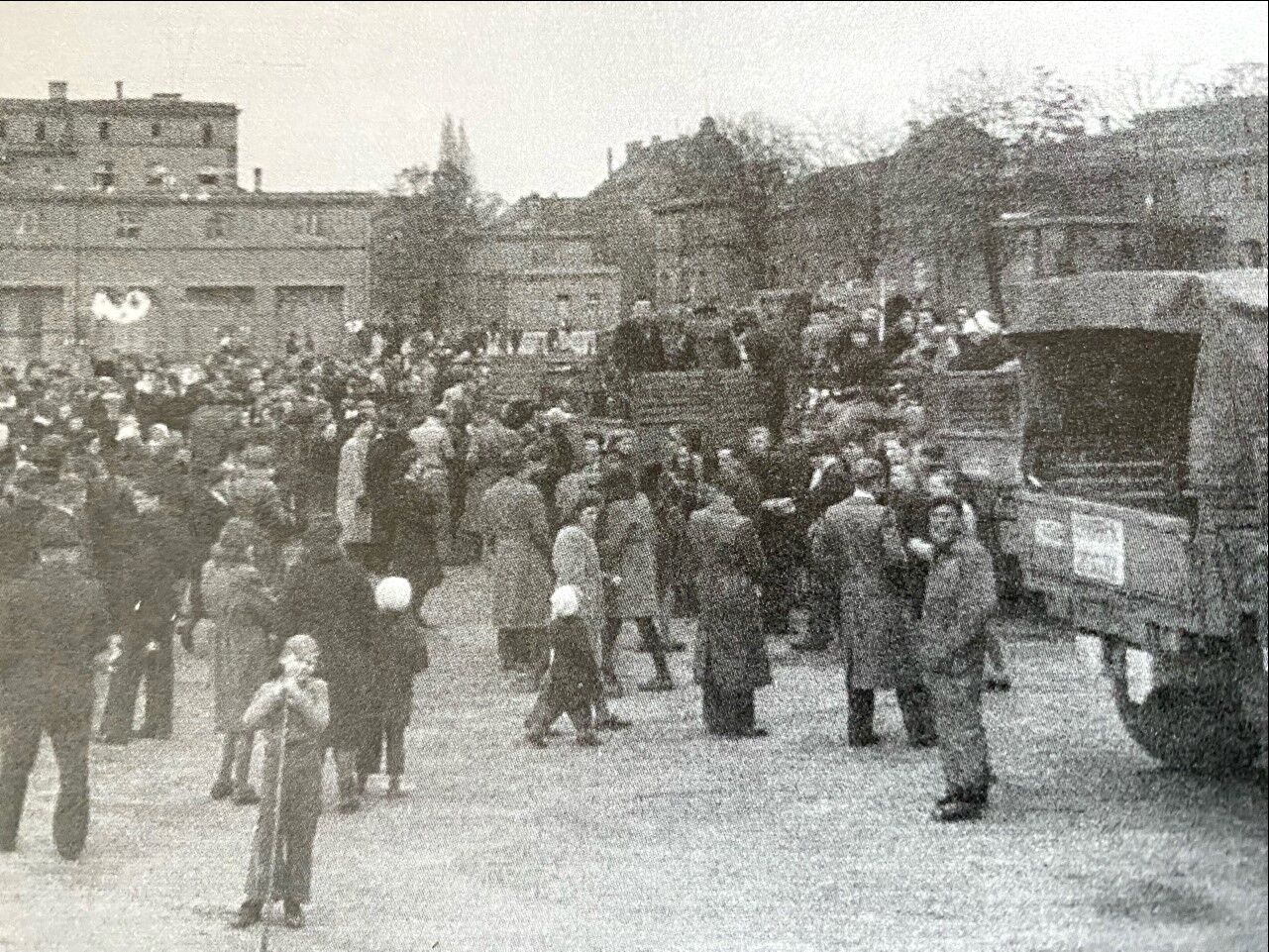
Hanau’s displaced-persons camp occupied former barracks along Lamboystraße. Thousands of people passed through its early international community; later, Baltic refugees formed its largest groups. Ukrainians also lived here, and a city-archive photograph records Russian and Ukrainian departures from François-Kaserne in 1945.
The camp opened within weeks of the American entry into the town and closed on 30 November 1950. In its last two years it served as the central displaced-persons establishment for the whole of Hesse, because the other camps in the state had already been wound up.
A history in dates
- 28 March 1945The US Army enters Hanau.
- 22 April 1945A UNRRA volunteer takes over a barracks assembly centre holding about 10,600 people.
- 8 May 1945The camp’s first school, a Polish one, begins teaching.
- 27 May 1945The first transport of 1,200 people leaves for the Soviet Union.
- 1 August 1945Soviet officers demand the Baltic residents as Soviet citizens and are refused.
- 1945The Lithuanian kindergarten serves 150 children.
- 4 October 1945The tracing service’s inventory records this as the opening date of the Lamboystraße assembly centre, AC 554.
- 1945An archival photograph records Russian and Ukrainian departures from François-Kaserne.
- 1945Polish children are photographed learning to read in a classroom run by UNRRA in the camp.
- End of 1945A camp hospital opens at Lamboystraße 54.
- 1946A camp census counts 6,184 residents.
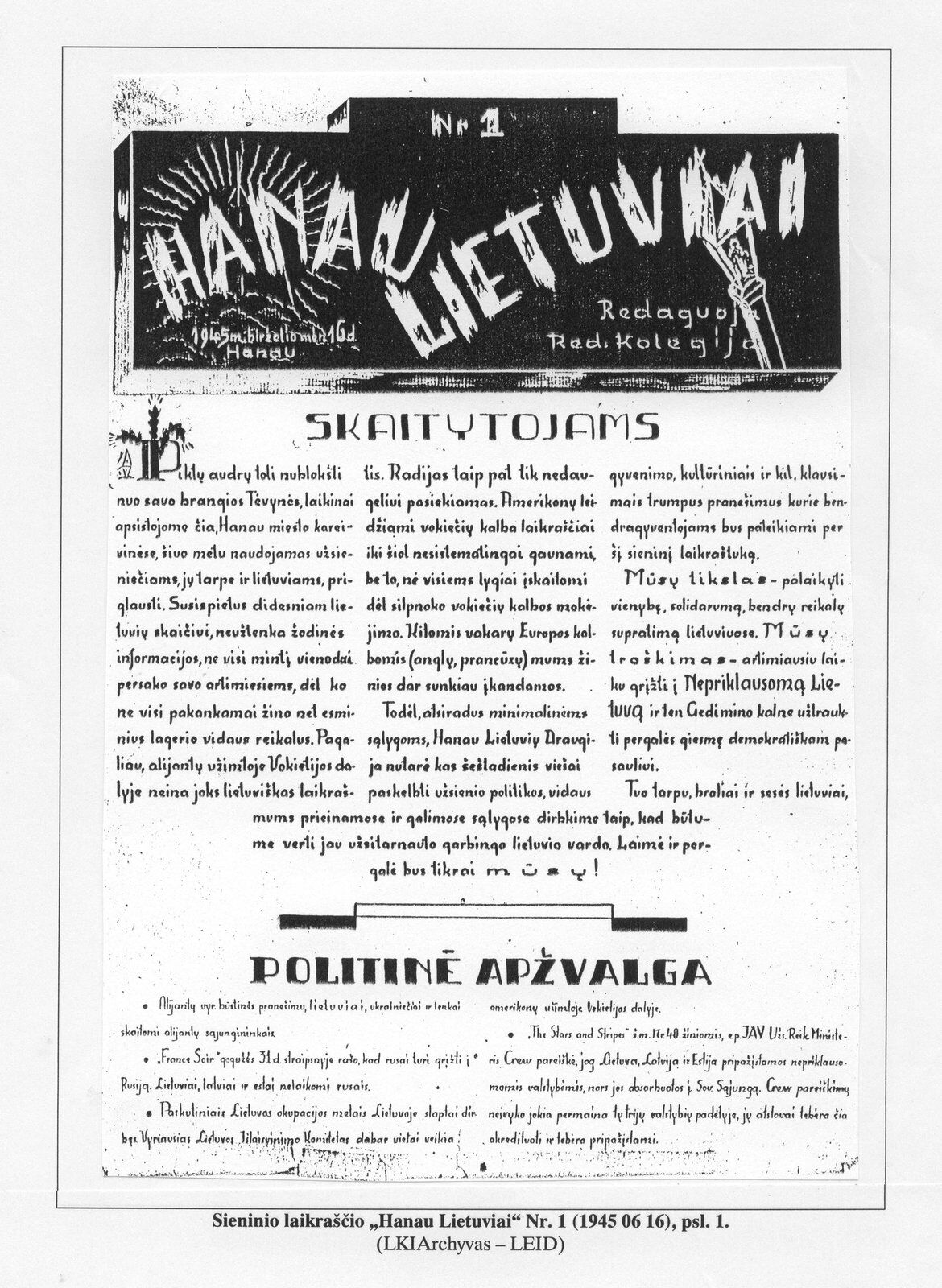
- 1946The newspaper Hanau lietuvis appears in the camp.
- August 1946A return records 146 Ukrainians.
- 20 December 1946The camp hospital is catalogued as a separate assembly centre, AC 554 A, with 110 places.
- 1947The Lithuanian community erects its memorial at Ulanenplatz.
- 1947Hanau hosts a congress of the Lithuanian journalists’ society in exile.
- 1947General Eisenhower visits the camp, recorded in a photograph held by the city archive.
- June 1947The camp’s first director leaves; the IRO takes over administration and resettlement becomes the aim.
- December 1947A return records 220 Ukrainians.
- 1948Hanau wins second prize among several camps for cleanliness, and an adult education institute opens.
- 1949Hanau becomes the central displaced-persons establishment for Hesse; 4,607 people live there.
- 1949The monthly cultural magazine Aidai is edited and published from the camp, with a stated circulation of 2,000.
- 13 June 1950Hessian officials and the city negotiate the camp’s closure.
- 30 November 1950The camp is cleared; 320 people pass to the city of Hanau and 150 move to Frankfurt.
- Early 1950sThe DP period in the Lamboystraße barracks gives way to renewed military use.
Sources for this section
- DP-Lager Hanau
- Befreit – und was nun?
- Children in DP camps
- DP camp inventory: Hanau
- Litauische Elite im Hanauer Displaced-Persons-Lager
- Polish Displaced Persons in Germany, 1945-1948, photograph HU 136550
- Camps in Germany for refugees from the Baltic: culture
- The Refugee Experience: Ukrainian Displaced Persons after World War II
- Verschiedene Unterlagen über die Litauer im Hanauer Displaced Persons Camp
- Aidai, 1949, Nr. 24: imprint
- Als die Amis auf Pioneer den Hut aufhatten
One camp across several barracks
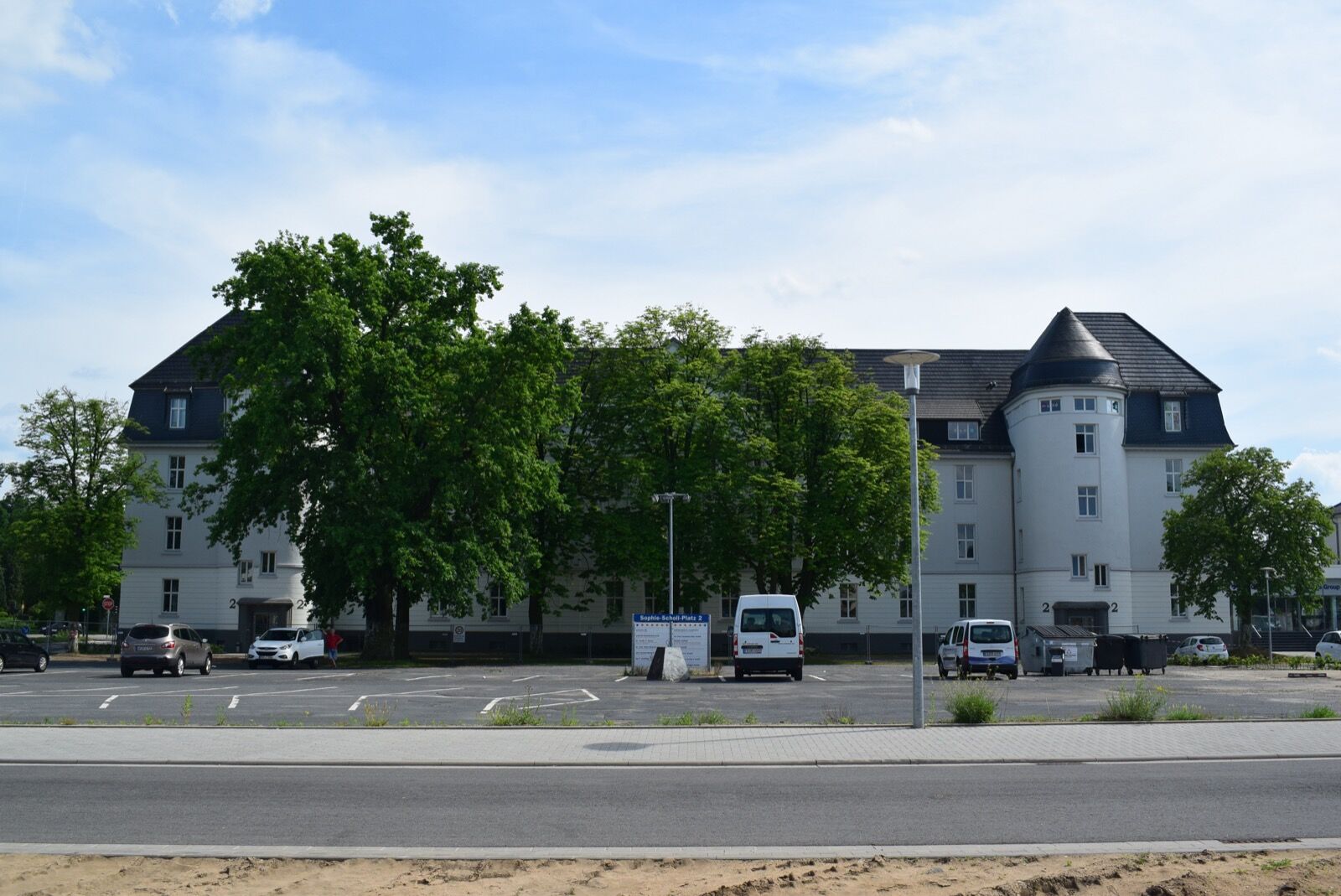
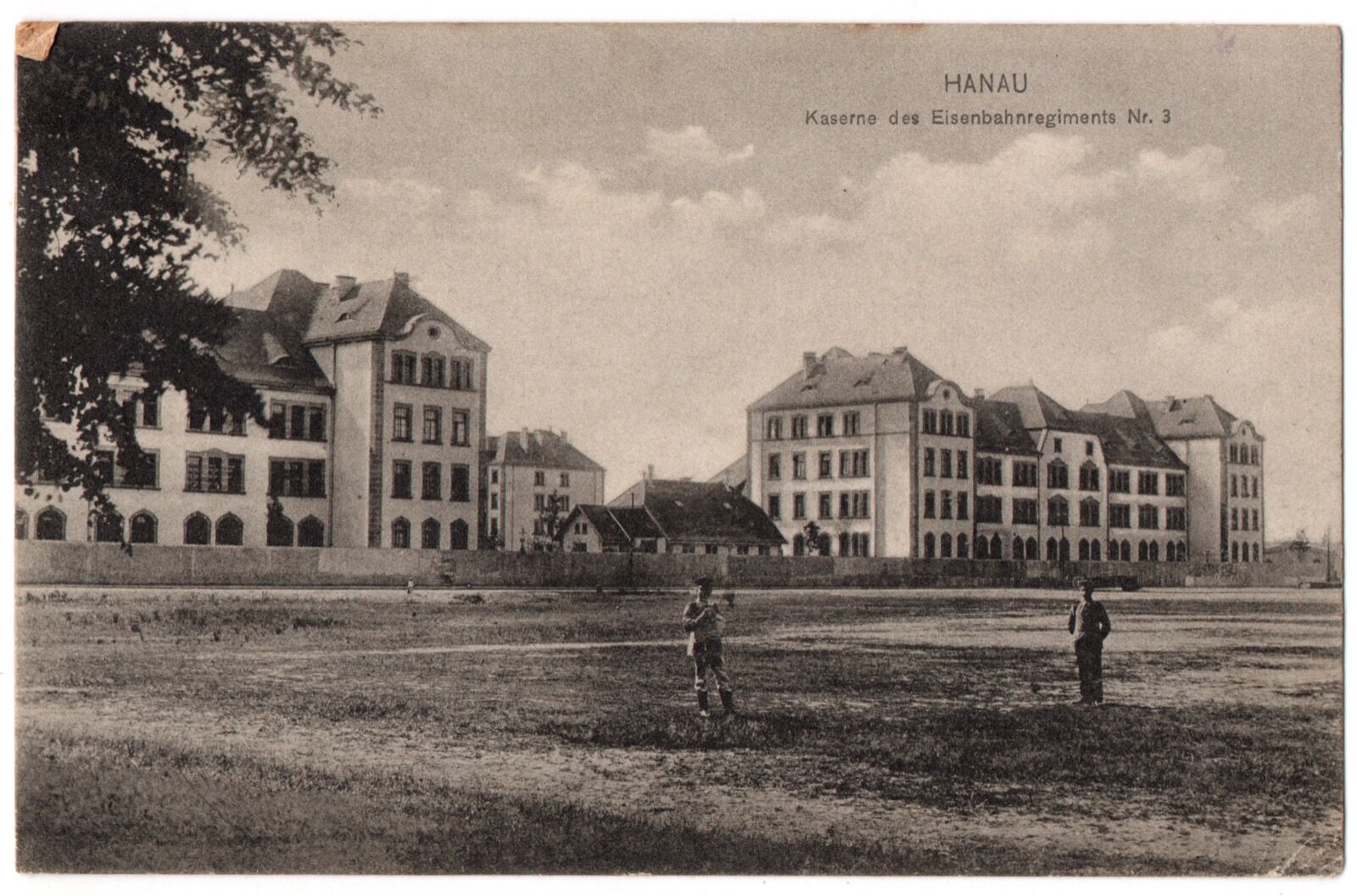
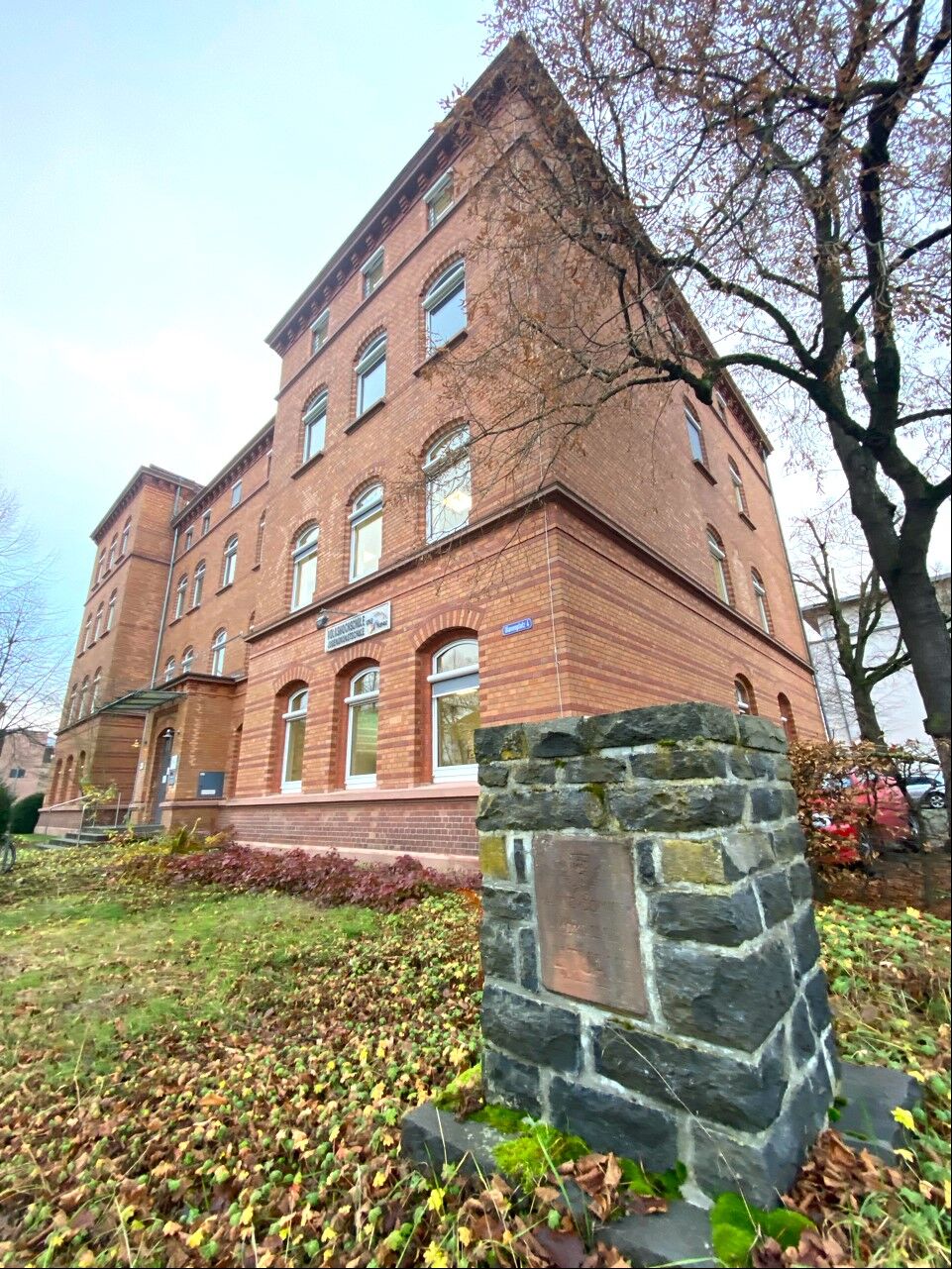
The camp extended across François-, Hutier-, Ulanen- and Hessen-Homburg-Kaserne in Hanau’s Lamboy district. These were neighbouring military compounds administered as a wider assembly centre. In April 1945 the camp’s first director, a UNRRA volunteer, took over a population of 10,600, with the immediate tasks of accommodation, food and medical care.
It began in two of the barracks. The Hessen-Homburg-Kaserne, until then a fuel store for the US Army, was added as a third site in May 1945 after the Latvians, Estonians and Lithuanians asked to be quartered separately. On the camp’s ground stood thirty-seven residential blocks together with ancillary buildings, a hospital, offices, stores, workshops, garages, stables and communal rooms.
The barracks offered substantial buildings, but they stood within a city devastated by war. Hanau had 42,191 inhabitants at the census of 17 May 1939 and only 22,067 in 1946, so for a time the camp held nearly a third as many people as the town around it. A search list compiled for the American authorities between 1947 and 1949 recorded 10,009 foreigners living in Hanau from more than thirty nations; the largest groups were 3,449 people entered in the statistics as Russians, who came mainly from Russia, Belarus and Ukraine, 2,027 French and 1,722 Poles.
The compounds’ later histories diverged. Hessen-Homburg became a school and administrative centre; François developed into housing, educational facilities and other civilian uses. These distinct sites help explain why records of the same camp use different barracks names.
An inventory of displaced-persons camps compiled by the Arolsen Archives from International Tracing Service records carries Hanau as three separate rows and corroborates the outline of the camp from a different direction. The barracks complex in the Lamboystraße — entered there as the Hutier-, François- and Hessen-Homburg-Kaserne, the three named in the earliest accounts — opens on 4 October 1945 with a capacity of 6,000 on 31 October 1947 and a nationality given as Baltic and various. The camp hospital has its own row, and a control centre was added on 11 July 1949. The inventory gives no exact closing date, bracketing it between 30 September 1949 and 30 September 1950; the final clearance of the barracks came later still.
The barracks in the camp’s history
| Compound | Later civilian use |
|---|---|
| François-Kaserne | Housing, schools, childcare and adult education |
| Hessen-Homburg-Kaserne | School centre and administrative offices |
| Hutier-Kaserne | Another component of the Lamboystraße camp complex |
| Ulanen-Kaserne | A fourth compound named in the city’s account of the camp |
Running an assembly centre
The American army entered Hanau on 28 March 1945. The camp was set up in two former Wehrmacht barracks as an Assembly Center, a collecting point from which displaced people were to be repatriated. When the British UNRRA volunteer Harry Heath first visited on 20 April 1945 it was still being run by women of the French Mission Militaire de Liaison Administrative, who had accompanied the Allied advance as nurses, doctors and welfare workers. He took charge on 22 April and led the camp until June 1947.
Heath had been a senior official for refugee affairs at the Ministry of Labour in London. His UNRRA team, Team 27, consisted at first of his wife Muriel as senior welfare officer, a British administrator, a French doctor as medical head and two French drivers. The team worked under the military government until October 1945, when Heath became sole camp leader while remaining answerable to it.
Each national group was required to choose its own representatives. By the time Heath arrived, Russians, Poles, Italians and others had already formed committees with a spokesman at their head, their own order-keeping service and officers for culture, schools and sport. Heath met the spokesmen every day at eleven o’clock to pass on the military government’s instructions and to discuss what needed doing.
Because tools and materials were not supplied to him, Heath and his wife salvaged what they could from bomb ruins in Frankfurt and from American army refuse tips. Out of this came fifteen workshops and a cinema, and a system of bonus points with which residents were paid for work and could buy goods and admission inside the camp. By the middle of October 1945 about 800 residents were in paid employment in the camp itself.
The inventory confirms the administrative frame independently of the diary. It records UNRRA Team 27 at Hanau, a team director whose surname is entered as Hoath and a field supervisor named Westerman, the assembly-centre number AC 554 and the code W 137, and it places Hanau under area teams at Frankfurt am Main and Darmstadt. Its holdings note points to the tracing service’s own lists and change reports for the camp and to displaced-persons photographs kept in the Stadtarchiv Hanau, in the photographic archive of the Hanauer Geschichtsverein 1844.
Sources for this section
Repatriation and the changing population
The first task was repatriation eastward. On 27 May 1945 the first 1,200 people counted as Russians left Hanau by lorry; by 5 June 4,367 had gone, leaving 360, of whom 280 lay helpless in hospital. By 3 September only 41 remained. Many of those in hospital were victims of lead-contaminated industrial alcohol: twenty died at the start of May, 250 were under treatment in the two camp hospitals by 17 May, and by the end of the month more than 800 had been poisoned.
As the eastern transports emptied the camp, Baltic refugees filled it. On 1 August 1945 Soviet officers came to the camp to claim the Balts as Soviet citizens and remove them; Heath refused, and received the backing of the American military. In September 1945 a former Lithuanian prime minister who had visited most of the Lithuanian camps in Germany described Hanau as the largest and best of them.
In mid-August 1945 about 8,000 people were living in the camp, a thousand more than there were proper sleeping places, and more than a thousand of them were children. From 1946 the camp was overwhelmingly Baltic: a dissertation completed in 1950 by a Holocaust survivor who was himself a displaced person, working from the camp registry, counted 6,184 residents in 1946 falling to 4,607 in 1949. Russians, Ukrainians, Poles and Jews together made up the small residual group listed as “others”, and it was the only group that grew, because smaller camps nearby were closed as their people emigrated and the remainder were moved to Hanau.
The camp population in 1945
| Nationality as recorded | 23 May 1945 | 23 July 1945 |
|---|---|---|
| Russians | 5,500 | 420 |
| Poles | 2,883 | 2,456 |
| Italians | 1,027 | 690 |
| Lithuanians | 73 | 2,405 |
| Latvians | 46 | 794 |
| Estonians | 32 | 348 |
| Yugoslavs | 87 | 41 |
| Romanians | 27 | — |
| Total | 9,675 | 7,154 |
The camp population, 1946 to 1949
| Year | Lithuanians | Latvians | Estonians | Others | Total |
|---|---|---|---|---|---|
| 1946 | 3,539 | 1,632 | 854 | 159 | 6,184 |
| 1947 | 3,286 | 1,494 | 857 | 276 | 5,913 |
| 1948 | 2,935 | 1,357 | 581 | 282 | 5,155 |
| 1949 | 2,390 | 1,277 | 459 | 481 | 4,607 |
Sources for this section
Ukrainians within a Baltic centre
The Ukrainians in the camp refused from the outset to be housed with Russians, and were quartered with the Poles instead. The distrust ran both ways: the Russians were particularly suspicious of the Ukrainians and asserted that many of them had worked actively with the Germans. Harry Heath’s wife later wrote that she and her husband had not thought the distinction between Russians and Ukrainians important, since both came from the Soviet Union, and recorded that the Ukrainians insisted they were a republic and not Russian.
That refusal had consequences for the record. Ukrainians were counted in the camp’s 1945 returns under the heading of Russians, the column which stood at 5,500 on 23 May 1945 and at 420 eight weeks later, and it is from that column that the eastward repatriation transports drew. The one surviving photograph of a departure from the camp, taken at François-Kaserne in 1945, is captioned in the city archive as Russian and Ukrainian displaced people leaving.
Ukrainian population returns compiled for a later study of the Ukrainian displacement recorded 146 people in August 1946, 186 in May 1947 and 220 in December 1947, with a separate questionnaire series giving 246. These figures describe the Ukrainian group, not Hanau’s full camp population, and the hospital has its own statistical entry.
Set against the camp registry those numbers place the Ukrainians as most of what was left once the camp had become Baltic. The registry counted the Lithuanians, Latvians and Estonians separately and put Russians, Ukrainians, Poles and Jews together in a column of others, which stood at 159 in 1946, 276 in 1947, 282 in 1948 and 481 in 1949 — the only column that grew, because residents of smaller camps nearby were moved to Hanau as those camps closed. A return of 146 Ukrainians in August 1946 against 159 others for that year leaves little room for anyone else.
Ukrainians were not excluded from what the camp offered. The vocational courses run for the Latvian and Estonian residents were given to the Ukrainian residents on the same terms.
Work opportunities brought another connection with Ukrainian displacement. An archival study of Gießen reports that some Ukrainians registered as Balts and moved to Baltic camps in Hanau, Frankfurt or Marburg to obtain better conditions. This was movement between German camps in search of work and improved support, rather than emigration to a new country. It also means that some of the people entered in the registry as Balts were Ukrainians, and that the returns above are a floor rather than a count.
The Ukrainian group’s own papers survive in North America. The Shevchenko Scientific Society Archives catalogues a collection on the displaced-persons camps at Hanau which holds handwritten and typewritten notes, meeting minutes, bulletins, lists of individuals and administrative documents of the Ukrainian Group in the Hanau DP camps. Only the catalogue entry has been read here.
A file in the Stadtarchiv Hanau on the camp’s Lithuanian residents also holds photographs. Its catalogue description lists among their subjects General Eisenhower’s visit in 1947, an excursion in an IRO lorry, a school-leaving class, an exhibition of the handicrafts school, and the forced repatriation of camp inmates from Ukraine. The catalogue gives no date for the repatriation photograph, and the photographs themselves have not been seen here.
Ukrainians recorded in Hanau
| Date / reporting series | Ukrainians |
|---|---|
| 1946–1947 questionnaires | 246 |
| August 1946 | 146 |
| May 1947 | 186 |
| December 1947 | 220 |
Sources for this section
- DP-Lager Hanau
- Litauische Elite im Hanauer Displaced-Persons-Lager
- The Refugee Experience: Ukrainian Displaced Persons after World War II
- Ukrainische Displaced Persons in Deutschland
- Collection on the Displaced Persons camps in Hanau, Germany, Identifier 209
- Verschiedene Unterlagen über die Litauer im Hanauer Displaced Persons Camp
Rooms, rations and sanitation
Housing was the hardest problem. Gross living space worked out at three and a half to four square metres a head in 1945 and 1946 and about five in 1949, and the cellars and attics of the barracks were declared uninhabitable only in 1948. The mostly three-storey buildings had about twenty-five rooms to a floor, of twenty to forty square metres, with one men’s and one women’s lavatory and a washroom on each floor from which residents also drew drinking and cooking water.
Inside the rooms families were often divided only by blankets or curtains. Furniture usually amounted to a table, a few chairs and a clothes locker; there were not enough beds, so adults frequently shared with a child, and many rooms had American folding camp beds rather than bedsteads. A kitchen corner partitioned off with board, with a small iron stove or an electric ring, served for cooking. The same account concluded that the German population of Hanau, badly housed as it was, still had between two and eight times as much living space as the people in the camp.
Food was good immediately after the war while UNRRA supplies lasted, apart from fresh meat and vegetables, then declined; after the IRO took over it fell to the level of the ordinary German ration. Rations were graded, with more for children, nursing mothers, the sick and those doing heavy work. Two kitchens served the camp, one Lithuanian and one for everybody else, supplied from food that residents handed back in exchange for a hot midday meal. Use of them fell away as families cooked for themselves: the Lithuanian kitchen fed 2,000 people in 1947, 1,500 in 1948 and only 220 in 1949.
A disinfector went round a set number of rooms every day with DDT so that each dwelling was treated afresh every five or six weeks; vermin, common in the early years, had become rare by 1949, and the camp never needed a delousing hut. In 1948 Hanau was awarded second prize among several camps for cleanliness and sanitary conditions.
Sources for this section
Doctors, hospital and disease
There were sick bays in two of the compounds from the start, and by the end of 1945 a hospital had opened at Lamboystraße 54 with an operating theatre for major surgery and a dental clinic; its central store supplied three camp pharmacies. An American public-health officer who inspected the camp in November and December 1945 found twenty-seven doctors drawn from among the displaced people themselves, judged the hospital overstretched by a population of about 8,500, criticised the overcrowding and recommended that a thousand people be moved out. He reported that the canteen could offer only coffee in the morning and soup at midday, and considered Hanau to have the greatest problems of any camp in Greater Hesse.
The hospital later carried 140 beds as DP General Hospital W 166 and took in patients from the surrounding district as well. At the beginning of 1949 the camp had twenty-three doctors and twenty-four nurses, six of the doctors being dentists; between 1947 and 1949 there were about 2,000 dental consultations a month, and a dental laboratory was added in 1949. Regular vaccination against typhoid, paratyphoid, smallpox and diphtheria, and X-ray screening for tuberculosis, kept the camp free of any large epidemic. Over the four years from 1946 to 1949 the camp recorded twenty-seven deaths, seven of them from methyl alcohol.
The hospital is separately catalogued in the Arolsen inventory as assembly centre AC 554 A under the same code, W 166, that the camp’s own account gives it, with an opening date of 20 December 1946 and 110 places on 31 October 1947 — fewer than the 140 beds it later carried.
Sources for this section
Children, students and continuity
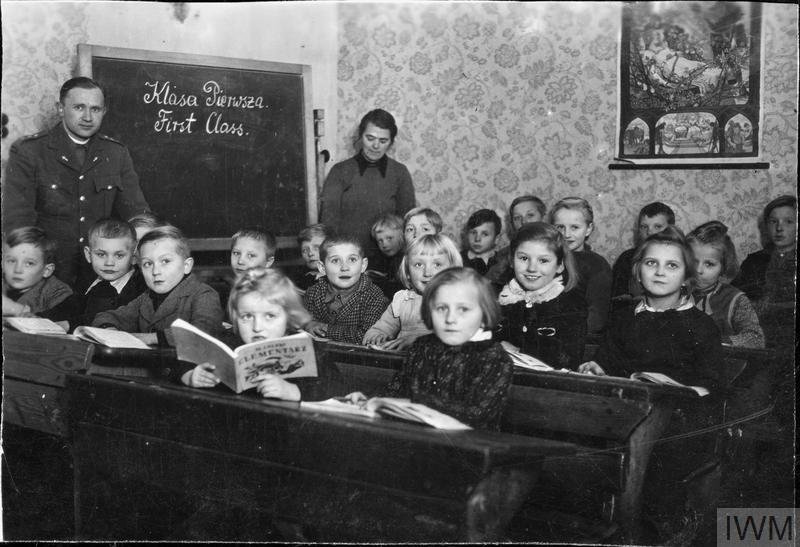
Schooling began within weeks and was organised strictly by nationality: a Polish school opened on 8 May 1945 and a Russian school with about a hundred pupils on 14 May. A photograph in the Imperial War Museums, dated 1945, shows Polish children in a classroom in the camp learning to read, the girl in the foreground holding the Polish alphabet book Elementarz. Children entered kindergarten at three and school at six, first a four-year primary course and then a four-year upper school, with vocational training for older adolescents; places at a sanatorium at Bad Orb were available for those who needed them. Unaccompanied children stayed in the camp until they could be identified, then moved to a UNRRA children’s centre or, if identification proved impossible, to a UNRRA orphanage.
The Lithuanian kindergarten at Hanau served 150 children in 1945. A Baltic archives exhibition also preserves evidence of a nursery in 1947. Childcare formed part of rebuilding community life after years of disrupted homes and education.
Older students travelled from the Hanau camp to Goethe University in Frankfurt. Research in university records documents group enrolments, UNRRA financial support and camp letters that helped applicants enter higher education. Medicine and the sciences attracted many Lithuanian students, preparing them for work that could be practised beyond Germany. Universities in the British and American zones were required to keep at least a tenth of their places for displaced persons who wished to study.
University study was nevertheless temporary for many. Most of those who enrolled in 1946 and 1947 had left Germany by the mid-1950s; many left the university in 1948 as opportunities to emigrate expanded. These findings concern the Lithuanian student group, alongside the smaller Ukrainian community documented in camp statistics.
Organising life in exile
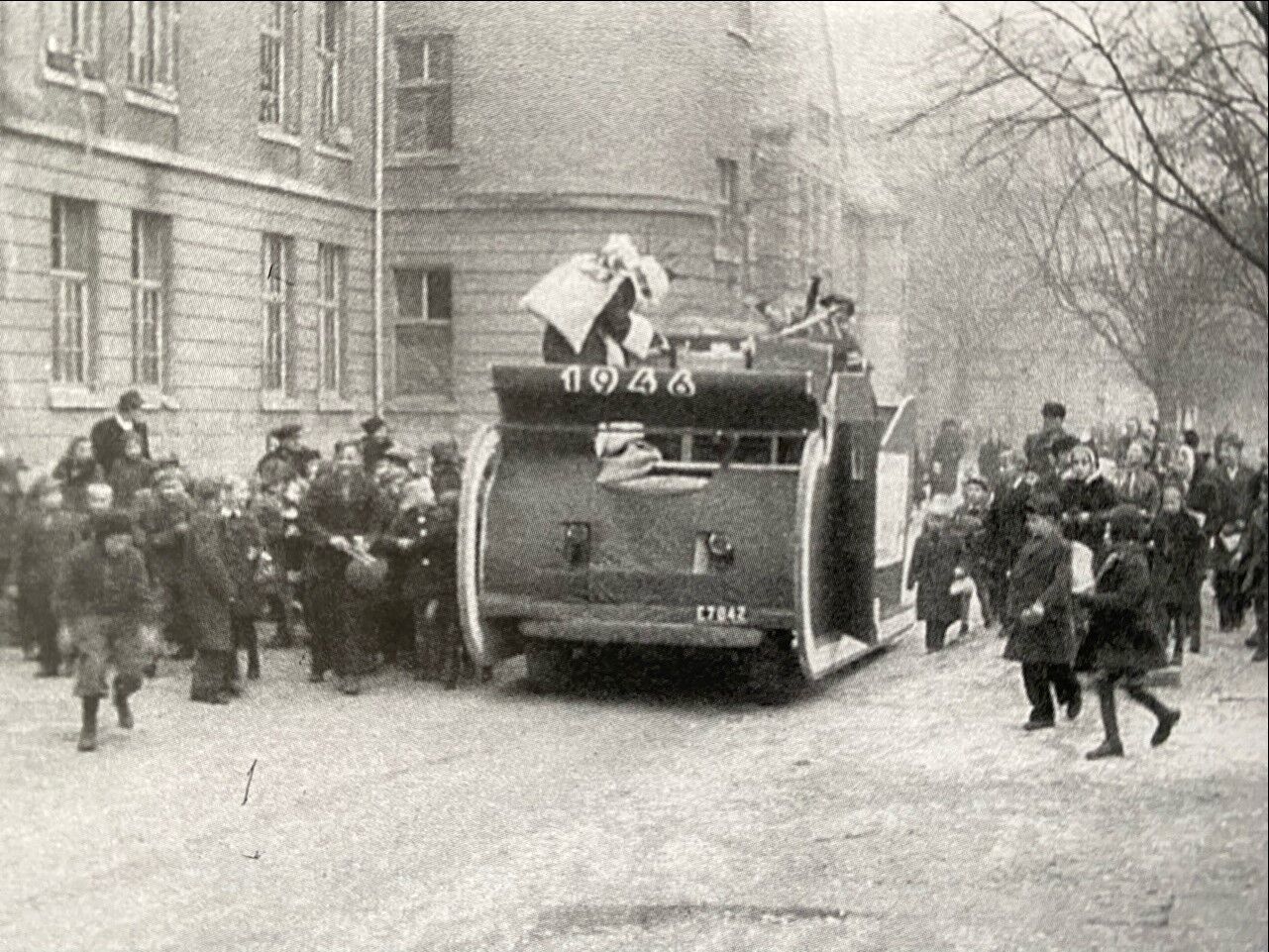
The Baltic communities maintained organisations and professional associations while advocating their countries’ independence. A memorial erected by the Lithuanian community in 1947 still stands at Ulanenplatz. A different surviving image—an American Army Christmas sleigh in the camp in 1946—records a festive moment amid the uncertainty.
The camp had its own music school, with free lessons and two pianos bought by the residents themselves, and instruments obtained by the YMCA, which ran youth work in the camp. The Hessian ministry of education came to recognise the examinations taken in the camp’s grammar school, and from 1948 an adult education institute operated there as well.
The camp also supported a Lithuanian press and stage. The monthly cultural magazine Aidai was edited and published from the Hanau camp by Povilas Gaučys under a EUCOM Civil Affairs Division authorisation for United Nations displaced-persons publications dated 20 June 1949, printed at Fellbach with a stated circulation of 2,000. A newspaper called Hanau lietuvis, the Hanau Lithuanian, appeared in the camp in 1946, and in 1947 Hanau was the venue for a congress of the Lithuanian journalists’ society in exile. The Baltic archives exhibition names the drama theatre Atžalynas at Hanau and preserves a placard advertising Delibes’ ballet Coppélia at the Hanau Lithuanian camp.
Repatriation, emigration and what remains
Early departures and later emigration were different phases. The 1945 photograph shows people leaving François-Kaserne, while local history describes later residents waiting for visas to the United States, Australia and Canada. Resettlement became the first aim once the IRO took over camp administration in 1947, and the falling population came above all from emigration by single men, so that the proportion of women and young people in the camp rose year by year.
On 9 February 1950 the Allied High Commission told the federal government that from 30 June it would be responsible for the displaced persons still in Germany, apart from those already in the resettlement pipeline. Hessian officials negotiated with the city of Hanau on 13 June 1950 over closing the camp: the state wanted the city to take the remaining 1,500 residents, while the city wanted the barracks released as housing for its own people. The military government decided instead that, because of the Korean War, the barracks would return to military use.
In the summer of 1950 residents needing nursing care were moved to homes in southern Germany. Five hundred and sixty-five displaced persons remained in the barracks along with 82 local people and 26 resettlers from Schleswig-Holstein. There were protests and a series of arson attacks. At the final clearance date set by the US Army, 30 November 1950, 320 people passed into the care of the city of Hanau and 150 moved to Frankfurt; Hesse provided three huts in Hanau and one in Frankfurt to house them. Under the 1951 law on the legal status of homeless foreigners the former displaced persons became a recognised category in German law, and state-funded social housing was built in Hanau for some of them.
The camp’s history survives in its buildings, the Lithuanian memorial, university records and the diary of its first director. The city’s expanded 2025 publication brought further research and photographs together, connecting Hanau’s neighbourhood history with the international journeys that passed through it.
Sources
- Litauische Elite im Hanauer Displaced-Persons-Lager
Stadt Hanau · 19 December 2025
City account of revised Alice Noll book. Camp barracks, UNRRA leadership, political organisation, 1947 memorial, and original archival images with captions.
- Befreit – und was nun?
Interessengemeinschaft Hanauer Altstadt / Alice Noll · 14 February 2023
10,600 people in April 1945, three named barracks. The unrelated Schauenstein illustration on this page is not used.
- The Refugee Experience: Ukrainian Displaced Persons after World War II
Canadian Institute of Ukrainian Studies Press · 1992
Ihor Stebelsky, table 7, printed page 47. Ukrainian Hanau returns separate from hospital returns.
- Ukrainische Displaced Persons in Deutschland
Nazarii Gutsul and Sebastian Müller, Bundeszentrale für politische Bildung · 30 June 2014
Archival study of Ukrainian workers in Gießen, including transfers to Baltic camps in Hanau, Frankfurt and Marburg. Gießen-specific pay and rations not assigned to Hanau.
- Displaced Persons an der Uni: Litauische Studierende an der Goethe-Universität Frankfurt
Elisa Lecointe, Goethe-Universität Frankfurt · 24 January 2014
University archival research: Hanau commuting students, group enrolment, medical/scientific studies and emigration. The site’s HTTPS certificate has expired, so the address may fail in a browser.
- Children in DP camps
Baltic DP archives exhibition / Lithuanian Cultural Institute · Accessed September 2026
Hanau Lithuanian kindergarten 150 children in 1945, and documented nursery photograph 1947. General or Ravensburg-specific teaching methods not assigned to Hanau.
- Als die Amis auf Pioneer den Hut aufhatten
Hanauer Anzeiger · 2018
Local history: DP occupation of Lamboystraße barracks into early 1950s and departures to USA, Australia and Canada.
- Kasernenanlage Lamboystraße
Landesamt für Denkmalpflege Hessen · Accessed September 2026
Protected barracks complex and postwar DP accommodation; distinct physical sites.
- Konversion militärischer Flächen in Hanau
Stadt Hanau · Accessed September 2026
Later civilian uses of Hessen-Homburg and François barracks.
- DP-Lager Hanau
German Wikipedia · Accessed 14 September 2026
Full article read in German, with its quotations and tables. It works from three main sources: Alice Noll’s 2022 edition of the diary of the camp’s first director Harry Heath, with her introduction and notes and his wife Muriel Gardner-Heath’s recollections; Aron Bernstein’s 1950 Frankfurt dissertation Das DP (displaced persons)-Lager Hanau und seine Gesundheitsverhältnisse, written from the camp registry; and Markus Häfner’s essay Displaced Persons in Hanau, together with Edgar Thielemann’s 2006 study of foreign and forced labour in Hanau. Population, housing, rations, medical and closure figures are taken from that article’s reproduction of these works, which were not inspected directly.
- DP camp inventory: Hanau
Arolsen Archives · 26 October 2023
Three Hanau rows read in full from the spreadsheet, all in the US zone, district 2. Row 1021: “Kasernenanlagen Lamboystrasse: Hutier-Kaserne, Francois-Kaserne, Hessen-Homburg-Kaserne”, opening 4 October 1945, closing between 30 September 1949 and 30 September 1950, nationality “baltisch, verschiedene”, capacity 6,000 on 31 October 1947, assembly centre AC 554, DP-ACS code W 137, UNRRA Team T 27 Hanau, team director Hoath, field supervisor Westerman, area teams AT 1022 Frankfurt/Main and AT 1021 Darmstadt, areas A 1 Hanau and A 3 Würzburg; holdings noted as ITS lists and change reports for Hanau, Dok-ID 81988902–81989455, with DP photographs in the Stadtarchiv Hanau’s Hanauer Geschichtsverein 1844 photographic archive. Row 1022: “DP-Hospital / General-Hospital”, opening 20 December 1946, capacity 110 on 31 October 1947, assembly centre AC 554 A, code W 166. Row 1020: “Control Center (Transient & Static)”, opening 11 July 1949, code W 174. Compiled by the Arolsen Archives from International Tracing Service records, independently of the published camp histories.
- Collection on the Displaced Persons camps in Hanau, Germany, Identifier 209
Shevchenko Scientific Society Archives
Catalogue listing read: a collection on the Hanau displaced-persons camps holding handwritten and typewritten notes, meeting minutes, bulletins, lists of individuals and administrative documents of the Ukrainian Group in the Hanau DP camps. Only the catalogue entry was read; the papers themselves were not consulted.
- Aidai, 1949, Nr. 24: imprint
Aidai, facsimile at aidai.eu · September 1949
Imprint at the foot of the issue overview page read: published under EUCOM Civil Affairs Division authorisation for United Nations displaced-persons publications, dated 20 June 1949; editor and publisher Povilas Gaučys, DP Camp Hanau; printed by Schwertschlag, Fellbach; circulation 2,000. The imprint carries several misprints as set.
- Camps in Germany for refugees from the Baltic: culture
Baltic DP archives exhibition, Lithuanian Cultural Institute in Germany
Sections “PRESS” and “Musical Life. Theater” read: the newspaper Hanau lietuvis, 1946; a congress of the Lithuanian journalists’ society in exile at Hanau in 1947; the drama theatre Atžalynas at Hanau; and a placard for Delibes’ ballet Coppélia at the Hanau Lithuanian camp.
- Verschiedene Unterlagen über die Litauer im Hanauer Displaced Persons Camp
Stadtarchiv Hanau, StadtA HU, L 1, 265, via Arcinsys Hessen
Catalogue entry read, field “Enthält u.a.”: photographs in the file include General Eisenhower’s visit in 1947, an excursion in an IRO lorry, a school-leaving class, an exhibition of the handicrafts school, and the forced repatriation of camp inmates from Ukraine. The file itself was not consulted and the photographs are not reproduced in the catalogue.
- Polish Displaced Persons in Germany, 1945-1948, photograph HU 136550
Imperial War Museums · 1945
Object description read: Polish children learning to read in a classroom in the Hanau DP camp run by UNRRA, 1945, the girl in the foreground holding the Polish alphabet book Elementarz. Reproduction would require the IWM Non-Commercial Licence and the credit “Image: IWM (HU 136550)”.
Last researched 14 September 2026