Haunstetten Camp
Displacement in Europe
Haunstetten, Augsburg, Germany · Ukrainian community documented 1945–1947
A Ukrainian settlement and school took shape in Haunstetten in 1945, and the school continued through Füssen to Mittenwald. Its history sits alongside the Baltic refugee settlement that occupied requisitioned Messerschmitt housing.
Introduction
Haunstetten was home to a Ukrainian displaced-persons community after the Second World War. The Shevchenko Scientific Society’s Augsburg finding aid records approximately 500 to 2,000 people during 1945 to 1947, alongside the larger Ukrainian camp at Somme-Kaserne, and notes that the Ukrainian National Council was active in the city over the same years. The range is an estimate for that period rather than a count on one particular day.
One of its most enduring contributions was a school. Ukrainian teachers established a gymnasium, a secondary school, in Haunstetten in 1945. Its subsequent journey through Füssen to Mittenwald shows how an institution could continue even as teachers and pupils moved between camps.
Sources for this section
A history in dates
- 1932–1938The Messerschmitt workers’ settlement is planned and then extended.
- 28 April 1945American forces enter Haunstetten without fighting.
- June 1945A later newspaper account describes former concentration-camp prisoners arriving at the Ukrainian settlement.
- 1945Ukrainian teachers establish a gymnasium in the Haunstetten camp.
- September 1945A parish report describes relief work and a congregation living mainly at Haunstetten.
- 1945–1947The Ukrainian National Council is active in Augsburg; the finding aid gives the Haunstetten community’s span as these years.
- By 1946The school moves through Füssen to Mittenwald.
- 12–13 October 1946The Dniprova Chaika theatre opens its autumn season at Haunstetten with the opera Zaporozhets za Dunayem.
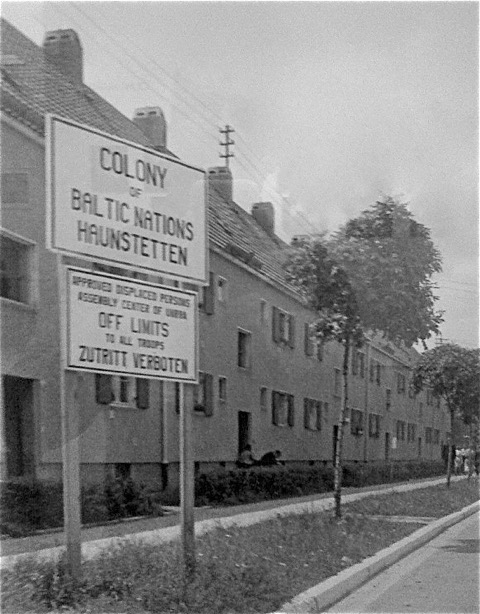
- 1947A photograph records the Baltic settlement entrance.
- February 1950The former DP housing settlement passes to American military use.
- July 1957The housing is released for civilian use.
Sources for this section
The place the settlement occupied
Haunstetten was an industrial village south of Augsburg rather than part of the city. A Messerschmitt settlement was laid out for the aircraft works in the 1930s: the city archive’s picture panel shows a model of the planned settlement in 1932 and an aerial photograph of its extension in 1938. The works drew the bombing that destroyed 62 houses in the village and severely damaged 41 more, and American forces entered without fighting on 28 April 1945. The accommodation displaced people were given was this recent workers’ housing rather than purpose-built barracks.
Sources for this section
A settlement seen from inside
A Ukrainian paper published at Somme-Kaserne in September 1946 carried a signed complaint about the treatment of former concentration-camp prisoners, and named the Ukrainian settlement at Haunstetten as its example. The writer says he reached the settlement about June 1945, that some ten former camp prisoners were there then, that they were issued a third of the ration given to others and none of the extra food other Ukrainian centres provided, and that the better items in the clothing relief went out by the back door. He adds that the position with UNRRA aid had since changed.
It does establish that a Ukrainian settlement with its own social welfare office existed at Haunstetten from the first summer after the war, and that former concentration-camp prisoners were among its residents.
The same paper carried an announcement for Haunstetten in its issue of 13 October 1946. The Dniprova Chaika music, drama and comedy theatre was to open its autumn season at Haunstetten on Saturday 12 and Sunday 13 October with S. Artemovsky’s opera Zaporozhets za Dunayem. The notice does not say where the company was based or how long it went on performing there.
Sources for this section
A school that travelled with its community
The school’s roots reached back to Modrany in Czechoslovakia, where many of its teachers had previously worked at a Ukrainian gymnasium. After the war they organised a new school in the Haunstetten DP camp. A later reunion account traces the school’s move to Füssen and then, in 1946, to Mittenwald.
Former pupils remembered teachers maintaining demanding standards despite shortages of textbooks and other teaching materials. Their account belongs to the history of the school across its successive locations; it does not show that every later Mittenwald pupil had lived in Haunstetten. The continuity lay in teaching, organisation and the effort to preserve a Ukrainian education through repeated moves.
The school’s successive locations
| Place | Documented stage |
|---|---|
| Modrany | Earlier teaching institution |
| Haunstetten | School established in 1945 |
| Füssen | Intermediate camp location |
| Mittenwald | School relocated here in 1946 |
Sources for this section
Several communities in Haunstetten
Haunstetten also had substantial Baltic displaced-persons accommodation. The Volksbund’s local history identifies Baltic communities here and at Hochfeld, while identifying Somme-Kaserne with Ukrainians. These accounts describe different communities within Augsburg’s wider refugee landscape; the Ukrainian school and population evidence cannot be used to classify every Haunstetten resident as Ukrainian.
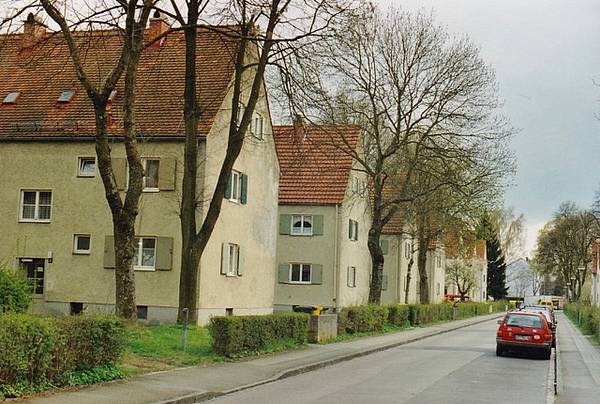
The photographed Baltic settlement occupied requisitioned housing associated with the Messerschmitt works. Its entrance sign in 1947 identifies a colony of Baltic nations. This is the settlement shown in the photographs below; the Ukrainian finding aid does not identify the school’s precise street or building, and the only Haunstetten address in the Ukrainian press that has been traced is a house number given in a family-tracing notice.
Keeping the different measures distinct
| Measure | Period | Reported figure |
|---|---|---|
| Ukrainian Haunstetten community | 1945–1947 | Approximately 500–2,000 people |
| Heimbau Bayern apartments requisitioned | Postwar settlement | 318 apartments |
| Messerschmitt apartments requisitioned | Postwar settlement | 70 apartments |
| Dwellings held by the American authorities | Until 1957 | 318, attributed to the Messerschmitt settlement |
| Houses destroyed in the village | Wartime bombing | 62, with 41 severely damaged |
| German expellees in Haunstetten | September 1950 | 1,949 among 9,253 inhabitants |
Worship, relief and practical support
A September 1945 report preserved in the history of Augsburg’s Russian Orthodox parish describes a congregation whose members lived both in and outside the city, with most living at Haunstetten. Its work combined worship with social and charitable help. The parish sought premises for workshops, especially shoe repairs, and reported support from the American military administration and refugee-relief authorities.
The same parish history records a library and small printing operation in the postwar years. These belonged to the wider parish network, rather than to a documented Ukrainian camp administration. They show how refugees could find books, worship and practical assistance through institutions extending beyond their accommodation.
Sources for this section
The housing settlement after displacement
The housing history followed a different timetable from the school. Local research records 318 Heimbau Bayern apartments and 70 Messerschmitt apartments requisitioned for displaced people. By early 1950 that settlement’s displaced-persons use had ended; from February it became American military housing, and the apartments returned to civilian use in July 1957. The Bavarian reconstruction atlas records the same release date but attributes all 318 dwellings to the Messerschmitt settlement, so the two accounts are given here as they stand.
The archival date range for the Ukrainian community ends in 1947. That is distinct from the Baltic settlement’s later housing history and American use. The school’s continuation in Mittenwald is the clearest documented institutional link connecting Haunstetten with the subsequent lives of displaced Ukrainians.
A further caution belongs with these numbers. In September 1950 Haunstetten counted 1,949 expellees among 9,253 inhabitants. Those were German expellees under German administration, a different category from the displaced persons of 1945 to 1947.
Sources
- Collection on the Displaced Persons camps in Augsburg, Germany
Shevchenko Scientific Society Archives · Finding aid revised 2023
Historical note explicitly identifies the Ukrainian Haunstetten community, 1945–1947, and its estimated population.
- Mittenwald gymnasium reunion
The Ukrainian Weekly · 25 June 2000
Page 12, school history: Modrany teaching staff, Haunstetten in 1945, subsequent move via Füssen to Mittenwald in 1946.
- Die Wohnungsbeschlagnahmungen
Amerika in Augsburg e.V. · Undated local-history article
Haunstetten housing settlement and dated 1947 photograph. Baltic settlement history is kept separate from the Ukrainian community’s documented dates.
- Geschichte unserer Gemeinde
Russian Orthodox Church Abroad, Augsburg parish · Undated parish history
September 1945 parish report, residence at Haunstetten, relief work and later library and printing activity. Parish totals are not Ukrainian camp totals.
- Zwangsarbeit und Displaced Persons
Volksbund Deutsche Kriegsgräberfürsorge, Bavaria · Undated historical interpretation
Distinguishes Ukrainian Somme-Kaserne from Baltic accommodation at Haunstetten and Hochfeld.
- Complaint about the treatment of former concentration-camp prisoners
Українська Думка (Ukrainian Thought), Somme-Kaserne, Augsburg; Ukrainian Museum-Archives of Cleveland / USHMM digitisation · Issue 1, 27 September 1946
Signed article naming the Ukrainian settlement at Haunstetten: arrival about June 1945, some ten former camp prisoners, a third ration, no supplementary food, clothing relief diverted, recourse to German institutions. Reported as an attributed accusation. No resident is named. Also used for the Haunstetten street address in a family-tracing notice.
- Haunstetten (heute Augsburg), Wiederaufbauatlas
Haus der Bayerischen Geschichte · Accessed 13 September 2026
War damage, the American entry of 28 April 1945, the 318 dwellings held in the Messerschmitt settlement until 1957, and the 1950 and 1952 expellee counts. The expellee figures are German expellees, not displaced persons.
- Haunstetten, Tafel 1
Stadtarchiv Augsburg, online exhibition on the incorporation of Haunstetten · Accessed 13 September 2026
Captioned picture panel: a 1932 model of the planned Messerschmitt settlement and a 1938 aerial photograph of its extension, with earlier village and industrial views. The panel carries no text on displaced persons.
- The Refugee Experience, Table 7: Ukrainians in UNRRA and IRO camps of the American zone of Germany
Ihor Stebelsky; Canadian Institute of Ukrainian Studies Press · 1992
Printed pp. 47–48. Columns 1946–7, August 1946, May 1947 and December 1947, assigned by position in the scan. The Augsburg entries are Somme-Kaserne, “Other Units” and the Servatius Hospital; Haunstetten has no row of its own.
Last researched 13 September 2026